“12 So Jesse sent for him. He had a healthy complexion, attractive eyes, and a handsome appearance. The Lord said, “Go ahead, anoint him. He is the one.” 13 Samuel took the flask of olive oil and anointed David in the presence of his brothers. The Lord’s Spirit came over David and stayed with him from that day on. Then Samuel left for Ramah.”
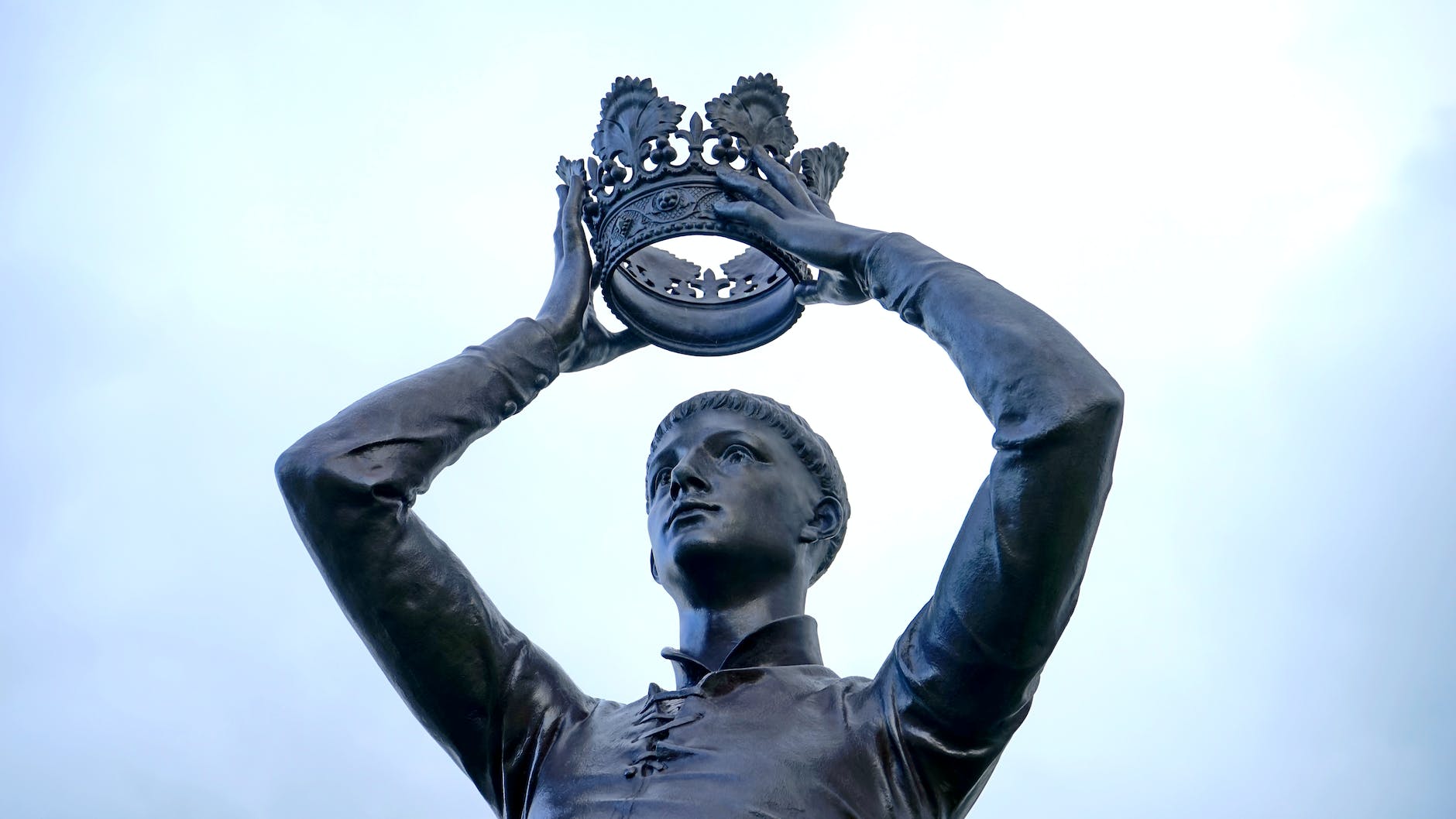
St. Joseph, Son of David, I bet when you were growing up the stories from the Torah you loved best were the stories of King David your ancestor. God told the Prophet Samuel that God does not choose as we do but sees the heart. You were poor but descended from a humanly unlikely king who was nevertheless after God’s own heart. He was little and yet mighty. His greatest gifts were from within. You could relate to that. Your boyish heart must have longed for adventure. Little did you know what adventure and danger and helping to save the world you were in for, and what joy you would find in ordinary life and the work of your hands, the love that surrounded you, the privilege you alone were given. You really were royalty. 👑 Help us to keep in mind our beautiful crowns as children of God and to love this day in quiet joy.
Blessed is the one who does not walk in step with the wicked or stand in the way that sinners take or sit in the company of mockers, 2 but whose delight is in the law of the Lord, and who meditates on his law day and night. 3 That person is like a tree planted by streams of water, which yields its fruit in season and whose leaf does not wither— whatever they do prospers. (From Psalm 1)
St. Joseph you would have heard and read and studied this Scripture. How beautifully you embodied it as you went about your daily work, took part in your community, served and loved Mary and Jesus. And to this day you are a beautiful tree planted by streams of water, shading and protecting us, giving us the fruit of your meditations and your labors and your love. Do us the honor of walking with us during this novena, giving us your blessing, teaching us your way. Pray with us the prayer you prayed daily all of your life.
4 Hear, O Israel: The Lord our God, the Lord is one.5 Love the Lord your God with all your heart and with all your soul and with all your strength (Dt. 6) Amen
I’ve been following Leticia Ochoa Adams, one of my favorite Catholic writers, for years on social media and I’ve loved reading her blog posts. She has always said what I wished someone would say even though I didn’t know I wished that until she made me laugh out loud or feel totally seen by a Catholic writer in a way I had not felt before. I admire her fearless and thorough self assessments, her frank story telling. There is a freedom that inspires in the way she manages to be rigorously honest about herself without sounding self absorbed or over dramatic. Reading her writing feels like sitting at The Kettle late at night with a comfortable friend who still surprises with her stories and insights.
So when I saw she had a book coming out I couldn’t wait to read it. It’s called Our Lady of Hot Messes from Ave Maria Press. It is the author’s spiritual memoir; the story of her life, a record of her conversion, an experience of her spirituality, the lessons she has learned, her observations about the world, her commentary on the times we are living through.
Leticia Ochoa Adams is not shy. Thank goodness because the world needs her voice, the voice of a Tejano daughter of a single mother who has endured more than her share of trauma and tragedy. Most recently she has survived the suicide of her son, Anthony. She is able to talk about this and the abuse she experienced as a child without being either lurid or glib. She makes it easy to learn from what she has been through and in sharing these things she lights the way for others.
She writes about the ways she, and we, numb ourselves, attaching ourselves to activities and material things that keep us from being with God as fully as we could be like “doom scrolling,” on social media and even more innocent things we become inordinately attached to. She examines the mixed motivations she and we often have with a disarming simplicity and clarity.
She reminds us we should just be ourselves. The most important thing to her is being real. I think she has accomplished that with a strength and self possession that might make you raise your eyebrows a little as you read.
One of her chapters is called “Cussing is Normal” in which she challenges us to consider if it’s really enough to use words like “dumb bunny” instead of cuss words when we have the same amount of malice in our hearts when we say them to someone.
I enjoyed her passages about finding God among people. She saw how Christ-like bar flies can be when they care for one another having witnessed the lives and friendships of the men who hung out in the dive bar where she was once a bartender. She learned the Ten Commandments and honorable conduct as part of a community from the “G Code” at the majority black high school she attended long before she learned these things in church. God had been teaching her all along through the events and people in her life. Jesus had been there.
Jesus is real and immediate to her. He’s watching TV with her on the couch. He’s funny, he makes her laugh sometimes and he loves her. She tells him everything. I appreciate the way she shares how that relationship has grown throughout her life, through grief and love and her search for truth.
She wants us to know she doesn’t have it all together, that we are at home in the Church whether we feel we have the perfect Catholic life or not.
It’s funny that she asked such hostile questions at the first RCIA (Rite of Christian Initiation of Adults) class she went to, she got kicked out. She only went to get her boyfriend to marry her, she says. She had been taught at a different church growing up that Catholics were idol worshipers and that the rosary was witchcraft. She was ready to be hostile again on her second try at the class but she was so blown away by the explanation of John chapter 6 she forgot to be mad when they got to the Virgin Mary and the rosary because she was still thinking about the Eucharist.
“The thing I love most about being Catholic is that I have found a place that hasn’t gotten tired of my questions. I can ask them without fear of being kicked out. Having a relationship with God and his mother does not mean that I know everything. It does not mean that I do not question why things are the way they are. But it does mean that I get to show up as me, even if that means I fall asleep when I try to pray my rosary at bed time.”
Her chapter on the rosary is my favorite one. “Praying the Rosary Like a Loser.”
“I also consider that Hail Marys are what make up the Rosary and each one is a rose laid at her feet. So when I don’t have time to pray the Rosary I just try to lay spiritual roses at her feet like not cussing out a coworker or not flipping off someone in traffic or paying for someone’s lunch. Those are all just as valid as roses to her. And that, my friends, is how to pray the Rosary like a loser when you do not have your life together. You just try not to be a jerk to others, and you think about those moments as roses laid at the feet of Our Lady. And you know that you are loved.”
The feast of the Presentation, February 2, also celebrates in a quieter way Mary’s purification. In fact from the 7th century The Purification of Mary was the name of this feast. These days the focus is on the Presentation of little Jesus in the Temple. That Mary was “purified” used to puzzle me as a new Catholic and maybe it puzzles you too. Why would she need purification and what did that entail?
Leviticus Chapter 12
The Lord said to Moses, 2 “Say to the Israelites: ‘A woman who becomes pregnant and gives birth to a son will be ceremonially unclean for seven days, just as she is unclean during her monthly period. 3 On the eighth day the boy is to be circumcised. 4 Then the woman must wait thirty-three days to be purified from her bleeding. She must not touch anything sacred or go to the sanctuary until the days of her purification are over. 5 If she gives birth to a daughter, for two weeks the woman will be unclean, as during her period. Then she must wait sixty-six days to be purified from her bleeding.
6 “‘When the days of her purification for a son or daughter are over, she is to bring to the priest at the entrance to the tent of meeting a year-old lamb for a burnt offering and a young pigeon or a dove for a sin offering.7 He shall offer them before the Lord to make atonement for her, and then she will be ceremonially clean from her flow of blood.
“‘These are the regulations for the woman who gives birth to a boy or a girl. 8 But if she cannot afford a lamb, she is to bring two doves or two young pigeons, one for a burnt offering and the other for a sin offering. In this way the priest will make atonement for her, and she will be clean.’” NIV
As Catholics we know Mary was free from both original sin and personal sin. She was the the Ark of the New Covenant. She was never unclean for even a second. Her womb is sacred and pure in a way we can hardly fathom. She had just born the Son of God. So what’s going on here?
“As with Jesus, so with Mary.” Jesus was baptized though he was divine and free from sin. So maybe Mary’s purification isn’t anymore puzzling than his baptism. Jesus’ baptism inaugurated in a beautiful ritual way the beginning of his ministry like a dedication, an intentional acceptance of who he was and what he was brought into the world to do. The Father responds in a wondrous way, and the Spirit descends on him as John the Baptist tells us.
Mary fulfilled the requirements of her religion in this purification regardless of her personal lack of need for it. God renewed its meaning and made it what he wanted it to be. Like much of Mary’s life how she would have experienced this requirement is hidden. We can however, learn more about the process she would have undergone.
After a woman’s period ended and the days of her ritual impurity (Niddah) were completed, during which no one could eat what she cooked or use what she touched and definitely not touch her at all, or become ritually impure themselves, she would have gone to the mikveh (pronounced MIK-vah). This was a special pool of naturally occurring water such as a spring or a well or collected rain water, enclosed for a ritual bath for the purpose of purification. All married women would have done this monthly and also after childbirth. Many Jewish women still do. She would have gone the night before the Presentation.
Mary would have bathed beforehand, to make sure there was nothing on her skin or hair or under her nails so that as much of her could be exposed to the water as possible. She would have brushed out her hair to get rid of any loose hairs and she would have clipped her nails. Once there she would have undressed privately and wrapped in a towel or loose robe around herself. A female attendant would have checked her nails and hair for cleanliness. Mary would have taken off the towel and walked down the seven steps ( representing the seven days of creation) into the water. The attendant would have made sure she was completely submerged including every bit of her hair. She would have come up and sank back into the water three times, praying:
Barukh ata Adonai Elohenu melekh ha’olam asher kideshanu b’mitzvotav v’tzivanu al ha’tevillah.
Blessed are You, O Lord, our God, King of the universe, who has sanctified us with Your commandments and commanded us concerning the immersion.
After this the attendant would give her the towel and Mary would have gone aside and prayed. We can imagine she had so much to pray about with all that was before her.
Maybe God used this ritual to open her heart even more and strengthen her before the presentation of Jesus. Maybe she recommitted herself to her mission, and to her family and to her love of God. I bet she was glad she would be able to hug Joseph again.
I loved learning about the mikveh because I love Mary and I want to understand as much about her life as I can. As Christians we no longer immerse in a mikveh. Instead we believe in “one baptism for the forgiveness of sins.”
Maybe now in the depths of winter we could use renewal and rededication too. We have the Sacrament of Reconciliation for that. And with Lent fast approaching this is a good time to begin our preparations and our intentions for it so we can come to Lent with a free heart ready for whatever God wants to communicate to us during this special time of grace.
We submit ourselves to the requirements of our faith with joy as Mary did, knowing that God will respond to us and grant us the graces we need to follow Jesus.
Luke 2:29-32
29 “Sovereign Lord, as you have promised, you may now dismiss[a] your servant in peace. 30 For my eyes have seen your salvation, 31 which you have prepared in the sight of all nations: 32 a light for revelation to the Gentiles, and the glory of your people Israel.” (NIV)
It’s a bit of a struggle. Some days are better than others. I noticed this summer that I was more emotionally fragile than I normally am. The anniversary of my brother’s death causes me grief but it hit me harder than usual this August. After it was over I didn’t feel all that much better. I had days I wondered what was going on with me this summer. When I start to feel alienated, withdrawn and broken I have to stop and sort out what it could be.
It could be regular old depression. It could be a stressor in my life. Or ten stressors. It could be that weird wiring I have from my Complex PTSS (formerly called PTSD). It could be grief issues coming up again for some reason. It could be more traumatic memories trying to surface – a process I particularly hate.
In any case I try to accept myself as God accepts me. Someone I like asked on social media whether God is with us in depression. It’s one thing to know the truth of his presence intellectually and quite another for our hearts, for our souls to know it. Of course he is with us.
Over the years when I am in this state that sometimes feels like a darkness and exhaustion, sometimes like broken-ness, sometimes like a crushing weight, I know he is with me, taking care of me, helping me bear this little cross of mine until I feel better.
It’s hard not to feel guilty when I’m depressed. Sometimes I need a walk or to pray. Other times I just need to hide in my room with a book. That last feels like I am being lazy and I feel bad. Jesus doesn’t want me to feel bad about what I need to do to get through depression. It’s hard for me to take care of myself when I am like this. It’s something I have to do for Jesus. “Eat a sandwich for me. Drink some water.” I tend to not only forget to eat when I am running rough, sometimes I feel angry about having to eat. So he says sweetly, “Eat something for me because I love you and I want you to.” And I will for him.
I’m so tired. I have this feeling of wanting to go home but I don’t know where I’m supposed to go. Even Heaven sounds exhausting.
Some afternoons are crushingly tough. Depression can be gray and tiring. Other times it can be a ferocious attack tearing me apart.
I’m impatient with my family, or irritable and I have to apologize.
This time around my depression seems like an agitated depression I have never had before. That scares me because my brother got like that before his suicide, though his was certainly more extreme. I think of this as a mild depression in comparison to what I saw my brother go through and not make it out of.
I am doing all the things I need to do. That in itself is a good sign. I even talked to my doctor; something I tend to avoid if at all possible. I try everything else first that I know to try. I look at my diet, stress, circumstances. I start taking B-Complex at my hardest time of day which tends to be the afternoon.
I look at the roses in the catalog. (I love looking at roses). I blow bubbles. I pet my cat.
I tell God, “I am depressed right now and I’m not sure what to do anymore. I’m so glad you are with me.”
Always I know it is temporary. I will get better. I imagine feeling better, sun on my face, feeling peaceful.
Now it is the holidays which are hard for my family and me, and maybe for you too. However I also know we will get through it, we all will.
If you are wondering if you should be “too blessed to be stressed” or something, (what nonsense), or if you are like me during depression and feel guilty about everything all the time every day, if you don’t know why your heart feels like it’s bleeding, and why you don’t have more faith, (you have plenty!) well I welcome you, and God does too.
Every second, love surrounds you, helping you along. This too shall pass, and once you have done all you can, and gotten the help you need, (I did, please don’t be ashamed about that) the rest is up to the Lord. Your job is to get through the day with his help.
Another thing I do is offer up my anguish to God with Mary, as she asked at Fatima, for the souls of others.
Oh Jesus, it is for love of you, for the conversion of sinners, and in reparation for the sins committed against your Sacred Heart and against the Immaculate Heart of Mary and, (I add), for everyone who suffers sorrow anywhere in the world today.”
I say to Jesus and Mary at the end of the day that I made it and thank you and also I add that I love sleeping and I’m comfortable and thank you for sleep.
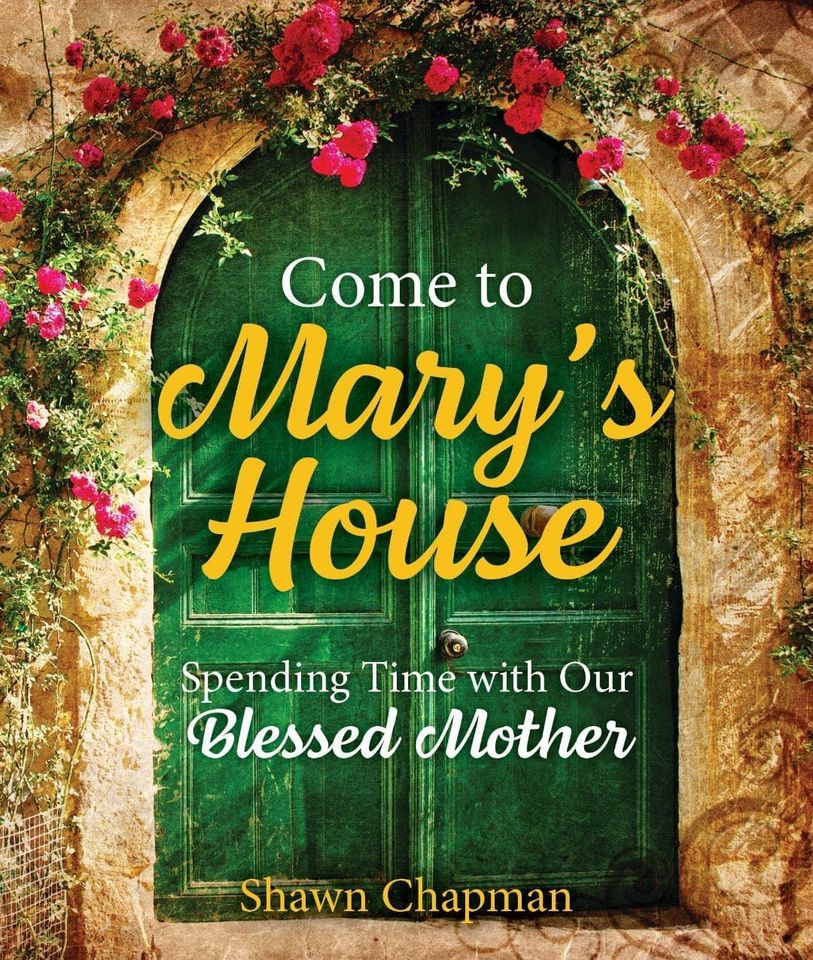
The message of my book, Come to Mary’s House; Spending Time with Our Blessed Mother, is that Mary is real, accessible, and relatable. She is our companion in the life of prayer and in our whole life with Jesus.
I filled this little book with reflections on Mary and her life to help you form a connection with a Mary you can be themselves with and feel seen by. At the end of each reflection are brief imaginative sequences. Come to Mary’s House invites you to imagine you are with the Blessed Virgin – hanging out in her living room, working in her garden, or catching up over coffee. The goal is to encourage your encounter Mary as a friend, sister, and mother – in a comfortable, gentle way. By developing a personal relationship with her, you’ll let her lead you closer to Jesus. No one knows him better!
So come to Mary’s house. Help her with her housework, travel with her to hear the cries of the world, fold laundry, make bread, and enter into deepest prayer in her presence and with her help. She will even let you pick the roses in her garden. She makes the most amazing soup!
This book is for all who long for Mary and want to live in spiritual companionship with her. If you want to pray more deeply, love Jesus profoundly, and serve authentically from the heart, you couldn’t choose a better master of the spiritual life than Our Lady.
Here are some reviews from readers so far.
What a gem! The author provides a unique perspective into the life of Mary and how she may be looked upon not only as a mother, but as a sister and friend. Each chapter invites the reader to an intimate encounter with Mary while weaving in humor and personal storytelling.
If you are interested in furthering your relationship with Mary, read this. If you have difficulty understanding Mary, read this. If you know nothing about Mary, read this. If you know all there is to know about Mary, read this. Whatever your history with Mary is, this book will be sure to draw you closer to Mary in a new and unique way. – “M”
This book is extremely well-written. The author uses her own experiences to bring the reader closer to the Blessed Virgin. The writer skillfully balances Mary’s humanity with her spiritual uniqueness. This is an excellent book to give the reader a better understanding of who Mary was during her life, and who she is to us now. – Francis
Just last week I was really struggling with prayer and this morning I had tears in my eyes while “ruffling the little Jesus’ curls”. Since starting this book I have taken Mary everywhere. It’s really full of love. I highly recommend it to anyone. – Latisha
This is a beautiful book reminding each of us of the beauty of having a relationship with the Holy Mother, and how that relationship deepens our relationship with her son. I highly recommend it , it’s very beautiful book. -Anne
This book represents such a warm invitation to build a relationship with Mary, the mother of Jesus. Inventive and imaginative, this work soothes the soul and encourages greater mental prayer. Reading this book has helped me to grow in my love and appreciation for the Holy Family. -Maria
First of all, I do not come from the Catholic tradition. I didn’t learn a lot about Mother Mary, either good or bad. She was just the mother of Jesus, but she held no particularly high place. I always seemed to, from my many Catholic friends, get the sense that she was almost untouchable, unreachable, and certainly from my standpoint, unrelatable. It likely was my lack of understanding or experience of her than it was about the Catholic faith.
Over the years that has for many reasons changed and evolved. One of them was reading the beautiful writings of the author of this fine book.
Her unique style and vision puts real flesh, bone, humanity, and yes, humor to her Catholic faith. It breathes. And I find myself feeling I am walking amongst humans that I can not only learn from but truly relate.
This book does all of that to Mary- we revere her, but also walk beside her, she is our mother, but also our friend.
I recommend this book not only for lifetime Catholics but for converts and Protestants who may yet to experience the richness and yes, tragic loss and challenges of her life.
You will likely leave sensing you have gotten to know someone who you can have a cup of coffee with and perhaps see in a whole new way, or this book may re-affirm the way you’ve always known her.
I found it best to read it a little at a time, and go about your day and sit with it. It will stay with you. Shawn’s vivid stories and various ways of offering encounters with Mary will feed your soul. And make you laugh. Or perhaps cry. But chances are it will move you. – Mark
Come to Mary’s House; Spending Time with Our Blessed Mother is available wherever books are sold.
Today is All Soul’s Day, the day we remember and pray for our beloved dead on their journey. It is a day to light candles for them, wash their head stones in the cemetery, to bring flowers. There will be masses and rosaries prayed for them in Catholic cemeteries all over the world today and every country has its own additional customs as well. Around here in some churches people bring pictures of their dead to leave there during the month of November. There will be a Book of the Dead placed near the door at church today so we can write their names in it and we will all pray for them during November at every mass.
Everyone is alive in God and we are still in communion with those who have gone before. I remember my husbands, my grandparents, my mother and my step father, my brother, and my friends who have died every day and I know they are with me. Love is stronger than death. And God is the God of both the living and the dead. All things are alive to him and therefor to me as one who loves him, and to you.
“… the world or life or death, or the present or the future: all belong to you, and you to Christ, and Christ to God. 1 Corinthians 3:22b-23
And Christ is all in all.
God bless you today and all of your loved ones who have died. May the tears you have cried for them be blessed. God holds every one of them close to his heart.
“You have stored my tears in your bottle and counted each of them. ” Psalm 56:8b
*The reason it says God keeps your tears in a bottle is because of the custom at that time to wear a small bottle around your neck when you were in mourning in which you stored your tears.
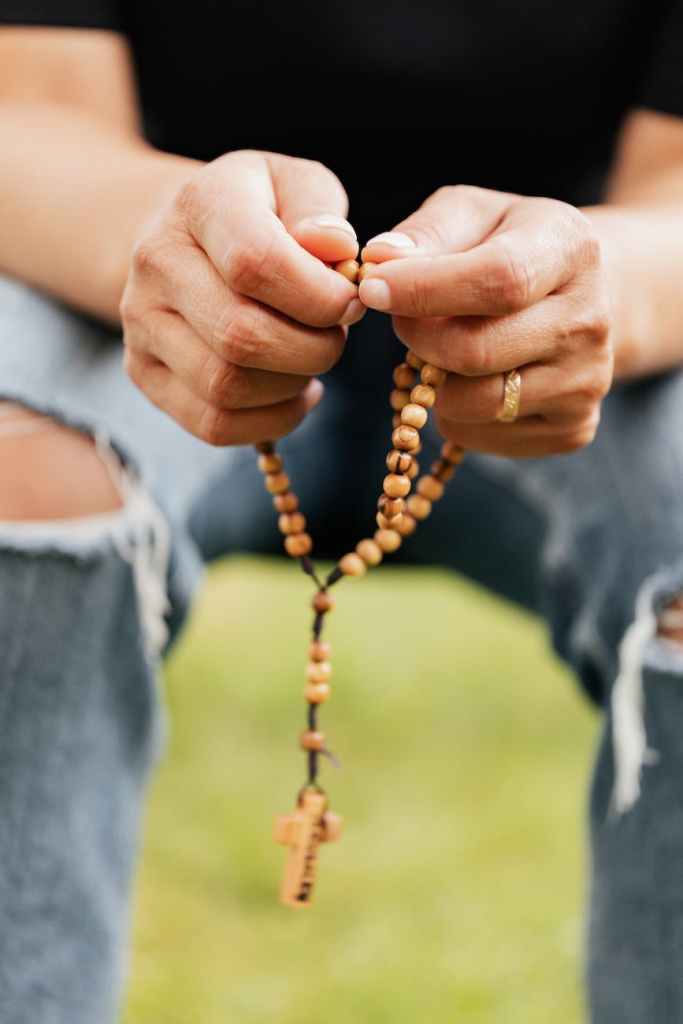
I went to see Fr. Cassian Sibley to discuss Prayer of the Heart in the Eastern Orthodox tradition. The sign on the house read, Theotokos of the Life-Giving Spring Russian Orthodox Church. That has to be the coolest church name I have ever heard in my life. I told Fr. Cassian so when he opened the door. He is a cheerful man with a kind face and a big bushy beard. He offered me coffee and showed me an assortment of beautiful prayer ropes, or “chotki” used for the meditative repetition of the “Jesus Prayer,” (“Lord Jesus Christ, Son of God, have mercy on me, a sinner”) which is at the core of Prayer of theHeart. Some of the chotkis were made with beads, some with knots in the shape of crosses. Some were quite long, and some were tiny, designed to fit on a baby’s wrist.
He explains that the simple repetition of the Jesus Prayer is the most common use for lay people, in order to pray without ceasing as they go about their busy lives. I am familiar with this because of one of my favorite spiritual books, The Way of the Pilgrim/The Pilgrim Continues His Way. The pilgrim wanders across Russia praying the Jesus Prayer until his heart prays it continually without effort. The book charts his travel, conversations and spiritual growth in the prayer.
Fr. Cassian points out that by replacing the “me” in the prayer with the name of someone else, one can use the prayer as an intercessory prayer – while warning that one does not use the phrase “a sinner” while doing so, since a Christian has no authority or right to judge another.
I had brought a rose for Mother Mary which he put in the chapel. Then I followed him into a pleasant sitting room filled with morning light, and comfortable furniture, lined with books. A parrotlet sang from a nearby cage. I got out my notebook but the conversation was so interesting and lively that I hardly took any notes. I couldn’t have been more content. I was sitting in a cozy chair conversing with an extremely intelligent and deeply spiritual person in a relaxed and friendly way, neither of us hurried. Priests are busy people so I was aware of what a gift his time was.
Fr. Cassian grew up Southern Baptist but was, as an early teen drawn to the Anglican Church and was preparing to be ordained as an Episcopal priest. As he studied theology though, he became more and more sympathetic to the Orthodox Church, and as a teen, he had read the J.D. Salinger novella, Franny and Zooey, and been introduced to the Jesus Prayer and The Way of the Pilgrim. Eventually he converted to Eastern Orthodoxy and ultimately was ordained as an Orthodox priest.
I told him my story of being tricked by Mother Mary into falling for Jesus and the Catholic Church after having grown up without religion. He chuckled knowingly and we talked about Mary in both our traditions. I really like the Orthodox title for her, “The Theotokos,” meaning “God-bearer.”
Our discussion turned to the life of prayer as experienced and expressed in each of our faiths’ contemplative traditions. We have so much in common. There are some interesting differences in our mystical theology, and in our ideas about the experience of Heaven. The Orthodox regard heaven as a continuous free growth of divinization -as an “ever moving rest” – which the Orthodox feel is in contradiction to the experience of what the Western Church calls the Beatific Vision. I said that St. Therese is busy “spending [her] Heaven doing good on earth,” so maybe we’re not so different there after all.
We discussed Confession, local events and world news, Church history, the degrees of union with God, the differences between praying with the chotki and the rosary, (for instance we use imaginative prayer and the Orthodox strongly caution against it).
We talked about the importance of being willing to know Jesus as he is, being ready to shed our own ideas and misconceptions and our lamentable tendency to only accept the aspects of the Lord that we are comfortable with.
I learned some Greek words and heard a few Russian ones I would be unable to reproduce.
Eventually we came to the point of my visit, the practice of Hesychasm (the path of deep prayer and living the life of prayer in the Orthodox tradition) and the practice of Prayer of the Heart.
Before Fr. Cassian gives me practical instructions, he cautions that if one desires to enter into this practice, a spiritual guide, teacher or spiritual director is extremely helpful – which is why the more mystical and non-verbal use of the Jesus prayer is more common, in Orthodoxy, amongst monastics and those with a monastic spiritual father or mother.
He goes on to say that today in Western Society we think of ourselves as centered in the brain, the mind, and that we tend to pray from there. Biblically, however, the heart is seen as the center of the person where both thoughts and spiritual movements occur. In Orthodox prayer, the pray-er seeks to redirect his or her awareness from the head down into the heart. Fr. Cassian touches his heart often as he speaks, seemingly unconsciously, closing his eyes when he does so. It seems to me that when he does this, a switch is flipped somewhere, a “peace switch” that visibly changes his entire demeanor. Maybe it is a breaker switch because I feel it too!
Practical Instructions for Prayer of the Heart
Stand or sit comfortably with your back relatively straight, in silence, solitude and stillness.
Breathe in, and allow one’s conscious awareness to follow that breath as one prays, silently, “Lord Jesus Christ”
Exhale slowly, maintaining, if possible, one’s conscious awareness in the heart, as one prays silently, “Son of God,”
Inhale, as before, while silently praying “have mercy on me”
Breathe out slowly and prayerfully acknowledge that one is “a sinner.”
Slowly repeat this cycle again and again.
Continually bring your awareness into your heart, bringing Jesus’ Name, his presence into it. Eventually it will be the heart that keeps time, so to speak, and the heart that speaks. After that, everything is up to God, and God alone.
The true Prayer of the Heart as he describes it sounds like what a Carmelite would call the grace of infused contemplation, where it is God who acts within us, and we are drawn into union with him.
We talk about the traditional understanding of the progress of the soul through the Purgative Way (purification), the Illuminative Way (the growing knowledge of God and his ways) and finally the Unitive Way (one-ness with God).
Before I leave, Fr. gives me a copy of his wife’s new book of poetry, Zoom and the Neanderthal Girl by Olympia Sibley, (I highly recommend it!) and I give him a copy of my book, Come to Mary’s House; Spending Time with Our Blessed Mother. (Release date September 26)
He invites me to come again, perhaps for dinner with his wife and him. I say that would be great.
I had set out today to write about the Prayer of the Heart but I can’t help but feel that perhaps Fr. Cassian and I have begun to do our part in healing the Great Schism one conversation, one prayer, one friendship at a time.
*My thanks to Fr. Cassian Sibley for his assistance with this piece.








 Bethany Hang Out