
July 29 is the feast of Sts. Martha, Mary and Lazarus, the siblings of Bethany. Bethany was a little village not far from Jerusalem. It seems to have been Jesus’ favorite stop on his journeys, his home away from home. Apparently these three friends were great company, and supportive of his mission. They had a house big enough for his travel companions, the food was great and Martha, Mary and Lazarus were always eager to be caught up on the latest adventures of Jesus and his itinerant followers.
Martha and Lazarus’ sister Mary has been conflated with St. Mary Magdalene since the Middle Ages and this impression continued for centuries in Christian hagiography and art. Modern Biblical scholarship and a pronouncement of Pope Paul VI put an end to that mix up. St. Mary Magdalen continues to be celebrated on July 22, and Mary of Bethany joined her brother and sister as her own person.
This leaves us with three Gospel stories of St. Mary of Bethany.
At the feet of Jesus (Luke 10:38-42)
Poor Martha is hosting all by herself, running ragged, resentful and starting to bang the pots and pans in the kitchen. Finally she decides to get her feelings out. She unburdens her heart right to Jesus. Isn’t that what we should do? Maybe not in front of the company, granted, but we should lay out burdens before him and be honest with him. He knows what’s inside us anyway.
I like to think the Lord’s answer gave Martha peace. All the times Jesus has straightened me out when I was wrong or off course I have felt instant peace. Whether what he asked of me was easy or unpleasant I felt peace and that’s how I knew he was speaking. It seems Martha had taken on more than she was required to. I have taken on tasks and responsibilities God was not asking me to and the first symptom I have is usually exhaustion followed by resentment and self righteousness. Eventually there will be an outburst. I hope Martha felt unbound and freed by what Jesus said to her.
It’s easy to see Mary feeling affirmed and freed, protected and understood by Jesus’ defense of her. I recently read that the way she is sitting at Jesus’ feet listening to his teaching would have been controversial in her time and culture. It was something a disciple did. Rabbis weren’t supposed to have female disciples. The study of Torah and the pursuit of knowledge was for men only. By sitting at Jesus’ feet as his student she was being quite bold and acting as an equal to the men. Jesus affirms her in this, allowing her to keep the place she has chosen.
Of course we also see Mary of Bethany here as a beautiful model for Christian contemplatives. She is deeply attentive to Jesus, looking at his face, internalizing all that he says, pondering in her heart.
During a skit of this scene we acted out as a family my then four year-old daughter Maire had Mary get up, offer to take over the host duties, and invite Martha to take a turn at Jesus’ feet. I like that a lot. Maybe it was that way.

Mourning Lazarus John (11:1–45)
Lazarus fell ill. His sisters cared for him and prayed over him, waiting for Jesus to come and heal him. They knew he could save their brother. They sent an urgent message. Mary would have sat by her brother’s bed keeping vigil, offering him her gift of profound presence and connection. Martha would have changed his blankets, kept a wet rag on his head, brewed medicinal teas, asked advice from the wise, sent for doctors, made favorite dishes she hoped he would eat. Sometimes they would have had to switch places and learn the other one’s ways of loving and serving.
Jesus never comes, though they keep a lamp burning for him through every night in hopes he will. Every footfall outside, every stirring they hear they think perhaps it is Jesus or at least a message from him. They don’t understand. Why doesn’t he come? Why doesn’t he respond?
Lazarus’ illness becomes imminently life threatening, their anxiety for him so intense, neither of them sleeps at all. They hold him in his struggle for breath and as life ebbs away.
They try to comfort one another. They ask each other, “Why did Jesus never come?”
They wash and anoint his body with the women of their family winding him in scented burial cloths to bury him in their family tomb.
The house is full of family friends and neighbors sitting shiva with them. https://www.shiva.com/learning-center/sitting-shiva
Finally Jesus shows. Martha as we have seen her do before, makes her thoughts and feelings known to him. She confronts Jesus while at the same time expressing her faith in him. She knows he could have saved her brother as he has saved so many others. She also has come to know and believe he is the Messiah and Son of God, just as Peter had also done and she says so. “Even now,” Martha says hopefully, “I believe.”
She runs to get her sister who is in the house with all the mourners and tells her Jesus is here and asking for her.
It’s when Jesus sees Mary’s tears that he cries too. This is important to me, to all of us. Yes for some reason Jesus does allow bad things to happen to us. At the same time, as Madeleine Le’Engle says, everything that happens to us happens to God too.
Mary also confronts Jesus, falling at his feet, her movement a desperate plea of prostate grief.
He doesn’t ask Mary for a declaration of faith. Maybe he knew she had it in abundance already. He only responds with his tears and his actions. He gives her her brother back alive.
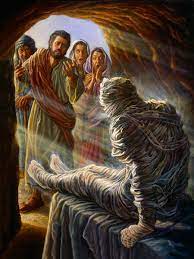
Anointing Jesus (John 12:1-8)
This is the beautiful story that captures the imagination so powerfully; Mary of Bethany interrupts dinner, unbinding her hair, carrying in an alabastron of outrageously expensive perfume worth a year’s wages.
Since she seems to have been unmarried (as she is living at home) perhaps it had been meant for her dowry. To me this brings out an extra meaning. Perhaps she intended never to marry and to fully dedicate her life to Jesus, pouring out her love and devotion to him alone.
Her contemplative nature, her attentiveness and connection to Jesus lead her to anticipate his death; the only one of his followers who understood that it was imminent, and maybe even what his death would mean.
With compassion she comes to acknowledge both what he is about to endure and what he means to her.
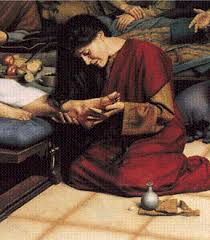
Have you ever smelled spikenard, aka nard? It is not a floral scent but a sharp, pungent smell. It would have filled the whole house and the scent would have lingered for days and days in every room and on both Jesus and on her hair.
The others at the table were offended at her extravagance, saying the nard could have been sold and used to feed the poor. Jesus defends her. We will always be able to help the poor but we would not always have him. “She has done a beautiful thing for me.” She dries his feet with her hair.
Women’s hair was supposed to be covered in public and especially in the presence of men who were not their husbands. Here our Mary of Bethany unveils and not only that dries the feet of Jesus with her hair. I wonder what those present would have made of that?
I’m thinking of the spiritual marriage written about and experienced by the great mystics of our faith such as Sts. Teresa of Avila, John of the Cross, Rose of Lima, Catherine of Sienna among others, in which the soul becomes one with God. Maybe Mary of Bethany was experiencing this or had. Maybe this bold and lavish gesture was her response, her understanding of his destiny born of that union and love.
Wouldn’t you love to be able to comfort Jesus with your compassion and love? To do something that is deeply meaningful for him? To pour out your love diffusing its fragrance through all his house, to smell it on your hair for days to remind you, knowing he also carried it? To remember his words, that you had done a beautiful thing for him?
We can. When we love, when we serve, when we pray like an oil poured out to the One we love.
Your anointing oils are fragrant;
your name is oil poured out;
therefore maidens love you.
Song of Songs 1:3


 Bethany Hang Out