Search

Bethany Hang Out

Catholic contemplative life and devotion

Tag

spirituality

Abbess Hildegard

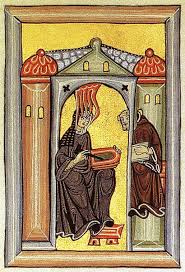
Born in 1098, the tenth child of her family and dedicated as a tithe to a monastery of Benedictine nuns at the age of eight, St Hildegard grew up to be an extraordinary and holy woman. She was a mystic, a poet, a composer of unique, soaring liturgical music so different from the plain chant of the time. St. Hildegard was the author of books, music, and plays. As a  Benedictine Abbess she communicated with Bishops and Popes. She was a popular public speaker at a time women were normally not allowed to teach or speak. Abbess Hildegard was a prophet, an adviser, an influencer of her time. 

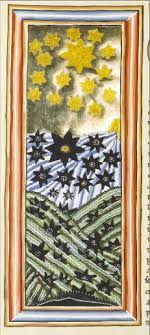
Her colorful mandala like art, not created by herself but overseen by her, represented her visions of the Trinity, and other Heavenly realities. The paintings often have a multi-layered appearance leading the eye to a central space containing a symbol. Looking at them makes me feel like I’m  seeing into another world or a into a great depth. 

Her  illustrated book Scivias describes  her mystical visions  and the interpretations of them she heard from God. It was written in 1151. She begins it with her experience of God commanding  her to write it. It is still available now as are other works of hers which ranged from the botanical to the medicinal, to the  theological. Her exquisite music has been performed for centuries.. Her musical play, Ordo virtutum, or Play of the Virtues, may well be the oldest known morality play. It is beautiful but you may jump when in the middle of the serene vocals, the wild discordant  voice of Satan interrupts the song unexpectedly for a moment. I have listened to it so many times but it still startles  me. Otherwise her songs are pure ethereal loveliness. You might start with The Origin of Fire (no devil voice,) or A feather on the Breath of God which sounds as poetic and pretty as the title.

St. Hildegard’s world view, like her poetry, was lush, verdant, filled with rich, vivid imagery. She was deeply in tune with nature and the divine as expressed in creation. She was profoundly  Incarnational, at once earthy and luminous in her spirituality and writing. 

Here is Viridissima Virga, a hymn she wrote in honor of Mary 

“ O branch of freshest green,

O hail! Within the windy gusts of saints

upon a quest you swayed and sprouted forth.

When it was time, you blossomed in your boughs—

“Hail, hail!” you heard, for in you seeped the sunlight’s warmth

like balsam’s sweet perfume.

For in you bloomed

so beautiful a flow’r, whose fragrance wakened

all the spices from their dried-out stupor.

And they all appeared in full viridity.

 Then rained the heavens dew upon the grass

and all the earth was cheered,

for from her womb she brought forth fruit

and  the birds of the sky

     have nests in her.

Then was prepared that food for humankind,

the greatest joy of feasts!

O Virgin sweet, in you can ne’er fail any joy.

All this Eve chose to scorn.

But now, let praise ring forth unto the Highest!”

Hildegard possessed unusual wisdom and compassion. People of every class came to her for medical advise, healing remedies, wise counsel, spiritual help or prayers. At times she even delivered babies. 

She was a Renaissance woman before the Renaissance, a polymath, someone brilliant in many subjects and incredibly creative. 

Her faith was absolute. When she was sure she was doing Gods will she was literally unmoveable. She ran into some trouble with religious authorities for burying a sinner who had been excommunicated on the holy grounds of her monastery. She insisted the man had confessed and received absolution and communion. She was not believed by the Bishop. She was ordered to have the man’s body removed. She refused.  Her sisters stood by her. She and they were placed under an interdict which meant they could not sing the Liturgy  of the Hours or receive the Sacraments. It was basically a mass excommunication. Hildegard became very ill in her spiritual anguish and could not leave her bed. When the Bishop sent six men to remove her, she became so heavy they could not, no matter how many worked together to lift her, be moved at all. It was considered a sign from God. 

The young man’s body remained where it had been buried. 

St. Hildegard Abbey, also known as St. Hildegardis Abbey, is located in Eibingen, along the Rhein river in Germany.  It was founded by Saint Hildegard  in 1165. It is still functioning and is visited by pilgrims from all over the world devoted to her and interested in her life and work. . 

Strangely she was not canonized  for more than 800 years after her death. Finally on May 10th, 2012 Pope Benedict XVI did so though she had been already widely regarded and locally venerated as a Saint after her death in 1179. This lapse was because the necessary paperwork was lost en route to the Vatican when her cause was first undertaken.  Pope Alexander III ordered the witnesses of her life and miracles to be gathered and interviewed again but somehow no one ever did so. 

Maybe the delay was because we need this brilliant Saint to arrive in our consciousness now in these times we live in. Who doesn’t need a beautiful vision, remarkable and holy art, gorgeous music and vivid poetry, showing us a spirit  that is unique in beauty with the ability to open our eyes in new ways to the glory and splendor of God? I think we all need that right now. 

Pope Benedict XVI elevated St. Hildegard  to the well deserved status of Doctor of the Church on October 7 of 2012 because of “her holiness of life and the originality of her teaching.” She is one of only four women Doctors of the Church along with St. Teresa of Avila, St. Catherine of Sienna and St.Therese of Lisieux. 

After Abbess Hildegard’s death the  nuns  of her monastery reported seeing her luminous figure several times carrying a bright light through their monastery. She was radiant and she was chanting. 

We celebrate St. Hildegard of Bingen on September 17. 

How to love in troubled times; St. Teresa Benedicta of the Cross (Edith Stein)

Yes I did say 70×7 but stop freaking out about it

Photo by Ron Lach on Pexels.com

Then Peter came to Jesus and asked, “Lord, how many times shall I forgive my brother or sister who sins against me? Up to seven times?”
 Jesus answered, “I tell you, not seven times, but seventy times seventy times.

Mtt. 18 21-22

It’s been almost nine years but I’m still not sure whether I have forgiven it or not. I still struggle with how I am supposed to forgive someone who turned out not to be who I thought they were. Forgive who? What was that who was that?

In the aftermath I realized I was thinking of the whole mess about once every 15 seconds. I began training myself to repeat the names of Jesus and Mary any time I caught myself dwelling on the whole thing. I had dwelt on it long enough truly. I increased my prayer time. I decided to try to stop talking about it. It helped a lot. Slowly I didn’t think about it, not even every week.

I went to Confession. In exasperation I asked the priest, “How do I get to Father forgive them for they know not what they do?” He said my penance would be to go out and meditate on the crucifix in the church and ask the Lord, “Father forgive me for I knew not what I did.” Instant peace came to me then.

Photo by Skylar Kang on Pexels.com

As time passed I realized that I “forgave” this person over and over again while they were still in my daily life but not in any real way because what I did was be upset about what they had done, avoid them for a while and then simply go on as before so that they did the same things again and again. My kids suffered emotional scars because of this lack of boundaries on my part. I let this person be with us for so long. At the time I didn’t realize how much the girls were harmed especially when they were still young. How did I fall into this trap? How could I not know how mean this person was being to them? Even the things I did know about them should have been bad enough. I should have not allowed this person around my daughters. I certainly did do things I didn’t know I was doing. Those mistakes seem crazy now.

Then at a time of another tragedy in my life, this person set out to ruin my reputation, blame me, interfere with my friendships and even my family relationships, to tell distorted versions of my private sufferings, commandeer one of my daughters with lies and emotional scenes when she needed me most and was too young ti break out of that situation. This person deeply hurt my other daughter as well during a time of grief and shock for my family with hateful accusations and not allowing her to retrieve what was hers and precious to her from the house. This person also participated in grave financial harm to me and one of my kids that we will never recover from. I was emotionally and socially betrayed on a level that was traumatic enough to keep me curled up on the couch for days. I never thought they would go that far especially at a time like that. Why was I shocked? I can’t answer that fully.

One thing I have learned from all this is that being a forgiving Christian does not mean having destructive people in my life. Even Jesus had boundaries.

But Jesus did not entrust himself to them because he knew their hearts.

Jn. 2:24

However I sometimes still feel angry at this person, even after I have peeled away several layers of resentment and reached certain levels of forgiveness. I didn’t feel that it was complete. Because of those feelings of rage coming up now and then, especially recently, I tend to think of this person every time I pray the Our Father. How can I forgive this person as God forgives me? God forgives me more than completely. God is mercy, God is love. I always ask that I will be able to do this. I have learned forgiveness is a grace. We just have to be willing to receive it. Was I willing? I didn’t know. My mom used to say that sometimes we have to ask to be willing. Other times we have to be ask to be willing to be willing. Sometimes the situation is so difficult we have to pray to be willing to be willing to be willing. I think this is like that.

Recently, sitting quietly in prayer, I felt that the Lord untangled my thinking a bit about what forgiveness looks like in a situation like this. In a flash I understood that all Jesus wanted from me now was to pray for this person’s salvation. I felt my heart open as it seemed the Holy Spirit prayed in me for just that: for this destructive person’s salvation. It was an understated but all the same beautiful moment. I understood that God did not need my tortuous worry about my lingering feelings about this, or the useless dead end paths of my self judgement or scrupulosity on this point. Just prayer for their salvation that is all. The rest was between that person and God. Oh.

Three times I pleaded with the Lord to take it away from me.  But he said to me, “My grace is sufficient for you, for my power is made perfect in weakness.”

2 Cor. :8-9a

Then I prayed the our Father in freedom and when I said, “forgive us our trespasses as we forgive those who trespass against us,” I almost felt a kiss from Jesus, and I had to smile. I love that guy.

Photo by MART PRODUCTION on Pexels.com

Acedia; a spiritual malady

Photo by Maria Geller on Pexels.com

During this little slice of Ordinary Time after Christmas and before Lent we might begin to feel spiritually unenthused. Maybe we were already. Maybe we even avoid prayer and the practice of our faith. Maybe we have an aversion to our daily duties. Maybe we’re bored and drawn mostly to distractions. What’s going on? St. Evagrius (AD 385-399) who lived  in the Egyptian desert as an early monastic wrote about something called acedia. 

What is acedia? The Catechism of the Catholic Church (2733) calls it a form of depression caused by giving in to spiritual laxity or presumption. The Desert Fathers thought of it as a spiritual condition people can fall into with a complex set of symptoms, a spiritual malady, or even as a demon. 

[Acedia is] a hatred of industriousness, a battle against stillness, stormy weather for psalmody, laziness in prayer, a slackening of ascesis, untimely drowsiness, revolving sleep, the oppressiveness of solitude, hatred of one’s cell, an adversary of ascetic works, an opponent of perseverance, muzzling of meditation, ignorance of the scriptures, a partaker in sorrow, a clock for hunger.

St. Evagrius

Yikes. 

St. Evagrious of Pontus says the real roots of acedia are self centeredness, anger and misdirected desire. When oppressed by acedia we tend to seek comfort and pleasure to counteract the restlessness we feel, and in response to our aversion to spiritual practice. We avoid the tasks we are responsible for. We withdraw from charitable activity and are more prone to gab with others for our own entertainment and distraction than to be useful to them.  We fill our lives with surface busy-ness, avoiding prayer and study. We lack spiritual desire and quietly long for things and activities that will draw us away from the spiritual. We are both restless and exhausted. We want to sleep, we want to pace the floor. We feel at once angry and dissatisfied as well as listless, staring at nothing. This sounds terrible. No wonder Evagrious called it “the most oppressive of demons.’ 

All of this reminds me of  a passage from one of my favorite books, The Phantom Tollbooth by Norton Juster. 

“There once was a boy named Milo who didn’t know what to do with himself; not just sometimes but always. When he was in school he longed to be out, and when he was out he longed to be in. On the way he thought about coming home, and coming home he thought about going. Wherever he was he wished he were somewhere else, and when he got there he wondered why he’d bothered. Nothing really interested him- least of all the things that should have. “It seems to me that almost everything is a waste of time,” he remarked as he walked dejectedly home from school.”

And “… while he was never anxious to be where he was going, he liked to get there as soon as possible.” 

Had Milo been a monk he would have been diagnosed by the Desert Fathers like Evagrius, as suffering from, and indulging in acedia. 

Photo by Jose Aragones on Pexels.com

If we find ourselves troubled by acedia, what is the remedy? What should we do?

  1. Master your thoughts. 

Notice when your thoughts are going into that irritable, lazy restless lane again, and change course as soon as you notice. Something that helps me is to repeat the names of Jesus and Mary; “Jesus Maria Jesus Maria Jesus Maria” each time I find myself on that negative track again. Be patient with yourself. It doesn’t help to be mad or disappointed in yourself. Simply move on and persevere.

“Whether or not all these thoughts trouble the soul is not within our power; but it is for us to decide if they are to linger within us or not and whether or not they stir up the passions.”

St. Evagrius
  1. Resist. If you want to sleep or run away or indulge in compulsive activity, persevere in what you are actually supposed to be doing in spite of how you feel. If you are avoiding prayer, pray. If you are avoiding your duties, get back on track. If you’ve lost sight of your routines, get back to them. I suggest working on one thing at a time so you aren’t overwhelmed. When you are stuck in acedia even one of these things can be hard enough to change.
  1. Gratitude. Write down five things you are grateful for when everything is getting on your nerves. It works surprisingly well. 
  1. Manual labor. Nothing helps me as much as some vigorous sweeping, mopping or dragging things around outside.  According to the Fathers, acedia is both mental and physical. This is why it’s so hard to kick.  
  1. Meditate on the Passion and Death of Jesus. Maybe praying the Sorrowful Mysteries of the Rosary or The Way of the Cross can assist you in this. This is uniquely grounding for us as Christians.
  1. Ask God for the gift of tears. According to Evagrius, the gift of tears in prayer, and tears of repentance are indispensable for liberation from acedia.  So have a good holy cry, it cleanses the soul. 
  2. Preach the Psalms to your own soul. As Dorothy Day wrote, “My strength returns to me with my cup of coffee and the reading of the psalms. ” 
  1.  Engage your intellect. I learned this from Fr. Gregory McLaughlin who taught me that when I was being ruled too much by my emotions, I should study, especially religious study such as Scripture or good spiritual reading. It works.
  1.  Go to confession. This may seem obvious but remember the Sacrament of Reconciliation is healing and restorative. God gave us Confession so we can receive his mercy, overcome our sins and begin anew which is exactly what we need to be free of acedia and free for God. 
  2. Good deeds. Go through the day quietly tucking in small kindnesses wherever you can. This is a remedy for almost any malady of any kind. When you are ready, throw yourself into working for others in some way.

Gently fold these things into your life and you will soon sense a clear fine spiritual love reclaiming its place in your heart. 

Photo by Tim Eiden on Pexels.com

Triumph of the Cross

Photo by Alem Su00e1nchez on Pexels.com

“The Sovereign Lord has opened my ears;
    I have not been rebellious,
    I have not turned away.
 I offered my back to those who beat me,
    my cheeks to those who pulled out my beard;
I did not hide my face
    from mocking and spitting.
 Because the Sovereign Lord helps me,
    I will not be disgraced.
Therefore have I set my face like flint,
    and I know I will not be put to shame.”

(Isaiah 50:5-7)

Anyone can give intellectual assent to Christ’s existence, his nature and purpose. Anyone can quote Scripture. Satan did both of those things. When the devil tempted Jesus in the desert he quoted Scripture just fine. The demons exorcised by Jesus proclaimed his truth screaming, “You are the Christ the Som of God!” as they left the scene at his command.. So it isn’t enough to know the Bible or to acknowledge Jesus in order to belong to him. Following him, identifying with him, seeking unity with him, living as he did, loving him in all of his mystery, that is what being Christian is.

His triumph was all of the things that most confound the forces of hell: sacrifice, obedience, love, surrender, acceptance, humility, non-violence, abandonment to God, suffering and losing a fight in front of the whole world, and on purpose.

Even we don’t understand it unless we console ourselves that he was resurrected on the third day, which he was. But in that moment he died with trust and abandonment. He gave himself over and faced his enemies in silence.

This throws Satan, and sadly it throws us too.

Even we Christians hold a deep attachment to violence and revenge. We cannot let go of the exhilarating high of vainglorious triumph.

And yet the Beautiful One admonished us to take up our crosses and follow him.

I don’t think that is simply putting up with the hardships of life hoping for reward though I know that is part of it. I think we need to respond to the violent world as he did.

Turning the other cheek to me means, “I will not be turned back from love.” That kind of power can only come from God and we have to want it.

We have to renounce ourselves and follow Jesus. That’s how we find life and even find ourselves.

I haven’t gotten there yet. I have been there sometimes but it is not yet my home, my way of being. Not yet. I suppose that is how it is for most of us.

I still want to win. I want to win, I tell myself, for others; for the poor, for those on the margins, for immigrants. However, like anyone, my motivations are mixed. There is still a selfishness and pride in it. We all want to force things, to feel powerful. It is the effect of the fall of humanity in us.

The real battle we have is against ourselves, as St. Teresa of Avila says. And this is hard, she points out, “because we love ourselves very much.”

God gave us an innate sense of justice and right. There is nothing wrong with this. We go wrong when we stray from the Gospel. A line in the Oscar Romero movie, Romero got to me. St. Oscar said to a fellow priest and advocate for justice, who tried to talk him into joining the rebels with him on behalf of the suffering people of El Salvador, “If you do this you will lose God just as they [those he would take up arms against] have.” Whether these were St. Romero’s exact words or not it is an incredibly powerful statement. It rings utterly true. If we persist in our attachment to violence we will lose God. Nothing, absolutely nothing is worth that. And we will “lie down in torment.” (Isaiah 50:11)

I have read that some people are starting to complain to their pastors when they preach on the Beatitudes, that the preaching was too left leaning. When confronted with the fact that these are the words of Jesus Christ, they retort that this is outdated, doesn’t work, is “weak.” Look at us. We haven’t changed. The Cross, the Gospel, is still a scandal, still makes no sense.

However, When he was insulted, he returned no insult; when he suffered, he did not threaten; instead, he handed himself over to the one who judges justly. (1 Peter 2:23)

For to this you have been called, because Christ also suffered for you, leaving you an example, so that you might follow in his steps” (1 Peter 2:21).

There is really no way around that.

Even those of us who know and accept the teachings of Jesus have parts of ourselves still attached to violence and our own ideas of justice. We still hope Jesus will clear the world of bad people on his return.. Not us though because we are nice people, right?

St. John of the Cross said that even if the only thing keeping a little bird tied to a tree branch is the thinnest of threads, the bird is still tethered, still not free.

We have to cut the thread.

On this Triumph of the Cross in 2023, in this era of mass shootings, unkindness and cruelty, and the promotion of a lack of compassion as a good thing by a significant portion of society, even by a good number of our fellow Christians, lets renounce violence in the Name of Christ, embracing instead the way of Jesus.

We can’t belong to the Christ of Revelation unless we belong to the Jesus of the Gospels with all that he showed us.

Thank God he is with us to help us with his endless grace.

He who has begun the work in us will complete it. (Philippians 1:6)

We have only to decide, every day, and trust that he will triumph in us.

“I have promised it and I will do it, says the Lord.” (Ezekiel 37:14b)

Photo by MART PRODUCTION on Pexels.com

The Liturgy of the Hours

Photo by Jaymantri on Pexels.com


Every morning as sunlight makes its way across the earth, the  praises of God awaken from the heart of the  praying Church. Behind  the sunrise the praises and petitions continue through the hours of the day. As each time zone turns into the darkness, Night Prayer is raised to God beneath the moon and stars. 

This is the official prayer of the Church called The Liturgy of the Hours, The Divine Office, “The Work of God,”  prayed by Catholics of every vocation, by Pope Francis, by our Bishops, priests, religious, and by many lay people as well; the same words of prayer in every language of humanity. 

It is an anchor in the day, a way to sanctify time, express unity with the whole Church, and to call our hearts back to God again and again. 

Morning and Evening Prayer are laid out for us daily as a hymn, two Psalms, and a Scriptural Canticle, (a poem or song in the Bible that is not a Psalm) each with antiphons, (a reflective one line prayer) and followed by “Glory to the Father and to the Son and to the Holy Spirit. As it was in the beginning, is now, and will be forever. Amen.” 

After the  Psalms and Canticle there is  a Scripture reading; usually from  a New Testament letter. 

After that  there is what is called a “Responsory.” For example: 

 Just is the Lord, in justice he delights.
— Just is the Lord, in justice he delights.

He looks with favor on the upright man;
— in justice he delights.

Glory to the Father, and to the Son, and to the Holy Spirit,
— Just is the Lord, in justice he delights.

This will be followed, for Morning  or Evening Prayer, by a New Testament Canticle. For Morning Prayer, this will always  be the Song of Zechariah (Luke 1:68-79). In the Evening it will be Mary’s Song we call The Magnificat ( Luke 1:46-55),  each with their respective antiphons.. 

After this are the Petitions, similar to the ones we pray at mass. These are different each day. Then we pray the Our Father and a closing prayer that changes daily. 

The other daytime  “Hours” : midmorning, midday and mid afternoon are more abbreviated.  Night Prayer is brief and includes an Examination of Conscience and Act of Contrition or Confiteor, along with its Psalms prayers and canticles. It ends with a Marian antiphon such as the “Hail Holy Queen” to kiss our mother goodnight. 

Photo by Rok Romih on Pexels.com


The “Office of Readings” will have a longer reading, usually from the Old Testament, and a Patrisric reading (from a Church father or from the writings of a Saint) and can be prayed any time. 

These prayers in their daily format can be found in the four volume version of The Liturgy of the Hours which unfortunately is a bit expensive for some. You can also buy  the one volume version called Christian Prayer if the expense is prohibitive. Christian Prayer does not include the Office of Readings. 

It’s hard to learn to navigate the volumes at first while you are getting used to this. You might want to buy what’s called The St. Joseph Guide, a little paper book that gives you all the page numbers for each day.  There is a lot of page turning and going back to a page and so on. I once heard a priest describe it as “death by ribbons.” Yes it feels like that! 

It was worth it to me to learn. The Liturgy of the Hours has become an indispensable part of my everyday life, connecting me consciously to God and to the whole Church at the times of day I pray it. As Secular Carmelite I am committed to pray Morning, Evening and Night Prayer daily. 

Through hard times I have prayed every available “hour” to help me get through the day, which was healing and helpful for me. At all times the rhythm of it grounds and connects me with the family of God. 

Morning and Evening Prayer should take about ten minutes for you to pray at a normal pace.  The other “hours” are shorter. 

When we pray the  Psalms of  Liturgy of the Hours we  are praying with Jesus who prayed these too as did the generations before him. We are praying with the whole Church, with the voice of the Church. 

I love praying with everyone. 

Another thing I love about praying The Liturgy of the Hours all these years is that the Scriptures they contain are written in my heart. A line from a Psalm that is just right will come to me at exactly the right time when I need it. The prayers , Canticles and  Psalms are woven into my life now like flowers in my hair. 

Photo by Valeriia Miller on Pexels.com

I look forward to praying the Divine Office as I wait for my coffee to brew,  or when I start thinking about what to make for dinner, or when I am getting ready for bed. 

I enjoy praying it alongside others as well, especially my family and my Carmelites when we are together. When we are apart the liturgy connects me with them.  

Know that praying The Liturgy of the Hours does something. It is never just a recitation. 

“For the word of God is alive and active.  (Hebrews 4:12a) 

“So shall my word be that goes out from my mouth; it shall not return to me empty, but it shall accomplish that which I pupose

and shall succeed in the thing for which I sent it.”  (Isaiah 55:11)

We are praying God’s words, and the words of the Church spoken by the Holy Spirit. We are participating in the healing of the world. We are allowing ourselves to become conduits of God’s grace when we join our brothers and sisters spiritually for “The Work of God”. 

Now I will tell you a secret. The secret is that nowadays you don’t have to go through “death by ribbons” unless you just want to. I feel like a cheater because I use the app now though I still cherish the books. I have the app called Divine Office on my phone. You can also pray from the Divine Office website or the other one,  Universalis. 

So you see? It’s not hard. Come on and join us. You’ll be glad you did.   

From the rising of the sun to its setting, let the Name of the Lord be praised. (Psalm 113:3)

Photo by NO NAME on Pexels.com

*This piece originally appeared as my column in The Eagle Newspaper Saturday June 24, 2023

Immaculate Heart of Mary

Photo by Felipe Balduino on Pexels.com

Happy Immaculate Heart of Mary day! I’m wearing my Immaculate Heart of Mary.shirt today as I clean house, watch my granddaughter and cook. Normally I would be at work on a Saturday but today I am not. As I clean or hang out laundry, I’m pondering Mary’s heart; open and free of the obstructions and blindness that would keep her from love. She had the freedom to be unreservedly given to prayer and communion with God.

Her beating heart also reminds us that Mary was and is 100% human. She is our sister. Because she is free from sin, she is us without impediments; able, as Eve would have been, to see other people’s inner truths as well as their physical bodies when she looked at them, and to see God in all things because of her purity of heart. When she looks at us now Mary sees and understands us completely with total freedom from selfishness and pride, able to love us as we are. She doesn’t judge us. She just loves us. She wants to give us everything. With all of her heart she longs to bring us to her Son more and more fully. She is totally human, totally pure of heart. She is all God’s. She is all ours.

Spend some time appreciating Mary’s beauty and humanity today, her love, her sweetness, her heart.

Photo by Hassan OUAJBIR on Pexels.com

“And now that you are alone daughter,”

Photo by Engin Akyurt on Pexels.com

To me Ordinary Time is getting back to the everyday and delightful work of prayer and service that makes up our beautiful Christian lives. It means hot Texas afternoons, coming into the cool, quiet church, feeling relieved as the sweat evaporates from my face and back and peace surrounds me.

“Hi Jesus. hi. Help me pay attention at mass this time.” I can’t help but smile to myself, or really, at him, in his sweet presence there.

His presence is also right here with us, in us.

Ordinary Time beckons

with the promise of quiet inner space

to be with Jesus in the center of my heart,

I in the center of his,

drawing from the source of all life.

St. Teresa wrote about how the companionship of the Lord is magnified when we are prayerfully solitary, our awareness of him not in the least disturbing our perfect solitude.

“Contemplation is nothing more than making time to be alone with the one who we know loves us.”

Instructing us in how to go about practicing inner prayer, she writes, “And now that you are alone, daughter, make the Sign of the Cross.”

In this way you acknowledge that you are in the presence of God, with the intention of spending time alone with him.

You will notice this kind of quiet and solitude are more full than empty, and that the fullness is nourishing, often joyful. Again, it makes me smile. “Hi Jesus, hi.”

If you have trouble with your focus when you are alone, if stillness causes you anxiety, or of you have many worries that disturb your peace, here are a few things to try.

It helps me to listen to the sounds around me. If you are blessed with a silent house or a quiet chapel, these sounds will be small. Mentally note them, starting with the farthest away. Maybe a dog barks from a neighbor’s yard down the street. Someone is mowing in the distance, a car drives by. Now bring your awareness closer. Maybe you hear birds singing, children playing next door, wind in the trees outside your window, a sprinkler perhaps. How about sounds in your house or wherever you are right now? A clock ticking, a washing machine swishing, the refrigerator humming, the dog drinking its water in the kitchen;

listen.

What sounds are in your room? The ceiling fan, the air coming on… your own breathing.

Speaking of breathing, take a few deep breaths; in through your nose, out through your mouth.

Put all your worries in a little pile; Milagros to leave here in his lap while you pray. He will take care of you.

And now that you are alone, daughter, son, love of God’s life, make the Sign of the Cross.

Ah, there he is now.

Smile.

See him smile back.

Send some time with this, with him.

Photo by Keenan Constance on Pexels.com

The Ascension

Photo by Ruvim on Pexels.com

To us who celebrate it every year the Ascension of Jesus  seems to naturally follow the initial celebration of his Resurrection. 

However I imagine it was an earth shattering surprise to his followers that he would be leaving them yet again. 

When I reflect on this event as part of the rosary the virtue I link to the Ascension is detachment as I see him beautifully disappear before the eyes of his followers as “a  cloud removed him from their sight.” 

The family of believers had to let go of their expectations that Jesus as they knew him would permanently remain to walk and talk with them. Again they had to face that Jesus was not about to get rid of the Roman occupiers either. There would be no restoration of the Davidic Kingdom  in the literal way they had thought of it. And the One they loved was going to withdraw from them yet again. They must have felt as if they were back from the defining experience of their lives with nothing to show for it, as if they were just a rag tag group of people standing on a mountainside for no particular reason. They were shocked and bereft. They didn’t understand what Jesus meant about him having to leave that the Holy Spirit could come to them. How could they? 

When the angel said that Jesus would be back they must have shaken their heads. Jesus had said for them to go and baptize, to take his message to the world. This must have seemed like too much for them, an overwhelming task, especially on their own. 

They had to greatly expand their understanding of God even past the miraculous three years they had left everything for and deeply identified with now. 

They had to let go so they could be filled and receive Jesus in a whole new way, by his presence in their hearts, and to come to know the Holy Spirit who was new to them. 

How can we receive the Spirit without detachment, self emptying, without freedom of heart? 

“Love- the way God wants to be loved, and leave off your own way of acting,” said St. John of the Cross. 

Or, as Jesus said to St. Angela of Foligno, “Make of yourself a capacity and I will make myself a torrent.” 

Jesus said that if his friends loved him they would be happy he was going to the Father. (Jon.14:28) Is there something more to that than being happy for him? Yes, because he says, “for the Father is greater than I.” Maybe it also means that we have to let our current perhaps more comfortable understanding go to make room for the immensity he has for us. We can be happy he is going to the Father because then, in letting him go as we thought we had him, he then is truly closer than our breath, more accessible than ever. Detachment is hard. We feel that we are losing our Treasure.   

 St. Faustina said of Mary’s experience of the Ascension that she deeply grieved as any mother would  that her Son was leaving but that, “her heart could not want what God did not want.” 

In seeking a pure heart for God and a Marian detachment; a detachment with great love, a detachment even from the way we thought Jesus would be present to us, we open ourselves to what is even greater, beyond what we could ever have thought of ourselves.  But first we let go. 

“Bend  my heart according to your will, O God.” (Ps. 119:36) 

Then, 

“I shall run in your paths for You will enlarge my heart.” (Psalm 119:32)

In this is peace that comes from open-ness to God and freedom of heart.

These verses are a perfect prayer to cultivate holy detachment as the disciples struggled to do this, standing there on the Mount of Olives, not knowing what to do with themselves. 

Fortunately we don’t have to rely on our own strength in this and neither did they.

Jesus had said to wait in Jerusalem and to pray. They did. They trusted in simplicity. And prayer continually purified theirattachments and intentions as disciples, transforming their dismay into receptivity.   

They still longed for Jesus; his voice, his hug, the sound of his footsteps, “like a deer that longs for running streams in a dry weary land without water,” (Ps. 42:2)  However they soon found that once emptied, their muddled and broken hearts were then open to the new gift of God’s presence; the descent of the Holy Spirit at Pentecost, filling them past overflowing, their thirst for God more than quenched.  “Your torrents and all your waves swept over me.”  (Ps. 42: 8)

Come, Holy Spirit, come. 

Photo by Jimmy Bolt on Pexels.com

Blog at WordPress.com.

Up ↑