It must have seemed to Mary that the sky smiled at her, that she was infused with tenderness and peace. When she looked around her at the world maybe she felt God telling her, “All this is yours, and you are mine.” At night when her family was asleep maybe she let herself into the quiet space of her heart to ponder the prophecies of her people, marveling at how vivid and alive these words were to her now. There was so much she didn’t understand but her trust left a gentle smile on her mouth as she drifted into sleep.
“The days are coming, says the LORD, when I will fulfill the promise I made to the house of Israel and Judah. In those days, in that time, I will raise up for David a just shoot ; he shall do what is right and just in the land. In those days Judah shall be safe and Jerusalem shall dwell secure; this is what they shall call her: “The LORD our justice.” Jeremiah 33:14-16 💜
If you are not familiar with Aggie Bonfire it was a long standing Texas A&M University tradition. It was the largest bonfire in the world. When I was a child we could see its flames from our front yard. My mom used to have the hose ready because the cinders would drift over the roofs of our neighborhood. Fire trucks would line the field it was held in.
It was designed by A&M Engineering students. It got bigger every year. It was the funnest to attend when I was a teenager. The Corps of Cadets formed a ring around it to keep drunk people from getting too close. It was a huge community wide party. The Aggie band was there and there was lots of singing and cheers.
A&M does not have cheer leaders. We have yell leaders. Cadet Trainees in overalls with no shirts leading. The yelling.
There was an old fashioned outhouse on top with our rival schools’ initials on it. Bonfire burned the night before our game with them. I say “our” even though I was never a student there. My parents were. Not me. However if you grow up here you’re part of it. Not much else goes on around here.
The weeks before bonfire are when the building happens. It’s a night and day thing. Girls signed up to be “bonfire buddies” and bring snacks and hot drinks and encouragement to the kids working on it. The entire process took three weeks or so. It involved giant cranes. You could see students climbing all over it in their hard hats tying logs with wire, watch its progress as you drove past on the Main Street of the town, Texas Avenue.
November 18 1999 was the end of it.
The Bonfire collapsed in the early hours just before 3am.
I woke up a bit before that with an intense urge to get up and pray the rosary. I tried to ignore it especially since I had my toddler asleep in my arms. “Get up! Pray now! Get your rosary and pray now! Now!” So I did. We lived near campus then. In the midst of my sleepy prayers I heard ambulances and sirens – more then I had ever heard before. That day I was giving Communion at the hospital. I saw staff crying in the halls, parents gathering in a glass room waiting to hear about their kids. I took communion to a young Aggie CT in intensive care but he was unconscious so I just prayed.
If you are from here do y’all remember how we were asked to stay off the phone so parents could get through to find their kids? And how the restaurants offered meals? And how our priests heard confession from young people trapped under the logs? And how all the other schools sent banners that were tied between the trees around the site? I don’t miss bonfire though I grew up with it. I’m glad they don’t do it anymore. Later I found out one of the dead was a cousin of mine from a part of the family I didn’t really know. She was a freshman and we were supposed to get together for coffee. Jamie Hand. Anyway I doubt anyone who was here for that could ever forget any of it. God bless all the families who lost someone.
if you’re dealing with a profound loss, the after effects of tragedy or post traumatic stress you may be feeling spiritually dead. Maybe you think you’ve lost your faith or that God has left you. It may be helpful for you to know there are neurological reasons for this apparent loss of your spiritual senses.
When there is a traumatic event or a terrible loss in our lives, our brains are actually affected. Trauma can disrupt the brain’s ability to process spiritual experiences by affecting its prefrontal cortex, amygdala, hippocampus, and temporal lobes. These areas are also involved in emotional regulation, memory, and our sense of self, even our feeling of connection with something greater than ourselves. Dysfunction in these regions can lead to a disconcerting loss of or distortion in a person’s spiritual life. It’s difficult for us to feel God with us, or to reach the peace we used to find in prayer and the practice of our faith.
The prefrontal cortex is responsible for self-reflection and focus. It helps us in practices like contemplative prayer and meditation by supporting awareness and attention. When this part of the brain is dealing with trauma we can’t seem to relax. We may feel void of any spirituality at all. Even the sacraments we believe in feel oddly empty as if we are merely spectators. Everything may seem meaningless to us now because the brain is preoccupied with stress and survival due to its injuries from trauma.
The amygdala and hippocampus process emotions, especially fear and joy. It gives us a sense of our life stories, of our own history. Spiritual experiences often evoke intense emotions and build on a relationship with God that we have developed over time. Trauma can even shrink the hippocampus . It may be hard to remember the love we once knew with God. Without this memory of the lived experience of God’s love and mercy, it’s hard to trust the Lord or that he is still there at all.
With post traumatic stress the amygdala becomes hyperactive, keeping our brains in a state of fear and hypervigilance. We might also feel emotionally overwhelmed and dysregulated making daily life difficult let alone communion with God.
The temporal lobes of the brain are associated with mystical experiences, and our perception of religious imagery. They also help us integrate our sensory experiences in life into spiritual meaning. Sustaining trauma can cause either overactivation or underactivation of the temporal lobes. This can lead to either intense visions or else fear-based religious thoughts. On the other hand, we may feel emotionally and spiritually blank. Where is God?
“God my God, why have you forsaken me?” Mark 15:33-34
Our anterior cingulate cortex helps us feel empathy and compassion. It’s also involved in the regulation of emotions and our sense of the Divine.The damage of trauma can impair the ACC. We may feel lost, cut off emotionally from our friends. We feel empty and alienated from people and God.
“Friend and neighbor you have taken away.
My one companion is darkness.” Ps. 88:18
The insula processes sensations and emotions, contributing to a sense of the nearness of God or a feeling of transcendence during prayer or meditation.Trauma can impair the functioning of the insula leading to either low body awareness or too much of it. We can feel a strange detachment from our bodies, unaware of even our physical needs. Conversely we may be overwhelmed by physical sensations, making it hard to relax or focus when we want to pray.
The good news is that contemplative prayer and meditation have been shown to be healing and even restorative to these areas of the brain impaired by trauma. Interior prayer practices and meditation can calm the amygdala, improve prefrontal cortex regulation, and enhance the connectivity of the ACC and insula, restoring emotional balance and renewing our sense of connection.
It means a lot to me that Jesus experienced trauma and that he allowed himself to descend into the depths of the abyss of abandonment when he cried out from the cross his desolation.
St. John of the Cross taught about the “Dark Night of the Soul,” a phase of the spiritual life of many Christian contemplatives and mystics, which seems to have similar effects as trauma does on our prayer life. St. John of the Cross wrote that “in the dark night of the soul, bright flows the river of God.” He teaches us that God is nearer than ever before at times we feel he is farthest away. He says to go on “naked faith” and not to give up.
I have found it true that “God is close to the broken hearted, those whose spirit is crushed he will save.” (Psalm 34:18)
So if you are grieving a tragedy, experiencing trauma or post traumatic stress, and your’re having trouble with spirituality as a result don’t blame yourself. You haven’t done anything wrong. Nor have you lost God.
We know Mary and Joseph were holy and faithful people but they still lost Jesus for three days. Maybe you feel bereft but he is still there in the temple of your heart and you will find him again just as they did.
It’s ok to pray in ways you can handle. Don’t hold yourself to what you used to do. For me emotional overwhelm kept me from deeper methods of prayer after a tragedy in my life. I talked to Jesus about it. I told him, “I still love you. I just need you not to come so close for now. Can you sit farther away but still nearby?” So he sat with me but not too close. I chose what felt to me a less personal or emotional method of prayer. I memorized psalms, set prayers or passages from the mystics I love like St. Teresa of Avila and Julian of Norwich. When I could handle it I sat quietly and slowly went over them in my mind as a form of prayer/meditation. Other times all I could do was hold my rosary. These things slowly began to bring me peace again.
My friend Jim had said “the devil will try to kick you when you’re down and darkness tries to overwhelm you at times like this so keep doing the things that are of light: the rosary, going to mass, whatever you can do.” He said that would keep my lamp alight no matter what I was going through. He was right.
And after all:
“The light shines in the darkness, and the darkness has not overcome it.” John 1:5
“We need no wings to go in search of Him, but have only to look upon Him present within us.”
St. Teresa teach me how to find Jesus within myself where you say he is enthroned in the center of my heart. Show me how to go within, to see his beauty, know his tenderness. You overcame impediments from the world, and reluctance of your own, to seek him and keep him company with growing love and joy. Lead me in the first steps onto the Royal Road of prayer meant for me, so that I may walk in the glow of your lamp held high to light my way.
Pray now a slow, attentive Our Father.
Day 2 The Sacred Humanity of Jesus
“Never set aside the Sacred Humanity of Christ. To do so is to lose your anchor.”
We are not Angel spirits as St. Teresa pointed out. We are human. We need a hug. We need to know that Jesus had and has hands and feet, had to blow his nose sometimes, that he sweated over his work, that his feet were often dirty in his sandals from all that walking he did, that he cried, that he laughed that he needed his friends as well as time alone. He knows all the stars by name but he also knows and cares about every tear we shed. He is glory beyond glory but when he takes our hands we can feel that they are work roughened and warm. You can trace your thumb along the deep scar in his palm.
Let yourself be captured by his eyes; dark and lovely. Ask him now: Jesus be real to me.
Day 3: Friendship with Christ
“It is a great thing to have experienced the friendship of Jesus Christ, because the friendship of His Majesty is full of love and reward.”
St. Teresa’s spirituality is rooted in friendship with Jesus, which implies intimacy, informality, and mutuality. She cautioned us not to be irreverent toward the Lord. She often called him “Your Majesty” when she spoke to him. At the same time she had a complete trust in his love and regard for her as his friend, his dear friend, a friend he trusted and loved to be with. She loved him back in a deeply personal way. She strove to bring her loving attentiveness to his presence into all that she did throughout the day, and to make time to be alone with him in conversation or sweet silence.
Jesus no longer calls us servants but friends. Try thinking of him as the Friend who you know loves you and who you love back.
Make friends with Jesus. Teresa says the best way to start is to ask him humbly for his friendship.
Here he is. Ask him now.
Day 4: Come into the castle of your soul
“I began to think of the soul as if it were a castle made of a single diamond or of very clear crystal, in which there are many rooms, just as in Heaven there are many mansions.”
“The door of entry into this castle is prayer and meditation.”
Oh Teresa what a beautiful vision you had of what I look like inside and Who lives there!
Help me to find my way to the Lord within. Show me how to open the beautiful doors of my heart to see the One I love so intensely. I want to sit at his feet. I want to be in his arms against his Sacred Heart listening to its beating.
Call to me Lord, draw me, help me to love you truly, to be all yours, to listen to you, know you, to walk through the rooms of the castle seeking your hand.
Let me hear your voice and see your face for your voice is sweet and your face is beautiful.
Day 5 Solitude and silence
”Settle yourself in solitude, and you will
come upon him in yourself.”
“Silence is God’s first language.”
Sometimes Jesus went off by himself to be alone and to pray. How much more do we need to do the same, to go into our inner room, close the door on the outside world with its sights and sounds and interruptions for a time.
Teresa talked about this as recollecting the senses and bringing them within ourselves like bees returning to the hive to make honey.
Let’s find time to be alone today in quiet, even for a few minutes, to go within ourselves where Jesus waits.
Greet him by the name you most love to call him.
Do you have anything you need to say to Jesus? Does he say anything to you?
Maybe you have a conversation with him.
Now sit with him in silence in a comfortable kind of way, the way friends do.
St. Teresa pray for us that we will come to love silence and solitude where we can be alone with God.
Day 6 Talking to Jesus
“But above all things, I want to impress upon you that, when we are speaking to him, we should look at him and remain in his presence, and not turn our backs upon him.”
Have you ever heard the rosary being prayed in church and thought it kind of sounded like an auction underway? It’s so easy to slip into vain repetition – meaning not paying attention to what we are saying or to Whom we are speaking. If the Lord is our friend we want to look at him when we talk to him, to know what we’re saying to him. To be attentive and not mechanical it’s important to slow down, and make conscious contact rather than reciting a formula. Jesus is here wanting us. He is the Friend, the Brother, a Father, our Spouse. St. Teresa advised us to speak to him one way and at other times another. She wants us to speak from the heart whether with our words or with silent love.
Speak to the Lord today, either in the words of a set traditional prayer, your own words, or in quiet attentiveness. In all of these keep the eyes of your soul on him, present within you, listening to you and loving you.
Day 7 Determined determination
St. Teresa you faced so many trials along the path of your spiritual life. Sometimes you laughed at threats like the Inquisition being suspicious of your work and ways. Other times like when a spiritual director thought your prayer experiences were from the devil you cried and you wanted to die and were afraid to be alone.
But God blessed you all the more with the consolations you were told to reject.
At times you even gave up prayer, feeling unworthy.
You dealt with other people’s fears and resentments toward you, opposition and obstacles. Somehow you accomplished all that the Lord asked of you. Once you knew what it was to pray with satisfaction, and once you truly knew the presence and love of God you were unwilling to ever give up prayer again.
You urged us on, reminding us that life is like one night at a bad inn and the prize, Christ himself was worth anything at all we could go through to get to him. You called this single minded persistence determined determination. Pray for us as we make our way inward and ultimately to Heaven, that we will proceed with “determined determination” as you did. Lead us straight into the Heart of Jesus.
Day 8 Holy Mary
It seems to me that there is no better teacher for prayer than the glorious Virgin.”
”Mary treasured all these things, pondering them in her heart.” Luke 2:19
Mary had a listening heart, attentive to every sign of God’s will and inspiration. Immaculately conceived and free from spiritual impediment she had a clarity of perception and relationship with God. She had one great visitation by the Angel Gabriel but we have no record of any visions and extraordinary signs she received otherwise. Mary live by faith as we do, living an ordinary life that was nevertheless quietly extraordinary.
In her heart she pondered and treasured the Word of God himself within herself, then in his daily presence, and remained United with him just as much in spirit as he began his ministry.
Teresa assimilated Mary’s spirit of contemplation, cherishing the Lord within, remaining attentive and united to him at all times. This is why Teresa’s Order of Discalced Carmelites sees Mary as Mother. Sister and Queen, and our primary devotion to her is meditation in the heart, contemplative prayer, perceiving God as within ourselves.
Oh beautiful Flower of Carmel, holy and singular, who brought forth the Son of God, ever still remaining a pure Virgin, assist us in our necessity! Show us that thou art Our Mother! Our Lady if Mt. Carmel, pray for us. .
Day 9 Love
”Amor saca amor.” Love draws out love.
Prayer leads us into union with God and union with God fills us with love, his love becoming ours. Teresa taught us that we should “make many acts of love.” She knew that love was active and effective, more than emotion it blossomed into friendship and service and compassion. The love of God is transformative and the more we pray the more we see that love of others deepens our prayer and prayer deepens the love with which we serve and our desire to serve.
Not only that but prayer becomes almost indistinguishable from love. Prayer becomes love and love becomes prayer.
St. Teresa pray for us and lead us into the depths of love with God. Brighten our way along the Royal Road of the spiritual life. Help us to truly know the Lord we love and live for. Remind us that love is both the means and the goal of this journey. We wish you a happy feast day and we pray for all the intentions you have for the Church, for priests, for the sanctification of the people of God, that Jesus will have the best and trustiest of friends and that we will be among them, that he will be followed and loved and praised and known by all of us. In your special honor we ask all of this of the Lord and in the sweet Name of Jesus.
St. Teresa pray for us. Our Lady of Mt. Carmel, pray for us.
This summer I finished my manuscript for a new book. The working title is Pray Like Teresa; how to pray the Prayer of Recollection of St. Teresa of Avila. The publisher will decide the official title. I agonized a lot writing it but that seems to be part of my creative process unfortunately. It was also my solace during a stressful summer as it turned out to be.
When I have a project on I continually “write” in my head until it’s finished. Then it’s hard for me to stop messing with it and to stop thinking about it all the time. I enjoyed St. Teresa’s accompaniment during the months of working on this little book for her. I hope she is happy with it.
The book is short, only 15,000 words, about half the length of my first one, Come to Mary’s House; spending time with Our Blessed Mother. It is also more instructional than Come to Mary’s House. I would describe the general vibe of the book as St. Teresa with a Shawn twist. I tried to stay absolutely true to Tersa’s teachings and to work in my own Teresian spirituality and experience as well.
An important goal I had for this book was to help everyday Catholics and others to get to know Teresa’s teachings in a friendly way. I included St. Teresa’s struggles and sense of humor along with her teachings on the Prayer of Recollection and her basic foundational teachings that underpin it. I hope for the reader to see that contemplative prayer is for everyone and that this method of prayer is one anyone can do.
I also wanted to show why contemplative prayer is desirable, not only for the growth of the person who prays but for the good of the Church and the whole world. In this way I believe deepening inner prayer and contact with God, friendship with Jesus, and the practice of a life of prayer are urgent necessities in our world today and for the renewal of the Church.
A lot of people may be intimidated by Teresa of Avila because of her profound mystical experiences, because she is the “Doctor of Prayer,” and such a great figure of Catholic spirituality. Maybe they had not thought of reading her works before because they were written about 500 years ago and they assume she is inaccessible and too Medieval to be understandable or applicable to their lives.
I hope the reader will find that St. Teresa was also very human, witty, funny, practical and grounded. Her wisdom is relevant to anyone wanting to live the spiritual life, to grow in prayer, to this day. I hope I have provided a simple way to take up this prayer that Teresa said the Lord himself taught her, to anyone who picks this book up.
I think it would be a perfect book to take to Adoration with you, enriching your prayer in that hour with Jesus, or to keep by the place you like to sit when you pray daily. One could easily read a section each day and try the part of the prayer that section suggests.
I intend to encourage everyone who reads this book to try the prayer, to stick with it, along with giving practical ideas to help them be consistent.
I arranged it as an introduction to Teresa herself, and then I played out reflectively her basic discoveries about prayer such as friendship with Jesus, his Sacred Humanity, and God being experienced as within us.
Then I wrote a section about each step of the prayer and how to do it, each one headed by a quote from Teresa or from Scripture.
I allowed myself the pleasure of writing about the effects of the prayer as well and let myself get poetic about those but not overly so I hope. I wanted to communicate the beauty and joy of intimate love of God.
I am hoping this book will appeal to the everyday Catholic who may be being called by God to cast their nets into the deep or at least the deeper or even a little bit deeper. Whether the reader takes up everything in the book as part of their daily prayer life or not I hope reading it will improve their prayer life and their relationship with the Lord at least a little. I think it will.
My parish is primarily young people in college. They are remarkably devout, however. I can imagine some of them being interested in this book. I thought of them while I was writing, but also of people my own age or so (I’m 56) who at this time of life may be more interested in contemplation and want to give it daily time. I want it to speak to anyone who looks through it.
I turned in my manuscript to Our Sunday Visitor on Assumption Day, a few days early. But I thought it was a good way to honor Our Lady and St. Teresa, whose habit (the Carmelite habit) she wore.
I see bumper stickers and social media posts and hear comments about how America should turn back to God and how we should pray for that or enact laws to that effect. Right now a law is being discussed that curriculum in Texas public schools should include Bible stories. Whether that will make people “turn back to God” or not I don’t know. I just have to rave a little bit right now. And here are some questions I think should be considered when we say our nation should “turn back to God.”
When was our nation with God to begin with? When we kidnapped and enslaved Africans for hundreds of years? When we murdered the indigenous peoples for land? When we forced their children into schools away from their parents to rid them of their cultures and languages and otherwise abuse them even to death? Maybe we were with God when we used to have school prayer but practiced corporal punishment? Or when we lynched black men on Saturday and went to church Sunday and never saw the conflict? Maybe we were closer to God during Jim Crow and segregation. Or perhaps when we put Japanese Americans in internment camps. Or maybe it was when women couldn’t own property or vote? Or go to college? Or were basically their husbands’ property? Or when we used to accuse women of being witches and burn them alive? Maybe it was when we used to do nothing about violence against women; when the police would say it was a private matter? Possibly we were the holiest when it was thought that rape was usually the woman’s fault and women lied about it? Or when sexual harassment was just an expected thing women had to put up with?
Maybe we should think about what it means to “turn back to God.” Does it mean saying some words of prayer or calling “Lord Lord?” Or is it living in righteousness and compassion and mercy with God because of our love for him and because his love has filled our hearts to love others?
We will know ourselves by our fruits Hopefully these will be the fruits of the Holy Spirit: love, joy, peace, patience, kindness, goodness, faithfulness, gentleness, and self control.
Because God is love. And there is no other way to turn to him. It doesn’t mean turning “back” to anything but to keep growing and walking ahead with love for God and neighbor. It means opening our hearts.
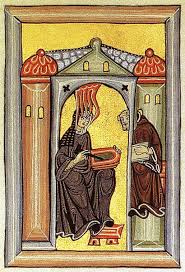
Born in 1098, the tenth child of her family and dedicated as a tithe to a monastery of Benedictine nuns at the age of eight, St Hildegard grew up to be an extraordinary and holy woman. She was a mystic, a poet, a composer of unique, soaring liturgical music so different from the plain chant of the time. St. Hildegard was the author of books, music, and plays. As a Benedictine Abbess she communicated with Bishops and Popes. She was a popular public speaker at a time women were normally not allowed to teach or speak. Abbess Hildegard was a prophet, an adviser, an influencer of her time.
Her colorful mandala like art, not created by herself but overseen by her, represented her visions of the Trinity, and other Heavenly realities. The paintings often have a multi-layered appearance leading the eye to a central space containing a symbol. Looking at them makes me feel like I’m seeing into another world or a into a great depth.
Her illustrated book Scivias describes her mystical visions and the interpretations of them she heard from God. It was written in 1151. She begins it with her experience of God commanding her to write it. It is still available now as are other works of hers which ranged from the botanical to the medicinal, to the theological. Her exquisite music has been performed for centuries.. Her musical play, Ordo virtutum, or Play of the Virtues, may well be the oldest known morality play. It is beautiful but you may jump when in the middle of the serene vocals, the wild discordant voice of Satan interrupts the song unexpectedly for a moment. I have listened to it so many times but it still startles me. Otherwise her songs are pure ethereal loveliness. You might start with The Origin of Fire (no devil voice,) or A feather on the Breath of God which sounds as poetic and pretty as the title.
St. Hildegard’s world view, like her poetry, was lush, verdant, filled with rich, vivid imagery. She was deeply in tune with nature and the divine as expressed in creation. She was profoundly Incarnational, at once earthy and luminous in her spirituality and writing.
Here is Viridissima Virga, a hymn she wrote in honor of Mary
“ O branch of freshest green,
O hail! Within the windy gusts of saints
upon a quest you swayed and sprouted forth.
When it was time, you blossomed in your boughs—
“Hail, hail!” you heard, for in you seeped the sunlight’s warmth
like balsam’s sweet perfume.
For in you bloomed
so beautiful a flow’r, whose fragrance wakened
all the spices from their dried-out stupor.
And they all appeared in full viridity.
Then rained the heavens dew upon the grass
and all the earth was cheered,
for from her womb she brought forth fruit
and the birds of the sky
have nests in her.
Then was prepared that food for humankind,
the greatest joy of feasts!
O Virgin sweet, in you can ne’er fail any joy.
All this Eve chose to scorn.
But now, let praise ring forth unto the Highest!”
Hildegard possessed unusual wisdom and compassion. People of every class came to her for medical advise, healing remedies, wise counsel, spiritual help or prayers. At times she even delivered babies.
She was a Renaissance woman before the Renaissance, a polymath, someone brilliant in many subjects and incredibly creative.
Her faith was absolute. When she was sure she was doing Gods will she was literally unmoveable. She ran into some trouble with religious authorities for burying a sinner who had been excommunicated on the holy grounds of her monastery. She insisted the man had confessed and received absolution and communion. She was not believed by the Bishop. She was ordered to have the man’s body removed. She refused. Her sisters stood by her. She and they were placed under an interdict which meant they could not sing the Liturgy of the Hours or receive the Sacraments. It was basically a mass excommunication. Hildegard became very ill in her spiritual anguish and could not leave her bed. When the Bishop sent six men to remove her, she became so heavy they could not, no matter how many worked together to lift her, be moved at all. It was considered a sign from God.
The young man’s body remained where it had been buried.
St. Hildegard Abbey, also known as St. Hildegardis Abbey, is located in Eibingen, along the Rhein river in Germany. It was founded by Saint Hildegard in 1165. It is still functioning and is visited by pilgrims from all over the world devoted to her and interested in her life and work. .
Strangely she was not canonized for more than 800 years after her death. Finally on May 10th, 2012 Pope Benedict XVI did so though she had been already widely regarded and locally venerated as a Saint after her death in 1179. This lapse was because the necessary paperwork was lost en route to the Vatican when her cause was first undertaken. Pope Alexander III ordered the witnesses of her life and miracles to be gathered and interviewed again but somehow no one ever did so.
Maybe the delay was because we need this brilliant Saint to arrive in our consciousness now in these times we live in. Who doesn’t need a beautiful vision, remarkable and holy art, gorgeous music and vivid poetry, showing us a spirit that is unique in beauty with the ability to open our eyes in new ways to the glory and splendor of God? I think we all need that right now.
Pope Benedict XVI elevated St. Hildegard to the well deserved status of Doctor of the Church on October 7 of 2012 because of “her holiness of life and the originality of her teaching.” She is one of only four women Doctors of the Church along with St. Teresa of Avila, St. Catherine of Sienna and St.Therese of Lisieux.
After Abbess Hildegard’s death the nuns of her monastery reported seeing her luminous figure several times carrying a bright light through their monastery. She was radiant and she was chanting.
We celebrate St. Hildegard of Bingen on September 17.
Evenings are my favorite time of day. Especially after the bustle of family end of day reunions, when the cooking and dinner and cleaning up is done I feel both alert and recollected.
The evenings I love most are summer evenings. There is relief from the heat of the day (sort of,) the cicadas and crickets are chanting their vespers, the neighborhood birds gather along the power line to pray and to gab about the day. I love the colors of the light at this time; rose and gold and the blue tint as dusk approaches.
Time to bring the chickens in.
They’re ready for me at the gate, waddling in a line of fluffy butts to their coop for the night.
And I love this traditional time to recite the Magnificat. I like best saying it by a window looking out so I can bless the world with Mary and her vision of the Kingdom of her Son.
Get you some iced tea now. Go to a window and pray it with us. Bless the world out there.
And Mary said,
“My soul proclaims the greatness of the Lord, my spirit rejoices in God my Savior, for he has looked with favor on his lowly handmaiden. From this day all generations will call me blessed: the Almighty has done great things for me, and holy is his Name. He has mercy on those who fear him in every generation. He has shown the strength of his arm, he has scattered the proud in their conceit. He has cast down the mighty from their thrones, and has lifted up the lowly. He has filled the hungry with good things, and the rich he has sent away empty. He has come to the help of his servant Israel for he has remembered his promise of mercy, the promise he made to our fathers, to Abraham and his children forever.” (Luke 1:46-55) Glory to the Father and to the Son and to the Holy Spirit, as it was in the beginning, is now, and will be forever. Amen.
Then Peter came to Jesus and asked, “Lord, how many times shall I forgive my brother or sister who sins against me? Up to seven times?” Jesus answered, “I tell you, not seven times, but seventy times seventy times.
Mtt. 18 21-22
It’s been almost nine years but I’m still not sure whether I have forgiven it or not. I still struggle with how I am supposed to forgive someone who turned out not to be who I thought they were. Forgive who? What was that who was that?
In the aftermath I realized I was thinking of the whole mess about once every 15 seconds. I began training myself to repeat the names of Jesus and Mary any time I caught myself dwelling on the whole thing. I had dwelt on it long enough truly. I increased my prayer time. I decided to try to stop talking about it. It helped a lot. Slowly I didn’t think about it, not even every week.
I went to Confession. In exasperation I asked the priest, “How do I get to Father forgive them for they know not what they do?” He said my penance would be to go out and meditate on the crucifix in the church and ask the Lord, “Father forgive me for I knew not what I did.” Instant peace came to me then.
As time passed I realized that I “forgave” this person over and over again while they were still in my daily life but not in any real way because what I did was be upset about what they had done, avoid them for a while and then simply go on as before so that they did the same things again and again. My kids suffered emotional scars because of this lack of boundaries on my part. I let this person be with us for so long. At the time I didn’t realize how much the girls were harmed especially when they were still young. How did I fall into this trap? How could I not know how mean this person was being to them? Even the things I did know about them should have been bad enough. I should have not allowed this person around my daughters. I certainly did do things I didn’t know I was doing. Those mistakes seem crazy now.
Then at a time of another tragedy in my life, this person set out to ruin my reputation, blame me, interfere with my friendships and even my family relationships, to tell distorted versions of my private sufferings, commandeer one of my daughters with lies and emotional scenes when she needed me most and was too young ti break out of that situation. This person deeply hurt my other daughter as well during a time of grief and shock for my family with hateful accusations and not allowing her to retrieve what was hers and precious to her from the house. This person also participated in grave financial harm to me and one of my kids that we will never recover from. I was emotionally and socially betrayed on a level that was traumatic enough to keep me curled up on the couch for days. I never thought they would go that far especially at a time like that. Why was I shocked? I can’t answer that fully.
One thing I have learned from all this is that being a forgiving Christian does not mean having destructive people in my life. Even Jesus had boundaries.
But Jesus did not entrust himself to them because he knew their hearts.
Jn. 2:24
However I sometimes still feel angry at this person, even after I have peeled away several layers of resentment and reached certain levels of forgiveness. I didn’t feel that it was complete. Because of those feelings of rage coming up now and then, especially recently, I tend to think of this person every time I pray the Our Father. How can I forgive this person as God forgives me? God forgives me more than completely. God is mercy, God is love. I always ask that I will be able to do this. I have learned forgiveness is a grace. We just have to be willing to receive it. Was I willing? I didn’t know. My mom used to say that sometimes we have to ask to be willing. Other times we have to be ask to be willing to be willing. Sometimes the situation is so difficult we have to pray to be willing to be willing to be willing. I think this is like that.
Recently, sitting quietly in prayer, I felt that the Lord untangled my thinking a bit about what forgiveness looks like in a situation like this. In a flash I understood that all Jesus wanted from me now was to pray for this person’s salvation. I felt my heart open as it seemed the Holy Spirit prayed in me for just that: for this destructive person’s salvation. It was an understated but all the same beautiful moment. I understood that God did not need my tortuous worry about my lingering feelings about this, or the useless dead end paths of my self judgement or scrupulosity on this point. Just prayer for their salvation that is all. The rest was between that person and God. Oh.
Three times I pleaded with the Lord to take it away from me. But he said to me, “My grace is sufficient for you, for my power is made perfect in weakness.”
2 Cor. :8-9a
Then I prayed the our Father in freedom and when I said, “forgive us our trespasses as we forgive those who trespass against us,” I almost felt a kiss from Jesus, and I had to smile. I love that guy.






















 Bethany Hang Out