Search

Bethany Hang Out

Catholic contemplative life and devotion

Tag

peace

Beautiful Queen

August 22 is the memorial of the Queenship of Mary. 

She was always a queen; more a queen than any other. Heaven has a different definition of greatness than we do. (Mtt.20:26). 

Our queen was poor, both in her material life and in her way of being. We may sometimes look down on, judge or blame the poor, but to Jesus they are royalty. He calls them blessed (Luke 6:20) He identifies deeply with them to the point he says whatever we do to them, we do to him (Mtt. 24:40).

Mary walked this earth as one of the anawim, (Lk.1:48) the little ones of God, poor and marginalized, depending completely on him. Mary was humble.

Pope Francis said “she knew she was little, and she was happy to be so.” Her sense of lowliness, of littleness would have given her the bold receptivity to God that we see at the Annunciation. (Lk. 1:26-38) Mary knew she was completely in God’s hands and it made her brave. 

This is why she inherited his Kingdom. 

Our  queen mourned. She cried. Completely human,she was traumatized by her Son’s brutal death, her heart  wounded by the sword that pierced. And she was comforted, repaid many times over with incomparable joy. 

Our queen was meek. We usually think of meek as weak. However the Greek of the Gospel for meek is “praus,” which is more like power restrained, like a strong horse choosing to be gentle, calm and patient. Mary, united to God, spouse of the Holy Spirit and Mother of God’s Son, the only other person besides Jesus to be called “full of grace,” * was already a queen. However, she chose gentleness, kindness, sweetness for her crown. This is why she inherited the earth. 

Our queen hungered and thirsted for justice. She longed to see the proud scattered, the lowly lifted up, the mighty brought down, the hungry fed and the rich sent away empty. With the advent of her Son, she knew she would see this, that Jesus would make that longing a reality, and her soul rejoiced. (Luke 1:51-53)

Our queen was merciful. She received mercy from the first moment of her conception in her mother’s womb on the merit of the sacrifice of her Son who would come into the world through her. (Luke 1:28) In mercy she carried Jesus straight to Elizabeth who was pregnant in her old age and in confinement, and stayed with her through the birth of John the Baptist. She noticed the humiliation of the newlyweds at the wedding of Cana when they ran out of wine and she brought Jesus into the situation. She wasn’t pushy. She wanted them to have their own encounter with him. She merely said, “Do whatever he tells you.” She stood at the foot of the cross to be with her dying Son. She expanded her motherhood to the Apostle John when Jesus said to John, “Behold your mother,” and to Mary, “behold your Son.” (John 21:19) John represented us all. She widened her heart to become our mother too. (Rev. 12:17) 

Her heart was united to God’s merciful love and she was always ready to share it. 

Mary was a queen who was pure of heart. Her heart was uniquely free to love, free to see clearly, filled with the  Spirit of God who overshadowed her.  Her purity of heart allowed her to see God, because when we are pure of heart, all we see is God. She would have been able to see God in everyone she met, in the events of her life, in the music she heard, the words that were spoken, in the beauty of the world around her. 

We call Mary “Queen of Peace.” She is Queen of Peace because through her we received our Lord, who is our Peace. Mary would have been as nonviolent as her Son. She would never let anything turn her back from it. As people reported feeling deep inner peace in the presence of Mother Teresa, even more would they have been at peace in Mary’s presence. She was a child of God who brought us the one who would make us children of God. 

Our queen stood at the cross as mother of the condemned. The insults hurled at Jesus fell on her too. I’m sure cruel words were aimed at her personally as well. She suffered the brutal death of her Son for his sake. And great, unimaginably great was her reward in Heaven. 

We are called to be little Marys in this world, the ones who hear the word of God and keep it, his brothers, his sisters, his mother. (Lk.8:21)

She was always a queen. Now she is not only crowned with every flower of the Beatitudes, (Mtt. 5:3-12) but with shining stars, (Rev. 12: 1) sending love from heaven, lighting the path to Christ who gave her to us. 

* “the glory of an only Son, coming from the Father, full of grace and truth.” John 1:14. 

And to Mary,  “Hail, full of grace, the Lord is with you.” Luke 1:28.

Twelve glowing stars arranged around a bright galaxy in space
Twelve radiant stars form a luminous circle around a richly detailed galaxy field.

Flowers of Gratitude

Photo by Lucie Nelson on Pexels.com

Rejoice always, pray continually, give thanks in all circumstances; for this is God’s will for you in Christ Jesus.” 

I Thessalonians %:16-18

I was going through a difficult time when I was nineteen. My best friend had just died a couple of months before and I had no spiritual foundation for dealing with that. Not only that but my family was going through a difficult time as well.  All of this was made more difficult by the fact that I was not any good at processing emotions or dealing with things in helpful ways. I was trying to change that but I was  still learning. I called a mentor of mine crying, not sure what to do about feeling so bad.  She said to go for a walk and think of five things I was grateful for. I didn’t understand but I was a mess so I did as she asked. I don’t remember what I was grateful for in the end. I mostly remember that being grateful for the smallest things and keeping them in mind as I walked lifted the dark heavy cloak I felt like I was wearing by at least a few pounds.

In the many years since that time I have learned that gratitude helps not only in dark times, but even in the midst of the very darkest of times. Not only that but it seems to fix a lot of problems. It may be that gratitude helps us to accept what is. Or perhaps the slight change in perspective helps us see with more clarity and makes problems appear smaller than they did when we were freaking out, and solutions seem possible. It is a great help in relationships. Appreciating people is an important glue holding us close to one another. It’s the same with God. When Jesus healed a group of ten lepers, he was shocked that only one came back to thank him (Luke 17:11-19). He appreciates our thanks. Gratitude draws us closer to the Giver. 

I haven’t forgotten the bad things that have happened to me in life, at least not the big ones. But I have made a habit of gratitude to the point that, as I recently noticed, when I wake up I usually smile at God as soon as I am conscious. (How long has this been going on?) Generally I’m not elated much. However I am content overall and I have a lot of joy in my life. Sometimes I am really worried about something and sometimes I have anxiety or I get angry or depressed. However the smile is real and at the same time habitual. I am not sure anymore which came first.

I know that when I am feeling out of sorts, uneasy or upset, that one of the best tools in my tool box is to say, “OK what am I grateful for?” Sometimes the things I am grateful for are only things like “Well I’m grateful it’s not worse,” or “I’m grateful for the trees,” or “At least we’re not dead.” Sometimes I laugh at myself that those things are all I can think of. But they are still good things as well as real things. It’s a start. 

Fr. Brian Eilers, when I had just confessed having lost my temper with my family, said he wanted me to go out into the main church and take up my rosary. “On each bead thank God for something. Keep going until you have been all the way around the rosary.” I had been upset when I had driven to the church. But by the time I finished my penance I was smiling. I had even thanked God for my family. I’m so pleased to have them, mad or not! 

So if you’re upset or in a bad mood today, if you got bad news, or if you watched the news and lost your peace, go for a walk. While you are walking, think of five things you are grateful for. Tell God about these.  When you get back, write them down. I’ve advised this to friends having a hard time before. I usually get a good report about how it went. This also helps if you’re angry with someone you love. Think of five things you are grateful for about them. I promise it helps. It can also help when you’re mad at God which at one time or another all of us has been. And when we are happy we should be sure to thank the good God for our joy. 

“If the only prayer you ever say in your entire life is thank you, it will be enough.”

Meister Ekhart

You might like to try Fr. Brian’s gratitude beads with your rosary.

Maybe you can imagine you are putting flowers at the altar of God in Heaven. After all, he deserves them. And he usually ends up pouring them into your lap.  He loves doing that.

Loose stemless flowers on jeans lap, POV

8 Minute Guided Prayer of Recollection

Photo by Gilmer Diaz Estela on Pexels.com

St. Teresa of Avila, Doctor of the Church, Carmelite reformer, and great teacher of Prayer, said that what she called the “Prayer of Recollection” was a method of mental prayer the Lord Himself taught her. Here is a video I have made of my brief, guided version of the Prayer of Recollection that you can use to learn it, or for a prayer break during the day. For more on the Prayer of Recollection, try reading my book, Meeting the One who Loves you, the way of prayer of St. Teresa of Avila from Our Sunday Visitor.

Meeting the One Who Loves You; St. Teresa of Avila’s Way of Prayer

Meeting the One Who Loves You; St. Teresa of Avila’s way of prayer

Where there is hatred, let me sow love

Meditating on the prayer of St. Francis, I thought that from a Teresian perspective, when we pray that where there is hatred we may sow love – we are already doing it. Our prayer, as we pray it, is sowing love in place of hatred. In a mysteries way God shares his grace with us and through us in our prayer. We become instruments of peace in a mystical way.

Lord, make me an instrument of your peace:
Where there is hatred, let me sow love;
Where there is injury, pardon;
Where there is doubt, faith;
Where there is despair, hope;
Where there is darkness, light;
Where there is sadness, joy.

Right now, in this time of global violence, cruelty and chaos that is in almost every way out of our control, it is a relief to open the heart to God and let his love and grace flow through us to the world, to know that he is doing something and that we can be part of his loving transformation of the people and situations most in need of his kindness. We never know what God will do and where he will send his Spirit, or how he will act on the hearts of the people we pray for. However, we can have total faith that he will respond to our prayers.

I invite you to memorize the Prayer of St. Francis if you haven’t already. Try dedicating your time of silent prayer to sitting with it, going over it as slowly as you can without losing focus. You don’t have to think about it or examine it so much as concentrating on the words, letting each one drop into your heart like a pearl dropped into still water where it drifts slowly to the bottom to rest. Know that God is within you and working with you for your good, and for every creature. You will be sowing love in the world, pardon, light, hope, joy, as an instrument of his peace.

In today’s Gospel, John 4:5-42, Jesus tells the Samaritan woman that the water he will give her will become a fountain welling up within her, giving eternal life. To me that fountain is love, his transforming love. It wells up within us helping us to live out this prayer. It not only transforms us but everyone we splash with it, both in our prayer and in our interactions with people and the things we do during the day. Every day we are given opportunities to seek to understand rather than be understood, to seek to love rather than be loved, to give rather than receive. It becomes a habit, easier and easier the more we submerge ourselves in the water of his love that never runs out.


O Divine Master, grant that I may not so much seek
To be consoled as to console,
To be understood as to understand,
To be loved as to love.

For it is in giving that we receive,
It is in pardoning that we are pardoned,
And it is in dying that we are born to eternal life.
Amen.”

We pray like a fountain gushing out and watering the whole world, flowing out and touching everyone. We live our lives in response to this grace given to us. We are transformed in it and so is the whole world.

St. Francis, pray for us.

Lay down your verbal arms for Lent

I would like to invite you to a very practical and frequently unappreciated form of abstinence: that of refraining from words that offend and hurt our neighbor. Let us begin by disarming our language, avoiding harsh words and rash judgement, refraining from slander and speaking ill of those who are not present and cannot defend themselves. Instead, let us strive to measure our words and cultivate kindness and respect in our families, among our friends, at work, on social media, in political debates, in the media and in Christian communities. In this way, words of hatred will give way to words of hope and peace.

Pope Leo XIV, Message for Lent 2026

The Holy Father has, in his serene and gentle way, thrown down a gauntlet with this challenge. This is a very tough form of fasting, especially now in these times of political extremes, immovable opinions, varying understandings of reality and a shocking lack of empathy or compassion. Language is too often used in flagrant attempts to dehumanize those who differ from us In this age of rage, are we contributing to the lack of peace by our words? We long for justice but do we really care about the effect our words have on others or are we just mad? How do we do better? What steps can we take to purify the violence of our speech and still speak truth when necessary?

We need some steps to get there, some tools, a frame work.

Jesus said, “out of the fullness of the heart, the mouth speaks.”
(Luke 6:45Matthew 12:34) He said our sinful and hateful words begin in our sinful and hateful hearts. Practically speaking, this means we need to master our thoughts. When we master our thoughts, we master our words. Here is my tool box for disarmament, if you will.

On mastering our thoughts, one of the best things one can do is replace them with something else. A dear priest told me once during Confession that every time I had a hateful or judgmental thought about a certain person I was struggling with, I should mentally say, “I renounce that thought in the Name of Jesus Christ.” Guess what? It worked! That person is among my inner circle of friends and has been for many years now. She loves telling people the story.

Some years back I found myself obsessively wrapped in raging thoughts about a betrayal in my life. My rotating anger was no longer helpful. I didn’t need to talk about my feelings. This pre-occupation of mine became a problem with family and friends. Nobody wanted to hear it anymore. I didn’t want to hear it anymore. I wasn’t healing, just stuck. I had to stop.

I remembered that I had tools I knew worked. So I began to mentally repeat the names of Jesus and Mary whenever I had the urge to talk about it or think abut it all again. It worked! I went from thinking about the whole thing at least once every 15 minutes to hardly ever. If we don’t think about something like that, we stop talking about it all the time, as well.

Another thing I was doing at the same time as forming the habit of repeating the holy names, was spending time daily in silent interior prayer. My main way of doing this at that time was memorizing passages of the Bible, prayerfully and silently going over and over them in my mind. This is called Ruminatio, a loving meditative recitation of God’s Word in the heart, from the monastic tradition. It’s a “chewing” on the Word until it becomes sweetness in the heart. Sweetness in the heart is what we need most.

Another thing silent prayer does is slow our minds down and makes our emotions less volatile. We have time to think before we speak rather than just spark into fire whenever we are challenged. The Lord is in us and he calms the destructive storms. (Matthew 8:23–27, Mark 4:35–41, Luke 8:22–25). The waves of our emotions calmed, we are more likely to speak wisely and less hurtfully.

Here are some helpful considerations from a modern proverb of uncertain origin.

There are three gates your words should pass through before you speak. Ask these questions of yourself:

Is what I want to say true?

Is it necessary?

Is it kind?

If what you want to say doesn’t pass through all three of these three gates, don’t say it!

What to do instead? Go for a fast walk and repeat the Holy Name of Jesus or the Jesus prayer the whole time. Don’t come back until you are calm. (The Jesus Prayer: “Lord Jesus Christ, Son of God, have mercy on me, a sinner”).

Remember this is not something you are doing alone. God is with you and his grace will aid you. So ask him.

May the words of my mouth, and the thoughts of my heart, be acceptable to you, my God.”

Psalm 19:14

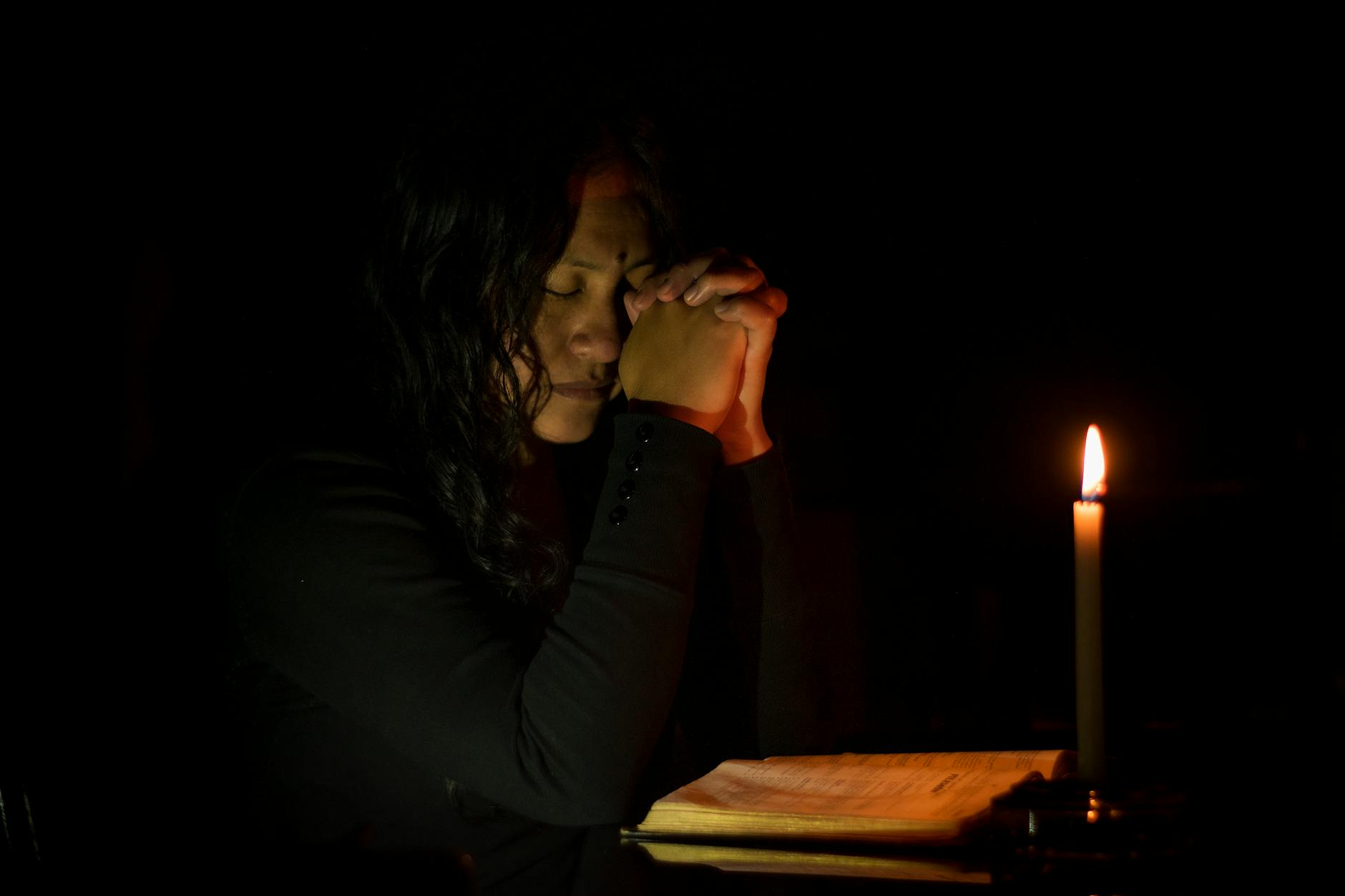
Prayer and solidarity in a dark church

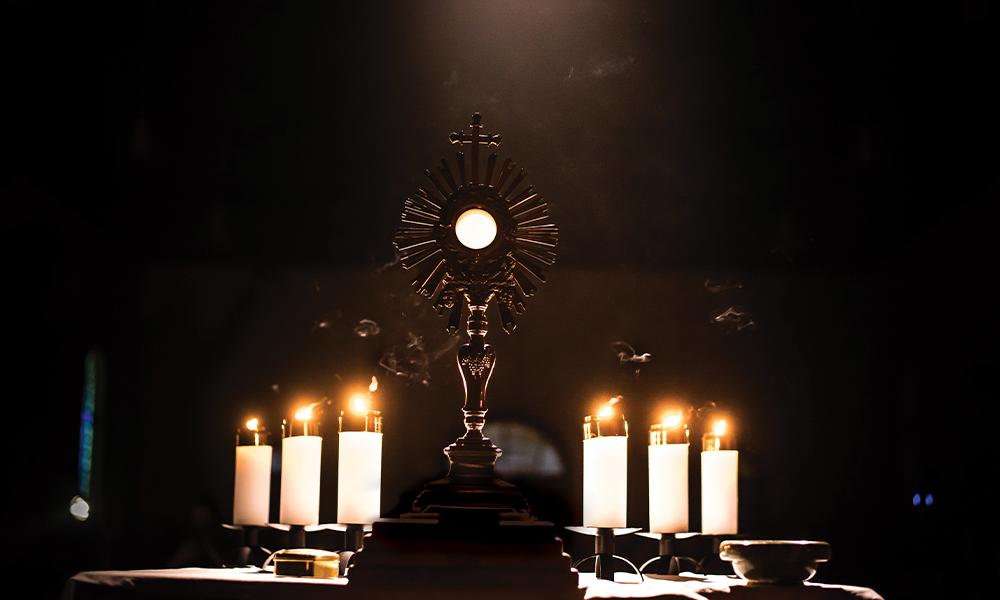
The church was dark and warm when I came in. I could hear sleepy children stirring in the corners, and see the shapes of people in the pews. I had missed the rosary but adoration would go on until late. The one light shone on the exposed Eucharist on the alter. I sat down in the back, then knelt to pray in the silence.

I noticed cantors were standing in a dimly lit alcove. One of them stood up and read something in Spanish that I thought was from the Gospel of John. I left off studying my Spanish this summer and I’ve already forgotten a lot but it sounded like something from that Gospel. I can’t remember what it was now. Jesus calming the waves? There were prayers. Something about children, loved ones, fear. The reader sounded not only somber but sad. They sang a Mexican hymn about walking with the Lord.

It sounds like any Adoration night in a Catholic Church. However I haven’t yet mentioned that the feeling as I came through the church doors was overwhelming sadness, an oppressive sorrow that was almost crushing. I can’t be sure that was what people there were feeling but if they were it would make sense.

This parish I was visiting is primarily Latino parish. We have had ICE here the last couple of weeks. We are not a big town. We used to be small but I suppose we’re medium now. Local TV has reported on where agents been sited, arrests they have made. Local police have made announcements telling us not to interfere with ICE. The popular news anchor has posted videos of ICE activity people have sent him. Unusually for this conservative bastion of a town, there have been school walk-outs, protests, prayer vigils, almost every day that ICE has been here.

Obviously this situation has caused stress for a lot of people. Nothing like in Minnesota. In fact I have only seen a couple of ICE agents in person, and one abandoned car with the doors open on the road.

I didn’t feel like trying to do any structural mental prayer. My mind was unusually clear and still. Making it do anything felt like introducing unnecessary clutter so I went with just sitting still, being conscious, being present.

As time went by I felt sorrow grow. Maybe it was me. Maybe it was all of us.

More prayers. I heard the phrases, “my heart,” and “your heart” several times. Another song about trusting God, I think. People came in, others left quietly, sleeping children over their shoulders. A boy came around with a box of LED votive lights. Soon there was one at the end of each pew, flickering like candles. The priest walked down the aisle checking on everyone. For me sorrow kept deepening. I began to feel an intense wreath of warmth around my heart.

Silence. More Scripture, more prayers. The trust and love they were expressing reminded me of our family’s attitude when my husband Bob had brain cancer. “Everything will be OK and even if it’s not OK it will be OK,” we used to say. In other words, “This is terrible and we have hope that it can end well. But no matter what has to happen, we will be with you, Lord, and we will always have you.”

They were live streaming the event; probably for anyone too ill to attend or too afraid to come to church or leave the house. I thought that the people in the church were probably not the ones who were especially targets. They were here to pray for everyone else. It would be likely that they are worried about someone they knew, a family member maybe.

I was likely the only white person there. I could have no idea what this community within my community was going through or what it was like to be them right now. This prayer vigil was a vigil for peace. It had been announced as a way to “put everything in God’s hands.” It struck me that the people I was sitting with likely did not have much they could do about the situation. All they had was God.

I felt such gratitude that they were letting me sit with them at the feet of Jesus even though I can’t possibly share what they were going through. I had that sense of astonishment that I was sitting among a persecuted people. Maybe some of them didn’t know what had happened to someone they loved, whether they were being tortured or starved or beaten, whether they were far away in a dangerous country, whether they would ever see that person again. It was one of those moments when I couldn’t believe this is my country.

I looked at the people around me again. “Jesus I know these are your people,” I prayed. “I will do whatever I can, whatever you ask me to do for them. Just make me able.” My eyes filled. “Thank you for letting me be with them tonight.

After about an hour, which passed quickly, I left.

I talked to my daughter Roise about the sadness I felt. Was I right that there was sadness in the voices of the cantors and readers? Was I projecting a pleading sentiment onto them? Was it my feelings coming out?

Roise suggested that as Catholics we believe that we are the Body of Christ together. Especially in the Eucharist, we are one together, sharing everything. Maybe I was sensing their feelings or maybe I was just part of the Body of Christ feeling its pain. When one part suffers all the others do too.

We thought about it some more. “Imagine how sad Jesus is about all this.”

Neither of us had anything else to say after that.

I will be LOVE

St. Teresa of Avila compared a contemplative to a standard bearer for an army in battle. His job is to hold the banner of the Cross high so those in combat can see it above the chaos. Even if the standard bearer is cut to pieces, he has to make sure he never drops the guidon. As people of faith you may feel like that standard bearer sometimes. And you are. There is a lot of chaos and cruelty going on right now. As Catholics we believe in the dignity of the human person, in the sanctity of life. Anyone paying attention right now probably does feel cut to pieces. Anyone who believes in treating even the most guilty among us as children of God is bound to feel horrified on a daily basis as violence and hate gain ascendency in our collective conscience and experience. 

One of my favorite bands in the 90’s was called Live. They had this great line from their song Run to the Water on their album The Distance to Here. 

 “Brother let your heart be wounded/and give no mercy to your fear.” I’ve thought of it often as faith leaders begin to tell us to get our affairs in order in case we are called to martyrdom. Do I sound crazy? Do they? 

… Adam and Eve live down the street from me

Babylon is every town

It’s as crazy as it’s ever been

Love’s a stranger all around.” 

St. Therese wrote about being a victim of love for Christ. She offered herself even should her commitment cause her great suffering, for his love and purpose. 

“ In a moment we lost our minds here

And lay our spirit down

Today we lived a thousand years

All we have is now.” 

The Carmelite martyrs of Compiegne lived at a time that perhaps started with good aims but ended up being a terrible persecution and even a blood bath. They were executed one at a time. The nuns sang a Psalm the whole time as their voices grew thinner with each execution. They had known this day could come. They had been preparing for it in prayer, offering themselves up to God as a sacrifice for the Church, for an end to the killing during the French Revolution. 

St. Teresa of Avila wrote that in some ways physical martyrs have it easier than we who live. “One chop and it’s all over.” Life, though, she said, was “a long martyrdom.” She said this because living in Christly love is not easy. It’s hard and not always accepted. 

These days we most likely won’t be martyred because of our faith but for living it. Somebody said to me, “We aren’t supposed to be the Church of Nice.” No, I said, “We are called to be the Church of radical LOVE.” And that’s the” long martyrdom” for me right now, and maybe for you too. 

The Prophet Elijah said, “The Lord  lives. I am standing in his presence.”( 1Kings17:1) We may not be able to physically do much about the hatred and violence we see. However, like Elijah, we are witnesses to the presence of God. And we have to be brave. A lot of people don’t care about love right now. So we have to intensify our witness. How do we do that? 

We have to remember that God loves the ICE agents every bit as much as he loves us. We have to remember that God loves the undocumented every bit as much as he loves us. We have to pray for our enemies and do good to them. If we don’t know how to do good to our enemy we can ask God to show us, to give us an opportunity if he wants us to do that. He will. 

We do what we can nonviolently and legally do to stand up for the vulnerable, to protect our neighbors. 

We have to root ourselves deep in the Lord so that all we do reflects him. Who is God? God is love. We have to reflect that love. 

As St. Therese said, “My vocation! At last I have found it! My vocation is love!” She wrote, “In the heart of the Church, my Mother, I shall be love.” 

We are not alone in love. God is with us, never to leave us; any of us.

“Run to the water
And find me there
Burnt to the core, but not broken
We’ll cut through the madness
Of these streets below the moon
With a nuclear fire of love in our hearts

Yeah, I can see it now Lord
Out beyond all the breakin’ of waves
And the tribulation
It’s a place and the home of ascended souls
Who swam out there in love”

 Run to the Water by LIVE

The subject tonight is love

My brother, Mark Manning

The subject tonight is Love
And for tomorrow night as well,
As a matter of fact,
I know of no better topic
For us to discuss
Until we all Die!

Hafiz

It’s been my brother Mark’s birthday today. He would have been 56. (1970-2015)
I was thinking about love and letting go. I actually don’t like the phrase “letting go.” To me it sounds like sending someone away, like forgetting them. I hate that.


However somebody pointed out to me this morning that loosening my grip this Christmas on our family traditions, my ability to be more open to doing something new and allowing our Christmas to unfold in the new family we are, was a letting go. The fact that I was OK today on my brother’s birthday though a little sad at times, and that I was OK not doing anything in particular in his honor necessarily, was letting go.

That sounds a little scary for me but it’s alright. I am always afraid if I don’t try hard to remember and keep everything I know about them, I will forget the people I have lost. I really fear that. I don’t want them to be far away from me- like childhood friends whose names I can’t really remember anymore. I don’t want to let them go.

Then I thought about how love is a living thing. Love changes and grows as the people in the relationship do. Love is not static. It isn’t only in the past. Love isn’t diminished by change In fact love deepens as people adjust and sacrifice in the midst of and because of it they grow together and for one another.

The love between my brother and me is a living thing. Death has changed our situation drastically. Love has had to adjust and change and grow with that. But death can’t take away love. And maybe that is what it means to let go; when I don’t need to force anything to feel connected, or struggle to wrest back any little scrap death has left behind when it raided my family and took so many people away. Maybe letting go is to be able to trust that love just is and I can let it be itself.

My dad used to say that my brother probably loved me more than anyone on the planet loved anyone. What if I can trust that he still does? He always loved me just as I was. I loved him like that too.

I love my brother as he is right now, even not quite knowing what that is like to be him right now. When I get there with him I expect to love him even more. Death can’t do anything about that.

.So faith, hope, love remain, these three; but the greatest of these is love.

1 Corinthians 13: 13

*My brother Mark Manning at 7 years old.

Octave peace

I did try to keep up with St. Martha this Advent. After I spilled things, forgot to turn the oven on and knocked over the broom at exactly the wrong moment she gave me a talk about keeping things simple and achievable. “Maybe you should go for a walk.” Everything turned out fine. It was simple and good and it was family. We even have a new baby this year to celebrate Christmas with. Mass was beautiful. Jesus has come to us. In the special grace of Christmas the morning star has risen in our hearts whatever we have been doing or feeling. Now as these continuing days of the Christmas season stretch before us so does the special grace of this season which lasts until Baptism of the Lord. Now that the dishes are done and St. Martha takes a well deserved nap, we can settle down with Jesus next to Martha’s sister Mary at the feet of Jesus who has been waiting. 
Especially during the Octave (the first eight days after Christmas Day) let’s challenge ourselves to spend time alone with Jesus daily. Even just five minutes with him a day when our loving attention is all for him would do us a good and make him happy. It’s what he wants for his birthday. 

So take a few minutes. Set a timer for five.  Sit comfortably with your back relatively straight (so you don’t fall asleep) and quiet your heart. Maybe Baby Jesus is lying on your chest, warm and peaceful. Kiss his little fuzzy head now and then. If you start thinking of other things or worrying or your your mind whizzes off to other planets, say his Name. Just look at him and love him for these few minutes. Look at his little fingers and toes. Contemplate his sweet face as Our Lady did so often. You don’t have to think about anything. Just be there. Just love.  

Blog at WordPress.com.

Up ↑