Search

Bethany Hang Out

Catholic contemplative life and devotion

Tag

love

Crazy mean people and how not to be one

Yellow laughing emoji with tears streaming from eyes

Why, oh WHY do so many people on social media  put “laughing” reactions on posts that show terrible human suffering? Even crying children in war zones,  a picture of that baby that was shot in the Walmart parking lot, a child being separated from her family. Why do some  cheer on the Ebola that’s spreading in the Congo? Why do so many react defensively about injustice or the suffering of others? For example: “Well they broke the law.” Or, “he should have complied” or saying they want to buy a beer for the ICE agent who killed Renee Goode?

Here are some possibilities:

  • Group identity becomes stronger than compassion.  People often show less empathy for those they perceive as outsiders. 
  • Moral justification.  “They broke the law” or “He should have complied” can reassure oneself that the world is fair.  This is called, “just-world hypothesis.”
  • Distance. Seeing suffering through a phone screen is different from standing next to a crying child. Some who would  comfort an injured person in real life may react callously online. 
  • Performing for an audience. A “😂” reaction is not always actual  amusement. Sometimes it’s a tribal signal: The reaction is less about the victim than showing loyalty to one’s “team.”
  • Dehumanization. History shows that when people are repeatedly described by leaders in media and politics as criminals, invaders, parasites, terrorists, or enemies, others begin to see them as less than fully human. That makes cruelty easier. This has been documented in many contexts, from wars to genocides. 
  • Psychological defense. Some people cope with disturbing news by denying it, minimizing it, or mocking it.
  • Online disinhibition. People are often meaner behind a screen than they would be face to face. The relative anonymity and lack of immediate consequences reduce normal social restraints.
  • Echo chambers. If someone’s online community rewards cruel comments with likes and approval, those comments become normalized. What once would have seemed shocking gradually comes to feel ordinary.

Social media can distort our perception. I should remember that  in the real world, disasters are still met with strangers donating blood, neighbors bringing meals, volunteers searching through floodwaters, and people quietly caring for one another. In spite of everything, compassion remains beautifully common.

And what is the best way to react to apparently heartless people? How do I have compassion for them? 

I should remember that people who have stopped feeling compassion are not necessarily happy people. They may be afraid, angry, overwhelmed, lonely, immersed in media that constantly tells them to fear certain groups, or rewarded by their social circle for cruelty. None of that excuses their horrible comments. But it does mean that the person behind the comment is likely carrying wounds, distortions, or habits that have narrowed their ability to see another person’s humanity.

A prayer from Alcoholics Anonymous about encountering mean people is, 

“This person is sick. How can I be of help? God save me from being angry.” 

I do think anger is an important emotion. However, anger at random mean people is not good for me and doesn’t help them either. 

I am Catholic. I don’t believe in bad people. God intended us to be good, and he made us good in spite of original sin and concupiscence, (the tendency to sin) God loves us all. 

God sees everything: the suffering and injustice, as well as those committing it, and those of us who witness with empathy or mockery. 

I don’t have the commission to straighten people out. They’re not my kids; they’re God’s kids. 

Maybe next time I can imagine two wounded people instead of one: the victim in the story, and the commenter whose heart has become so constricted that they can laugh at suffering. The first deserves justice and mercy, and prayer. The second also needs healing, and prayer though they don’t seem to know it. 

I think St. Teresa of Avila would tell me that my task is not to carry every burden in the world by sheer emotional force. As a Carmelite, my part is to stay close to Jesus, and from his sacred heart, receive the love I need to give away. If I try to absorb every tragedy and every cruel comment, it does nothing but damage my heart, which is such a mood sponge, and ruin my day. Prayer is one way of gently wringing it out.  

I could, if I bump into mean posts or comments, pray a quick prayer. 

“Lord, have mercy on these people who are so deeply harmed, 

have mercy on the hard of heart, 

and have mercy on me too.” 

The best response can also be to close the app, water my persimmon trees, tend my chickens, stock my Little Free Library, pray for immigrants in detention, write a reflection, or encourage my daughter before a gig. Those are not escapes, just a better contribution to the world than freaking out. 

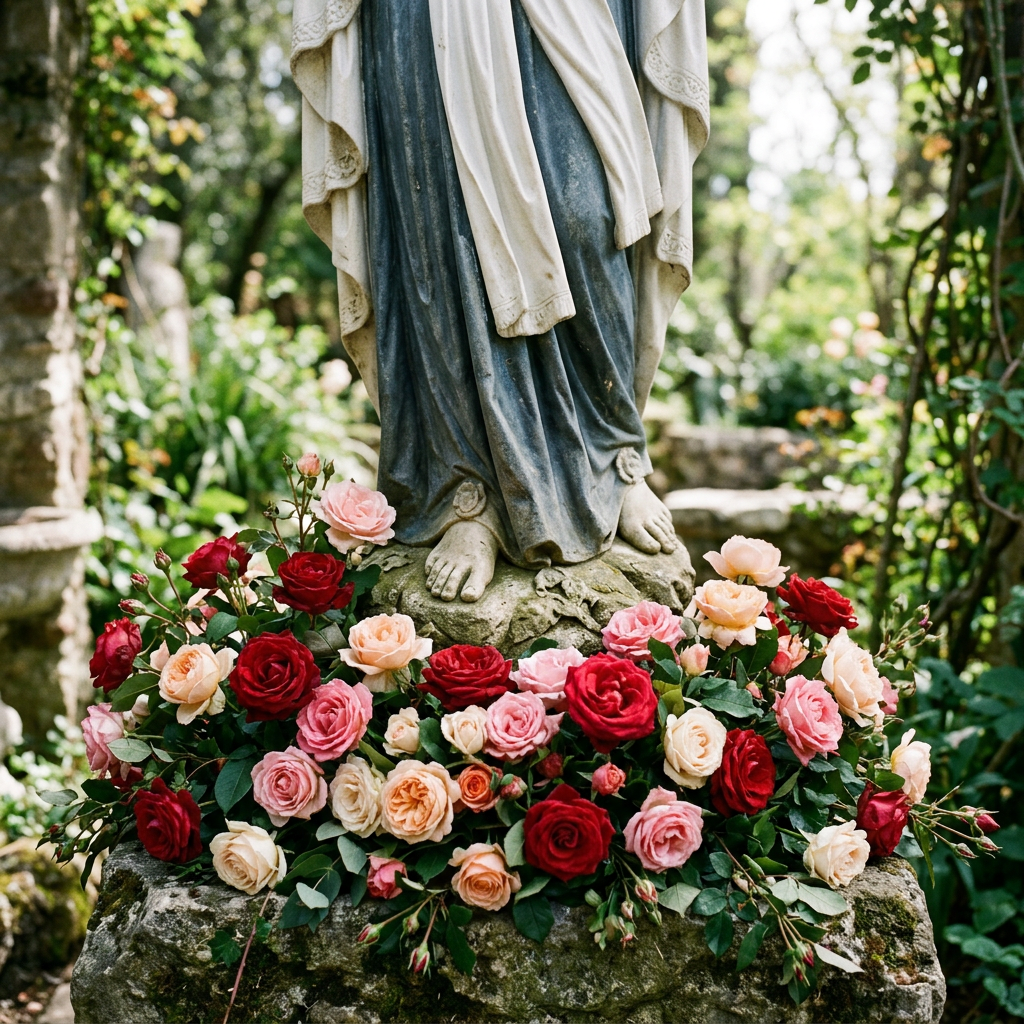
Catholic author Leticia Ochoa Admas writes that (in paraphrase,) every act of mercy, every refusal to mock another person, every prayer for someone whose heart has hardened, is a rose laid at the feet of the Virgin Mary. Well I love her so I will let that motivate me. 

The world scatters thorns wildly and seemingly without plan or reason.  Maybe my job, our  job is to keep growing roses anyway. 

Base of garden statue with red, pink, and peach roses arranged around feet
A colorful rose arrangement decorates the base of a garden statue’s feet

Flowers of Gratitude

Photo by Lucie Nelson on Pexels.com

Rejoice always, pray continually, give thanks in all circumstances; for this is God’s will for you in Christ Jesus.” 

I Thessalonians %:16-18

I was going through a difficult time when I was nineteen. My best friend had just died a couple of months before and I had no spiritual foundation for dealing with that. Not only that but my family was going through a difficult time as well.  All of this was made more difficult by the fact that I was not any good at processing emotions or dealing with things in helpful ways. I was trying to change that but I was  still learning. I called a mentor of mine crying, not sure what to do about feeling so bad.  She said to go for a walk and think of five things I was grateful for. I didn’t understand but I was a mess so I did as she asked. I don’t remember what I was grateful for in the end. I mostly remember that being grateful for the smallest things and keeping them in mind as I walked lifted the dark heavy cloak I felt like I was wearing by at least a few pounds.

In the many years since that time I have learned that gratitude helps not only in dark times, but even in the midst of the very darkest of times. Not only that but it seems to fix a lot of problems. It may be that gratitude helps us to accept what is. Or perhaps the slight change in perspective helps us see with more clarity and makes problems appear smaller than they did when we were freaking out, and solutions seem possible. It is a great help in relationships. Appreciating people is an important glue holding us close to one another. It’s the same with God. When Jesus healed a group of ten lepers, he was shocked that only one came back to thank him (Luke 17:11-19). He appreciates our thanks. Gratitude draws us closer to the Giver. 

I haven’t forgotten the bad things that have happened to me in life, at least not the big ones. But I have made a habit of gratitude to the point that, as I recently noticed, when I wake up I usually smile at God as soon as I am conscious. (How long has this been going on?) Generally I’m not elated much. However I am content overall and I have a lot of joy in my life. Sometimes I am really worried about something and sometimes I have anxiety or I get angry or depressed. However the smile is real and at the same time habitual. I am not sure anymore which came first.

I know that when I am feeling out of sorts, uneasy or upset, that one of the best tools in my tool box is to say, “OK what am I grateful for?” Sometimes the things I am grateful for are only things like “Well I’m grateful it’s not worse,” or “I’m grateful for the trees,” or “At least we’re not dead.” Sometimes I laugh at myself that those things are all I can think of. But they are still good things as well as real things. It’s a start. 

Fr. Brian Eilers, when I had just confessed having lost my temper with my family, said he wanted me to go out into the main church and take up my rosary. “On each bead thank God for something. Keep going until you have been all the way around the rosary.” I had been upset when I had driven to the church. But by the time I finished my penance I was smiling. I had even thanked God for my family. I’m so pleased to have them, mad or not! 

So if you’re upset or in a bad mood today, if you got bad news, or if you watched the news and lost your peace, go for a walk. While you are walking, think of five things you are grateful for. Tell God about these.  When you get back, write them down. I’ve advised this to friends having a hard time before. I usually get a good report about how it went. This also helps if you’re angry with someone you love. Think of five things you are grateful for about them. I promise it helps. It can also help when you’re mad at God which at one time or another all of us has been. And when we are happy we should be sure to thank the good God for our joy. 

“If the only prayer you ever say in your entire life is thank you, it will be enough.”

Meister Ekhart

You might like to try Fr. Brian’s gratitude beads with your rosary.

Maybe you can imagine you are putting flowers at the altar of God in Heaven. After all, he deserves them. And he usually ends up pouring them into your lap.  He loves doing that.

Loose stemless flowers on jeans lap, POV

8 Minute Guided Prayer of Recollection

Photo by Gilmer Diaz Estela on Pexels.com

St. Teresa of Avila, Doctor of the Church, Carmelite reformer, and great teacher of Prayer, said that what she called the “Prayer of Recollection” was a method of mental prayer the Lord Himself taught her. Here is a video I have made of my brief, guided version of the Prayer of Recollection that you can use to learn it, or for a prayer break during the day. For more on the Prayer of Recollection, try reading my book, Meeting the One who Loves you, the way of prayer of St. Teresa of Avila from Our Sunday Visitor.

Meeting the One Who Loves You; St. Teresa of Avila’s Way of Prayer

Meeting the One Who Loves You; St. Teresa of Avila’s way of prayer

Why meditate on the Suffering and Death of Jesus?

  the Isenheim Altarpiece by Matthias Grünewald.

It is a pronounced characteristic of our Catholic faith that both personally and as Church we meditate deeply on the suffering of Jesus. Our crucifixes, art and literature are often graphic in their portrayals of his Passion and Death. The Saints emphasize this practice, the rosary we pray, the Church calendar, all return us to our suffering Lord. In the Stations of the Cross we walk with Jesus through his suffering step by step. Why do we do this? To an outsider it might seem ghoulish to dwell on the lurid details of his torn flesh, his bloody sweat, the tears he shed. 

The mystics say that Our Lord’s Passion is like a fire of love. The more we draw near to this fire the more we are warmed and transformed by it. 

I am a deeply sensitive, and, I hope, compassionate person. I am always uncomfortable with the Sorrowful Mysteries of the Rosary (traditionally prayed on Tuesdays and Fridays. During Lent it is also on Sundays).  Meditating on the Sorrowful Mysteries, we follow Jesus through his Agony in the Garden of Gethsemane, his Scourging at the Pillar, his Crown of Thorns, his Carrying the Cross, his Crucifixion and Death. It’s tough. But I don’t want to leave him alone in his sorrow. I want to share in it as his mother did. I want to comfort and help him. Also we can’t expect to only share the sweetness of the Lord without the bitterness of the cross.  Part of love is acceptance. I don’t want to only love part of Jesus I want to love all of him, accept everything. That means following him not only in his joyous times but right into the valley of death as well, and the cruelty he experienced from others. 

For me the fact of the betrayal of Judas, Our Lord’s broken heart, his grief, the abuse heaped on him, have helped me accept the sorrows in my own life. Sharing in his pain has made me more able to not look away from the suffering of others but to ‘weep with those who weep.”  (Romans 12:15)

A Methodist minister friend told me he noticed that Catholics don’t see ourselves as witnesses of the events in the life of Jesus. We think of ourselves as taking part in a very present way in our prayer and especially at mass. We are there at the Last Supper at mass. We don’t think we are witnessing something. It’s not a story. We are in it.  I like that. Maybe this points to why we submerge ourselves in the torture and cruelty of his death in such detail. We’re helping ourselves be there. 

Our Lord’s Passion teaches about love as intense faithfulness and determination, sacrifice, acceptance. It helped me stand by my husband all through his fight with brain cancer. In his darkest and fearful moments I listened to him talk about his feelings of raw desolation, anger, and even shame, of terror, of feeling there was no comfort anywhere. In spite of my love for him, part of me wanted to run and hide from the enormity of what he was expressing.  

I had no mitigating words to say. The profound suffering of another person is frightening to be present to. When he eventually asked how I felt about this on a spiritual level, all I had was the fact of Christ’s suffering. At least as we went through this with cancer we had a God with us who didn’t die gracefully in a shower of rose petals but was coldly executed, naked and bleeding like an animal, nailed to a cross, with a cry of spiritual abandonment only just having died on his lips. 

My husband nodded gravely. He got it. 

 1565
Oil on canvas
Scuola Grande di San Rocco, Venice

The Christian life is illuminated by the choice of Jesus to take our suffering on himself. It was our sins, our iniquities, yes, but our suffering too, according to Isaiah. 

“Surely he took up our pain and bore our suffering… by his wounds we are healed” Isaiah 53:4-5

The incomparable light he generated by choosing to undergo his Passion as an offering shines forever. It reminds me in my own darkest times, of his compassion. My tears are his too. St. Teresa of Avila says so great is his compassion that when you visit him in his agony he will forget his own sorrow in looking at you and wanting to comfort you. 

As we approach Holy Week let’s avail ourselves of the opportunity to love Jesus through his suffering and death, and to let him love us too.

Where there is hatred, let me sow love

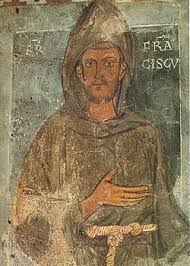
Meditating on the prayer of St. Francis, I thought that from a Teresian perspective, when we pray that where there is hatred we may sow love – we are already doing it. Our prayer, as we pray it, is sowing love in place of hatred. In a mysteries way God shares his grace with us and through us in our prayer. We become instruments of peace in a mystical way.

Lord, make me an instrument of your peace:
Where there is hatred, let me sow love;
Where there is injury, pardon;
Where there is doubt, faith;
Where there is despair, hope;
Where there is darkness, light;
Where there is sadness, joy.

Right now, in this time of global violence, cruelty and chaos that is in almost every way out of our control, it is a relief to open the heart to God and let his love and grace flow through us to the world, to know that he is doing something and that we can be part of his loving transformation of the people and situations most in need of his kindness. We never know what God will do and where he will send his Spirit, or how he will act on the hearts of the people we pray for. However, we can have total faith that he will respond to our prayers.

I invite you to memorize the Prayer of St. Francis if you haven’t already. Try dedicating your time of silent prayer to sitting with it, going over it as slowly as you can without losing focus. You don’t have to think about it or examine it so much as concentrating on the words, letting each one drop into your heart like a pearl dropped into still water where it drifts slowly to the bottom to rest. Know that God is within you and working with you for your good, and for every creature. You will be sowing love in the world, pardon, light, hope, joy, as an instrument of his peace.

In today’s Gospel, John 4:5-42, Jesus tells the Samaritan woman that the water he will give her will become a fountain welling up within her, giving eternal life. To me that fountain is love, his transforming love. It wells up within us helping us to live out this prayer. It not only transforms us but everyone we splash with it, both in our prayer and in our interactions with people and the things we do during the day. Every day we are given opportunities to seek to understand rather than be understood, to seek to love rather than be loved, to give rather than receive. It becomes a habit, easier and easier the more we submerge ourselves in the water of his love that never runs out.


O Divine Master, grant that I may not so much seek
To be consoled as to console,
To be understood as to understand,
To be loved as to love.

For it is in giving that we receive,
It is in pardoning that we are pardoned,
And it is in dying that we are born to eternal life.
Amen.”

We pray like a fountain gushing out and watering the whole world, flowing out and touching everyone. We live our lives in response to this grace given to us. We are transformed in it and so is the whole world.

St. Francis, pray for us.

Lenten listening

This year for Lent, the Holy Father, Pope Leo, is asking us to “listen.” He says listening to the Word of God will train our ability to listen to the voices God wants us to hear, such as the cries of the poor and the marginalized, the sick and the suffering. I wasn’t sure how that worked but as I have been reflecting on it, the practice of Lectio Divina came to mind. In this prayer we aren’t just reading Scripture texts. we are “listening” with an open heart to any words or phrases that stand out to us as we read. We understand these as God’s words to us personally in that moment. So we prayerfully repeat them in our minds, pondering them in our hearts. Then we respond to what God is saying to us, replying to him. Then we rest in interior silence for a while. Then we go out and act on his Word.

If we learn and pray Lectio Divina regularly, it becomes the way we hear Scripture all the time. When it is read at mass, we will hear God speaking to us, even as we are aware of hearing his Word as community too. We will be attuned to him speaking and we automatically apply it to our lives without hesitation.

The Benedictines talk about “Lectio on Life,” This is being aware of how God is speaking to you in your daily life. He may speak in a song that comes on at the right moment, something you read or that someone says to you, even something you overhear from a stranger when you’re out and about. It can be a life event, even a small one, that stands out to you as symbolic or providential. I used to say, when something like that happened, “If this was a dream, what would it mean?” I said this because in the way we interpret the meaning of a dream, in the same way, could be done with something that really happened as well, drawing out its meaning.

What if we hear or see something happening around us, read about it or it comes to us in prayer, or keeps returning to our thoughts as we go about that day? We can use the same process of Lectio Divina to ponder it in our hearts, ask God what he is saying to us in this event or thing we heard during the day, respond to him about it, and go out and act on it. This could be noticing the young woman at the store putting her groceries back. It gets to you. Just in seeing that through God’s loving and merciful eyes as a person of prayer, you understand the message and you act on it. Ask her what’s going on, listen to her, and do something about her trouble. Maybe you can’t pick up her whole tab but when she tells you she was trying to get after school snacks for her kids before she picks them up, maybe you can at least get today’s snacks. Then thank God for the opportunity to see, hear and serve him. That’s just one quick way this could play out. Being in tune with God helps you notice her. Otherwise perhaps you wouldn’t have.

One of the things I am doing this Lent is staying away from the news during the week. I can always catch up at the end of the week. Like a lot of people I am hyper vigilant lately because of all the violence, chaos, suffering and injustice happening every day. I’m overwhelmed and so is everyone I talk to about it. What I am hoping for with backing off from the constant news is to use that time for silence and prayer. I also get to the point sometimes when my mind of cluttered up with all the things I am seeing, reading and hearing that I think the clutter interferes with real listening.

I want to listen to life and the people around me and allow God to raise the voices to me he wants me to hear. I am probably too overwhelmed to discern them now. I’m hoping God will sort me out during this gracious time of Lent. Going into the desert with Jesus is one of my favorite things to do. Sometimes I having to skip or run to keep up with him but still, I am so ready to slow down and focus on him and what he wants to talk about or show me, or even if he just wants to hang out.

May the Lord open the ears of our hearts to hear him.

May the voices now “blurred by comfort” as Pope Leo said, and the faces we don’t see,

come into sharp relief for us

through our prayer, listening, fasting and almsgiving this Holy Lent,

Oh Jesus, “For your voice is sweet, and your face is beautiful.” (Song of Songs 2:14)

* If you don’t know how to Lectio 😉

I have written about it here


Prayer and solidarity in a dark church

The church was dark and warm when I came in. I could hear sleepy children stirring in the corners, and see the shapes of people in the pews. I had missed the rosary but adoration would go on until late. The one light shone on the exposed Eucharist on the alter. I sat down in the back, then knelt to pray in the silence.

I noticed cantors were standing in a dimly lit alcove. One of them stood up and read something in Spanish that I thought was from the Gospel of John. I left off studying my Spanish this summer and I’ve already forgotten a lot but it sounded like something from that Gospel. I can’t remember what it was now. Jesus calming the waves? There were prayers. Something about children, loved ones, fear. The reader sounded not only somber but sad. They sang a Mexican hymn about walking with the Lord.

It sounds like any Adoration night in a Catholic Church. However I haven’t yet mentioned that the feeling as I came through the church doors was overwhelming sadness, an oppressive sorrow that was almost crushing. I can’t be sure that was what people there were feeling but if they were it would make sense.

This parish I was visiting is primarily Latino parish. We have had ICE here the last couple of weeks. We are not a big town. We used to be small but I suppose we’re medium now. Local TV has reported on where agents been sited, arrests they have made. Local police have made announcements telling us not to interfere with ICE. The popular news anchor has posted videos of ICE activity people have sent him. Unusually for this conservative bastion of a town, there have been school walk-outs, protests, prayer vigils, almost every day that ICE has been here.

Obviously this situation has caused stress for a lot of people. Nothing like in Minnesota. In fact I have only seen a couple of ICE agents in person, and one abandoned car with the doors open on the road.

I didn’t feel like trying to do any structural mental prayer. My mind was unusually clear and still. Making it do anything felt like introducing unnecessary clutter so I went with just sitting still, being conscious, being present.

As time went by I felt sorrow grow. Maybe it was me. Maybe it was all of us.

More prayers. I heard the phrases, “my heart,” and “your heart” several times. Another song about trusting God, I think. People came in, others left quietly, sleeping children over their shoulders. A boy came around with a box of LED votive lights. Soon there was one at the end of each pew, flickering like candles. The priest walked down the aisle checking on everyone. For me sorrow kept deepening. I began to feel an intense wreath of warmth around my heart.

Silence. More Scripture, more prayers. The trust and love they were expressing reminded me of our family’s attitude when my husband Bob had brain cancer. “Everything will be OK and even if it’s not OK it will be OK,” we used to say. In other words, “This is terrible and we have hope that it can end well. But no matter what has to happen, we will be with you, Lord, and we will always have you.”

They were live streaming the event; probably for anyone too ill to attend or too afraid to come to church or leave the house. I thought that the people in the church were probably not the ones who were especially targets. They were here to pray for everyone else. It would be likely that they are worried about someone they knew, a family member maybe.

I was likely the only white person there. I could have no idea what this community within my community was going through or what it was like to be them right now. This prayer vigil was a vigil for peace. It had been announced as a way to “put everything in God’s hands.” It struck me that the people I was sitting with likely did not have much they could do about the situation. All they had was God.

I felt such gratitude that they were letting me sit with them at the feet of Jesus even though I can’t possibly share what they were going through. I had that sense of astonishment that I was sitting among a persecuted people. Maybe some of them didn’t know what had happened to someone they loved, whether they were being tortured or starved or beaten, whether they were far away in a dangerous country, whether they would ever see that person again. It was one of those moments when I couldn’t believe this is my country.

I looked at the people around me again. “Jesus I know these are your people,” I prayed. “I will do whatever I can, whatever you ask me to do for them. Just make me able.” My eyes filled. “Thank you for letting me be with them tonight.

After about an hour, which passed quickly, I left.

I talked to my daughter Roise about the sadness I felt. Was I right that there was sadness in the voices of the cantors and readers? Was I projecting a pleading sentiment onto them? Was it my feelings coming out?

Roise suggested that as Catholics we believe that we are the Body of Christ together. Especially in the Eucharist, we are one together, sharing everything. Maybe I was sensing their feelings or maybe I was just part of the Body of Christ feeling its pain. When one part suffers all the others do too.

We thought about it some more. “Imagine how sad Jesus is about all this.”

Neither of us had anything else to say after that.

I will be LOVE

St. Teresa of Avila compared a contemplative to a standard bearer for an army in battle. His job is to hold the banner of the Cross high so those in combat can see it above the chaos. Even if the standard bearer is cut to pieces, he has to make sure he never drops the guidon. As people of faith you may feel like that standard bearer sometimes. And you are. There is a lot of chaos and cruelty going on right now. As Catholics we believe in the dignity of the human person, in the sanctity of life. Anyone paying attention right now probably does feel cut to pieces. Anyone who believes in treating even the most guilty among us as children of God is bound to feel horrified on a daily basis as violence and hate gain ascendency in our collective conscience and experience. 

One of my favorite bands in the 90’s was called Live. They had this great line from their song Run to the Water on their album The Distance to Here. 

 “Brother let your heart be wounded/and give no mercy to your fear.” I’ve thought of it often as faith leaders begin to tell us to get our affairs in order in case we are called to martyrdom. Do I sound crazy? Do they? 

… Adam and Eve live down the street from me

Babylon is every town

It’s as crazy as it’s ever been

Love’s a stranger all around.” 

St. Therese wrote about being a victim of love for Christ. She offered herself even should her commitment cause her great suffering, for his love and purpose. 

“ In a moment we lost our minds here

And lay our spirit down

Today we lived a thousand years

All we have is now.” 

The Carmelite martyrs of Compiegne lived at a time that perhaps started with good aims but ended up being a terrible persecution and even a blood bath. They were executed one at a time. The nuns sang a Psalm the whole time as their voices grew thinner with each execution. They had known this day could come. They had been preparing for it in prayer, offering themselves up to God as a sacrifice for the Church, for an end to the killing during the French Revolution. 

St. Teresa of Avila wrote that in some ways physical martyrs have it easier than we who live. “One chop and it’s all over.” Life, though, she said, was “a long martyrdom.” She said this because living in Christly love is not easy. It’s hard and not always accepted. 

These days we most likely won’t be martyred because of our faith but for living it. Somebody said to me, “We aren’t supposed to be the Church of Nice.” No, I said, “We are called to be the Church of radical LOVE.” And that’s the” long martyrdom” for me right now, and maybe for you too. 

The Prophet Elijah said, “The Lord  lives. I am standing in his presence.”( 1Kings17:1) We may not be able to physically do much about the hatred and violence we see. However, like Elijah, we are witnesses to the presence of God. And we have to be brave. A lot of people don’t care about love right now. So we have to intensify our witness. How do we do that? 

We have to remember that God loves the ICE agents every bit as much as he loves us. We have to remember that God loves the undocumented every bit as much as he loves us. We have to pray for our enemies and do good to them. If we don’t know how to do good to our enemy we can ask God to show us, to give us an opportunity if he wants us to do that. He will. 

We do what we can nonviolently and legally do to stand up for the vulnerable, to protect our neighbors. 

We have to root ourselves deep in the Lord so that all we do reflects him. Who is God? God is love. We have to reflect that love. 

As St. Therese said, “My vocation! At last I have found it! My vocation is love!” She wrote, “In the heart of the Church, my Mother, I shall be love.” 

We are not alone in love. God is with us, never to leave us; any of us.

“Run to the water
And find me there
Burnt to the core, but not broken
We’ll cut through the madness
Of these streets below the moon
With a nuclear fire of love in our hearts

Yeah, I can see it now Lord
Out beyond all the breakin’ of waves
And the tribulation
It’s a place and the home of ascended souls
Who swam out there in love”

 Run to the Water by LIVE

The subject tonight is love

My brother, Mark Manning

The subject tonight is Love
And for tomorrow night as well,
As a matter of fact,
I know of no better topic
For us to discuss
Until we all Die!

Hafiz

It’s been my brother Mark’s birthday today. He would have been 56. (1970-2015)
I was thinking about love and letting go. I actually don’t like the phrase “letting go.” To me it sounds like sending someone away, like forgetting them. I hate that.


However somebody pointed out to me this morning that loosening my grip this Christmas on our family traditions, my ability to be more open to doing something new and allowing our Christmas to unfold in the new family we are, was a letting go. The fact that I was OK today on my brother’s birthday though a little sad at times, and that I was OK not doing anything in particular in his honor necessarily, was letting go.

That sounds a little scary for me but it’s alright. I am always afraid if I don’t try hard to remember and keep everything I know about them, I will forget the people I have lost. I really fear that. I don’t want them to be far away from me- like childhood friends whose names I can’t really remember anymore. I don’t want to let them go.

Then I thought about how love is a living thing. Love changes and grows as the people in the relationship do. Love is not static. It isn’t only in the past. Love isn’t diminished by change In fact love deepens as people adjust and sacrifice in the midst of and because of it they grow together and for one another.

The love between my brother and me is a living thing. Death has changed our situation drastically. Love has had to adjust and change and grow with that. But death can’t take away love. And maybe that is what it means to let go; when I don’t need to force anything to feel connected, or struggle to wrest back any little scrap death has left behind when it raided my family and took so many people away. Maybe letting go is to be able to trust that love just is and I can let it be itself.

My dad used to say that my brother probably loved me more than anyone on the planet loved anyone. What if I can trust that he still does? He always loved me just as I was. I loved him like that too.

I love my brother as he is right now, even not quite knowing what that is like to be him right now. When I get there with him I expect to love him even more. Death can’t do anything about that.

.So faith, hope, love remain, these three; but the greatest of these is love.

1 Corinthians 13: 13

*My brother Mark Manning at 7 years old.

Blog at WordPress.com.

Up ↑