Search

Bethany Hang Out

Catholic contemplative life and devotion

Tag

Faith

The Prophet Elijah: A Model for Holy Activism

I dreamed about the Prophet Elijah a couple weeks ago. We were sitting on a mountainside talking.The conversation we had is lost to me for the most part.  It seemed significant that I dreamed of him. In the time following,  I re-read the stories of Elijah’s life in Scripture. 

*You can find these in 1 Kings chapters 17-19, and 21,   

2 Kings Chapters 1-2, and in Sirach 48:1-11.

The pattern of his life that stood out to me as I read and reflected, is the path of the holy activist. 

Elijah embodies the prophetic response to times of upheaval and injustice. He is an icon of a prophet arising in a time of darkness, burning like a torch.  He spoke truth to power, confronted corruption, and defended the vulnerable. He drew his strength and inspiration from God as he served the hungry, healed the sick, and returned to a hostile land he had run in fear from. Sometimes he was afraid for his life, frustrated, burned out. Then he charged back into the fray, blazing, lit by God’s transforming love. Elijah’s life is a map lighting the path of the holy activist. 

Elijah confronted corrupt leaders 

King Ahab and Queen Jezebel were horrible, shameless, lawless people. They were greedy, murderous, corrupt idolaters and false accusers leading the people into apostasy. Elijah confronted them several times over killing the prophets and destroying God’s altars, taking from and murdering the poor, warning of consequences to come. 

During one of his confrontations with Ahab, the king called Elijah his enemy, blaming him for causing trouble. This happens a lot to anyone who speaks up against wrongdoing.  Elijah doesn’t care what the King says. He contradicts him briefly, undeterred. He doesn’t  let himself be drawn into argument. He delivers God’s message with its warning and walks away, leaving the results in God’s hands.

If you have to call out corruption or injustice, remember to detach from what happens after you have spoken. You can do your part and the rest is up to the hearers to choose how to respond. 

Elijah spoke truth to power

Baal, a pagan god whose worship included child sacrifice, was popular at the time just as destructive ideologies have so much sway now.  Elijah was the only prophet of the God of Israel left and the Queen was trying to kill him as well. Sometimes we have to speak the truth at great risk. 

Elijah called the priests of Baal to meet him for a duel between their false god and the true God of Israel. The prophet of God stands alone against 450 priests of Baal  and before his own people who had gone over to them. He trusted God to act. Dramatically and miraculously, God came through, sending fire from Heaven to consume Elijah’s sacrifice. 

God will give us everything we need to do as he asks; to stand up and speak out even if we are all alone in doing so, he is with us. 

Elijah made use of humor 

I want to add that Elijah made fun of the prophets of Baal as they called to their false god.  He taunted them sarcastically about whether their god was sleeping, or deaf or busy. “Maybe you should yell a little louder.” 

Making fun of the powerful can be a good thing at times like these so we aren’t overcome by fear or hopelessness. Those late night comedians keep me going sometimes. I’m all for it. After all, Elijah ends up slaying the false prophets and there are more ways than one to slay. 

So if you can, find ways to laugh. Bring the powerful down to size with humor. 

Elijah served the needy with faith and compassion

After a time of frustration and even despair, God sends Elijah on a journey to help a poor widow and her son who are on the brink of starvation. 

 By the prophet’s prayers and the woman’s trust,  her oil jug never runs dry and her flour jar never runs out of flour until the famine is over. 

Elijah prayed over her son when he fell ill and died while he was there, which brought the child back to life. Elijah shows himself to be a man of profound compassion and faith. His service to the widow renews him and helps him grow. 

If you’re freaking out, an act of kindness or service will help your perspective and give you peace. 

Defending the poor and oppressed

King Ahab and Queen Jezebel conspired to take the ancestral land of a man named Naboth after he refused to sell. It was already against Jewish law to press someone to sell their family land. Then Jezebel arranged false accusations against Naboth because of which he was executed. Then the King took over the man’s land. Naboth stands for all of the poor who suffer injustice and oppression,  from the greed of the rich and powerful, from unjust systems. 

Always defend the poor and oppressed and be sure that even if you don’t think you succeed in doing so, God will, either now or in the future. 

Being guided by God, motivated by love 

One of the times Elijah was in hiding, God asked him, “Elijah, what are you doing?” Elijah pours out his heart to the Lord. He tells him how scared he is with the Queen trying to have him killed. Then he tells God of his burning, intense love for him, which is the spark of his zeal. This is what it means to be a holy activist. Our inspiration, our strength, our courage to confront people in power, our compassion, our hunger and thirst for righteousness, are all from God. 

Now and then it’s important for an activist of faith to do some soul searching with God. What are you doing? Why are you doing it? Is God with you on this? 

Elijah experienced burnout and renewal

Twice in Elijah’s life story, we see him in hiding, scared and frustrated, overwhelmed to the point he wants to die and asks God to let him. He suffers from exhaustion, fear, frustration and self doubt. Twice God comes to him like a gentle parent, giving him bread, telling him to drink some water and have something to eat. Elijah rests, gets some sleep, and is fed by God until he is ready for a new mission, and sets out restored and reassured. 

If you’re overwhelmed or burned out, let God care for you for a while. Rest, get extra sleep, until you’re ready and receive new guidance.

Elijah encounters God profoundly

God calls Elijah to the mouth of the cave he has been staying in, and invites him to experience him passing by. There is a mighty wind, but the wind is not God. There is an earthquake but neither is this God. When Elijah hears a “still, small voice” within himself, in a gesture of reverence as he covers his face with his cloak, recognizing the presence of the Lord. 

Draw from the Source of all life, and practice attentiveness to God’s presence at all times. You will grow exponentially in love, strength and compassion, reflecting the Lord you love and listen to. 

Elijah mentored the next generation to take on the work

An important part of activism is  handing on the spirit of the work to the next generation. Elijah,  after training Elisha at his side, grants him a double portion of his spirit before he is taken up to heaven.  Elisha takes the mantle of his mentor over his shoulders, going on to do the great work of a prophet. 

Whatever form of activism or mission you are involved in, always take time to talk to interested young people and pass on your wisdom and experience.

I’ve been so worried about so many things going on in our country, in our world. Maybe you have been too. Let us look to the Prophet Elijah to light our way, asking him for a double portion of his spirit, praying for the knowledge of his will for us and the power to carry it out. * from the 11th Step of AA

“The lord lives! I am standing in his presence.”

*Antiphon from the Carmelite proper, feast of Elijah the Prophet, July 20 

Immigration, our Catholic faith, the present moment

Most  of the people about to be deported and rounded up into camps are our fellow Catholics; people who are praying their rosaries scared to death. Our people. When the U.S. invaded Mexico  Irish mercenaries were brought in to fight with the U.S.. But when they saw the flag of Our Lady of Guadalupe on the other side they refused to fight their fellow Catholics. They’re known as the San Patricios or The Saint Patrick Brigade, of 1846. I’ve been reflecting on their celebrated legacy in the wake of the protection of our churches as sanctuaries has been taken away. 

We all need to think about how we will respond to possible raids during holy mass. What will you do? 

Our Holy Father has said the way we treat migrants and refugees is as important as the way we treat the unborn. The Scripture says we must treat the alien as our native born and not persecute or oppress them. (Lv. 19: 33-34)  The Catechism teaches us that they are to be treated in such a way as respects their human  dignity, and with compassion. 

The Church understands we can’t accept everyone who comes to us asking for asylum but that we should always treat them with empathy and understanding regardless. Catholics believe in the unconditional dignity of the human person made in the image and likeness of God. Jesus says whatever we do to the lowly we  do to him.  (Matt. 25:40) 

The following are quotes from the Catechism of the Catholic Church on the topics of migration and immigration.

¶1911: Internal quote is from Gaudium et Spes: “The unity of the human family, embracing people who enjoy equal natural dignity, implies a universal common good. This good calls for an organization of the community of nations able to provide ‘for men’s different needs, both in the fields of social life—such as food supplies, health, education, labor and also in certain special circumstances which can crop up here and there, e.g., the need to promote the general improvement of developing countries, or to alleviate the distressing conditions in which refugees dispersed throughout the world find themselves, or also to assist migrants and their families. to alleviate the distressing conditions in which refugees dispersed throughout the world find themselves, or also to assist migrants and their families.’”

¶2211: “The political community has a duty to honor the family, to assist it, and to ensure especially… the right to private property, to free enterprise, to obtain work and housing, and the right to emigrate.”

¶2241: “The more prosperous nations are obliged, to the extent they are able, to welcome the foreigner in search of the security and means of livelihood which he cannot find in his country of origin. Public authorities should see to it that the natural right is respected that places a guest under the protection of those who receive him.”

¶2433: “Access to employment and to professions must be hope to all without unjust discrimination; men and women, healthy and disabled, natives and immigrants. For its part society should, according to circumstances, help citizens find work and employment.”

We may be having a moment here; a moment when God is asking us to stand up even though it’s scary. Everyone worries about the reputation of the Church. We have made our mistakes, often because of that worry.  But we know what is right. I hope we won’t blow this and let this moment pass us by. We haven’t always stood up when we should have. We always worry about the balance  between appeasing authority to effect change or avoid interference in our affairs, and being faithful to our mission and our call to radical love and to “speak truth to power” as some say. I hope our leaders won’t just straddle the fence. In some of what’s going on we will have to pick a side. Let it be the side of the lowly, the persecuted and the oppressed, the stranger, the immigrant, the refugee. 

A friend asked, “I wonder how many of them are named Jesus’. “ 

“All of them,” I said. 

Take refuge in prayer and service on Inauguration Day

Photo by RDNE Stock project on Pexels.com


This post is for those of us for whom the 2025 Inauguration of our incoming president will be a day of grief, or at least a difficult day.

I am very very sad for my country too and worried as well as I have said before. I am horrified by the ugliness and hate this administration is already unleashing into society – bringing out the worst in all of us.

Here are my survival plans for January 20.

I am not watching the inauguration, not in any way. In fact I’m not listening to the news at all that day. Spiritual reading or audio book sounds a lot better.

I plan to celebrate MLK whose day it is. I can do this by being grateful for him, by posting about him, by reading some of his writings, by talking about him with my family, especially with my grandchildren. Locally we have an MLK day March that because of weather will be a caravan this year. We plan to join it.

If you’re home for the MLK holiday then you can make this a mini retreat day for yourself to recharge and put on the armor of God

.
“Put on the full armor of God, so that you can take your stand against the devil’s schemes. For our struggle is not against flesh and blood, but against the rulers, against the authorities, against the powers of this dark world and against the spiritual forces of evil in the heavenly realms.  Therefore put on the full armor of God, so that when the day of evil comes, you may be able to stand your ground, and after you have done everything, to stand. Stand firm then, with the belt of truth buckled around your waist, with the breastplate of righteousness in place, and with your feet fitted with the readiness that comes from the gospel of peace. In addition to all this, take up the shield of faith, with which you can extinguish all the flaming arrows of the evil one. Take the helmet of salvation and the sword of the Spirit, which is the word of God.”

Ephesians 6:11-17

Pray. Because when we pray we are truly putting more love into the world , in whatever way we choose to pray. If we pray with love and attentiveness God will work through us in secret and powerful ways; our soul becomes a door of grace for the movement of divine love into this world. We don’t have to say anything. We only bring ourselves to God with an open heart. He will only do what is right.

So pray in whatever way you can. Pray as much as you can.

I plan to dedicate my actions that day and any suffering I feel or any happiness, all my thoughts words and experiences of the day, to the cause of truth and justice and right. God knows what those truly are so I don’t even have to be specific.

Next, make this a day of service. Do a good deed. Make a connection with someone. You can pick up trash in your neighborhood. Perform a random act of kindness. Volunteer at a local charity. Spend some time really listening to a child and let them lead the conversation or the activity of their choice. Kids remember things like that. Do someone else’s chores. Pay it forward at a drive through. Give someone flowers. Ask a homeless person how they are. You know what to do.


I also think at least for that day Philippians 4:8 has excellent advice for what to keep in mind. I’m going to try to master my thoughts and put that verse into action.

“Finally, brothers, sisters, whatever is true, whatever is honorable, whatever is just, whatever is pure, whatever is lovely, whatever is commendable, if there is any excellence, if there is anything worthy of praise, think about these things.”

Philippians 4:8


I plan to listen to beautiful music and also to take refuge in poetry. I’ve been reading a lot of poetry lately.

Make good use of that dark day of worry fear and grief. Make it something beautiful for God and for others, for yourself.

It’s like putting flowers in guns I think. Only these flowers are able to bring about the change they represent.

This is it y’all. Let’s prepare ourselves with prayer, with beauty, with acts of service, with peace. That’s our real refuge.


A reign like no other


Our king is not a king of this world who has to seek or cling to power.  He would never scrabble for control of others. He did not seek wealth. He did  not fight for victory over anyone, or use force on anyone who disagreed with him. Everyone was and is free to walk away or to take on his gentle yoke. 

When asked to show force or use vengeance he refused. When asked to punish someone, the ones who asked ended up walking away in silence, contemplating their own sins. 

He was clear about who he was but he never had to brag about anything. Why would he? He was quietly in charge of every star, every atom, every quark, every beetle, every galaxy.  His spirit upheld all things. “I am that I am” God told Moses when he asked him his name.  He just Is.

And he  knew who he was. 

When Pilate asked Jesus  if he was a king Our Lord’s answer showed us we didn’t understand the kind of king he really was. 

Our worldly minds, even as his followers, still find it hard to understand someone who has absolute power but instead chooses dusty feet and sacrificial love. 

Can you imagine a mosquito landing on you and biting you? And instead of smacking the mosquito you die for it to save it? We are less than mosquitos given the scale of creation and the absolute power of God. But we are everything to him because he loves us, each one like the only one. 

What kind of king is Christ? The kind of king who is infinite but makes himself small for us so we can be friends. The kind of king who washes our feet, shares his rule with us for the small exchange of our love. Indeed we are crowned with the stars in his eyes when he looks at us. He makes us like himself, he lifts us up, he washes our feet, feeds us, dresses us in his own bright finery. 

What does this kind kind of Christly kingship mean for us? He summed up his expectations of us by saying “love one another as I have loved you.” He would have us love humbly, sacrificially and completely. He said  that if we had authority in this world we should never lord it over those in our charge.  He never did. He didn’t have to. It means that we should be grounded in the dignity he gives each of us, in his gift of free will, his unfathomable and tender humility. We reflect his heart, keeping him always at the center seeing with his eyes. 

I heard in a homily once from Bishop Bill Wack that 1 Corinthians 13: 4-8 could be taken to describe the Lord. We know God is love.  So we just read the passage replacing the word love with his name. 

“Jesus  is patient, Jesus is kind. He does not envy, he does not boast, he is not proud. He does not dishonor others, he  is not self-seeking, he is not easily angered, he keeps no record of wrongs. Jesus does not delight in evil but rejoices with the truth. Jesus always protects, always trusts, always hopes, always perseveres 

Jesus never fails.”

To see how you are doing following this King of ours, go back now and this time put your name in in place of “Love.” 

I think we all have a way to go. It’s a good thing we have him to help us. 

How can we serve a King like this one? A king who washes feet? Who gives freely? Who rules by love and asks for nothing else? 

By washing feet, by giving freely, being ruled by love alone. 


My new book I finished writing this summer

Photo by Mikhail Nilov on Pexels.com

This summer I finished my manuscript for a new book. The working title is Pray Like Teresa; how to pray the Prayer of Recollection of St. Teresa of Avila. The publisher will decide the official title. I agonized a lot writing it but that seems to be part of my creative process unfortunately. It was also my solace during a stressful summer as it turned out to be.

When I have a project on I continually “write” in my head until it’s finished. Then it’s hard for me to stop messing with it and to stop thinking about it all the time. I enjoyed St. Teresa’s accompaniment during the months of working on this little book for her. I hope she is happy with it.

The book is short, only 15,000 words, about half the length of my first one, Come to Mary’s House; spending time with Our Blessed Mother. It is also more instructional than Come to Mary’s House. I would describe the general vibe of the book as St. Teresa with a Shawn twist. I tried to stay absolutely true to Tersa’s teachings and to work in my own Teresian spirituality and experience as well.

An important goal I had for this book was to help everyday Catholics and others to get to know Teresa’s teachings in a friendly way. I included St. Teresa’s struggles and sense of humor along with her teachings on the Prayer of Recollection and her basic foundational teachings that underpin it. I hope for the reader to see that contemplative prayer is for everyone and that this method of prayer is one anyone can do.

Photo by Matheus Bertelli on Pexels.com

I also wanted to show why contemplative prayer is desirable, not only for the growth of the person who prays but for the good of the Church and the whole world. In this way I believe deepening inner prayer and contact with God, friendship with Jesus, and the practice of a life of prayer are urgent necessities in our world today and for the renewal of the Church.

A lot of people may be intimidated by Teresa of Avila because of her profound mystical experiences, because she is the “Doctor of Prayer,” and such a great figure of Catholic spirituality. Maybe they had not thought of reading her works before because they were written about 500 years ago and they assume she is inaccessible and too Medieval to be understandable or applicable to their lives.

I hope the reader will find that St. Teresa was also very human, witty, funny, practical and grounded. Her wisdom is relevant to anyone wanting to live the spiritual life, to grow in prayer, to this day. I hope I have provided a simple way to take up this prayer that Teresa said the Lord himself taught her, to anyone who picks this book up.

I think it would be a perfect book to take to Adoration with you, enriching your prayer in that hour with Jesus, or to keep by the place you like to sit when you pray daily. One could easily read a section each day and try the part of the prayer that section suggests.

I intend to encourage everyone who reads this book to try the prayer, to stick with it, along with giving practical ideas to help them be consistent.

I arranged it as an introduction to Teresa herself, and then I played out reflectively her basic discoveries about prayer such as friendship with Jesus, his Sacred Humanity, and God being experienced as within us.

Then I wrote a section about each step of the prayer and how to do it, each one headed by a quote from Teresa or from Scripture.

I allowed myself the pleasure of writing about the effects of the prayer as well and let myself get poetic about those but not overly so I hope. I wanted to communicate the beauty and joy of intimate love of God.

I am hoping this book will appeal to the everyday Catholic who may be being called by God to cast their nets into the deep or at least the deeper or even a little bit deeper. Whether the reader takes up everything in the book as part of their daily prayer life or not I hope reading it will improve their prayer life and their relationship with the Lord at least a little. I think it will.

My parish is primarily young people in college. They are remarkably devout, however. I can imagine some of them being interested in this book. I thought of them while I was writing, but also of people my own age or so (I’m 56) who at this time of life may be more interested in contemplation and want to give it daily time. I want it to speak to anyone who looks through it.

I turned in my manuscript to Our Sunday Visitor on Assumption Day, a few days early. But I thought it was a good way to honor Our Lady and St. Teresa, whose habit (the Carmelite habit) she wore.

Look for the new book August 25th, 2025

Should America “Turn back to God?”


I see bumper stickers and social media posts and hear comments about how America should turn back to God and how we should pray for that or enact laws to that effect. Right now a law is being discussed that curriculum in Texas public schools should include Bible stories. Whether that will make people “turn back to God” or not I don’t know. I just have to rave a little bit right now. And here are some questions I think should be considered when we say our nation should “turn back to God.”

When was our nation with God to begin with? When we kidnapped and enslaved Africans for hundreds of years? When we murdered the indigenous peoples for land? When we forced their children into schools away from their parents to rid them of their cultures and languages and otherwise abuse them even to death? Maybe we were with God when we used to have school prayer but practiced corporal punishment? Or when we lynched black men on Saturday and went to church Sunday and never saw the conflict? Maybe we were closer to God during Jim Crow and segregation. Or perhaps when we put Japanese Americans in internment camps. Or maybe it was when women couldn’t own property or vote? Or go to college? Or were basically their husbands’ property? Or when we used to accuse women of being witches and burn them alive? Maybe it was when we used to do nothing about violence against women; when the police would say it was a private matter? Possibly we were the holiest when it was thought that rape was usually the woman’s fault and women lied about it? Or when sexual harassment was just an expected thing women had to put up with?

Maybe we should think about what it means to “turn back to God.” Does it mean saying some words of prayer or calling “Lord Lord?” Or is it living in righteousness and compassion and mercy with God because of our love for him and because his love has filled our hearts to love others?

We will know ourselves by our fruits Hopefully these will be the fruits of the Holy Spirit: love, joy, peace, patience, kindness, goodness, faithfulness, gentleness, and self control.

Because God is love. And there is no other way to turn to him. It doesn’t mean turning “back” to anything but to keep growing and walking ahead with love for God and neighbor. It means opening our hearts.

Corpus Christi and a cautionary note about blasphemy

Today is Body and Blood of Jesus Sunday, otherwise known as the feast of Corpus Christi ♥️ So happy feast.

This is a good time to reflect on the humility of God who became incarnate and remains with us as simple Bread and Wine for us to eat and drink, sharing in our humanity that we might share in his Divinity. There is one Lord who suffered and died for us and we take part in his redemption of all when we suffer with that intention; of uniting our suffering to his in union with his mission of salvation, mercy and love. Under those conditions we can say someone is suffering with Christ or in a way that Jesus did. We can also say he suffers in the poor, the oppressed and those in the margins of society as he said he did in the Gospel of Matthew. That’s it. Anything else is blasphemous. We should keep our eyes on the sinless Son of God who deserves all of our love. One God one faith one baptism. He is God and there is no other.

I’m writing about this because it’s disturbing to see pictures of Trump “crucified” with Jesus or Jesus “embracing” Trump and whispering that he too was wrongly convicted. To me this is an insult to the martyrs who deserve that consolation. We Christians understand that their unjust deaths were for their faith, for their love of God and were their sacrifice for the Gospel.

Trumps’s conviction is not a situation like that whether one believes he is guilty or not. That’s almost beside the point.

Yes God loves the powerful the rich and political figures too and cares about them just as he does the rest of us. However I think there is an innate danger both spiritual and secular in comparing a political figure to Jesus. Let us rather pray for our leaders that they will be what God wants them to be and created them to be. What more could we ask for anyone? Let’s stick with that. We can never go wrong in praying for God’s will. He will give what is right – and only he truly knows what that is.

The Sorrowful Mysteries of the Rosary

Photo by Alem Su00e1nchez on Pexels.com

 Come into Mary’s rose garden which is the rosary, and pick red roses of devotion to bring with you on this journey with her through the Sorrowful Mysteries.

Photo by Irina Iriser on Pexels.com

The first Sorrowful Mystery: The Agony in the Garden

rose hip: Union of will with God

“My Father, may this cup be taken from me. Yet not as I will, but as you will.” Mtt. 26:39

Mary takes your hand. She brings you to Jesus, lying prostrate as he prays. Suddenly as if  you fell in, you are in the depths of Christ’s Heart, experiencing his anguish, physically feeling his bloody sweat, his stinging tears smearing on your cheek as you sink into the abyss of his agonized heart.

 Let yourself feel your love for him. What do you want to say to him? 

Maybe, “Jesus I love you. I will not deny you anything. “

He hands you the cup he has now drunk, compassion  in his eyes. 

You understand. 

It tastes like fire but is sweet.

Chaos breaks out. He is arrested and taken away. 

In the silent  Garden of Gethsemane you and Mary lay a red rose. Beside it place the empty cup.  

The Second Sorrowful Mystery: The Scourging at the Pillar

Rose hip: endurance with love

“My soul is in deep anguish. How long, Lord, how long?” Psalm 6:3

You’ve never seen or imagined cruelty like this. As hooked whips tear into Jesus’ back you want to throw up and Jesus does as his body goes into shock.  You look at Mary as the violence goes on and on. How can she stand it? Her eyes are filled with tears, yet her face is resolute. His blood pools between the tiles of the courtyard. You want to stop this, comfort him, comfort her. Her arm slips around your shoulders without her taking her gaze from her Son. 

Finally Jesus is carried away and the laughter of the guards fades. Holding hands, you and Mary silently venture forward. Together lay a red rose beside the pillar. Kneel here. Pray with Mary. 

Third Sorrowful Mystery: The Crowning with Thorns

rose hip: reverence

“My spirit blesses the Lord, the Great King.” Tobit 13:15

They’ve been beating Jesus for what seems like Hours. Then one of the soldiers gets an idea. He weaves a crown of long thorns which is forced onto Jesus’ head. Blood runs down over his face and eyes from the wounds. This isn’t enough because they start hitting his head with reeds and shouting “Hail to the King” in mock reverence. Mary is on her knees repeating something again and again. Listening closely you can tell she is saying, Barukh ata Adonai Eloheinu, melekh ha’olam…” (“Blessed are You, LORD our God, King of the universe) in praise of God. Join her in making reparation to the Lord for the mock reverence of the soldiers who know no better. 

You and Mary lay a red rose in Jesus’s cell once he is taken away for an interview with Pilate. 

The Fourth Sorrowful Mystery: Carrying the Cross

Rose hip: holy perseverance

[We keep] our eyes fixed on Jesus, the leader and perfecter of our faith. For the sake of the joy that lay before him he endured the cross, heedless of its shame. Hebrews 12:2a

Your hand tightens on Mary’s as Jesus comes your way dazed and stumbling under the heavy weight of the cross, prodded on by soldiers. You don’t even want to look at Mary. It hurts too much. It hurts too much to see any of this anymore.  To shut it out you close your eyes. Then you remember, “for the sake of the joy that was set before him.” Mary squeezes your hand and you understand that the joy set before the Lord that urges him on is yourself. You are his joy.  Open your eyes now. Don’t be afraid to join Mary in sharing his suffering. 

Once he has passed by, you and Our Lady lay a red rose on this path of sorrows.  

Fifth Sorrowful Mystery: The Crucifixion and Death of Jesus

Rose hip: sacrificial love

[His Mother whispered,] “do not be afraid of this executioner, but be worthy of your brothers and accept death, so that in the time of mercy I may receive you again with your brothers.” -2 Maccabees 7:29

“I’m not going to cry until he’s gone,” she says in a low voice. You understand that she has to be present to him, even participate with him, united with him in heart and purpose. She wants to look at the face of her Son as long as he has left to live. She will grieve later. 

He is struggling to speak to her. “Mom. Mom, this is your son.” Then he says to you,  Beloved Disciple, son, daughter, “this is your mother.” 

Hold Mary close now as Jesus cries out in utter abandonment. Every strangled cry of his you can feel sending shock waves through her. And now his body is without life and the sky darkens. She collapses against you. Your prayer is only to hold her, to share her tears. 

Go together now to the foot of the cross and lay a red rose in the place of sacrifice. Unpetal the others and sprinkle them over Mary. Some of the petals stick to her tear stained face,  some to her hair. Most flutter down to this holy ground which has become the altar of the world. She scoops them up and throws them toward the body of her Son. You do the same. 

Photo by cottonbro studio on Pexels.com

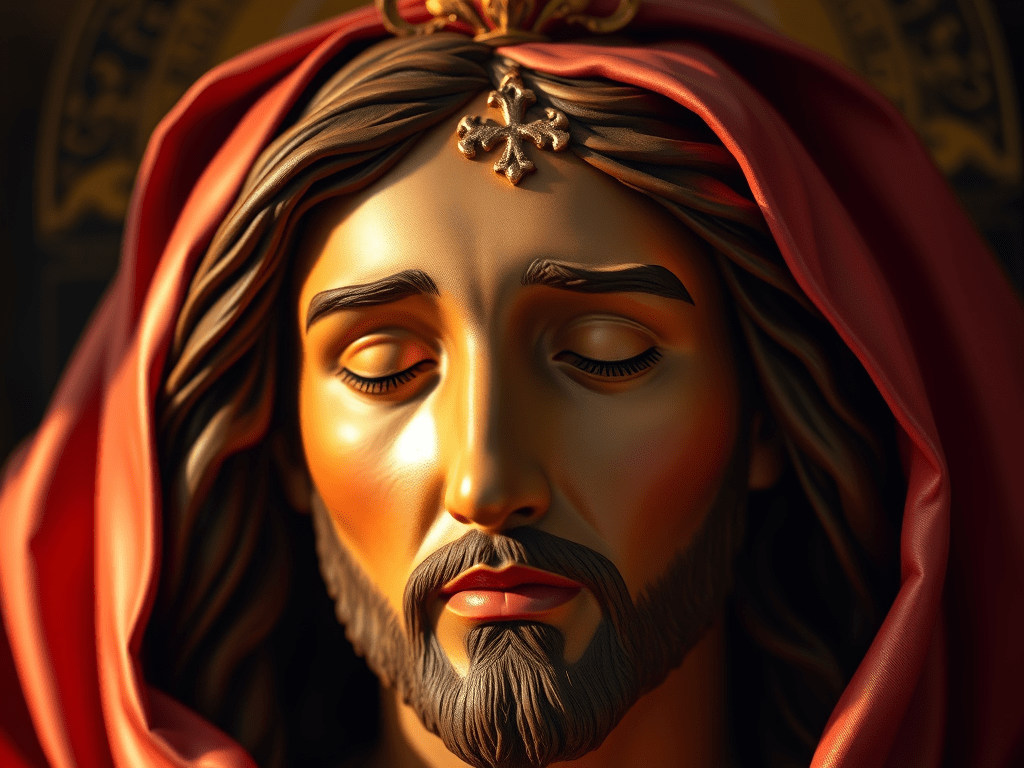
Sorrowful and Immaculate Heart of Mary, pray for us.
Acedia; a spiritual malady

Photo by Maria Geller on Pexels.com

During this little slice of Ordinary Time after Christmas and before Lent we might begin to feel spiritually unenthused. Maybe we were already. Maybe we even avoid prayer and the practice of our faith. Maybe we have an aversion to our daily duties. Maybe we’re bored and drawn mostly to distractions. What’s going on? St. Evagrius (AD 385-399) who lived  in the Egyptian desert as an early monastic wrote about something called acedia. 

What is acedia? The Catechism of the Catholic Church (2733) calls it a form of depression caused by giving in to spiritual laxity or presumption. The Desert Fathers thought of it as a spiritual condition people can fall into with a complex set of symptoms, a spiritual malady, or even as a demon. 

[Acedia is] a hatred of industriousness, a battle against stillness, stormy weather for psalmody, laziness in prayer, a slackening of ascesis, untimely drowsiness, revolving sleep, the oppressiveness of solitude, hatred of one’s cell, an adversary of ascetic works, an opponent of perseverance, muzzling of meditation, ignorance of the scriptures, a partaker in sorrow, a clock for hunger.

St. Evagrius

Yikes. 

St. Evagrious of Pontus says the real roots of acedia are self centeredness, anger and misdirected desire. When oppressed by acedia we tend to seek comfort and pleasure to counteract the restlessness we feel, and in response to our aversion to spiritual practice. We avoid the tasks we are responsible for. We withdraw from charitable activity and are more prone to gab with others for our own entertainment and distraction than to be useful to them.  We fill our lives with surface busy-ness, avoiding prayer and study. We lack spiritual desire and quietly long for things and activities that will draw us away from the spiritual. We are both restless and exhausted. We want to sleep, we want to pace the floor. We feel at once angry and dissatisfied as well as listless, staring at nothing. This sounds terrible. No wonder Evagrious called it “the most oppressive of demons.’ 

All of this reminds me of  a passage from one of my favorite books, The Phantom Tollbooth by Norton Juster. 

“There once was a boy named Milo who didn’t know what to do with himself; not just sometimes but always. When he was in school he longed to be out, and when he was out he longed to be in. On the way he thought about coming home, and coming home he thought about going. Wherever he was he wished he were somewhere else, and when he got there he wondered why he’d bothered. Nothing really interested him- least of all the things that should have. “It seems to me that almost everything is a waste of time,” he remarked as he walked dejectedly home from school.”

And “… while he was never anxious to be where he was going, he liked to get there as soon as possible.” 

Had Milo been a monk he would have been diagnosed by the Desert Fathers like Evagrius, as suffering from, and indulging in acedia. 

Photo by Jose Aragones on Pexels.com

If we find ourselves troubled by acedia, what is the remedy? What should we do?

  1. Master your thoughts. 

Notice when your thoughts are going into that irritable, lazy restless lane again, and change course as soon as you notice. Something that helps me is to repeat the names of Jesus and Mary; “Jesus Maria Jesus Maria Jesus Maria” each time I find myself on that negative track again. Be patient with yourself. It doesn’t help to be mad or disappointed in yourself. Simply move on and persevere.

“Whether or not all these thoughts trouble the soul is not within our power; but it is for us to decide if they are to linger within us or not and whether or not they stir up the passions.”

St. Evagrius
  1. Resist. If you want to sleep or run away or indulge in compulsive activity, persevere in what you are actually supposed to be doing in spite of how you feel. If you are avoiding prayer, pray. If you are avoiding your duties, get back on track. If you’ve lost sight of your routines, get back to them. I suggest working on one thing at a time so you aren’t overwhelmed. When you are stuck in acedia even one of these things can be hard enough to change.
  1. Gratitude. Write down five things you are grateful for when everything is getting on your nerves. It works surprisingly well. 
  1. Manual labor. Nothing helps me as much as some vigorous sweeping, mopping or dragging things around outside.  According to the Fathers, acedia is both mental and physical. This is why it’s so hard to kick.  
  1. Meditate on the Passion and Death of Jesus. Maybe praying the Sorrowful Mysteries of the Rosary or The Way of the Cross can assist you in this. This is uniquely grounding for us as Christians.
  1. Ask God for the gift of tears. According to Evagrius, the gift of tears in prayer, and tears of repentance are indispensable for liberation from acedia.  So have a good holy cry, it cleanses the soul. 
  2. Preach the Psalms to your own soul. As Dorothy Day wrote, “My strength returns to me with my cup of coffee and the reading of the psalms. ” 
  1.  Engage your intellect. I learned this from Fr. Gregory McLaughlin who taught me that when I was being ruled too much by my emotions, I should study, especially religious study such as Scripture or good spiritual reading. It works.
  1.  Go to confession. This may seem obvious but remember the Sacrament of Reconciliation is healing and restorative. God gave us Confession so we can receive his mercy, overcome our sins and begin anew which is exactly what we need to be free of acedia and free for God. 
  2. Good deeds. Go through the day quietly tucking in small kindnesses wherever you can. This is a remedy for almost any malady of any kind. When you are ready, throw yourself into working for others in some way.

Gently fold these things into your life and you will soon sense a clear fine spiritual love reclaiming its place in your heart. 

Photo by Tim Eiden on Pexels.com

Blog at WordPress.com.

Up ↑