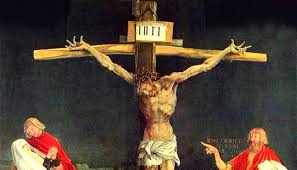
the Isenheim Altarpiece by Matthias Grünewald.
It is a pronounced characteristic of our Catholic faith that both personally and as Church we meditate deeply on the suffering of Jesus. Our crucifixes, art and literature are often graphic in their portrayals of his Passion and Death. The Saints emphasize this practice, the rosary we pray, the Church calendar, all return us to our suffering Lord. In the Stations of the Cross we walk with Jesus through his suffering step by step. Why do we do this? To an outsider it might seem ghoulish to dwell on the lurid details of his torn flesh, his bloody sweat, the tears he shed.
The mystics say that Our Lord’s Passion is like a fire of love. The more we draw near to this fire the more we are warmed and transformed by it.
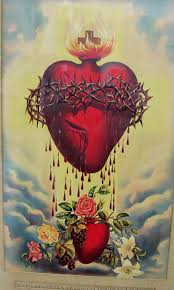
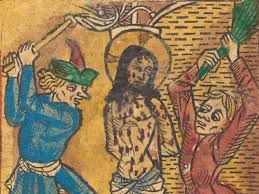
I am a deeply sensitive, and, I hope, compassionate person. I am always uncomfortable with the Sorrowful Mysteries of the Rosary (traditionally prayed on Tuesdays and Fridays. During Lent it is also on Sundays). Meditating on the Sorrowful Mysteries, we follow Jesus through his Agony in the Garden of Gethsemane, his Scourging at the Pillar, his Crown of Thorns, his Carrying the Cross, his Crucifixion and Death. It’s tough. But I don’t want to leave him alone in his sorrow. I want to share in it as his mother did. I want to comfort and help him. Also we can’t expect to only share the sweetness of the Lord without the bitterness of the cross. Part of love is acceptance. I don’t want to only love part of Jesus I want to love all of him, accept everything. That means following him not only in his joyous times but right into the valley of death as well, and the cruelty he experienced from others.
For me the fact of the betrayal of Judas, Our Lord’s broken heart, his grief, the abuse heaped on him, have helped me accept the sorrows in my own life. Sharing in his pain has made me more able to not look away from the suffering of others but to ‘weep with those who weep.” (Romans 12:15)
A Methodist minister friend told me he noticed that Catholics don’t see ourselves as witnesses of the events in the life of Jesus. We think of ourselves as taking part in a very present way in our prayer and especially at mass. We are there at the Last Supper at mass. We don’t think we are witnessing something. It’s not a story. We are in it. I like that. Maybe this points to why we submerge ourselves in the torture and cruelty of his death in such detail. We’re helping ourselves be there.
Our Lord’s Passion teaches about love as intense faithfulness and determination, sacrifice, acceptance. It helped me stand by my husband all through his fight with brain cancer. In his darkest and fearful moments I listened to him talk about his feelings of raw desolation, anger, and even shame, of terror, of feeling there was no comfort anywhere. In spite of my love for him, part of me wanted to run and hide from the enormity of what he was expressing.

I had no mitigating words to say. The profound suffering of another person is frightening to be present to. When he eventually asked how I felt about this on a spiritual level, all I had was the fact of Christ’s suffering. At least as we went through this with cancer we had a God with us who didn’t die gracefully in a shower of rose petals but was coldly executed, naked and bleeding like an animal, nailed to a cross, with a cry of spiritual abandonment only just having died on his lips.
My husband nodded gravely. He got it.
1565
Oil on canvas
Scuola Grande di San Rocco, Venice
The Christian life is illuminated by the choice of Jesus to take our suffering on himself. It was our sins, our iniquities, yes, but our suffering too, according to Isaiah.
“Surely he took up our pain and bore our suffering… by his wounds we are healed” Isaiah 53:4-5
The incomparable light he generated by choosing to undergo his Passion as an offering shines forever. It reminds me in my own darkest times, of his compassion. My tears are his too. St. Teresa of Avila says so great is his compassion that when you visit him in his agony he will forget his own sorrow in looking at you and wanting to comfort you.
As we approach Holy Week let’s avail ourselves of the opportunity to love Jesus through his suffering and death, and to let him love us too.


 Bethany Hang Out