When I wake up on Easter morning what I usually feel is happy for Jesus. He is the first person I say “Happy Easter” to. Happy Easter, Beloved Lord. You win!
Love is stronger than death, oh Love Itsef!
Then I think of the Church all over the world and how we are all together in spirit, experiencing this day that is not just a remebrance of the past, but something happening now, a special time of grace from Heaven as we all celebrate together.
Then I think of all the people I miss, especially my family that have died, and I am so grateful I will see them again because of this Lord who accomlished it.
Granted this has been the strangest Easter in any of our lifetimes, but that’s another thing about Easter. Jesus is unstoppable.
I had a good enough day, and was able to pray with my youngest daughter and her four year old in our traditional way. I heard from my eldest daughter, and my friends too. I have had time to pray and reflect and listen to music that is special to me at Easter. It was sad to be away from mass and that is an understatement. I am sure you can understand too.
It was a quiet day, and pretty outside. I blew bubbles on the back porch with my granddaughter, a sweet way to end the day.
And now my place is quiet again. I think about how this is the time maybe the disciples settled down enough they could just enjoy Jesus.
All day he was playing hide and seek, surprising different disciples in different places and in different, wonderful ways, all of them crazy. It had been an overwhelming day, a world inside out day.
They had laughed and cried and screamed, tried to understand and experience impossible things and some couldn’t even believe their own eyes. It was too astonishing.
All that was settled now, and they said, “Stay with us Lord, for evening draws near.”
They got to be with him for 40 more undoubtedly beautiful days.
It must have been hard to stop looking at him, hard to stop hugging him, hard to calm down and just be with him. Maybe it was easier in the glow of the fire to relax in his presence, to enjoy his tenderness and love for them.
To me the signature of the touch of the Lord is tenderness. This is something I am deeply grateful for today.
Sometimes I don’t emotionally identify with Easter that much. My life feels like a long Holy Saturday after several Good Fridays. I’m not complaining. I want to say that I am aware that I possess a much deeper joy than emotional happiness, though I would say I am happy enough, even after all the losses. I have been aware of this joy through it all, not to say I haven’t been desolate because I have. It’s the joy of that rock solid knowledge of God all the way to the center of my soul. I don’t think I would have that if I hadn’t gone through hell so many times; emotional hell, and spiritual desolation.
“My one companion is darkness,” the Psalmist wrote (Psalm 81.) In some ways this is still true, my soul cleared of so many things that filled it. But there is something beyond that emptiness. That something is what I am made of now. The darkness has a radience to it. I lost all the lushness of my spirituality and gained infinitely more. Maybe the disciples found something in their own souls similar after the Ascension.
Carl Jung, asked if he believed in God, said, “No.”
And then he added, “I don’t believe, I KNOW.”
I can identify with that.
I don’t believe in the Resurrection. I know. And that’s a gift of the Resurrection itself, of the power flowing from it.
Even when I don’t necessarily “feel” God I just know and that’s enough for me.
When I do sense his presence, that tenderness I also know as his sign. I hope he feels my tenderness too.
Jesus said, “I will not leave you orphans. I will come to you.” (John 14:18)
My late husband, Bob Chapman, was diagnosed with Stage 4 Glioblastoma Multiforme, an aggressive Brain Cancer, in February 2010 while we were still engaged and dreaming about our wedding. We married in May that year just after he finished his initial treatment, a period of simultaneous radiation and chemotherapy.
He lived 2 ½ years. The course of his illness was hands down the most terrifying thing I have ever had to go through. If you know me, you know this is saying a lot.
However it was also the most beautiful time of all my life. He said the same for himself too. My daughters remember it as the happiest of times for them.
We had to make a daily decision not to live in fear and sorrow every minute. This does not mean we didn’t cry sometimes, or that we pretended not to be afraid. We were scared to death. Of course we were. But who wants to live like that? We decided to live happily as long as we could, and to “lovingly eat the bread of the will of God,” as St. Elizabeth of the Trinity expressed holy acceptance.
We thought if we did go down, we would go down swinging. We did all we could as enthusiastically as we could to fight cancer. We strove to leave the rest up to God. It was empowering.
We knew that things might not work out the way we wanted which was a horrifying prospect. We also knew that sometimes people did survive it. We ignored the statistics and tried to live in the hope; not with false expectations, but real hope. We knew that Bob would not be taken from this world without God’s permission. We decided remaining positive but without stifling our feelings when we were sad, angry or afraid seemed best. And we looked to God. As Bob said to me the week he died, “God is IT!”
We decided to love and to serve as much as we could. After a frightening MRI result we were really scared. All we could do for a while was hold one another. When he was ready to talk, he said. “Well, what do we do? We love, we walk on.”
And we did.
We learned to allow others to love and serve us. We grew in our appreciation of community.
We grew to understand that each day could be seen as an entire life -time, being born in the morning and dying in the Father’s arms at night. Getting dressed for work one morning, Bob said, “I’m alive today. That’s all anybody’s got.”
Living like this begins to bring out the beauty in all things. Life becomes more vivid. Connection with people and all living things becomes profound. The heart expands.
When we were overwhelmed we had a designated spot we pretended was our “clubhouse” where cancer could not go. We needed to take time out in that spot sometimes.
As a family we learned that almost anything is funny. Bob had speech problems that came and went for a long time. They were hilarious! One of his more famous utterances then was when he said, “What time do we eat the kids? 6:30?”
Trying to talk to someone on the phone about a bill, he explained to her, “My voice is broken but my THINK is fine!”
At M.D. Anderson, the staff seemed horrified that I kept laughing at Bob’s speech mistakes. I told one of them, “Hey we can laugh all day or we could cry all the time!” And anyway, he was laughing too! “What!?” he would say, “I speak the King’s English!”
We tried to make scary things fun. Bob took his guitar to the hospital with him and played it from his bed. The nurses loved it.
One time he went to a scary appointment with half his mustache and half his beard shaved so he had a perfect half and half face. The doctor did such a double take! It was so funny!
At chemotherapy we used to sit and blow bubbles together in the treatment room. He brought his guitar there too and played for everyone with the I.V. in his arm.
Bob was a do-er. He was always moving. One month almost to the day before his death he was mowing the lawn, pushing his crazy big mower uphill. I took a picture. Well that was Bob. He was unstoppable. Bob was into helping. Even when we went out to eat he would end up fixing the cook’s car in the parking lot or something like that. Once he saw a young woman having to put back her purchases at the grocery store so he went behind her putting the same items in his own basket. He bought them all for her and sent me to give them to her outside.
He fixed things for the elderly he saw struggling with something. He was all about service and not creating hardship or work for others. He called this his “skin religion.”
He brought me breakfast in bed on Saturdays and put on Bugs Bunny for me. He did everything he could for all of us for as long as he could.
Being able to serve was important to him as a person.
Eventually, he began to be paralized on one side. Still he dragged himself by one arm horizontally out the back door to work on a drainage project. Sometimes he got tired and had to lay down in the grass for a while.
He was a do-er and he was tenacious. We called him “The Atomic Bob.”
He was an artist but he began to lose his ability to paint. He couldn’t play guitar. He started dropping dishes so he couldn’t do them for me anymore. He got where any speaking at all was very difficult. He had trouble at work and finally took that extended sick leave he had not taken yet. He could no longer play guitar.
He was confined to his chair for a lot of the day. One afternoon he called me to him and said,
“Shawn! I can’t DO anymore.” I nodded, tears in my eyes. Then he said, “I can’t DO!” Here he put his hand on his heart, sobbing, “but I STILL LOVE!”
I knew what he meant.
He realized his love, doing or not, was valuable. He was reaching out to everyone, loving them, and that in his very inactivity, his great big heart was active and spreading love on a whole new level. “Hey,” I told him, between kisses, “you’re speaking like the great mystics of the Church now!”
We are such do-ers in this world and often this is a great thing. Through the history of our faith, though, some Christians have felt called to withdraw into holy seclusion to live a hermits’ life and to pray.
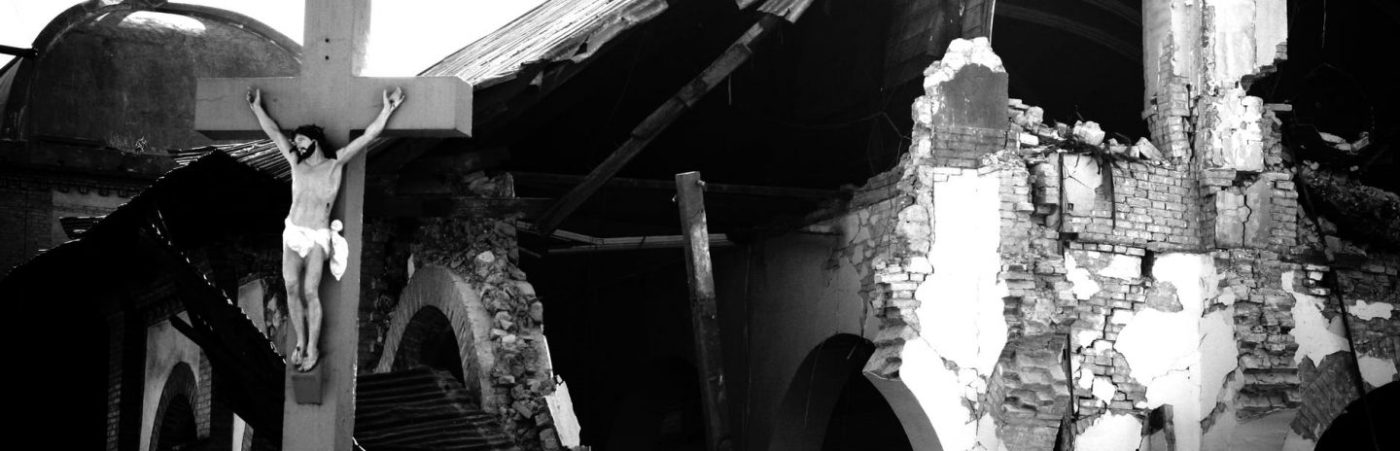
To us this looks like not helping, not doing. But as Servant of God Catherine Doherty wrote, “Look at the Man on the Cross. He is not doing anything because He is crucified.” Ah but He was doing EVERYTHING, wasn’t He?
Our family found humor and beauty, mindfulness, joy in service, acceptance, courage, tenacity, renewed faith, a closer bond, community and the spiritual gift of understanding right in our crisis. In the midst of sorrow, loss of control, uncertainty and intense fear we found the Kingdom of Heaven. When the situation was “down to the wire,” we found the true power of love.
God is with us. There are jewels in the rubble that are there for us to find and to share as we deal with Covid-19 as a community. If we seek this treasure we will find all we need and more. It is there for every one of us.
This is my husband’s painting of us praying together during his fight with Brain Cancer. He called it “Miracle.”
* This piece originally ran as my column in The Bryan College Station Eagle
Where you find no love, put love, and then you will find love.” ~ St, John of the Cross
I had a birthday cake to make on March 12. My eldest daughter, Maire was turning 27 the next day. This is her first birthday home in Texas again in years and she is so glad to be here.
I planned to make a Mexican Chocolate Cake (dense chocolate with a little kick from a pinch of hot pepper powder.)
I wanted a yellow rose (the Yellow Rose of Texas, of course) for a little cake top arrangement as well.
I had heard news of emptied out grocery stores in other places, and even a couple of local complaints. I tend to resist getting caught up in that sort of thing so I didn’t really pay attention too much.
The emotional climate in the store was distressing. People seemed angry and upset, even banging their shopping carts around. Almost everyone I saw seemed scared, furtive even. No one was making even passing eye contact.
Workers looked exhausted and rushed.
Young people in particular looked dazed, some standing and staring at the place where something they had been looking for was supposed to be.
I thought of my Focolare friend, Julia, who had been looking for ways to be useful during the Corona Virus outbreak. She and some others had some great ideas. I felt unsure of how to be useful and I still do.
The Focolare have a saying, “Be the first to love.”
“Jesus what can I do?”
The first thing I could think of was to smile at people if I did happen to catch their eyes. This was encouraging exercise because I could see some visibly relax and several smiled back. It was a Jesus smile I think because then they smiled at others too.
Some of the things I needed for the cake were hard to find. Sugar was in very short supply. I did find some raw sugar eventually. I tried to joke with a couple of people and it went well. They were ready to laugh. We laughed about how crazy it all was.
There was no salt. There were a lot of empty shelves. It made me kind of scared too, to see that. I had never seen that before.
When I saw young people staring at things and looking confused I tried to help them find what they were looking for. At first I was stupid and picked up the item when I found it and they probably thought, “No thanks since you touched it, Stranger, and that was the last one too!” Oh yeah. I did better the next time.
I saw tired children looking around wide eyed as their flustered parents negotiated the crowds. I tend to feel overstimulated and anxious in crowds myself. I told one kid, “Hey you are being really good in the store! My youngest is 22 and she isn’t as good in the store as you are!” If a child was crying I tried to give a sympathetic look.
I finally had everything I needed, thank goodness.
I went ahead and got some beans and rice which, as a vegan, I kind of have to have. They were almost completely out. I took one small bag of each. My pay day is not for a few more days so I can imagine other people having to wait until pay day too and then everything would be gone. I didn’t want to do that to anyone else. Lots of reasons not to take more than I needed.
I tried to notice when other people were attempting to reach for things I was reaching for too and let them go first. That’s hard for me since I usually don’t notice things like that. But I tried.
I had intended to pay in cash as I usually do but I didn’t because the cashiers would have to touch that.
I felt so sorry for the young women at the register. They looked exhausted; flushed, sweaty and scared. I found out one of them was from some other department but had to come help and neither of them had gotten off work hours ago when they were supposed to be off. I thanked them so much for being there and I said I was sorry for what they were going through. They seemed to appreciate it a little bit.
I told Jesus on my way out, “Those poor girls! Please protect them and give them strength.”
On the way home people drove crazy. It made me sad. But I felt lifted up just a little bit and I had a sense of peace beneath the worry. Maybe some of the people in the store did too.
That brief experience made me think that if we can try to connect even for a second in the little ways that we can, and smile a little bit sometimes, it might lift us all up just that much more. We could use that right about now.
Maybe the reason you find love when you invest love is that it isn’t really that your love comes back to you but that Jesus is there whenever we try to give love even just that little bit, in a tough situation and he multiplies the love just as he multiplied the loaves and fishes.
We are all going to need a lot of love.
Jesus walk among us and help us remember love even a little bit in the days ahead, and to see you multiply our smallest investments.
Today we humbly receive ashes on our foreheads and hear that we are dust, or maybe, “turn away from sin and believe in the Gospel.”
Usually I think of setting out into the desert with Jesus to pray and fast with him.
This year I am thinking about Mary. What was it like for her when Jesus went into the desert for 40 days?
I am sure he let her know he was going. Maybe his apprentices ran the carpentry shop while he was gone so Mary wouldn’t go without.
I am sure she missed him and she understood that their private lives together were over, and that his mission had begun. Like any mother, I am sure she was both sad and excited too. “”Son we have waited so long, so long for you!”
She knew how much people needed him. She knew who and what he was and she was ready to assist him, let him go, face what came next, do or be whatever he required of her.
Just as Mary accepted the purification ceremony after the birth of Jesus even though she was already free from original sin or any other sin, I have no doubt she would have wanted to be baptized too as Jesus had ( though he was sinless and didn’t need baptism.) Maybe she was there that day.
She would have seen the Holy Spirit come down from Heaven in the form of a dove and heard the voice of the Father, “This is my beloved Son in whom I am well pleased.” I can almost see her smile and close her eyes in prayer when that happened.
Jesus went into the desert to pray, to fast and face Satan. Mary went home to an empty house. And she had to get on with her life.
She would have gone about her work in the garden, with her weaving,cooking, hauling water, kneading bread, caring for the animals, talking with friends and family. Yet the sense of him was always with her. Now and then maybe she paused, raising her hands in prayer for her Son, and for the whole world.
In Carmel, one facet of our charism is “to stand before God for all,” as St. Edith Stein put it. This is also Mary’s vocation in her prayer for us all as universal mother.
While Jesus was in the desert, Mary kept her spirit close to his. In the spirit of her baptism, she stood before God for us all, praying for us, in sack cloth and ashes, at least in the depths of her heart on our behalf. I imagine her prayerfully lowering her head to touch the ground, a gesture of solidarity with the earth and with the profound humility she had as a daughter of Eve. She wanted to put her freedom from sin, and her place as Queen Mother toward our good in her petitions to the Father, and to unite herself with the mission of Jesus.
When we make our Lenten sacrifices, maybe we could say with Mary, “Oh Jesus, it is for love of you, and in union with Mary.”
So when we receive our ashes for penance and dedication for our journey of Lent, we could receive them in union with Mary for the whole world as well as the way we always do, which is to say, for ourselves. And as we go about our lives during these forty days, maybe we could do so with Mary, doing our work, living our lives, always aware of Jesus, pausing and praying deeply whenever we can for the whole world, and for Jesus’ continued mission of salvation on earth.
“In the noise and clatter of my kitchen, while several persons are at the same time calling for different things, I possess God in as great tranquility as if I were upon my knees in the Chapel.”~ Brother Lawrence
Brother Lawrence was a Carmelite Lay Brother (d. 1691.) He had an intense realization of “the fact of God” while looking at a dead and leafless tree. He had been a soldier, and after being wounded he became somewhat lame. He then became a footman but, as he said, was “a great clumsy fellow who broke everything.” He no doubt was feeling like a dead, leafless tree himself at that time. But God opened a way for him to find life again. He became a Lay Brother in a Carmelite monastery; cooking, (a job he disliked right away) running errands, sweeping floors and of course, praying and discovering God within at all times and sharing this way he called The Practice of the Presence of Godwith others.
By making active use of the teachings of The Practice of the Presence of God we can learn to be continually recollected in God, which keeps our souls most open for God’s grace and at his service at all times.
The flow of our lives then becomes a conscious flow of God’s transforming love.
The consequences of this simple practice seep into our personalities and the way we are in the world. We find we even touch inanimate objects with love. We feel affectionate and open towards people. We feel happier, more peaceful, certainly more in tune with God.
1. Morning Offering.
Many Catholics begin the day by dedicating/offering it to the Sacred Heart of Jesus in a Morning Offering. If you already do this, try to do it more consciously than usual. Pay close attention to what you are saying and to Whom you are speaking. Reflect on what the words mean to you.
If you don’t do this, you could start doing this. Write a Morning Offering on a post-it note and stick it on the coffee maker. You could write your own dedication instead of the traditional one if that would be more meaningful to you.
2. Address your thoughts to God.
This may sound overwhelming to do all the time but even recalling God and restarting your conscious awareness of him whenever you remember to, during the day can have a noticeable effect that will grow.
While you are at it, try turning your grouchy thoughts into prayers of praise. No really. So many things in the course of the day are annoying to us. Figure out how to make prayers of praise or gratitude out of these irritating things. You may be surprised how amusing this can be, and how it becomes second nature after a while.
Turn your thoughts into a continual conversation with God. We all live in a river of thoughts, images, memories, plans, worries, what have you. Turn this river toward the Lord, as often as you can remember to.
I think about my daughters more times a day than I care to enumerate. So, for example, I can try to talk to Jesus about them instead of only thinking to myself or worrying or dreaming for them, as parents will.
Today my daughter is moving, My other daughter and her husband are helping while I watch the grandchildren and hope the three year olds get along and the baby isn’t too distressed by the whole thing. I can talk to the Lord about this. “Calm any fears that arise, Lord. Help us to make this a joyful day.” Or I can express my concerns to him if I want to. As Winnie the Pooh says, “It’s friendlier with two.”
The best way is to hold your pain up to God just like you used to bring your bumps and bruises to your mom for her to kiss. Words are unnecessary here unless you want them. Let God sit with you like a loving quiet friend when you are hurting. You probably know this is harder than it sounds.Try it anyway though.
Catholics also have the habit of offering up our suffering in union with the suffering of Jesus. We call this being co-redeemers. When something bad happens to me I consider myself a treasure of grace and try to offer my suffering as prayer for everyone who needs it.
4.Purposely invite God into even the smallest things you do each day
This is at the center of Brother Lawrence’s teaching, and a big part of The “Little Way” of St. Therese as well. Instead of rushing through a task or just trying to get a thing done, it helps to slow down and concentrate on it. As Eknath Easwaran says, “Concentration is consecration.”
Offer your task as if it were an act of prayer and then it will be.
St. Therese would offer the difficult things she had to do for missionaries or for priests. Maybe you would like to offer your work for something you care about to help the world or the Church.
Your offerings can be as simple as saying, “Lord here is my little pancake for you” if you are cooking, for instance. Maybe this sounds silly to you but I recommend you try it for a while and see for yourself. Maybe you too will find God “amidst the pots and pans.”
“We ought not to be weary of doing little things for the love of God, who regards not the greatness of the work, but the love with which it is performed.”~ Brother Lawrence
This habit of being aware of God in your actions takes a lot of practice but even if you only remember to do this a couple times a day God will bless it and you. You will soon notice a difference in how connected you feel to God at all times.
When you are in line somewhere or at a red light (we spend a lot of our day waiting) use some of that time to connect to and talk to God. It’s easy.
5.“Listen” for God with an open heart
No matter where you are, whether you are alone or with others, hanging out with your friends, at work, petting your dog or talking to a small child, try to maintain a sensitivity to God in all situations. You will sense a heightened awareness and connection to other people and all living things when you do this. You will notice beauty you used to miss. You will be more and more able to register signs of God’s will or voice in the events and conversations of your day. It will become a working part of you in time.
6.Presence/mindfulness
We hear a lot about these concepts lately and I think that is good. As Christians, being present in the moment and being mindful in our daily lives is going to mean conscious awareness of God in the present moment, mindfulness of God in all we do and experience.
Fr. Greg McLaughlin said to me once, “You are not on this planet! I don’t think you are even in the solar system! God is in the present moment. God is right here! And right now, right here, he is saying‘ Where are YOU?”
To be absent minded is to be absent to attentiveness to God who is here with us now. This one has been a hard one for me as I am given to day dreaming. I have learned that we don’t have to be perfect at this present mindedness. But every little bit helps.
St. Teresa of Avila’s way of thinking was that “God is within us, and we should not leave him there alone!” She thought we should imagine the Lord beside us at all times until that active mental effort becomes internalized and natural, part of consciousness.
7. Repetition of the Holy Names
Brother Lawrence doesn’t talk about this in his letters or conversations. However this can be a useful key to keep on your key ring that can help you in your quest to cultivate the constant sense of the presence of the Lord in your life during your day. It can open the door for you.
When I am doing a task that doesn’t require a lot of thinking, I repeat the names of Jesus and Mary. For me it does the trick, and brings me into conscious awareness and attentiveness to the presence of God. It is also a prayer because I am calling on them in my heart and dedicating whatever I am doing to them.
Doing this in the waiting times of our lives can bring us into focus as well, so we can fill those empty spaces with the Lord.
It is very helpful in times of stress or fear too or any time I need to re-center.
St. Rose of Lima is said to have memorized the Names of God from the Bible during a time of blankness and darkness in her prayer life, and repeated them while she did her embroidery or any task that allowed it. It was her light through that difficult time.
Before going to sleep I like to tell God what I am grateful for about the day and commend all to him, good and bad.
I also try to fall asleep with the holy names of Jesus and Mary, taking them with me into the night.
“He does not ask much of us, merely a thought of Him from time to time, a little act of adoration, sometimes to ask for His grace, sometimes to offer Him your sufferings, at other times to thank Him for the graces, past and present, He has bestowed on you, in the midst of your troubles to take solace in Him as often as you can. Lift up your heart to Him during your meals and in company; the least little remembrance will always be the most pleasing to Him. One need not cry out very loudly; He is nearer to us than we think.”
― Brother Lawrence
People who wrote about talking to Brother Lawrence remarked on his deep peacefulness. He was a simple Lay Brother who had had a poor and difficult life, wounded in war and witness to horrific slaughter in his own home town. Through his remarkable relationship with God, and this way he found to live always in his presence, he found deep peace and was able to help others find the same.
This way is available to all of us.
Developing these habits may sound like an arduous process. Remember that we do what we can and God will do the rest. God sees and will bless our efforts. He’s cool like that.
The bond I had with Yeshi was, I felt, even more deep that one of blood. A blood father is chosen by God to be the parent of a child. As my wife said to me so often, I was chosen for Yeshi by God. The Lord gave me such a powerful attachment to this son of mine I was wild with terror at the angels’ news. I sat up, jumped to my feet, immediately on full alert. My wife was asleep next to him. I tried to wake her gently. I watched as her face hardened when she understood. Quickly she strapped the protesting baby to her back and helped me load the donkey. We had become a good team and she was nearly as strong as a man. In only a few minutes we were on the road.
We were frightened about passing the watchman. But we were both ready for anything, ready to give our lives if we had to. As we drew near I tried to walk calmly and confidently,though I was so taught with fear I ached to break into a run. I knew Mary was frightened too. I heard her trying to slow her breathing. I was conscious of the knife at my belt, praying to God I would not have to use it.
I needn’t have worried. The guy only greeted us and remarked on the fact that we were leaving in the wee hours. I managed to laugh and say that with a newborn we couldn’t sleep anyway so we thought we may as well be our way. We passed without incident.
Fortunately I had been curious about the beautiful maps the wise men had poured over before they left. For some reason I remembered a side rout to Egypt. We needed to avoid the Northern Way most people took. There had been a lot of talk about the Child around Bethlehem, certainly about our fantastical visitors on camels who had followed a star to our son, saying he was a long expected king. We knew if they got a lead Herod’s soldiers could pursue us into Egypt, also part of the Roman Empire.
I walked as fast as I could, leading the donkey with Mary and the baby on its back. We kept our voices low. I tried to squeeze Mary’s foot now and then to reassure her. She was grave and resolute whenever I looked at her. If anything she seemed angry rather than afraid most of the time.
We traveled in this way until we were sure we were well away. Hours after sunrise we hid as best we could behind a large rock and took turns sleeping and keeping watch.
Again we left in the night.
The way was treacherous. I tripped several times on rocks and brush. Finally one trip sent me flying. The pain in my ankles was bad enough I could not walk at all no matter how I tried.
Mary got down from the donkey, running to me. We still had plenty of frankincense and she spread the fragrant oil over my fast swelling ankles. My wounded leg she cleaned with water and then healing myrrh. The oil and ointment helped but not enough for me to walk, even with her help. What to do?
“We have to get you on the donkey and let me walk,” she said. I was opposed.
“Joey,” she insisted, “there is no other way!
After several painful tries, together we pushed, pulled and lifted me onto the little donkey. I felt ashamed that she had to do this. Also, “I’m a big hairy man on a donkey!” I complained. “I look ridiculous!”
She laughed. “You DO look ridiculous.”
“I’m worried about you,” I said. I was. I could feel it in the pit of my stomach.
“Take this,” I said, handing her the knife which she solemnly took. “Remember how to use it if you have to, the way I showed you before?” I asked her. She nodded.
“OK now make yourself useful,” she said, handing me the baby. I could see his eyes shining in the dark. I pressed him to me.
We went ahead bravely.
She insisted on stopping now and then to put more oil and ointment on my injuries. She tried to joke with me to make me feel better. I told her she was my warrior queen.
We were scared but we trusted God. There was nothing else to do. We tried to encourage one another. We had a saying together: “God is it.” Our lives were for God. “Everything will be OK,” we said to one another, “and even if it’s not OK, it will be OK.”
We had to stop to nurse and change the baby every few hours. Soon we would need supplies. We had gold from the wise men. We knew that a poor young couple trying to buy food with foreign gold was going to cause a stir but it couldn’t be helped.
We continued to travel by night, exhausted and afraid. Our minds started to fill with every possible thought. We talked about King Herod. How could any grown man, a king no less, be so insecure about his power, so angry, hateful and afraid, he would seek to harm a child? Why would anyone obey such a man?
The wise men had told us they were warned in a dream that Herod had become hostile about their mission, and that they must leave by another way themselves. How could anyone fear the signs of God and fight God himself instead of being joyful that God was coming to his people? What kind of person dares to fight God?
“Satan, “ Mary whispered with certainty. “He is possessed by Satan.”
At one point we were trudging along on a seemingly endless night and I began to worry about my sanity.
“Mary?” I whispered tentatively. “I see them too,” she said.
All around us we saw fellow travelers, people of all colors in various costume as if they were from far away or from another age. They carried children, belongings, what food and water they could. They too were fleeing something, trying to protect their children; frightened, determined, doing their best to trust in God. Some of them died or fell to robbers along the way. Others pressed on because they had no choice.
“Mary,” I said after an awed silence between us, “I think God is trying to tell us something.”
She nodded in understanding.
Even after the vision ended we talked about it for a long time.
We concluded that God was showing us peoples of the ages who would be refugees like ourselves.
We resolved together that in time to come, we would always be with these people in whatever way God allowed us to be. We would walk with them, ease their suffering, protect them, pray for them, be their advocates before the throne of God. We would see their children as our own.
There would always be mad kings, we knew, until the age of the Lord would come fully.
Eventually my ankles were in good enough shape I was able to relieve Mary, and take that knife back.
The night we were sure we were in Egypt their was a beautiful full moon. Mary was happy. She jumped off the donkey and danced, holding Yeshi high, singing,
“Lift up your heads, O gates;
be lifted, you ancient portals,
that the king of glory may enter.
Who is this king of glory?
The LORD, strong and mighty,
the LORD, mighty in war.
Lift up your heads, O gates;
rise up, you ancient portals,
that the king of glory may enter.
Who is this king of glory?
The LORD of hosts, he is the king of glory!”
I know you might feel a little wilted, Reader, after all the Christmas presents and family and food (and sugar, etc.) I do too. I like this kind of tired though. It is a good tired. And the Octave of Christmas is a peaceful time.
I deeply enjoyed Christmas day with my daughters and their young families. This is the first time since the string of tragic deaths my family has gone through, that I felt I really could connect to Christmas and like it. A lot of healing has happened, time has gone by, and though I still miss everyone so much, I have begun to see daylight again and so have the kids. A big part of the happiness this year is that my eldest daughter, who has been living in Oregon for some years,has moved back home to Texas with her husband, their three year old and her eight month old. Basically with them gone our family was down to my youngest daughter, her three year old, and myself. With Maire and Jon back we feel like a family again. We feel complete.
Our gathering went well, and we were glad to be together. It was a fun and chaotic in all the right ways. We had a patchwork meal composed of everyone’s favorite dishes (rajmah, masala potatoes, potato cheese soup and spice muffins.) We had a family prayer service, sang happy birthday to Jesus (with candles and chocolate fudge cake) and opened presents, of course. Which was predictably wild.
There was a lot of laughter and relaxed joy,the two small children running around, the baby crawling through wrapping paper.
And now my little place is quiet. That is a good metaphor to me for this part of the season: the quiet house.
We scurried to get ready for the big day. Then we had the big day, the beautiful day, of the Nativity. We enjoyed family and friends. We went to mass to celebrate. And now, during the Octave of Christmas, we have a special opportunity to slow down, to be still, and appreciate the gift of the Lord in simplicity of heart.
It is pleasantly quiet, and Jesus is home for the holidays.
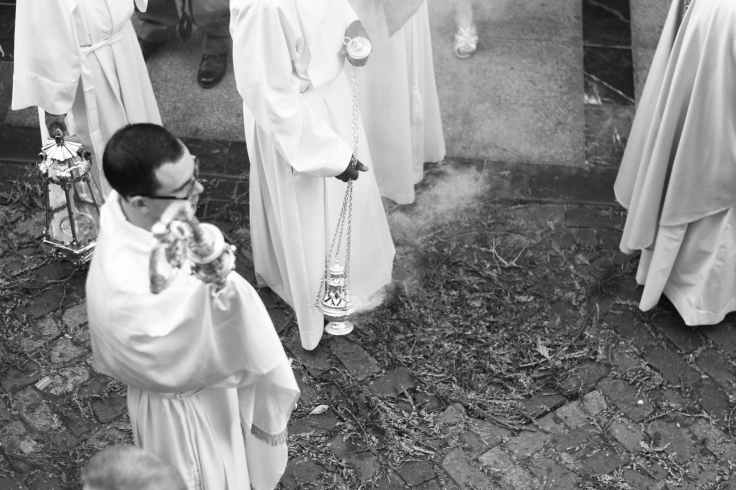
At this writing, it is cloudy and warm Texas day. I have some nice frankincense incense burning.
I have enjoyed some quiet prayer time today, gazing at my little Christmas tree and it’s multi colored lights, coffee cup in hand, Christmas peace in my heart.
St. Teresa of Avila imagined the soul as a beautiful crystalline castle with Jesus in its center, enthroned in the heart.
He is indeed home for the holidays and His home is right here, right now, in us. This is something He accomplished by His birth. He not only came among us and lived among us, but now and for eternity, He lives within us.
The Church season of Christmas is a time to return to the heart, to enjoy His company there, and let Him enjoy ours.
“The Father spoke one Word which was His Son, and this Word He always speaks in eternal silence, and in silence must it be heard by the soul.” ~ St. John of the Cross
This Advent, I have asked the Friars, Priests and Sisters what they do for Christmas in their communities. I called a cloistered Carmelite convent and asked what the nuns do for Christmas. I read accounts in articles and on web sites of Christmas at monasteries.
I was surprised by some of the responses I got to my question, especially by the fact that there is sometimes loneliness or emotional distance in religious communities at Christmas.
I heard about Christmas nights with everyone exhausted from ministry work.
Some Christmas Days are spent, anti-climactically, with each member in his own room after all the masses are over.
Some Christmases are difficult or disappointing, just as some of ours are.
I don’t know what I expected to hear. Of course they have problems, too.
Some described happy Christmases among brothers as the norm.
Other accounts had a gentle simplicity and sense of the sacred we could work harder to imitate or be more in touch with if we wanted to.
Advent can be a quiet but intense time. The days are getting shorter and darker. It is a period in which nature and the liturgy can harmonize in a way that naturally draws a monk or nun more into a reflective and prayerful mood. When the great day of the Lord’s birth arrives, it is as if a great light had burst on the scene. The dramatic turning point is Midnight Mass, something Trappists do in a very distinctive way. The liturgy is simple but majestic. We are often joined by dozens or as many as a hundred of our friends and neighbors with their children.
On Christmas day, we are allowed to sleep in a little longer. Breakfast will often feature delicious pastries made by a Trappist brother or sister or one of our neighbors. We do not exchange gifts, but we receive many cards and goodies from people far and wide who appreciate our silent witness as contemplatives. We are permitted to call our families and catch up on news from home. All of these are means for really enjoying and celebrating Christmas. But, perhaps, what a Trappist monk or nun most cherishes about Christmas day are the free periods given us to spend time in the chapel or walk in nature and enter into the mystery of Christmas in silence and solitude.
This response from my friend, Sister Lynn, was particularly joyful:
“ We have a special Vespers service on Christmas Eve where we sing the portions of Isaiah that speak of the Emmanuel. We usually sing Christmas carols in Chapel before Mass as people are arriving. Since we are located in a very rural area we don’t usually have a lot of guests at Mass; perhaps a dozen or so on Sundays. But Christmas Eve is the one Mass where we get a huge turnout of people – usually around 100. After Mass we visit with our guests a bit as they leave.
Christmas morning we have Morning Prayer. We have Christmas Day Mass with our elder sisters in the infirmary. Then the sister cooks get to work preparing our Christmas dinner. Easter and Christmas we splurge … this year we are having steak! Different sisters sign up to do parts of the meal – I am on for vegetarian main dish (we’re having specially seasoned Boca burgers and cauliflower steaks) and also salad.
In the afternoon we have some rest time. The evening is my favorite part of the day – we have our community Christmas party. We have fun finger foods, open gifts that have been given to the community – usually there is a small gift for each sister (something like an Amazon gift card or gift of an extra retreat day). It’s only community – no guests, we put on our jammies and just have fun being together.
~ Sr. Lynn, O.S.B.
My friend, Fr. John, S.J., said most of the other Jesuits go home to their families of origin for the holidays during the break at the University where he teaches, though those that remain behind have a special mass and dinner. He thought I should write about something else. My life sounds more entertaining to him.
The sisters of Carmel gave me this glimpse into their Christmas celebrations.
On Christmas Eve morning we pray Lauds and then chant (Gregorian) the hour of Prime, in which the Martyrology is also formally chanted by one of the Sisters. On Christmas Eve we are announcing and proclaiming the Birth of our Savior, so the chant is very solemn and beautiful. We have copied it here below for you to read what is sung in Latin. When the Sister pronounces the words that speak of God becoming Incarnate for us, we all kneel and then prostrate with our faces to the floor in adoration. It is a moving and inspiring moment…
In the 1599th year from the creation of the world, when God in the beginning created the heavens and the earth. The 2957th year after the flood. The 2015th year from the birth of Abraham. The 1510th year from Moses and the going forth from Egypt of the people of Israel. In the 1032nd year from the anointing of King David. The 65th week according to the prophecy of Daniel. In the 194th Olympiad. The 752nd year from the foundation of the City of Rome. In the 42nd year of the reign of Octavius Augustus, all the world being at peace, Jesus Christ the Eternal God and Son of the Eternal Father desirous to sanctify the world by His most merciful coming, being conceived by the Holy Ghost, nine months after his conception was born in Bethlehem of Judah made man of the Virgin Mary. – Sisters of Carmel
My friend, Fr. Gregory, OCD, said his community is very busy at Christmas with the parish and the staff. Though they spend a lot of time in prayer, it sounded to me that their obligations are almost as heavy as those of lay people at that time of year. They did have a lovely Christmas together this year, though, even with the stress of their current building project.
“In this house all must be friends, all must be loved,
all must be held dear,
all must be helped.” ~ St. Teresa of Avila
It sounded as if religious communities are just a different type of family, with similar joys and difficulties. Sometimes Christmas makes things that are going wrong stand out more to us, and the longing for a better unity is drawn out in every heart as we ache for Jesus to come among us, to be born in our midst again. Our families feel that deeply at times, and so do theirs. I wonder if our lay families can find more ways to support those in consecrated life, especially since they give so very much to us?
After hearing some of the difficulties they had, a friend of mine paid for a dinner so a small community of Friars could have a special meal together Christmas Eve. I sent a book of poetry by Hafiz to another religious priest I care about. Who can be lonely with great poetry?
Let’s remember and bless these human beings who have given themselves to God for the good of the Church and the world. We can pray for them, thank them, be grateful for them, but we could also learn more about them, deepen our appreciation of their contributions, get to know some of them, let them inspire our own family lives, and find out how we can support them as they support us.
After some packing and chores people were milling around downstairs. Most of our group was flying back to Milwaukee. My brother-in-law, Frank and Sister Ann Catherine and I were driving.
Chris had never gotten to his plan of taking us to a scenic overlook he wanted us to see. I really wanted to go and several of us did, piling into the van one last time.
What a lovely place; situated on a mountainside with a view of Juarez and El Paso stretching out before us.
The border wall was invisible.
I thought that this must be how God sees this place.
El Paso del Norte, once one city, now divided like East and West Germany were by the Berlin wall. Frank had been stationed in Germany while he was in the Army and this situation we had experienced in El Paso reminded him very much of the Berlin wall. Only in Berlin people were heroes for making it across to freedom. In America it is quite the opposite. We treat such people as criminals. There is no welcome. Our one policy is deterrence – seemingly by any means.
There were historical markers and memorials to read and take note of.
Apparently the scenic overview is a place for lovers as well as historical markers. Padlocks covered the hand rails. Chris said sometimes they had to be cut off.
I can see why the spot is inspirational to people in love. Love is transcendent, eternally bonding, an experience of unity that verges on the mystical. Mountains give the human spirit that feeling too. All is one from up high.
Back at Casa Vides Alex and Father Jose were laughing with the kids that came in last night. We showed the kids and one another pictures of our families.
Tim had bought some cat food for the stray cats. We chuckled as he gave it to the sisters.
Eventually it was time to go. We hugged one another and wished each other well. The sisters came and hugged me. Sister Bea had said she saw my goodness and that it shone out from me. That must have made an impression on me because I still remember it. She had taken notice of qualities she saw in each of us. She gave these as gifts to each one of us in parting.
I told Sister Caroline I had a feeling I would be back. I was surprised that she had such a big response to that. “Praise God!” she said, her blue eyes wide.
I have little idea of what I can ever do to help out, not speaking Spanish and not being that good at much. However it is true. I can’t imagine not going back.
Chris told me to keep in touch and everyone said to send them a copy of my book. (I am working on one though what happens with it I don’t yet know- but it is great that they believe in me.)
The guests came and hugged me, smiling.
Then we hopped in Franks’ car with our suit cases.
Once we were out of town I turned on the stereo. I had put on a mix CD that was labeled “Indigo Girls.”
As the first song played I remarked that it was the perfect song to end this experience at Annunciation House with. And it was. It seemed to sum up how we felt, what we had received and what we longed to give.
I come to you with strange fire
I make an offering of love
The incense of my soul is burned
By the fire in my blood
I come with a softer answer
To the questions that lie in your path
I want to harbor you from the anger
Find a refuge from the wrath
This is a message, a message of love
Love that moves from the inside out
Love that never grows tired
I come to you with strange fire, fire…