Catholicly speaking October is a month rich with beloved Saints. Tonight we pass from grumpy old St. Jerome to the young sweet spiritual giant St. Therese. Tonight her Basilica in San Antonio has 1900 roses ready for the “mass of the roses..”
There will be roses all over the world tomorrow because of something she said when she was dying at the age of 24; “Oh I will come down! I will spend my Heaven doing good on earth! I will let fall a shower of roses from heaven!” And she will, too. Somewhere in all those roses ready for her feast day, there is one for you. Maybe she is already holding it close to her heart.
I see bumper stickers and social media posts and hear comments about how America should turn back to God and how we should pray for that or enact laws to that effect. Right now a law is being discussed that curriculum in Texas public schools should include Bible stories. Whether that will make people “turn back to God” or not I don’t know. I just have to rave a little bit right now. And here are some questions I think should be considered when we say our nation should “turn back to God.”
When was our nation with God to begin with? When we kidnapped and enslaved Africans for hundreds of years? When we murdered the indigenous peoples for land? When we forced their children into schools away from their parents to rid them of their cultures and languages and otherwise abuse them even to death? Maybe we were with God when we used to have school prayer but practiced corporal punishment? Or when we lynched black men on Saturday and went to church Sunday and never saw the conflict? Maybe we were closer to God during Jim Crow and segregation. Or perhaps when we put Japanese Americans in internment camps. Or maybe it was when women couldn’t own property or vote? Or go to college? Or were basically their husbands’ property? Or when we used to accuse women of being witches and burn them alive? Maybe it was when we used to do nothing about violence against women; when the police would say it was a private matter? Possibly we were the holiest when it was thought that rape was usually the woman’s fault and women lied about it? Or when sexual harassment was just an expected thing women had to put up with?
Maybe we should think about what it means to “turn back to God.” Does it mean saying some words of prayer or calling “Lord Lord?” Or is it living in righteousness and compassion and mercy with God because of our love for him and because his love has filled our hearts to love others?
We will know ourselves by our fruits Hopefully these will be the fruits of the Holy Spirit: love, joy, peace, patience, kindness, goodness, faithfulness, gentleness, and self control.
Because God is love. And there is no other way to turn to him. It doesn’t mean turning “back” to anything but to keep growing and walking ahead with love for God and neighbor. It means opening our hearts.
Triumph of the Cross is today. It sounds like “ha ha what a win” but I never think of it that way. I think of intense love, non-violence, humility, sacrifice in the face of indifference, cruel efficiency, fear and profound misunderstanding. The death of the Lord confused Satan a lot because it was something he would never do. He waited for Jesus to come down from the cross and be a lion, challenge him to a fight or a match of wills, anything. I think he even wondered what was wrong with these people around Jesus who either ran away or merely stood by. He had no understanding of love. He is a powerful super intelligent being but humility, love and sacrifice, forgiveness he can’t understand at all. In that moment I don’t think he understood anything. Neither did most people. It’s still a bit of a problem for us, especially the take up YOUR cross part. It’s a big big ask. Only the One who really did that can help us to do such a thing and find the flowers in it. So we have to ask him all the time for that.
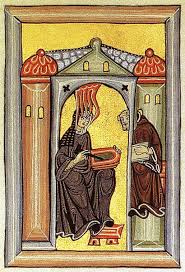
Born in 1098, the tenth child of her family and dedicated as a tithe to a monastery of Benedictine nuns at the age of eight, St Hildegard grew up to be an extraordinary and holy woman. She was a mystic, a poet, a composer of unique, soaring liturgical music so different from the plain chant of the time. St. Hildegard was the author of books, music, and plays. As a Benedictine Abbess she communicated with Bishops and Popes. She was a popular public speaker at a time women were normally not allowed to teach or speak. Abbess Hildegard was a prophet, an adviser, an influencer of her time.
Her colorful mandala like art, not created by herself but overseen by her, represented her visions of the Trinity, and other Heavenly realities. The paintings often have a multi-layered appearance leading the eye to a central space containing a symbol. Looking at them makes me feel like I’m seeing into another world or a into a great depth.
Her illustrated book Scivias describes her mystical visions and the interpretations of them she heard from God. It was written in 1151. She begins it with her experience of God commanding her to write it. It is still available now as are other works of hers which ranged from the botanical to the medicinal, to the theological. Her exquisite music has been performed for centuries.. Her musical play, Ordo virtutum, or Play of the Virtues, may well be the oldest known morality play. It is beautiful but you may jump when in the middle of the serene vocals, the wild discordant voice of Satan interrupts the song unexpectedly for a moment. I have listened to it so many times but it still startles me. Otherwise her songs are pure ethereal loveliness. You might start with The Origin of Fire (no devil voice,) or A feather on the Breath of God which sounds as poetic and pretty as the title.
St. Hildegard’s world view, like her poetry, was lush, verdant, filled with rich, vivid imagery. She was deeply in tune with nature and the divine as expressed in creation. She was profoundly Incarnational, at once earthy and luminous in her spirituality and writing.
Here is Viridissima Virga, a hymn she wrote in honor of Mary
“ O branch of freshest green,
O hail! Within the windy gusts of saints
upon a quest you swayed and sprouted forth.
When it was time, you blossomed in your boughs—
“Hail, hail!” you heard, for in you seeped the sunlight’s warmth
like balsam’s sweet perfume.
For in you bloomed
so beautiful a flow’r, whose fragrance wakened
all the spices from their dried-out stupor.
And they all appeared in full viridity.
Then rained the heavens dew upon the grass
and all the earth was cheered,
for from her womb she brought forth fruit
and the birds of the sky
have nests in her.
Then was prepared that food for humankind,
the greatest joy of feasts!
O Virgin sweet, in you can ne’er fail any joy.
All this Eve chose to scorn.
But now, let praise ring forth unto the Highest!”
Hildegard possessed unusual wisdom and compassion. People of every class came to her for medical advise, healing remedies, wise counsel, spiritual help or prayers. At times she even delivered babies.
She was a Renaissance woman before the Renaissance, a polymath, someone brilliant in many subjects and incredibly creative.
Her faith was absolute. When she was sure she was doing Gods will she was literally unmoveable. She ran into some trouble with religious authorities for burying a sinner who had been excommunicated on the holy grounds of her monastery. She insisted the man had confessed and received absolution and communion. She was not believed by the Bishop. She was ordered to have the man’s body removed. She refused. Her sisters stood by her. She and they were placed under an interdict which meant they could not sing the Liturgy of the Hours or receive the Sacraments. It was basically a mass excommunication. Hildegard became very ill in her spiritual anguish and could not leave her bed. When the Bishop sent six men to remove her, she became so heavy they could not, no matter how many worked together to lift her, be moved at all. It was considered a sign from God.
The young man’s body remained where it had been buried.
St. Hildegard Abbey, also known as St. Hildegardis Abbey, is located in Eibingen, along the Rhein river in Germany. It was founded by Saint Hildegard in 1165. It is still functioning and is visited by pilgrims from all over the world devoted to her and interested in her life and work. .
Strangely she was not canonized for more than 800 years after her death. Finally on May 10th, 2012 Pope Benedict XVI did so though she had been already widely regarded and locally venerated as a Saint after her death in 1179. This lapse was because the necessary paperwork was lost en route to the Vatican when her cause was first undertaken. Pope Alexander III ordered the witnesses of her life and miracles to be gathered and interviewed again but somehow no one ever did so.
Maybe the delay was because we need this brilliant Saint to arrive in our consciousness now in these times we live in. Who doesn’t need a beautiful vision, remarkable and holy art, gorgeous music and vivid poetry, showing us a spirit that is unique in beauty with the ability to open our eyes in new ways to the glory and splendor of God? I think we all need that right now.
Pope Benedict XVI elevated St. Hildegard to the well deserved status of Doctor of the Church on October 7 of 2012 because of “her holiness of life and the originality of her teaching.” She is one of only four women Doctors of the Church along with St. Teresa of Avila, St. Catherine of Sienna and St.Therese of Lisieux.
After Abbess Hildegard’s death the nuns of her monastery reported seeing her luminous figure several times carrying a bright light through their monastery. She was radiant and she was chanting.
We celebrate St. Hildegard of Bingen on September 17.
Evenings are my favorite time of day. Especially after the bustle of family end of day reunions, when the cooking and dinner and cleaning up is done I feel both alert and recollected.
The evenings I love most are summer evenings. There is relief from the heat of the day (sort of,) the cicadas and crickets are chanting their vespers, the neighborhood birds gather along the power line to pray and to gab about the day. I love the colors of the light at this time; rose and gold and the blue tint as dusk approaches.
Time to bring the chickens in.
They’re ready for me at the gate, waddling in a line of fluffy butts to their coop for the night.
And I love this traditional time to recite the Magnificat. I like best saying it by a window looking out so I can bless the world with Mary and her vision of the Kingdom of her Son.
Get you some iced tea now. Go to a window and pray it with us. Bless the world out there.
And Mary said,
“My soul proclaims the greatness of the Lord, my spirit rejoices in God my Savior, for he has looked with favor on his lowly handmaiden. From this day all generations will call me blessed: the Almighty has done great things for me, and holy is his Name. He has mercy on those who fear him in every generation. He has shown the strength of his arm, he has scattered the proud in their conceit. He has cast down the mighty from their thrones, and has lifted up the lowly. He has filled the hungry with good things, and the rich he has sent away empty. He has come to the help of his servant Israel for he has remembered his promise of mercy, the promise he made to our fathers, to Abraham and his children forever.” (Luke 1:46-55) Glory to the Father and to the Son and to the Holy Spirit, as it was in the beginning, is now, and will be forever. Amen.
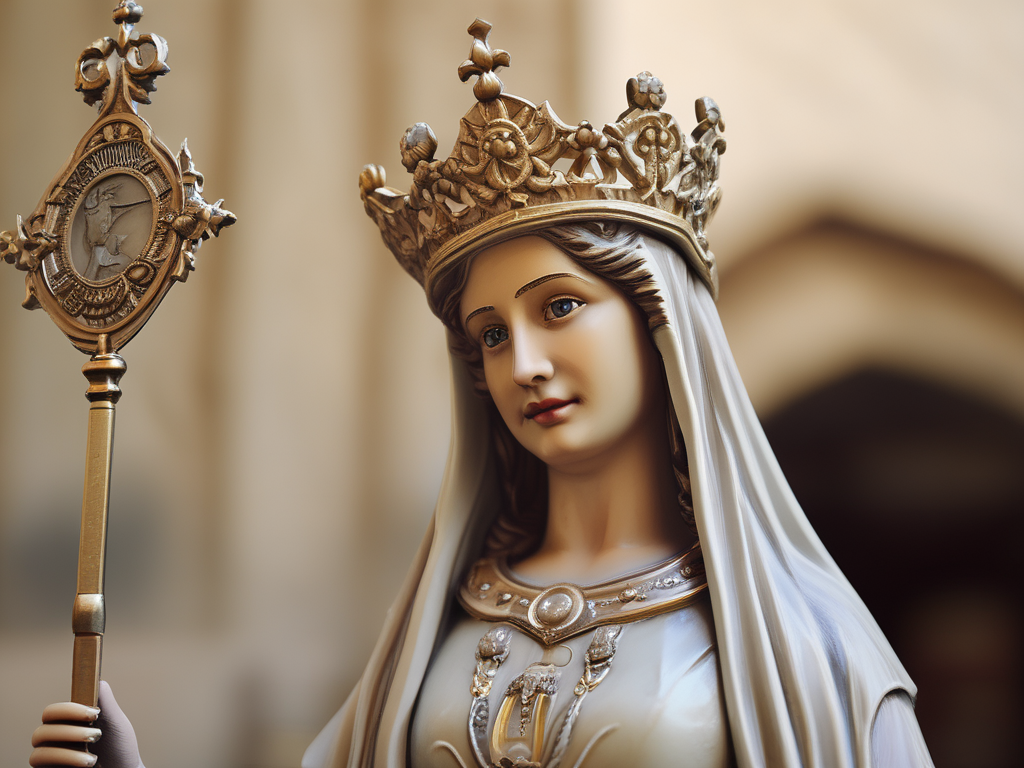
Today is Our Lady of Perpetual Help. I just don’t know what I would do without Mary. Why would anyone want to live without her? Sometimes I want to tell people just to give friendship with her a shot, try it for themselves and they will see right away what she is to us. When I think of Our Lady of Perpetual help, I think of how she was and is a good Jewish Mother. When we are in trouble, she moves in, cleans up, takes over, thinks of the little things that are actually big things we need. She rubs our back, she asks us if we’ve eaten, she calls her Son with updates. She makes sure we take a nap and have a snack and a glass of water.
She says, “Tell me what else I can do. How can I help? I told Jesus not to be late he will be here in a minute. Until then, here is some soup I just made. And a sandwich. Here you need more water you cried so much. Here’s a tissue. Wipe your nose. There you go. You know how much I love you, right? We all love you and you’re going to be OK. We will make sure.”
One time I had been crying for hours. I went to adoration and there were no tissues in there. I was annoyed. They usually have some. I got home and checked the mail. I kid you NOT I opened an envelope from a religious organization and in it there was a small packet of tissues. On it there was a picture of Our Lady of Perpetual Help. I had to laugh.
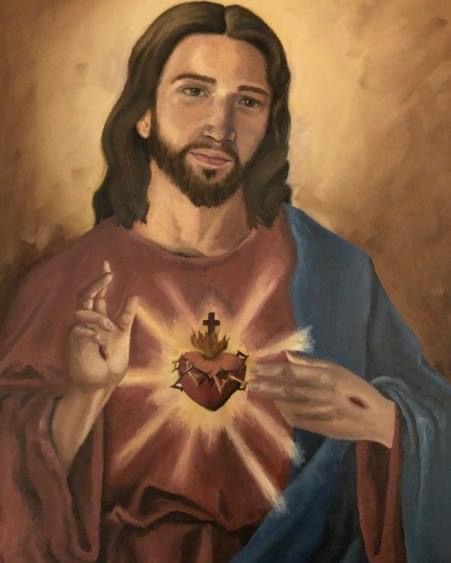
Today is Body and Blood of Jesus Sunday, otherwise known as the feast of Corpus Christi ♥️ So happy feast.
This is a good time to reflect on the humility of God who became incarnate and remains with us as simple Bread and Wine for us to eat and drink, sharing in our humanity that we might share in his Divinity. There is one Lord who suffered and died for us and we take part in his redemption of all when we suffer with that intention; of uniting our suffering to his in union with his mission of salvation, mercy and love. Under those conditions we can say someone is suffering with Christ or in a way that Jesus did. We can also say he suffers in the poor, the oppressed and those in the margins of society as he said he did in the Gospel of Matthew. That’s it. Anything else is blasphemous. We should keep our eyes on the sinless Son of God who deserves all of our love. One God one faith one baptism. He is God and there is no other.
I’m writing about this because it’s disturbing to see pictures of Trump “crucified” with Jesus or Jesus “embracing” Trump and whispering that he too was wrongly convicted. To me this is an insult to the martyrs who deserve that consolation. We Christians understand that their unjust deaths were for their faith, for their love of God and were their sacrifice for the Gospel.
Trumps’s conviction is not a situation like that whether one believes he is guilty or not. That’s almost beside the point.
Yes God loves the powerful the rich and political figures too and cares about them just as he does the rest of us. However I think there is an innate danger both spiritual and secular in comparing a political figure to Jesus. Let us rather pray for our leaders that they will be what God wants them to be and created them to be. What more could we ask for anyone? Let’s stick with that. We can never go wrong in praying for God’s will. He will give what is right – and only he truly knows what that is.
700 years ago in Ireland a young girl left her home in the middle of the night as swiftly and silently as she could. She left with a priest, two household servants and a court jester who were her friends. She was not fleeing a forced marriage to a foreign prince or running away to a convent. She was running from her own father who seemed to have lost his mind after her mothers’ death and was trying to make his daughter marry him in her place.
Dymphna and her friends were able to make it to a Belgian town called Gheel.
She must have been a hard worker and had a compassionate heart. She and her friends established themselves in the town and Dymphna began caring for the sick and the poor. She had a special sympathy for people suffering from mental illness. She still shows that sympathy now through her intercession.
Eventually her father, who was a minor Irish king, found out where she was. He had her priest executed as soon as he arrived and demanded Dymphna return home. When she refused he beheaded her on the spot. She was 15.
The people of Gheel eventually built a church over where Dymphna was buried. Over the years it began to be noticed that healings happened at her tomb, especially healing from mental illness.
Inspired by St. Dymphna’s special concern for the mentally ill the people of Gheel began to take into their homes the pilgrims who came to visit Dymphna’s tomb. In a time when the mentally ill were chained, beaten and locked away the families of Gheel made these sufferers part of their households with acceptance, freedom, dignity and whatever level of responsibility they could handle. Some stayed for a short time, some for the rest of their lives becoming members of the family.
Gheel became famous for this model of family care that seemed to work so well. This tradition is still ongoing though now combined with a hospital that is only used when absolutely necessary, and with modern medicine as part of overall treatment.
Gheel’s example makes us want to rethink the way we treat the mentally ill, especially those whose conditions are severe. Gheel shows us how it could be.
Among us here the mentally unwell often end up without homes or anyone to assist them. Federal and state agencies set up to help these people are understaffed and overwhelmed. It is a testament to serious failures on our society’s part. To see some poor emaciated sufferer shouting and waving his arms at traffic with toilet paper wrapped around his legs as I did last week breaks the heart. It’s wrong and we know it. Unfortunately our state is last in mental health access in the country.
Gheel and St. Dymphna challenge us. How can we as people of faith contribute in a respectful and merciful way to necessary change, to the well being of people who suffer mental, emotional or neurological difficulties? Our society is not set up for them. How can we help? How can we change that?
Perhaps we can begin by asking for St. Dymphna’s intercession and inspiration.
St. Dymphna, healer of mental and emotional suffering, pray for us. Pray for everyone in mental or emotional pain, especially those left on the outskirts without resources. You inspired a whole town to take people with mental suffering into their homes so that they might live near you and the place you are buried. They still come and stay with you and the people of your town today. Help us build a culture of compassion and acceptance so these children of God can live with dignity among us as the people they are and so that the rest of us don’t miss out on what they can give, on their potential part in building community. Show us the way. Amen.
St. Dymphna’s feast day is May 15th. She is the patron saint of the mentally ill, victims of incest and domestic abuse, and runaways.













 Bethany Hang Out