Search

Bethany Hang Out

Catholic contemplative life and devotion

Category

Uncategorized

Mary of Bethany; an oil poured out

Photo by Yaroslav Shuraev on Pexels.com

July 29 is the feast of Sts. Martha, Mary and Lazarus, the siblings of Bethany. Bethany was a little village not far from Jerusalem. It seems to have been Jesus’ favorite stop on his journeys, his home away from home.  Apparently these three friends were great company, and supportive of his mission. They had a house big enough for his travel companions, the food was great and Martha, Mary and Lazarus were always eager to be caught up on the latest adventures of Jesus and his itinerant followers.  

Martha and Lazarus’ sister Mary has been conflated with St. Mary Magdalene since the Middle Ages and this impression continued for centuries in Christian hagiography and art. Modern Biblical scholarship and a pronouncement of Pope Paul VI put an end to that mix up.  St. Mary Magdalen continues to be celebrated on July 22, and Mary of Bethany joined her brother and sister as her own person. 

This leaves us with three Gospel stories of St. Mary of Bethany. 

At the feet of Jesus (Luke 10:38-42)

Poor Martha is hosting all by herself, running ragged, resentful and starting to bang the pots and pans in the kitchen. Finally she decides to get her feelings out. She unburdens her heart right to Jesus. Isn’t that what we should do? Maybe not in front of the company, granted, but we should lay out burdens before him and be honest with him. He knows what’s inside us anyway. 

I like to think the Lord’s answer gave Martha peace. All the times Jesus has straightened me out when I was wrong or off course I have felt instant peace. Whether what he asked of me was easy or unpleasant I felt peace and that’s how I knew he was speaking. It seems Martha had taken on more than she was required to.  I have taken on tasks and responsibilities God was not asking me to and the first symptom I have is usually exhaustion followed by resentment and self righteousness. Eventually there will be an outburst. I hope Martha felt unbound and freed by what Jesus said to her. 

It’s easy to see Mary feeling affirmed and freed, protected and understood by Jesus’ defense of her. I recently read that the way she is sitting at Jesus’ feet listening to his teaching would have been controversial in her time and culture. It was something a disciple did. Rabbis weren’t supposed to have female disciples. The study of Torah and the pursuit of knowledge was for men only.  By sitting at Jesus’ feet as his student she was being quite bold and acting as an equal to the men. Jesus affirms her in this, allowing her to keep the place she has chosen.  

Of course we also see Mary of Bethany here as a beautiful model for Christian contemplatives. She is deeply attentive to Jesus, looking  at his face, internalizing all that he says, pondering in her heart.  

During a skit of this scene we acted out as a family my then four year-old daughter Maire had Mary get up, offer to take over the host duties, and invite Martha to take a turn at Jesus’ feet. I like that a lot. Maybe it was that way. 

Mourning Lazarus John (11:1–45)

Lazarus fell ill. His sisters cared for him and prayed over him, waiting for Jesus to come and heal him. They knew he could save their brother. They sent an urgent message. Mary would have sat by her brother’s bed keeping vigil, offering him her gift of profound presence and connection. Martha would have changed his blankets, kept a wet rag on his head, brewed medicinal teas, asked advice from the wise, sent for doctors, made favorite dishes she hoped he would eat. Sometimes they would have had to switch places and learn the other one’s ways of loving and serving. 

Jesus never comes, though they keep a lamp burning for him through every night in hopes he will. Every footfall outside, every stirring they hear they think perhaps it is Jesus or at least a message from him. They don’t understand. Why doesn’t he come? Why doesn’t he respond? 

Lazarus’ illness becomes imminently  life threatening, their anxiety for him so intense, neither of them sleeps at all. They hold him in his struggle for breath and as life ebbs away. 

They try to comfort one another. They ask each other, “Why did Jesus never come?” 

They wash and anoint his body with the women of their family winding him in scented burial cloths to bury him in their family tomb.  

The house is full of family friends and neighbors sitting shiva with them. https://www.shiva.com/learning-center/sitting-shiva

Finally Jesus shows. Martha as we have seen her do before, makes her thoughts and feelings known to him. She confronts Jesus while at the same time expressing her faith in him. She knows he could have saved her brother as he has saved so many others. She also has come to know and believe he is the Messiah and Son of God, just as Peter had also done and she says so. “Even now,” Martha says hopefully, “I believe.”

She runs to get her sister who is in the house with all the mourners and tells her Jesus is here and asking for her. 

It’s when Jesus sees Mary’s tears that he cries too. This is important to me, to all of us. Yes for some reason Jesus does allow bad things to happen to us. At the same time, as Madeleine Le’Engle says, everything that happens to us happens to God too. 

Mary also confronts Jesus, falling at his feet, her movement a desperate plea of prostate grief. 

He doesn’t ask Mary for a declaration of faith. Maybe he knew she had it in abundance already. He only responds with his tears and his actions. He gives her her brother back alive. 
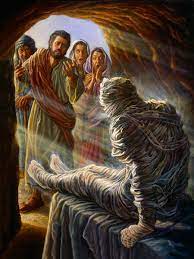
Photo by Zaksheuskaya on Pexels.com

Anointing Jesus (John 12:1-8)

This is the beautiful story that captures the imagination so powerfully; Mary of Bethany interrupts dinner, unbinding her hair, carrying in an alabastron of outrageously expensive perfume worth a year’s wages. 

Since she seems to have been unmarried (as she is living at home) perhaps it had been meant for her dowry. To me this brings out an extra meaning. Perhaps she intended never to marry and to fully dedicate her life to Jesus, pouring out her love and devotion to him alone. 

Her contemplative nature, her attentiveness and connection to Jesus lead her to anticipate his death; the only one of his followers who understood that it was imminent, and maybe even what his death would mean.  

With compassion she comes to acknowledge both what he is about to endure and what he means to her. 
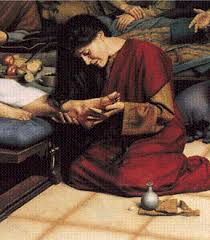
Have you ever smelled spikenard, aka nard?  It is not a floral scent but a sharp, pungent smell. It would have filled the whole house and the scent would have lingered for days and days in every room and on both Jesus and on her hair.

The others at the table were offended at her extravagance, saying the nard could have been sold and used to feed the poor. Jesus defends her. We will always be able to help the poor but we would not always have him. “She has done a beautiful thing for me.” She dries his feet with her hair.  

Women’s hair was supposed to be covered in public and especially in the presence of men who were not their husbands. Here our Mary of Bethany unveils and not only that dries the feet of Jesus with her hair. I wonder what those present would have made of that? 

I’m thinking of the spiritual marriage written about and experienced by the great mystics of our faith such as Sts. Teresa of Avila, John of the Cross, Rose of Lima, Catherine of Sienna among others, in which the soul becomes one with God. Maybe Mary of Bethany was experiencing this or had. Maybe this bold and lavish gesture was her response, her understanding of his destiny born of that union and love. 

Wouldn’t you love to be able to comfort Jesus with your compassion and love? To do something that is deeply meaningful for him? To pour out your love diffusing its fragrance through all his house, to smell it on your hair for days to remind you, knowing he also carried it? To remember his words, that you had done a beautiful thing for him? 

We can. When we love, when we serve, when we pray like an oil poured out to the One we love. 

 Your anointing oils are fragrant; 

your name is oil poured out; 

therefore maidens love you.

Song of Songs 1:3

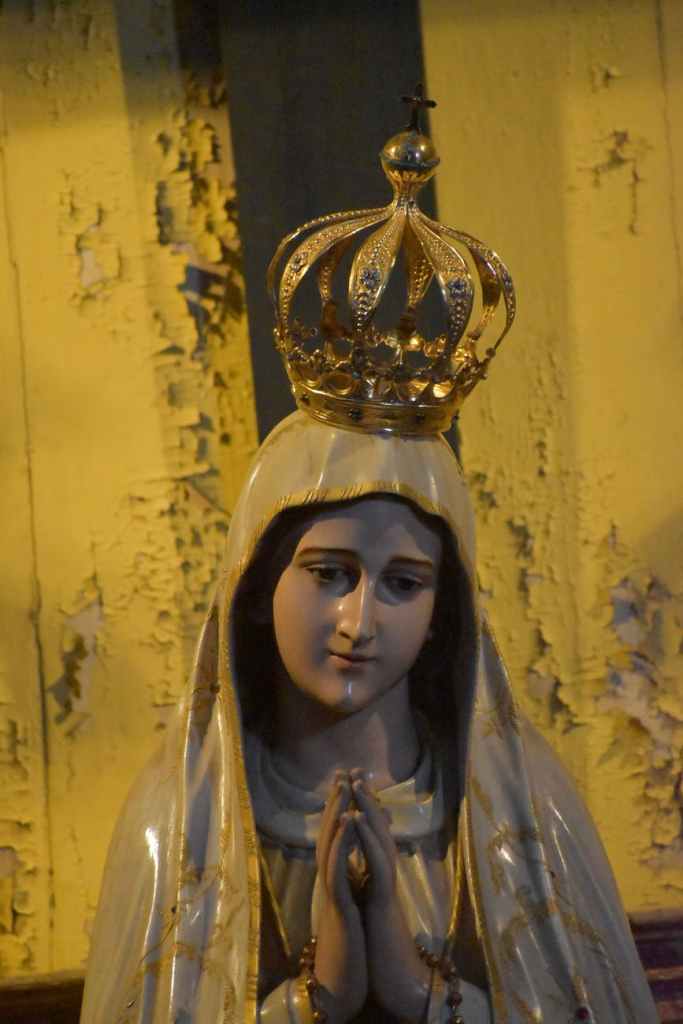
Our Lady of Guadalupe at the Walmart Memorial in El Paso

The shooter was sentenced to 99 life sentences this week.

Shawn Chapman's avatarBethany Hang Out

Fifteen or more years ago I had a dream that is still vivid to me now. I was in a small, dimly lit church where the early arrivals were just sitting down before mass. Near the altar there was a large terra cotta colored relief of Our Lady of Guadalupe. I was standing in the aisle gazing at this rendering of Our Lady and it started to become beautifully colorful. A man in the pews to my right started complaining about the image and saying there were too many (*racial slur*) around here already and the image should be removed. He continued to complain about dark skinned people being in the church and “taking over.” I was extremely upset of course and started begging him not to say things like that especially in the church. As I continued to try to persuade him, the corner of Mary’s dress began to…

View original post 1,256 more words

St. Maria Goretti; a different take


July 6 is the feast of St. Maria Goretti, a Saint I love very much.

Loving her was not immediate for me. My appreciation of her has been more of a journey. I had to take a prayerful look at her life and my own life too. She became a good friend and has always been there for me.

As a survivor of child rape the way her story has most often been interpreted is disturbing to me. Holding her up to young people as a “model of purity” does not fit out current understanding of the dynamics of sexual abuse. I often read she “resisted a challenge to her purity.” She was eleven. She did not want to be raped. No one does. Abuse is not the child’s choice or fault. We know that though usually that is not how the child feels. Those feelings are hard to get over and can last a lifetime. Saying she was pure because she managed not to be raped and was murdered… instead? Can sound twisted to us survivors and not only to us, to anyone who knows much about these things.

Maria had survived the death of her father. Her mother had to go out and work the fields by herself. They had to share a house with another family. The other family had a disturbed young adult son. Maria had to take care of the house and the younger children. She was very gentle and kind. The young man thought she would be silent about his advances (most children are) and he was right. He thought she could be cowed into doing what he wanted. He was wrong. It’s not that I’m not proud of her for resisting, and for the way her thoughts even in those moments were on God. It’s amazing. She tried to persuade him with concern for his soul. He was angry with her for this and certainly for her noncooperation. So he murdered her, stabbing her fourteen times.

At the hospital her priest asked if she forgave her killer. She said she did. A lot of us are asked to forgive our abusers. It’s inappropriate for someone to ask that of us. I understand she was dying but that still bothers me. So many of us are asked to do this so we don’t make other people uncomfortable or mess up the status quo. So we are expected to carry the load alone so nobody has to deal with the relational and systemic consequences of us telling the truth. So I don’t like that he asked her that.

Later she appears to her killer in prison with fourteen lilies, one for each of her wounds. I love this. I love it because it shows that she did have the wounds. They are real and have meaning. He is confronted with that truth. However in Heaven her wounds are transformed and can become a gift to transform others; even the one who did the wounding. And he is transformed. He is converted and joins a monastery. He testified in the investigation for her cause of sainthood.

Something that moves me is that when she was exhumed her body was (and still is) incorrupt. Like Snow White she lies in a glass casket now. People come and pray and look at her.

What is God saying by this?

St. Eulogius wrote to St. Flora when she was about to be sent as punishment for being a Christian into a brothel, that even if her body was violated, her soul would remain pure. When I read about that I was very struck by it and I have remembered it for years. Abuse survivors don’t feel pure. We feel gross. I felt deeply flawed and somehow dirty all through childhood. It has taken years of work not to feel intense shame all the time. The idea and the trust that my soul is still pure regardless was profound for me.

I am sure that St. Maria felt violated by what happened to her. She was groomed and sexually propositioned at eleven years old. She was afraid of that man. That is already not OK. Just because he didn’t succeed in penetrating her doesn’t mean what she endured was not a sexual assault. He assumed like the “incels” of today that he was entitled to the bodies of women and girls, that they owed him access. He didn’t see her as a person deserving dignity and sexual autonomy. Her refusals enraged him and he brutally murdered her.

And that beautiful girl found healing in the arms of Jesus. She had been extremely devout. The love she always had with God carried her to Heaven and she was given the work of healing, real healing where the truth is brought to light and with God’s touch becomes a light for others.

He left her little body free of corruption to reveal to us the beauty of her bright soul treasured and healed in his heart, in his light.

Yes she is pure. She was always pure whether a man sexually assaulted her or not. Her body is holy and precious to God. He wants to show her to us. He wants us to know.

The pure of heart shall see God.

Photo by Tomas Williams on Pexels.com

Mary’s life of letting go

Photo by Min An on Pexels.com


Today’s Gospel (Mt 10:37-42) made me think of how Mary constantly let her own plans go in order to embrace what God was asking of her. She did this over and over. “Whoever loves (fill in the blank) more than me is not worthy to be my disciple. Whoever does not take up her cross and come after me is not worthy to be my disciple. Whoever finds his life will lose it. Whoever loses his life with find it.” At the Annunciation Mary whole heartedly accepted a surprising and sudden radical change in the course of her life. She continued to do this again and again throughout her ministry as the Mother of Jesus and Mother of the Church. She even accepted and offered to God the brutal death of her Son. She let him go at the Ascension. She left home and family to join the community of believers. She left all she knew again to go with John the Apostle to Ephesus. Again and again she let go and accepted change and loss for the sake of the Kingdom. So if you feel like there is a sign on your life that says “EVERYTHING MUST GO!” Remember Mary’s beautiful crown of stars. Remember that. Because you’re getting one too! 💫

The Liturgy of the Hours

Photo by Jaymantri on Pexels.com


Every morning as sunlight makes its way across the earth, the  praises of God awaken from the heart of the  praying Church. Behind  the sunrise the praises and petitions continue through the hours of the day. As each time zone turns into the darkness, Night Prayer is raised to God beneath the moon and stars. 

This is the official prayer of the Church called The Liturgy of the Hours, The Divine Office, “The Work of God,”  prayed by Catholics of every vocation, by Pope Francis, by our Bishops, priests, religious, and by many lay people as well; the same words of prayer in every language of humanity. 

It is an anchor in the day, a way to sanctify time, express unity with the whole Church, and to call our hearts back to God again and again. 

Morning and Evening Prayer are laid out for us daily as a hymn, two Psalms, and a Scriptural Canticle, (a poem or song in the Bible that is not a Psalm) each with antiphons, (a reflective one line prayer) and followed by “Glory to the Father and to the Son and to the Holy Spirit. As it was in the beginning, is now, and will be forever. Amen.” 

After the  Psalms and Canticle there is  a Scripture reading; usually from  a New Testament letter. 

After that  there is what is called a “Responsory.” For example: 

 Just is the Lord, in justice he delights.
— Just is the Lord, in justice he delights.

He looks with favor on the upright man;
— in justice he delights.

Glory to the Father, and to the Son, and to the Holy Spirit,
— Just is the Lord, in justice he delights.

This will be followed, for Morning  or Evening Prayer, by a New Testament Canticle. For Morning Prayer, this will always  be the Song of Zechariah (Luke 1:68-79). In the Evening it will be Mary’s Song we call The Magnificat ( Luke 1:46-55),  each with their respective antiphons.. 

After this are the Petitions, similar to the ones we pray at mass. These are different each day. Then we pray the Our Father and a closing prayer that changes daily. 

The other daytime  “Hours” : midmorning, midday and mid afternoon are more abbreviated.  Night Prayer is brief and includes an Examination of Conscience and Act of Contrition or Confiteor, along with its Psalms prayers and canticles. It ends with a Marian antiphon such as the “Hail Holy Queen” to kiss our mother goodnight. 

Photo by Rok Romih on Pexels.com


The “Office of Readings” will have a longer reading, usually from the Old Testament, and a Patrisric reading (from a Church father or from the writings of a Saint) and can be prayed any time. 

These prayers in their daily format can be found in the four volume version of The Liturgy of the Hours which unfortunately is a bit expensive for some. You can also buy  the one volume version called Christian Prayer if the expense is prohibitive. Christian Prayer does not include the Office of Readings. 

It’s hard to learn to navigate the volumes at first while you are getting used to this. You might want to buy what’s called The St. Joseph Guide, a little paper book that gives you all the page numbers for each day.  There is a lot of page turning and going back to a page and so on. I once heard a priest describe it as “death by ribbons.” Yes it feels like that! 

It was worth it to me to learn. The Liturgy of the Hours has become an indispensable part of my everyday life, connecting me consciously to God and to the whole Church at the times of day I pray it. As Secular Carmelite I am committed to pray Morning, Evening and Night Prayer daily. 

Through hard times I have prayed every available “hour” to help me get through the day, which was healing and helpful for me. At all times the rhythm of it grounds and connects me with the family of God. 

Morning and Evening Prayer should take about ten minutes for you to pray at a normal pace.  The other “hours” are shorter. 

When we pray the  Psalms of  Liturgy of the Hours we  are praying with Jesus who prayed these too as did the generations before him. We are praying with the whole Church, with the voice of the Church. 

I love praying with everyone. 

Another thing I love about praying The Liturgy of the Hours all these years is that the Scriptures they contain are written in my heart. A line from a Psalm that is just right will come to me at exactly the right time when I need it. The prayers , Canticles and  Psalms are woven into my life now like flowers in my hair. 

Photo by Valeriia Miller on Pexels.com

I look forward to praying the Divine Office as I wait for my coffee to brew,  or when I start thinking about what to make for dinner, or when I am getting ready for bed. 

I enjoy praying it alongside others as well, especially my family and my Carmelites when we are together. When we are apart the liturgy connects me with them.  

Know that praying The Liturgy of the Hours does something. It is never just a recitation. 

“For the word of God is alive and active.  (Hebrews 4:12a) 

“So shall my word be that goes out from my mouth; it shall not return to me empty, but it shall accomplish that which I pupose

and shall succeed in the thing for which I sent it.”  (Isaiah 55:11)

We are praying God’s words, and the words of the Church spoken by the Holy Spirit. We are participating in the healing of the world. We are allowing ourselves to become conduits of God’s grace when we join our brothers and sisters spiritually for “The Work of God”. 

Now I will tell you a secret. The secret is that nowadays you don’t have to go through “death by ribbons” unless you just want to. I feel like a cheater because I use the app now though I still cherish the books. I have the app called Divine Office on my phone. You can also pray from the Divine Office website or the other one,  Universalis. 

So you see? It’s not hard. Come on and join us. You’ll be glad you did.   

From the rising of the sun to its setting, let the Name of the Lord be praised. (Psalm 113:3)

Photo by NO NAME on Pexels.com

*This piece originally appeared as my column in The Eagle Newspaper Saturday June 24, 2023

The Ascension

Photo by Ruvim on Pexels.com

To us who celebrate it every year the Ascension of Jesus  seems to naturally follow the initial celebration of his Resurrection. 

However I imagine it was an earth shattering surprise to his followers that he would be leaving them yet again. 

When I reflect on this event as part of the rosary the virtue I link to the Ascension is detachment as I see him beautifully disappear before the eyes of his followers as “a  cloud removed him from their sight.” 

The family of believers had to let go of their expectations that Jesus as they knew him would permanently remain to walk and talk with them. Again they had to face that Jesus was not about to get rid of the Roman occupiers either. There would be no restoration of the Davidic Kingdom  in the literal way they had thought of it. And the One they loved was going to withdraw from them yet again. They must have felt as if they were back from the defining experience of their lives with nothing to show for it, as if they were just a rag tag group of people standing on a mountainside for no particular reason. They were shocked and bereft. They didn’t understand what Jesus meant about him having to leave that the Holy Spirit could come to them. How could they? 

When the angel said that Jesus would be back they must have shaken their heads. Jesus had said for them to go and baptize, to take his message to the world. This must have seemed like too much for them, an overwhelming task, especially on their own. 

They had to greatly expand their understanding of God even past the miraculous three years they had left everything for and deeply identified with now. 

They had to let go so they could be filled and receive Jesus in a whole new way, by his presence in their hearts, and to come to know the Holy Spirit who was new to them. 

How can we receive the Spirit without detachment, self emptying, without freedom of heart? 

“Love- the way God wants to be loved, and leave off your own way of acting,” said St. John of the Cross. 

Or, as Jesus said to St. Angela of Foligno, “Make of yourself a capacity and I will make myself a torrent.” 

Jesus said that if his friends loved him they would be happy he was going to the Father. (Jon.14:28) Is there something more to that than being happy for him? Yes, because he says, “for the Father is greater than I.” Maybe it also means that we have to let our current perhaps more comfortable understanding go to make room for the immensity he has for us. We can be happy he is going to the Father because then, in letting him go as we thought we had him, he then is truly closer than our breath, more accessible than ever. Detachment is hard. We feel that we are losing our Treasure.   

 St. Faustina said of Mary’s experience of the Ascension that she deeply grieved as any mother would  that her Son was leaving but that, “her heart could not want what God did not want.” 

In seeking a pure heart for God and a Marian detachment; a detachment with great love, a detachment even from the way we thought Jesus would be present to us, we open ourselves to what is even greater, beyond what we could ever have thought of ourselves.  But first we let go. 

“Bend  my heart according to your will, O God.” (Ps. 119:36) 

Then, 

“I shall run in your paths for You will enlarge my heart.” (Psalm 119:32)

In this is peace that comes from open-ness to God and freedom of heart.

These verses are a perfect prayer to cultivate holy detachment as the disciples struggled to do this, standing there on the Mount of Olives, not knowing what to do with themselves. 

Fortunately we don’t have to rely on our own strength in this and neither did they.

Jesus had said to wait in Jerusalem and to pray. They did. They trusted in simplicity. And prayer continually purified theirattachments and intentions as disciples, transforming their dismay into receptivity.   

They still longed for Jesus; his voice, his hug, the sound of his footsteps, “like a deer that longs for running streams in a dry weary land without water,” (Ps. 42:2)  However they soon found that once emptied, their muddled and broken hearts were then open to the new gift of God’s presence; the descent of the Holy Spirit at Pentecost, filling them past overflowing, their thirst for God more than quenched.  “Your torrents and all your waves swept over me.”  (Ps. 42: 8)

Come, Holy Spirit, come. 

Photo by Jimmy Bolt on Pexels.com

Red


Red had an easy laugh; open and free 

He laughed at himself because he was funny, 

And at the world because it was his playground and he loved when it surprised him.

At The Eagle Newspaper pressroom

Red was irreplaceable 

Ingenious 

An out of the box thinker who loved to save the day. 

He liked telling pressman history and showed me how to fold the paper hats they used to wear in the old days to protect their hair from ink. 

He was proud of his work. 

Red had endurance


Working long hours until the job was done. 

I hardly ever saw him not covered with grease and ink. 

He was often seen eating refied beans out of the front pocket of his uniform. 

Red was a hard worker but a rebel 

Full of mischief although he understood honor 

A little crazy though he had his own wisdom. 

He would have made a good pirate. 

Great in an emergency Red had the presence of mind to laugh and take a sweeping bow when his hat caught on fire. 

He was a gentleman who smiled at the ladies, opened doors for us, always ready with a compliment “You smell good!” 

Red was kind, believing in love. 

Red was a wild man.

Red could fix anything 

Blow up anything

Get into anything 

Race anything. 

He had a theatrical sense of humor; coming to work dressed in a sarape and sombrero, maracas in hand.

It was a national immigrant walk out day but those in the mail room were not allowed to participate under threat being fired. Red and Bob harassed the manager all day yelling “No worky Monday” on their behalf. Loudly they sang in fake Spanish their made up Tejano music making said employees screech with laughter and take pictures.

And who could forget Bob and Red’s mock strip tease routine in their tool belts when they popped out of a cardboard cake for that mail room crumudgen on his birthday? 

Red was accident prone.

Once accidentally peeling off the top of an Eagle truck under a bridge. We had a picture of him shrugging dramatically at the scene, smile intact.

Red was the most believable Gun Smoke cowboy and on alternate years, tie dye hippie, at The Eagle Halloween parties, always in character with memorable lines off the cuff

Red always had something inappropriate to say to make us shake our heads and laugh.

Red believed in peace but he didn’t mind stirring up a little trouble now and then.

Red was a dare devil we were sure would go out in a blaze of glory one day.

Red loved his six Yorkies with all his heart maybe especially Chester the rattlesnake fighter. 

He loved his kids and spoke of them often. 

He married in his teens and stayed with his wife until her death, often writing on face book afterward, that he would love her forever.  

Red tattle tailed on my daughter but also defended her to me, reminding me she was a good girl. 

Red made everything he touched and every place he inhabited into art. Things that dangled, things that drove, things you weren’t sure about. He was an unusual yet somehow traditional decorator. Odd keepsakes and knick knacks you couldn’t mistake for anyone else’s’ filled every available space of his house. 

Red had a quick mind and a ready wit.

Once he fixed a dirt bike in the woods with a rock.

At The Eagle Red is legend, someone we’re proud we knew. 

Red repaired my rosaries with love though he made cracks about it the whole time. 

Red loved the press crew as his brothers. 

He was there for my husband when he was dying, racing him around in his wheelchair for “one last ride.” 

He said he and the press crew wanted to heal my broken heart. 

Well they did. 

You helped a lot Red.

Red was a good friend to all of us. 

Red was reckless, adventurous, a lover of danger but he could be a sage at times, cautioning me against resentment. 

If he left us with a message maybe it would be a kindly but funny warning like the one he spray painted on a barrel of toxic waste the guys were stacking on the dock to be taken away; bad shit do not eat.” 

Red would tell us to forgive, to let things go and not to ever let hate settle in our hearts to embitter us. 

He would tell us to live, love and be free.

Don’t eat  bad shit that will damage your well being and the priceless gift of joy. 

I don’t think Red  will just “rest in peace.”

Too much to do.

God will have to start breaking stuff to keep Red occupied. 

We love you Red. 

In the great beyond

You do you. 

In silence and trust

Photo by Evie Shaffer on Pexels.com


Oh silence you are so safe and all is contained in you. As much as music fills my soul so do you nourish me as you gather yourself to me and come into my heart. God’s embrace is silent, his kisses on the soul even more so. God creates a silence, a unique solitude, a stillness with his presence, a stillness we all know and recognize as his.

Holy Saturday is about the silence of the earth, silence of the soul of the world.

Silence in the depths of Mary’s soul even in grief.

Wherever you are today take some time to enter into her silence. And trust.

“Your strength will be in silence and trust.” Isaiah 30:15b

Photo by Pixabay on Pexels.com

Mary at the foot of the Cross; a reading from my book Come to Mary’s House; spending time with Our Blessed Mother

Shawn Chapman's avatarBethany Hang Out

Photo by Joshua Miranda on Pexels.com

View original post

Blog at WordPress.com.

Up ↑