During this little slice of Ordinary Time after Christmas and before Lent we might begin to feel spiritually unenthused. Maybe we were already. Maybe we even avoid prayer and the practice of our faith. Maybe we have an aversion to our daily duties. Maybe we’re bored and drawn mostly to distractions. What’s going on? St. Evagrius (AD 385-399) who lived in the Egyptian desert as an early monastic wrote about something called acedia.
What is acedia? The Catechism of the Catholic Church (2733) calls it a form of depression caused by giving in to spiritual laxity or presumption. The Desert Fathers thought of it as a spiritual condition people can fall into with a complex set of symptoms, a spiritual malady, or even as a demon.
[Acedia is] a hatred of industriousness, a battle against stillness, stormy weather for psalmody, laziness in prayer, a slackening of ascesis, untimely drowsiness, revolving sleep, the oppressiveness of solitude, hatred of one’s cell, an adversary of ascetic works, an opponent of perseverance, muzzling of meditation, ignorance of the scriptures, a partaker in sorrow, a clock for hunger.
St. Evagrius
Yikes.
St. Evagrious of Pontus says the real roots of acedia are self centeredness, anger and misdirected desire. When oppressed by acedia we tend to seek comfort and pleasure to counteract the restlessness we feel, and in response to our aversion to spiritual practice. We avoid the tasks we are responsible for. We withdraw from charitable activity and are more prone to gab with others for our own entertainment and distraction than to be useful to them. We fill our lives with surface busy-ness, avoiding prayer and study. We lack spiritual desire and quietly long for things and activities that will draw us away from the spiritual. We are both restless and exhausted. We want to sleep, we want to pace the floor. We feel at once angry and dissatisfied as well as listless, staring at nothing. This sounds terrible. No wonder Evagrious called it “the most oppressive of demons.’
All of this reminds me of a passage from one of my favorite books, The Phantom Tollbooth by Norton Juster.
“There once was a boy named Milo who didn’t know what to do with himself; not just sometimes but always. When he was in school he longed to be out, and when he was out he longed to be in. On the way he thought about coming home, and coming home he thought about going. Wherever he was he wished he were somewhere else, and when he got there he wondered why he’d bothered. Nothing really interested him- least of all the things that should have. “It seems to me that almost everything is a waste of time,” he remarked as he walked dejectedly home from school.”
And “… while he was never anxious to be where he was going, he liked to get there as soon as possible.”
Had Milo been a monk he would have been diagnosed by the Desert Fathers like Evagrius, as suffering from, and indulging in acedia.
If we find ourselves troubled by acedia, what is the remedy? What should we do?
Master your thoughts.
Notice when your thoughts are going into that irritable, lazy restless lane again, and change course as soon as you notice. Something that helps me is to repeat the names of Jesus and Mary; “Jesus Maria Jesus Maria Jesus Maria” each time I find myself on that negative track again. Be patient with yourself. It doesn’t help to be mad or disappointed in yourself. Simply move on and persevere.
“Whether or not all these thoughts trouble the soul is not within our power; but it is for us to decide if they are to linger within us or not and whether or not they stir up the passions.”
St. Evagrius
Resist. If you want to sleep or run away or indulge in compulsive activity, persevere in what you are actually supposed to be doing in spite of how you feel. If you are avoiding prayer, pray. If you are avoiding your duties, get back on track. If you’ve lost sight of your routines, get back to them. I suggest working on one thing at a time so you aren’t overwhelmed. When you are stuck in acedia even one of these things can be hard enough to change.
Gratitude. Write down five things you are grateful for when everything is getting on your nerves. It works surprisingly well.
Manual labor. Nothing helps me as much as some vigorous sweeping, mopping or dragging things around outside. According to the Fathers, acedia is both mental and physical. This is why it’s so hard to kick.
Meditate on the Passion and Death of Jesus. Maybe praying the Sorrowful Mysteries of the Rosary or The Way of the Cross can assist you in this. This is uniquely grounding for us as Christians.
Ask God for the gift of tears. According to Evagrius, the gift of tears in prayer, and tears of repentance are indispensable for liberation from acedia. So have a good holy cry, it cleanses the soul.
Preach the Psalms to your own soul. As Dorothy Day wrote, “My strength returns to me with my cup of coffee and the reading of the psalms. ”
Engage your intellect. I learned this from Fr. Gregory McLaughlin who taught me that when I was being ruled too much by my emotions, I should study, especially religious study such as Scripture or good spiritual reading. It works.
Go to confession. This may seem obvious but remember the Sacrament of Reconciliation is healing and restorative. God gave us Confession so we can receive his mercy, overcome our sins and begin anew which is exactly what we need to be free of acedia and free for God.
Good deeds. Go through the day quietly tucking in small kindnesses wherever you can. This is a remedy for almost any malady of any kind. When you are ready, throw yourself into working for others in some way.
Gently fold these things into your life and you will soon sense a clear fine spiritual love reclaiming its place in your heart.
I dress kind of shabbily, or so I’ve been told; not in a mean way. I don’t mind hearing that. In fact my bandanas and old jeans and t-shirts with worn out shoes have allowed me to gain some insight into something going on in the churches that is or should be of great concern to us.
Not too long ago I stepped into an adoration chapel at a church I don’t attend as often as my own parish. I was looking at some pamphlets and holy cards near the front door in the foyer. There were some people who had just finished an event that seamed to have ended. One of them came over to me. “Can I HELP you?” She asked pointedly. I was dumbfounded which is funny because this isn’t the first time this has happened to me at church ( I do attempt to dress more nicely for mass). One time when this happened, I had said, truthfully, “Yeah I’m looking for the ministry schedule.” This time I could think of nothing to say for myself. We continued to stare at one another. Suddenly she looked at my Immaculate Heart of Mary shirt and seamed embarrassed. It was OK. I wasn’t mad. I didn’t want her to feel bad. But because of experiences like these I have had and that others tell me they have had or have seen I am worried about something.
I’m worried that we don’t seam to have contact with the poor at our actual Catholic parishes generally. In my area and also in Lubbock the Catholic Churches have kind of “contracted out” that experience to a Diocesan charity all the parishes contribute to. I’m sure it’s not intentionally in order not to have the poor and homeless around our churches. However that is mostly the result. Furthermore it appears everyday Catholics don’t want the poor and the homeless around. Some have police or security guards at the door during mass. There could be a lot of reasons for this. I have asked around but never gotten a satisfactory answer, only vague or seemingly evasive ones or else the people I asked didn’t know.
I just have to wonder what message we give an outsider who may be nervous about coming in. Some people are comforted by the presence of the police but I don’t know any low or no income people who are. Having grown up in an alternative or “subculture” style household I don’t like seeing police around either. No hard feelings I just don’t. Their presence doesn’t mean anything good to me. So I imagine anyone needing help or community but hesitant to enter a church even though they want to may interpret a police presence as unwelcoming and frightening. It’s a great deterrent but is that what we want? How necessary is it to have that? I’m open to answers. I honestly don’t know.
In Austin I attended mass at a parish that has a little attached building in the back of the church where the homeless can come and get something to eat, something to wear, a blanket, whatever. When you come to the church during the day there are unhoused people sitting at picnic tables drinking battled water, maybe eating sandwiches. Some of them come to mass. I like that a lot. There is a chance to get to know them, an opportunity to learn what their lives are like, what their problems are, and in what ways they want to be helped in contrast to how we want to help them. Not everyone stops to say hi to them but some do. What a great idea.
By seeing the unhoused at mass with us we receive the message that we are one with them, that we are all in God’s eyes, on the same level. This is so much better than having them be out of sight.
It seems to me that the more contact we have with people in need and get to know what they’re about and what chronically troubles them, and what they think they need, we would be better able to deal with these problems on a larger scale.
Another time I was coming out of mass with everyone else in an Austin church on a very cold night. A young woman was waiting outside. She looked very young and very scared. She had two little kids with her. She was asking for bus money or anything anyone could do. Most people filed past her as if she were not there. Others looked at her as if they smelled something bad. I didn’t smell anything but winter air and unkindness. What are we all doing here worshipping Jesus and then ignoring him outside of mass?
That’s shabby.
Sometimes I have looked away from someone in need when I knew I didn’t have any money or any way to help. I had to learn to cut that out. It’s a shabby reaction. I can at least greet people like this and talk to them, try to find out what’s going on, let them feel cared about. I may even be able to help them in some other way than what I thought they would ask.
In the same parish where some people have treated me like I don’t belong, I was scolded years ago by a long gone priest at a local parish about having been late to mass because a woman with a baby was standing out in the cold asking for help and I tried to help her… which made me late. He said they didn’t want to encourage this kind of thing (people coming up to the church asking parishioners for help) and also that I should prioritize being punctual for mass. This was another time I had no idea what to say so I just looked at him. I said, “Oh.” I wanted to tell him I didn’t think I could do that, just couldn’t. On the way home I prayed about it. “Am I really supposed to do that?” I didn’t know. But it has never made sense to me.
A pertinate Catholic social teaching is the Preferential Option for the Poor. How can we practice that as Church if we are only sending money to some charity we know little about, or random collection of faceless (to us) poor? To me love should be more personal if at all possible.
If I give all I possess to the poor and give over my body to hardship… but do not have love, I gain nothing. (1 Corinthians 13:3, a &c)
It does seem as if just giving money isn’t enough.
How can we as Church encourage our government leaders to enact policy that is really helpful to the needy if we don’t know what goes on for them or even know any of them at all? When we don’t know we tend to make things up, assume things we shouldn’t, or just believe other people who may have their own agendas concerning the issue at hand. I think we should find out if a politician speaking about these things knows any low income or no income or mentally ill or unhoused people personally before we consider their ideas about what should be done or not done.
I often hear, “We should let the charities take care of that.” The problem with that is that the need is overwhelming. Donations are low. Local charities in my area are out of money almost as soon I they get it. One I’m fairly knowledgeable about only takes calls on Fridays. On Fridays about twenty people can get through and then they’re out of donations again and can help no one else. I usually advise those in need of their help to invite all their friends over and have everyone call repeatedly starting early in the morning. Then maybe somebody will get through.
A good friend of mine who had to resort to food stamps when her husband was ill and needed constant care was only able to get $23 per month in assistance. Sometimes I talked to her and she hadn’t eaten for several days. She lives eight hours away or I would have taken her our dinner. The food bank where she lives is out of food all the time. Charities do amazing work. But we can’t always think we don’t have to help because they’re doing all that on our behalf.
On behalf of another family I was trying to help I called and I drove all over town and could only get a Wal-mart card for $50 from Catholic Charities. They were out of money. Everyone was. The clinic said they couldn’t help the very ill mother either because her extremely painful illness was not on their list of illnesses they could help with. The family, the very sick mom and her two sons only got $11 of food stamps per month. Yes you read that right. Eleven dollars.
I have learned so much about what really goes on by getting to know people who live in survival mode and have to depend on charities, churches and government agencies for the necessities of life either all or some of the time. I learned enough to know I don’t know anything about anything and that I need to make an effort to find out for myself what they go through.
What I’m hoping to do here is make a case for Catholic Churches to stop merely farming out their work for the poor and welcome them instead. As parishioners we are missing out not having the poor around. We are also getting the message that the practice of our faith and worship is separate from helping the poor. Nobody says that but isn’t that the way it is playing out? We want to go to mass and not be bothered with them. We think it is a nuisance. Maybe it is but I don’t think Jesus has prioritized that.
One area parish I called on behalf of someone needing help does refer everyone to that charity the churches here contribute to. However they also have someone in the office who calls and talks to the person and sees what else the parish can do. The person I was calling for had just lost her boyfriend to a tragic event she had witnessed. He had died a few weeks prior. I hadn’t even thought of grief counseling for her I was just trying to get her help with her bills. The woman who called from the church got this girl hooked up with free grief counseling.
All the parishes can do that. Maybe they do. However in my experience of trying to be of help people, what they get when they call a local Catholic Church is sent away with yet another phone number to call or list or a brochure to check out. Sometimes these are outdated and the places on the list don’t even exist anymore. We can do better than that. We can be more personal. We can make sure they don’t feel stupid or unwanted or unwelcome when they come to us. We could have a little food pantry or clothes closet or some diapers on hand at least. Some of our churches do.
We can keep somebody on staff whose job is to truly connect with compassion and respect, to walk people through what they need to do next, help them fill out a form or make a call. Maybe that person can be you. Maybe we can all take turns being there. We can ask questions kindly, really wanting to know; not because we are worried they are going to pull a fast one on us, but because we want to see if there are any other ways we can help.
Yeah I dress shabby. But what’s really shabby? This. It’s shabby. There is no need for it. Sure dress nicely for mass as expected. But first, as a community, let us be resplendent in charity.
“Orare est Laborare, Laborare est Orare—to pray is to work, to work is to pray” – St. Benedict
St. Joseph you knew this and it was your way of life, your “skin religion” to pray by hand, to instill love into all you did. For you concentration on your work was consecration of your work as you lived continually aware of the presence of your God, and of Jesus and Mary’s physical presence with you.
You taught Jesus your trade and way of life and prayer, the dignity love and beauty of work.
Teach us your special brand of the practice of the presence of God, of the holiness of work and how it changes the world as we dedicate it to you in ways we can’t imagine. Be with us in our daily work and help us to bless our fellow human beings with our work and prayer, our ora et labora. We pray with you for all who work, especially those who do hard labor. May their burdens be lightened today. May they find joy in their prayer and work. Amen.
What is Christian love? After my conversion to Catholicism (quite a leap from the way I was raised which was without religion,) my family had adjusting to do. My brother was the person I was closest to. We were symbiotic and as my mom said, “joined at the hip.” For me to make such a radical change in my world view seemed like a kind of betrayal by me. In the beginning we argued. I would say I loved him, which wasn’t especially well received when he was mad. Once he said, “I don’t want your ‘Christian love.‘ I just want you and YOUR love.” This upset me. I thought “What’s the difference?”
Pondering this interaction on the drive home, I realized what he meant and what his fear was. When we were kids my parents were very young, idealistic and nonconformist. We looked different. Our Hippie family was ill treated in the small Texas town my parents had moved to for school in 1968. It was a college town, yes, but unbelievably conservative. They did not allow women into the University unless they were married to a male student until 1972.
A lot of people who said they were Christian didn’t let us play with their kids, talked mess about our parents right in front of us, were harsh and cold with my brother and me and we didn’t understand why. We saw them as alienating people with fake smiles, and vacant eyes who were prone to heartlessness. When they said anything about loving us for Jesus’ sake it just sounded like they didn’t want to “love us” (whatever that meant) but Jesus wanted them to play nice. Which they didn’t.
My brother was afraid I would now love him in some generalized fake way, judging him as a person the whole time. It took him time and experience with me as a Catholic to disabuse him of that notion.
What does Christian love really mean? What does it mean to love someone for Jesus’ sake? I do think sometimes people don’t go very far with this. Maybe sometimes we do think it means to play nice.
Someone on social media told me he was tired of the Church being “the Church of nice.” I said I knew we weren’t supposed to be “the Church of Nice.” No we are supposed to be the Church of radical love.
I’m still working this out. All of us are, as my granny used to say, “full of prunes.” We don’t know what we’re talking about and we think we do. We think better of ourselves sometimes than we really are. We can wake up feeling like we love everybody and we hate everybody by 2 O’clock, or at least we hate several people. Some people. I’m no different. Sometimes I tell Jesus, “I know I’m not allowed to hate that guy. I know you love him, I know.” I tell him all about it. Then there is a glimmer, a hint, of what Jesus feels for that person, and I can’t go on with my tirade or hot headed attitude. I can perceive my self both as the fool I am and the affection and love God has for me. Most of the time peace comes to me pretty quickly if I’m willing. Life is so hard and I don’t know why it has to be so hard. It just is.
In that glimmer of understanding and touch of peace, I think lies the answer of the beginning of Christian love, real love, personal love for a unique and unrepeatable human being we may not know as well as we could, or a transformed love for someone we know as we know ourselves.
Christian love comes from union with Christ, the transforming love of “putting on the new self.” (Eph. 4:24. This is how we begin to love others as Jesus loves us. (See Jn. 13:34.) I don’t think this ability comes from baptism alone. I think it comes from prayer and time spent consciously in God’s presence. It is prayer that taught me how to love more fully, to examine my inner motivations and attitudes toward others and myself. Prayer and fledgling love of God inspired me to own up to my character defects and wrongheaded, prideful or selfish way of loving- even my brother.
With prayer and being with God we receive a new clarity and freedom of heart. This doesn’t happen right away. It takes so much time that often I get frustrated with myself. I have to remember that God will “complete the good work he has begun in [me.]”
For I am confident of this very thing, that He who began a good work in you will complete it by the day of Christ Jesus.
Philippians 1:6
Teresa of Avila wrote about detachment in relationships, especially in Chapter 7 on spiritual friendship in her book The Way of Perfection. “Detachment” sounds cold to us today. Based on my own experience I think I know what she means a little bit that we can apply here. This doesn’t mean less love for someone! It really means a detachment from self, from selfishness in our relationships.
How do we do that? Admittedly I don’t have this figured out yet. However, there is a lot of mystery involved so I don’t blame myself for that!
Similar to our efforts and experience of prayer there is an active part to this new kind of human love, and a mystical part.
The active part is more obvious. We decide to be more self aware to notice what to let go of in our ways of relating. Some of this is simple. Let’s have a look at my brother and me. When he went to rehab at age 16, we learned from the staff there how to better communicate. At first we felt silly like we had to learn to talk all over again and we would get tired of it sometimes and revert to old ways. Or we lost our tempers and had outbursts. We talked about this. We decided to see our progress. The progress was we noticed what we were doing wrong. Then with practice we got where we noticed even before we were mean and stopped ourselves. Then later, we didn’t even think about being mean anymore. Or controlling. Or selfish anymore. This is basic stuff for some people but to us it was a whole new fish bowl.
In the mean time I was learning to pray. I must have been quite an emergency to God because he set about teaching me what real love felt like right away. It was the way he loved me, and the way I learned to love him back. His love is simple and tender and clear. It stops the thoughts and worries running through your mind and you don’t even think “Hey I’m being loved.” It just is.
My own love started to simplify itself, both my love for God and my love and regard for other people. I learned to listen to people in the same way I was learning to listen to God. This took work and came from an urging I think was from him, that I do so. But the transformation took time.
My brother decided I was still me and that he didn’t have to worry about me turning into someone else or loving him in some impersonal creepily fake way. He noticed me growing as a person and that he could translate my new language of spirituality into his own understandings about life and his pragmatic view of spiritual things. He noticed I judged him less, not more. Sometimes, like his early sober days, we reverted to old fears in our relationship, both of us afraid of not being accepted as were were. We both learned, we both grew. We learned to accept one another.
And that’s how it is. What do you know? When we are able to love someone in a Christly way, they don’t just experience Jesus through us, we experience Jesus through them as well, whether they are Christian or not. We want to know a person better when we meet them and we know that every one of them belongs. We may not know how we know, but we know.
And pretty soon the whole thing gets out of control and our way of loving grows a new dimension. The world opens up and the possibilities are endless.
What does God say about this?
Beloved, we are God’s children now. What we shall be has not yet been revealed. However, we do know that when he appears we shall be like him, for we shall see him as he really is.
1John 3:2
Applied to learning to love others, I take this to mean in this case that we are already God’s children, but we ourselves are a mystery unfolding, known only to God. The closer we get to the Lord, the more we are transformed as we come to know him and love him as he is, which is for himself; the way he loves us. We will not be perfect at this in this life. However we can cultivate God’s kind of love through prayer, self awareness, God awareness, and the service he inspires. In his mysterious way he will work his beautiful will in us all our lives more and more in pathways of love.
And then we have so much to look forward to: the absolute fullness of love, the fullness of God and union with him.
“Turn not to the easiest, but to the most difficult,” wrote St. John of the Cross.This principle has been my inspiration for my project for Lent 2022.
By nature I am somewhat reclusive. Solitude, prayer, and reflection come far more easily to me than leaving the house. Leaving the house requires an urgent duty such as work, the request of someone who needs me, or maybe a crowbar.
When people ask me to go to events I usually say no. Sometimes I say maybe and then don’t go. Even events I want to go to I start to dread as the time draws near, and I wish there was a way out of them.
St. Teresa of Avila wrote that the perfect soul is a sublime balance between Mary of Bethany who listened at Jesus’ feet and her sister Martha who served his needs. (See Luke 10:38-42) This soul would be an ellipse dedicated to both prayer and service. If we don’t serve, then have we prayed in a way that allowed Christ to transform us? How can we keep what we have with Jesus if we don’t give it away? How can we grow if we don’t change? Well we can’t.
St. Teresa said the life of prayer should always lead us to “good works, my daughters, good works.” I don’t mind “good works,” and in spite of my love of solitude, I have a full and busy life.
When I am with someone they are the only person in the world to me. However, group interaction with people I don’t know tends to overwhelm me. Make it something official like a meeting for an organization and I am automatically miserable and feel socially inept.
For Jesus this Lent I have been trying to show up anyway, go against my natural inclinations, and expand into new territory. Doing this I have found new dreams and new vistas where Jesus is leading me. I am even on the board now of a new organization to help those in need in our community. (More on that new endeavor at another time.) I have never been on the board of anything and would never have thought that I would be competent to do so. I’m still uncertain but am trying anyway.
In the past I have helped people in a “vigilante” kind of way, just on my own. I thought this was because organizations have so many of what I considered “annoying rules” such as “don’t let random people you help into your car or home, and avoid getting involved in their lives,” etc. I like to be free to let someone take a shower at my house if they need to. I have wanted to be a friend more than to feel like an agent of some kind. I don’t want to have to fill out forms or be impersonal with someone in any way. At least this is what I thought my disinclination was about. It was partly that.
However, through this Lenten project of “going to things” like meetings for charitable concerns, I have come to see that some of my aversion to rules and organizations comes also from the fact that I am willful and kind of flakey, or I have been in the past. I didn’t want to be accountable. I didn’t want to have to help every day or on a schedule. I liked to do whatever I wanted when I wanted and the way I wanted, mostly as opportunities to help naturally came my way. Well that is a new insight into my selfish nature I had not looked at before.
What I am learning now by experience is that collaboration with other people and organizations on behalf of a person or people in need, is one of the most powerful forces for change in the world. You probably already knew that but I didn’t. I am continually surprised how much can be done when people put their heads together to do something good.
I am learning that showing up makes even my home life and my prayer life more fruitful and creative. I feel inspired. I even feel like my life has taken a turn down a new path and all I did was go to things. While there, I tried to keep an honest, open and willing heart even if I was nervous and uncomfortable. Maybe the Martha and Mary parts of my soul are influencing one another and working together in new ways. Maybe they can be friends.
I’m still a hermit type. I’m still nervous at meetings and I still wish I could stay home. But I’m excited too that Jesus is doing something new with me even though it is still somewhat unknown. For me, following him into this new adventure is a big step.
And what about you? What are you doing or what can you do that may be new or come less easily for you? Where might Jesus be taking you?
Whether your journey with the Lord this Lent is inward or out into the world, may the same love of Christ urge us on.
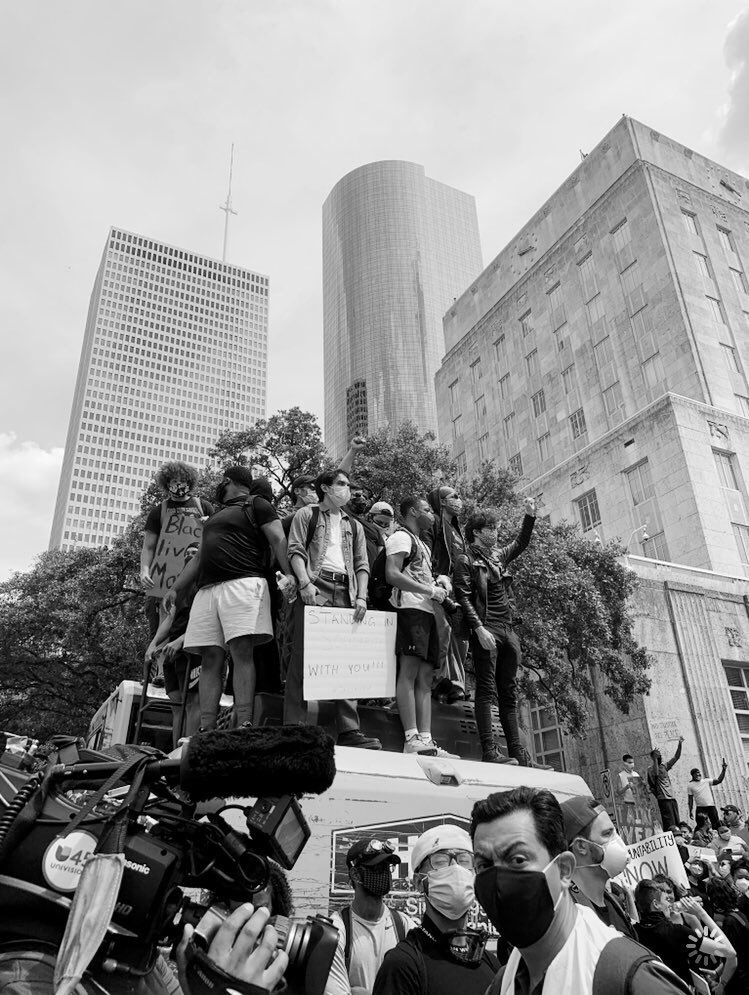
Yesterday I walked in a peaceful (though good and loud) Black Lives Matter protest in Houston in response to the murder by police of George Floyd and by the long list of black men and women who have also been killed by police.
It was a powerful experience.
My daughter drove us so even though traffic was slow and she didn’t know where she could park, I jumped out of the car right away with my sign, my phone in my back pocket and joined the chanting throng streaming into the street from Discovery Green.
It felt so good to be able to do something, to show support at this time along with so many others of every possible race and ethnicity. I saw “Arabs for Black Lives” t-shirts. I saw Jewish men with their prayer shawls on. I saw Hispanic people, Asian people, and plenty of other white people. There were families with their children too. Mostly I saw everywhere beautiful black people standing up for themselves, and for their murdered brothers and sisters and their families, supporting one another, demanding righteous change. It was awe inspiring.
One of the chants were the last words of George Floyd, “I can’t breathe!” He also had said to please let him up and that they were killing him. And he called out for his mother. There was so much heartbreak that day at the protest that at times it seemed like a funeral. Sure enough that is partly what it was. As the leaders of the March said, “We are here to lift up his name.”
That was another chant: “SAY HIS NAME!” And the response, “GEORGE FLOYD!” Over and over they said this and I think it is so important. We should not forget the individual people who have died in the seemingly never ending stream of police violence against people of color. They were people, individuals. We are standing up for them specifically, as well as the entire African American community.
“BLACK LIVES MATTER,” of course, was shouted throughout.
*For the “all lives matter” crowd, maybe I can be of some help as to what “Black Lives Matter” means and why it is a non starter to keep saying that.
My friend, here is what I gather about this: black people are telling us they feel their lives don’t matter to us. Can you blame them? They are not trying to tell us other people’s lives don’t matter. They are asking us to notice what’s happening when they say that. And they are reminding themselves that their lives matter in the face of all this. When people say back “all lives matter” it sounds like “you aren’t suffering from this,” “It’s all in your head,” or worse, “We don’t care.”
Suppose a fire truck arrives at your home as it is burning and begins to fight the flames; and a neighbor runs up yelling at the firemen, “all homes matter.” Think about it, or better yet, pray about it.
-Julian Mcmurrey
We marched to the courthouse where there were speeches I couldn’t hear very well. I understood that at least one woman who spoke was a mother of another black man killed by police. The drift of what a lot of the speakers were saying, though was that we should not stop here with this protest, that there is a lot of work to be done once we got back to our lives.
There were signs about different organizations and their websites so people could follow up on their commitment. I will include a couple of these at the end of this post.
It annoyed me that there were drones buzzing around close enough we could have swatted them. Helicopters flew overhead constantly. Eventually we noticed snipers on the roof of the court house and on other nearby buildings.
“See?” a woman said to me, “They don’t even care about us. We’re trying to speak out but they aren’t listening. This is how they do.” It was over kill, I thought. And so many children in the crowd too.
I texted my daughter who had her little one with her, and told her about the snipers. That was her cue to head in another direction. (By the way I also told other people coming into the area who had children with them as well.)
I stayed a while longer. Eventually, after a couple of hours, I started to head back to the car.
A couple of women from the march stopped me and wanted to take a picture of me with my sign. I said sure I would be honored. My sign was a quote from Pope Francis, “Racism is the greatest evil in our world today.” I had a bright red rosary wrapped around my wrist. Its dangling cross against my hand reminded me constantly of what I was doing there. I absolutely considered it my Christian duty to be there. I wanted to bring Jesus and Mary with me to love the people and stand with them, to try to radiate their love and solidarity. Also I was there as a Catholic. If anybody noticed my rosary maybe they would know “Catholics (some Catholics) “are with you.”
That was my idea anyway.
Volunteers were on corners handing out masks (I already had one) and water bottles. It was so hot so I took one. Im glad I did because after that my phone went dead and my daughter and I had a harrowing few hours where we couldn’t find each other.
I also couldn’t find my way back to the car although I had a general idea where it was.
I got kind of lost but then I managed to get back to the courthouse. There was a group of women on a corner there talking about prayer not being enough, and how God expects us to take action too. (I have noticed this too about God.)
“Its the Holy Spirit,” another woman said. “This is the Holy Spirit.”
I asked if they could point me back to Discovery Green because I hadn’t paid attention to the route we all took earlier, having been too excited to do so. They laughed kindly about that and said all we had done is go straight down the street behind them. It would take me straight to Discovery Green.
They liked my sign and I told them I had carried it in the Richard Spencer protest at Texas A & M too. One lady asked if I knew my daughter’s number. No I did not. She asked if Roise was on Social Media, and eventually she found her and sent her an instagram message for me that I was headed to the car.
Expressing my gratitude I started to pick up my sign and go. An older lady said she had an assignment for me once I got safe home. I was eager to hear it. She said, “Memorize. Your daughter’s. Number!” “I know right? Thanks ya’ll, for telling my daughter her ridiculous mother is headed her way.”
They thanked me earnestly for being there that day. I hadn’t expected that and I didn’t feel I really deserved it since it was something I wanted to do. But I knew what she meant. And I said thanks for having me.
Actually my daughter and I got that all day from people, “Thank you for being here.” Silly us! We hadn’t been quite sure we would be welcome or if it was appropriate. We know this is a black lead movement and we want to support that. Sometimes it just isn’t clear to us as white allies learning on the job, what we should do. I feel like I understand a little better now.
A long, tired, hot time later, I finally found the car. Two other people let me use their phones to try to call my daughter on social media along the way. “This is mom. I’m at the car.” I also had good conversations with them.
Of course my girl had the keys. Exhausted, I climbed on top of the car with my sign and prayed the rosary. After a while though, I started to get scared. Where was she? Did she get held up? What should I do if she never came back? What if something bad happened to her or the baby? My other daughter, I reflected, was going to kill me if anything happened. She had been very upset and scared that we were coming to this, given what happened in Minneapolis. I started to get that cold feeling you get in your stomach when you are really worried.
I saw a group of police officers getting out of a car near me. One of them pulled his baton out and said, “Yeah now we’re going to have some fun.” He caught my eye and looked (appropriately) a little embarrassed. As far as I know he never got to have any “fun.” For which I am grateful. I should say though that the police I saw around yesterday were trying to be relaxed and non intrusive.
On I waited. I checked nearby restaurants. No luck. I went back to my car.
I think I had been sitting on the car for an hour and a half before I happened to look up at the right time and see my daughter, pushing the stroller a couple blocks down. I was astonished when she didn’t turn to come down the street where the car was.
After thinking about why she would do that, I scrambled down from the car and took off running. When I got to the street she was on, she seemed hopelessly far away. So I put on the mom voice I used to call my daughters home with when they were out playing in the neighborhood as kids. “ROSAAAAAAAAAAAAY!” A man nearby resting with his sign on his lap chuckled.
To my relief she turned around and started coming toward me. I jogged toward her and was surprised to see she had been crying. She started crying when I hugged her and said she had gotten lost and her GPS was acting crazy, sending her all over the place. She had gotten overheated and collapsed and some people from the protest had helped her up, some talking brightly to her daughter as other people gave her water and stood by until she had drunk the entire bottle. They had her sit on a curb with them until she was better. Someone called her phone and helped her find it. They gave her directions to Discovery Green but she stopped to get a soda at a pub which made her sick and she promptly forgot the way. My granddaughter, Arelani, was glad to see me. She started chattering like the loquacious little being she is.
I walked them back to the car and drove us out of the city and toward home.
We were kind of in awe about the day, grateful there was at least something we could do, and so glad of all the kind people we had met, and how amazing the solidarity and unity had been. So many people, thousands of people, coming together to do a good thing, a holy thing, really. It had felt sacred to me, as well as sad and angry and hopeful too. It was motivating and we intend to do whatever we can to help out in future.
I want to say that our dearest black friends were very supportive. LeeAnne and her husband said “God bless you.” Mel told me to play Bob Marley on the way there for him. Between Mel and me this is how I keep him present at special times, like when I am making his birthday spice cake every year. He and his wife Lilly sent pictures of themselves to me too so I could carry them with me. My daughter’s best friend wept when she told her where we were going. “Why are you crying?” “I just feel thankful that y’all are doing this.” We hadn’t expected that but I think it is worth noting.
I remembered an article I had seen, and the photo in it of a big sign that said, “White people. Do Something.” Maybe it felt to them that we were responding. And that is what the black community wants from us, y’all. That’s what they want. For us to listen to what they want to say to us, to care and respond and be willing to help the way they want to be helped with this.
I’m slow but I am learning.
In the car, my four year old granddaughter, who is half African American, started chanting “BLACK YIVES MATTER! BLACK YIVES MATTER!” And “GEORGE FYOYD! GEORGE FYOYD!” Well, she had heard those things a lot today. We took video of her doing this and sent it to her dad (who is black.) It was adorable but also touching to see her do that. This is all also about her and her future.
On the way home we got a flat tire. I had forgotten my spare had been stolen so we were in a pickle. A friend picked us up and we are home safe and incredibly tired today. But it is a “good tired.”
In spite of the trouble, we are both profoundly glad we went, honored to have been there, to have been a part of it.
*photos not taken by my daughter, Roise Manning-Pauc, have been used with permission from the photographers.
Think Twice (Before you call the police, consider these alternatives.)
My late husband, Bob Chapman, was diagnosed with Stage 4 Glioblastoma Multiforme, an aggressive Brain Cancer, in February 2010 while we were still engaged and dreaming about our wedding. We married in May that year just after he finished his initial treatment, a period of simultaneous radiation and chemotherapy.
He lived 2 ½ years. The course of his illness was hands down the most terrifying thing I have ever had to go through. If you know me, you know this is saying a lot.
However it was also the most beautiful time of all my life. He said the same for himself too. My daughters remember it as the happiest of times for them.
We had to make a daily decision not to live in fear and sorrow every minute. This does not mean we didn’t cry sometimes, or that we pretended not to be afraid. We were scared to death. Of course we were. But who wants to live like that? We decided to live happily as long as we could, and to “lovingly eat the bread of the will of God,” as St. Elizabeth of the Trinity expressed holy acceptance.
We thought if we did go down, we would go down swinging. We did all we could as enthusiastically as we could to fight cancer. We strove to leave the rest up to God. It was empowering.
We knew that things might not work out the way we wanted which was a horrifying prospect. We also knew that sometimes people did survive it. We ignored the statistics and tried to live in the hope; not with false expectations, but real hope. We knew that Bob would not be taken from this world without God’s permission. We decided remaining positive but without stifling our feelings when we were sad, angry or afraid seemed best. And we looked to God. As Bob said to me the week he died, “God is IT!”
We decided to love and to serve as much as we could. After a frightening MRI result we were really scared. All we could do for a while was hold one another. When he was ready to talk, he said. “Well, what do we do? We love, we walk on.”
And we did.
We learned to allow others to love and serve us. We grew in our appreciation of community.
We grew to understand that each day could be seen as an entire life -time, being born in the morning and dying in the Father’s arms at night. Getting dressed for work one morning, Bob said, “I’m alive today. That’s all anybody’s got.”
Living like this begins to bring out the beauty in all things. Life becomes more vivid. Connection with people and all living things becomes profound. The heart expands.
When we were overwhelmed we had a designated spot we pretended was our “clubhouse” where cancer could not go. We needed to take time out in that spot sometimes.
As a family we learned that almost anything is funny. Bob had speech problems that came and went for a long time. They were hilarious! One of his more famous utterances then was when he said, “What time do we eat the kids? 6:30?”
Trying to talk to someone on the phone about a bill, he explained to her, “My voice is broken but my THINK is fine!”
At M.D. Anderson, the staff seemed horrified that I kept laughing at Bob’s speech mistakes. I told one of them, “Hey we can laugh all day or we could cry all the time!” And anyway, he was laughing too! “What!?” he would say, “I speak the King’s English!”
We tried to make scary things fun. Bob took his guitar to the hospital with him and played it from his bed. The nurses loved it.
One time he went to a scary appointment with half his mustache and half his beard shaved so he had a perfect half and half face. The doctor did such a double take! It was so funny!
At chemotherapy we used to sit and blow bubbles together in the treatment room. He brought his guitar there too and played for everyone with the I.V. in his arm.
Bob was a do-er. He was always moving. One month almost to the day before his death he was mowing the lawn, pushing his crazy big mower uphill. I took a picture. Well that was Bob. He was unstoppable. Bob was into helping. Even when we went out to eat he would end up fixing the cook’s car in the parking lot or something like that. Once he saw a young woman having to put back her purchases at the grocery store so he went behind her putting the same items in his own basket. He bought them all for her and sent me to give them to her outside.
He fixed things for the elderly he saw struggling with something. He was all about service and not creating hardship or work for others. He called this his “skin religion.”
He brought me breakfast in bed on Saturdays and put on Bugs Bunny for me. He did everything he could for all of us for as long as he could.
Being able to serve was important to him as a person.
Eventually, he began to be paralized on one side. Still he dragged himself by one arm horizontally out the back door to work on a drainage project. Sometimes he got tired and had to lay down in the grass for a while.
He was a do-er and he was tenacious. We called him “The Atomic Bob.”
He was an artist but he began to lose his ability to paint. He couldn’t play guitar. He started dropping dishes so he couldn’t do them for me anymore. He got where any speaking at all was very difficult. He had trouble at work and finally took that extended sick leave he had not taken yet. He could no longer play guitar.
He was confined to his chair for a lot of the day. One afternoon he called me to him and said,
“Shawn! I can’t DO anymore.” I nodded, tears in my eyes. Then he said, “I can’t DO!” Here he put his hand on his heart, sobbing, “but I STILL LOVE!”
I knew what he meant.
He realized his love, doing or not, was valuable. He was reaching out to everyone, loving them, and that in his very inactivity, his great big heart was active and spreading love on a whole new level. “Hey,” I told him, between kisses, “you’re speaking like the great mystics of the Church now!”
We are such do-ers in this world and often this is a great thing. Through the history of our faith, though, some Christians have felt called to withdraw into holy seclusion to live a hermits’ life and to pray.
To us this looks like not helping, not doing. But as Servant of God Catherine Doherty wrote, “Look at the Man on the Cross. He is not doing anything because He is crucified.” Ah but He was doing EVERYTHING, wasn’t He?
Our family found humor and beauty, mindfulness, joy in service, acceptance, courage, tenacity, renewed faith, a closer bond, community and the spiritual gift of understanding right in our crisis. In the midst of sorrow, loss of control, uncertainty and intense fear we found the Kingdom of Heaven. When the situation was “down to the wire,” we found the true power of love.
God is with us. There are jewels in the rubble that are there for us to find and to share as we deal with Covid-19 as a community. If we seek this treasure we will find all we need and more. It is there for every one of us.
This is my husband’s painting of us praying together during his fight with Brain Cancer. He called it “Miracle.”
* This piece originally ran as my column in The Bryan College Station Eagle
Where you find no love, put love, and then you will find love.” ~ St, John of the Cross
I had a birthday cake to make on March 12. My eldest daughter, Maire was turning 27 the next day. This is her first birthday home in Texas again in years and she is so glad to be here.
I planned to make a Mexican Chocolate Cake (dense chocolate with a little kick from a pinch of hot pepper powder.)
I wanted a yellow rose (the Yellow Rose of Texas, of course) for a little cake top arrangement as well.
I had heard news of emptied out grocery stores in other places, and even a couple of local complaints. I tend to resist getting caught up in that sort of thing so I didn’t really pay attention too much.
The emotional climate in the store was distressing. People seemed angry and upset, even banging their shopping carts around. Almost everyone I saw seemed scared, furtive even. No one was making even passing eye contact.
Workers looked exhausted and rushed.
Young people in particular looked dazed, some standing and staring at the place where something they had been looking for was supposed to be.
I thought of my Focolare friend, Julia, who had been looking for ways to be useful during the Corona Virus outbreak. She and some others had some great ideas. I felt unsure of how to be useful and I still do.
The Focolare have a saying, “Be the first to love.”
“Jesus what can I do?”
The first thing I could think of was to smile at people if I did happen to catch their eyes. This was encouraging exercise because I could see some visibly relax and several smiled back. It was a Jesus smile I think because then they smiled at others too.
Some of the things I needed for the cake were hard to find. Sugar was in very short supply. I did find some raw sugar eventually. I tried to joke with a couple of people and it went well. They were ready to laugh. We laughed about how crazy it all was.
There was no salt. There were a lot of empty shelves. It made me kind of scared too, to see that. I had never seen that before.
When I saw young people staring at things and looking confused I tried to help them find what they were looking for. At first I was stupid and picked up the item when I found it and they probably thought, “No thanks since you touched it, Stranger, and that was the last one too!” Oh yeah. I did better the next time.
I saw tired children looking around wide eyed as their flustered parents negotiated the crowds. I tend to feel overstimulated and anxious in crowds myself. I told one kid, “Hey you are being really good in the store! My youngest is 22 and she isn’t as good in the store as you are!” If a child was crying I tried to give a sympathetic look.
I finally had everything I needed, thank goodness.
I went ahead and got some beans and rice which, as a vegan, I kind of have to have. They were almost completely out. I took one small bag of each. My pay day is not for a few more days so I can imagine other people having to wait until pay day too and then everything would be gone. I didn’t want to do that to anyone else. Lots of reasons not to take more than I needed.
I tried to notice when other people were attempting to reach for things I was reaching for too and let them go first. That’s hard for me since I usually don’t notice things like that. But I tried.
I had intended to pay in cash as I usually do but I didn’t because the cashiers would have to touch that.
I felt so sorry for the young women at the register. They looked exhausted; flushed, sweaty and scared. I found out one of them was from some other department but had to come help and neither of them had gotten off work hours ago when they were supposed to be off. I thanked them so much for being there and I said I was sorry for what they were going through. They seemed to appreciate it a little bit.
I told Jesus on my way out, “Those poor girls! Please protect them and give them strength.”
On the way home people drove crazy. It made me sad. But I felt lifted up just a little bit and I had a sense of peace beneath the worry. Maybe some of the people in the store did too.
That brief experience made me think that if we can try to connect even for a second in the little ways that we can, and smile a little bit sometimes, it might lift us all up just that much more. We could use that right about now.
Maybe the reason you find love when you invest love is that it isn’t really that your love comes back to you but that Jesus is there whenever we try to give love even just that little bit, in a tough situation and he multiplies the love just as he multiplied the loaves and fishes.
We are all going to need a lot of love.
Jesus walk among us and help us remember love even a little bit in the days ahead, and to see you multiply our smallest investments.
“In the noise and clatter of my kitchen, while several persons are at the same time calling for different things, I possess God in as great tranquility as if I were upon my knees in the Chapel.”~ Brother Lawrence
Brother Lawrence was a Carmelite Lay Brother (d. 1691.) He had an intense realization of “the fact of God” while looking at a dead and leafless tree. He had been a soldier, and after being wounded he became somewhat lame. He then became a footman but, as he said, was “a great clumsy fellow who broke everything.” He no doubt was feeling like a dead, leafless tree himself at that time. But God opened a way for him to find life again. He became a Lay Brother in a Carmelite monastery; cooking, (a job he disliked right away) running errands, sweeping floors and of course, praying and discovering God within at all times and sharing this way he called The Practice of the Presence of Godwith others.
By making active use of the teachings of The Practice of the Presence of God we can learn to be continually recollected in God, which keeps our souls most open for God’s grace and at his service at all times.
The flow of our lives then becomes a conscious flow of God’s transforming love.
The consequences of this simple practice seep into our personalities and the way we are in the world. We find we even touch inanimate objects with love. We feel affectionate and open towards people. We feel happier, more peaceful, certainly more in tune with God.
1. Morning Offering.
Many Catholics begin the day by dedicating/offering it to the Sacred Heart of Jesus in a Morning Offering. If you already do this, try to do it more consciously than usual. Pay close attention to what you are saying and to Whom you are speaking. Reflect on what the words mean to you.
If you don’t do this, you could start doing this. Write a Morning Offering on a post-it note and stick it on the coffee maker. You could write your own dedication instead of the traditional one if that would be more meaningful to you.
2. Address your thoughts to God.
This may sound overwhelming to do all the time but even recalling God and restarting your conscious awareness of him whenever you remember to, during the day can have a noticeable effect that will grow.
While you are at it, try turning your grouchy thoughts into prayers of praise. No really. So many things in the course of the day are annoying to us. Figure out how to make prayers of praise or gratitude out of these irritating things. You may be surprised how amusing this can be, and how it becomes second nature after a while.
Turn your thoughts into a continual conversation with God. We all live in a river of thoughts, images, memories, plans, worries, what have you. Turn this river toward the Lord, as often as you can remember to.
I think about my daughters more times a day than I care to enumerate. So, for example, I can try to talk to Jesus about them instead of only thinking to myself or worrying or dreaming for them, as parents will.
Today my daughter is moving, My other daughter and her husband are helping while I watch the grandchildren and hope the three year olds get along and the baby isn’t too distressed by the whole thing. I can talk to the Lord about this. “Calm any fears that arise, Lord. Help us to make this a joyful day.” Or I can express my concerns to him if I want to. As Winnie the Pooh says, “It’s friendlier with two.”
The best way is to hold your pain up to God just like you used to bring your bumps and bruises to your mom for her to kiss. Words are unnecessary here unless you want them. Let God sit with you like a loving quiet friend when you are hurting. You probably know this is harder than it sounds.Try it anyway though.
Catholics also have the habit of offering up our suffering in union with the suffering of Jesus. We call this being co-redeemers. When something bad happens to me I consider myself a treasure of grace and try to offer my suffering as prayer for everyone who needs it.
4.Purposely invite God into even the smallest things you do each day
This is at the center of Brother Lawrence’s teaching, and a big part of The “Little Way” of St. Therese as well. Instead of rushing through a task or just trying to get a thing done, it helps to slow down and concentrate on it. As Eknath Easwaran says, “Concentration is consecration.”
Offer your task as if it were an act of prayer and then it will be.
St. Therese would offer the difficult things she had to do for missionaries or for priests. Maybe you would like to offer your work for something you care about to help the world or the Church.
Your offerings can be as simple as saying, “Lord here is my little pancake for you” if you are cooking, for instance. Maybe this sounds silly to you but I recommend you try it for a while and see for yourself. Maybe you too will find God “amidst the pots and pans.”
“We ought not to be weary of doing little things for the love of God, who regards not the greatness of the work, but the love with which it is performed.”~ Brother Lawrence
This habit of being aware of God in your actions takes a lot of practice but even if you only remember to do this a couple times a day God will bless it and you. You will soon notice a difference in how connected you feel to God at all times.
When you are in line somewhere or at a red light (we spend a lot of our day waiting) use some of that time to connect to and talk to God. It’s easy.
5.“Listen” for God with an open heart
No matter where you are, whether you are alone or with others, hanging out with your friends, at work, petting your dog or talking to a small child, try to maintain a sensitivity to God in all situations. You will sense a heightened awareness and connection to other people and all living things when you do this. You will notice beauty you used to miss. You will be more and more able to register signs of God’s will or voice in the events and conversations of your day. It will become a working part of you in time.
6.Presence/mindfulness
We hear a lot about these concepts lately and I think that is good. As Christians, being present in the moment and being mindful in our daily lives is going to mean conscious awareness of God in the present moment, mindfulness of God in all we do and experience.
Fr. Greg McLaughlin said to me once, “You are not on this planet! I don’t think you are even in the solar system! God is in the present moment. God is right here! And right now, right here, he is saying‘ Where are YOU?”
To be absent minded is to be absent to attentiveness to God who is here with us now. This one has been a hard one for me as I am given to day dreaming. I have learned that we don’t have to be perfect at this present mindedness. But every little bit helps.
St. Teresa of Avila’s way of thinking was that “God is within us, and we should not leave him there alone!” She thought we should imagine the Lord beside us at all times until that active mental effort becomes internalized and natural, part of consciousness.
7. Repetition of the Holy Names
Brother Lawrence doesn’t talk about this in his letters or conversations. However this can be a useful key to keep on your key ring that can help you in your quest to cultivate the constant sense of the presence of the Lord in your life during your day. It can open the door for you.
When I am doing a task that doesn’t require a lot of thinking, I repeat the names of Jesus and Mary. For me it does the trick, and brings me into conscious awareness and attentiveness to the presence of God. It is also a prayer because I am calling on them in my heart and dedicating whatever I am doing to them.
Doing this in the waiting times of our lives can bring us into focus as well, so we can fill those empty spaces with the Lord.
It is very helpful in times of stress or fear too or any time I need to re-center.
St. Rose of Lima is said to have memorized the Names of God from the Bible during a time of blankness and darkness in her prayer life, and repeated them while she did her embroidery or any task that allowed it. It was her light through that difficult time.
Before going to sleep I like to tell God what I am grateful for about the day and commend all to him, good and bad.
I also try to fall asleep with the holy names of Jesus and Mary, taking them with me into the night.
“He does not ask much of us, merely a thought of Him from time to time, a little act of adoration, sometimes to ask for His grace, sometimes to offer Him your sufferings, at other times to thank Him for the graces, past and present, He has bestowed on you, in the midst of your troubles to take solace in Him as often as you can. Lift up your heart to Him during your meals and in company; the least little remembrance will always be the most pleasing to Him. One need not cry out very loudly; He is nearer to us than we think.”
― Brother Lawrence
People who wrote about talking to Brother Lawrence remarked on his deep peacefulness. He was a simple Lay Brother who had had a poor and difficult life, wounded in war and witness to horrific slaughter in his own home town. Through his remarkable relationship with God, and this way he found to live always in his presence, he found deep peace and was able to help others find the same.
This way is available to all of us.
Developing these habits may sound like an arduous process. Remember that we do what we can and God will do the rest. God sees and will bless our efforts. He’s cool like that.




















 Bethany Hang Out