It must have seemed to Mary that the sky smiled at her, that she was infused with tenderness and peace. When she looked around her at the world maybe she felt God telling her, “All this is yours, and you are mine.” At night when her family was asleep maybe she let herself into the quiet space of her heart to ponder the prophecies of her people, marveling at how vivid and alive these words were to her now. There was so much she didn’t understand but her trust left a gentle smile on her mouth as she drifted into sleep.
“The days are coming, says the LORD, when I will fulfill the promise I made to the house of Israel and Judah. In those days, in that time, I will raise up for David a just shoot ; he shall do what is right and just in the land. In those days Judah shall be safe and Jerusalem shall dwell secure; this is what they shall call her: “The LORD our justice.” Jeremiah 33:14-16 💜
if you’re dealing with a profound loss, the after effects of tragedy or post traumatic stress you may be feeling spiritually dead. Maybe you think you’ve lost your faith or that God has left you. It may be helpful for you to know there are neurological reasons for this apparent loss of your spiritual senses.
When there is a traumatic event or a terrible loss in our lives, our brains are actually affected. Trauma can disrupt the brain’s ability to process spiritual experiences by affecting its prefrontal cortex, amygdala, hippocampus, and temporal lobes. These areas are also involved in emotional regulation, memory, and our sense of self, even our feeling of connection with something greater than ourselves. Dysfunction in these regions can lead to a disconcerting loss of or distortion in a person’s spiritual life. It’s difficult for us to feel God with us, or to reach the peace we used to find in prayer and the practice of our faith.
The prefrontal cortex is responsible for self-reflection and focus. It helps us in practices like contemplative prayer and meditation by supporting awareness and attention. When this part of the brain is dealing with trauma we can’t seem to relax. We may feel void of any spirituality at all. Even the sacraments we believe in feel oddly empty as if we are merely spectators. Everything may seem meaningless to us now because the brain is preoccupied with stress and survival due to its injuries from trauma.
The amygdala and hippocampus process emotions, especially fear and joy. It gives us a sense of our life stories, of our own history. Spiritual experiences often evoke intense emotions and build on a relationship with God that we have developed over time. Trauma can even shrink the hippocampus . It may be hard to remember the love we once knew with God. Without this memory of the lived experience of God’s love and mercy, it’s hard to trust the Lord or that he is still there at all.
With post traumatic stress the amygdala becomes hyperactive, keeping our brains in a state of fear and hypervigilance. We might also feel emotionally overwhelmed and dysregulated making daily life difficult let alone communion with God.
The temporal lobes of the brain are associated with mystical experiences, and our perception of religious imagery. They also help us integrate our sensory experiences in life into spiritual meaning. Sustaining trauma can cause either overactivation or underactivation of the temporal lobes. This can lead to either intense visions or else fear-based religious thoughts. On the other hand, we may feel emotionally and spiritually blank. Where is God?
“God my God, why have you forsaken me?” Mark 15:33-34
Our anterior cingulate cortex helps us feel empathy and compassion. It’s also involved in the regulation of emotions and our sense of the Divine.The damage of trauma can impair the ACC. We may feel lost, cut off emotionally from our friends. We feel empty and alienated from people and God.
“Friend and neighbor you have taken away.
My one companion is darkness.” Ps. 88:18
The insula processes sensations and emotions, contributing to a sense of the nearness of God or a feeling of transcendence during prayer or meditation.Trauma can impair the functioning of the insula leading to either low body awareness or too much of it. We can feel a strange detachment from our bodies, unaware of even our physical needs. Conversely we may be overwhelmed by physical sensations, making it hard to relax or focus when we want to pray.
The good news is that contemplative prayer and meditation have been shown to be healing and even restorative to these areas of the brain impaired by trauma. Interior prayer practices and meditation can calm the amygdala, improve prefrontal cortex regulation, and enhance the connectivity of the ACC and insula, restoring emotional balance and renewing our sense of connection.
It means a lot to me that Jesus experienced trauma and that he allowed himself to descend into the depths of the abyss of abandonment when he cried out from the cross his desolation.
St. John of the Cross taught about the “Dark Night of the Soul,” a phase of the spiritual life of many Christian contemplatives and mystics, which seems to have similar effects as trauma does on our prayer life. St. John of the Cross wrote that “in the dark night of the soul, bright flows the river of God.” He teaches us that God is nearer than ever before at times we feel he is farthest away. He says to go on “naked faith” and not to give up.
I have found it true that “God is close to the broken hearted, those whose spirit is crushed he will save.” (Psalm 34:18)
So if you are grieving a tragedy, experiencing trauma or post traumatic stress, and your’re having trouble with spirituality as a result don’t blame yourself. You haven’t done anything wrong. Nor have you lost God.
We know Mary and Joseph were holy and faithful people but they still lost Jesus for three days. Maybe you feel bereft but he is still there in the temple of your heart and you will find him again just as they did.
It’s ok to pray in ways you can handle. Don’t hold yourself to what you used to do. For me emotional overwhelm kept me from deeper methods of prayer after a tragedy in my life. I talked to Jesus about it. I told him, “I still love you. I just need you not to come so close for now. Can you sit farther away but still nearby?” So he sat with me but not too close. I chose what felt to me a less personal or emotional method of prayer. I memorized psalms, set prayers or passages from the mystics I love like St. Teresa of Avila and Julian of Norwich. When I could handle it I sat quietly and slowly went over them in my mind as a form of prayer/meditation. Other times all I could do was hold my rosary. These things slowly began to bring me peace again.
My friend Jim had said “the devil will try to kick you when you’re down and darkness tries to overwhelm you at times like this so keep doing the things that are of light: the rosary, going to mass, whatever you can do.” He said that would keep my lamp alight no matter what I was going through. He was right.
And after all:
“The light shines in the darkness, and the darkness has not overcome it.” John 1:5
“We need no wings to go in search of Him, but have only to look upon Him present within us.”
St. Teresa teach me how to find Jesus within myself where you say he is enthroned in the center of my heart. Show me how to go within, to see his beauty, know his tenderness. You overcame impediments from the world, and reluctance of your own, to seek him and keep him company with growing love and joy. Lead me in the first steps onto the Royal Road of prayer meant for me, so that I may walk in the glow of your lamp held high to light my way.
Pray now a slow, attentive Our Father.
Day 2 The Sacred Humanity of Jesus
“Never set aside the Sacred Humanity of Christ. To do so is to lose your anchor.”
We are not Angel spirits as St. Teresa pointed out. We are human. We need a hug. We need to know that Jesus had and has hands and feet, had to blow his nose sometimes, that he sweated over his work, that his feet were often dirty in his sandals from all that walking he did, that he cried, that he laughed that he needed his friends as well as time alone. He knows all the stars by name but he also knows and cares about every tear we shed. He is glory beyond glory but when he takes our hands we can feel that they are work roughened and warm. You can trace your thumb along the deep scar in his palm.
Let yourself be captured by his eyes; dark and lovely. Ask him now: Jesus be real to me.
Day 3: Friendship with Christ
“It is a great thing to have experienced the friendship of Jesus Christ, because the friendship of His Majesty is full of love and reward.”
St. Teresa’s spirituality is rooted in friendship with Jesus, which implies intimacy, informality, and mutuality. She cautioned us not to be irreverent toward the Lord. She often called him “Your Majesty” when she spoke to him. At the same time she had a complete trust in his love and regard for her as his friend, his dear friend, a friend he trusted and loved to be with. She loved him back in a deeply personal way. She strove to bring her loving attentiveness to his presence into all that she did throughout the day, and to make time to be alone with him in conversation or sweet silence.
Jesus no longer calls us servants but friends. Try thinking of him as the Friend who you know loves you and who you love back.
Make friends with Jesus. Teresa says the best way to start is to ask him humbly for his friendship.
Here he is. Ask him now.
Day 4: Come into the castle of your soul
“I began to think of the soul as if it were a castle made of a single diamond or of very clear crystal, in which there are many rooms, just as in Heaven there are many mansions.”
“The door of entry into this castle is prayer and meditation.”
Oh Teresa what a beautiful vision you had of what I look like inside and Who lives there!
Help me to find my way to the Lord within. Show me how to open the beautiful doors of my heart to see the One I love so intensely. I want to sit at his feet. I want to be in his arms against his Sacred Heart listening to its beating.
Call to me Lord, draw me, help me to love you truly, to be all yours, to listen to you, know you, to walk through the rooms of the castle seeking your hand.
Let me hear your voice and see your face for your voice is sweet and your face is beautiful.
Day 5 Solitude and silence
”Settle yourself in solitude, and you will
come upon him in yourself.”
“Silence is God’s first language.”
Sometimes Jesus went off by himself to be alone and to pray. How much more do we need to do the same, to go into our inner room, close the door on the outside world with its sights and sounds and interruptions for a time.
Teresa talked about this as recollecting the senses and bringing them within ourselves like bees returning to the hive to make honey.
Let’s find time to be alone today in quiet, even for a few minutes, to go within ourselves where Jesus waits.
Greet him by the name you most love to call him.
Do you have anything you need to say to Jesus? Does he say anything to you?
Maybe you have a conversation with him.
Now sit with him in silence in a comfortable kind of way, the way friends do.
St. Teresa pray for us that we will come to love silence and solitude where we can be alone with God.
Day 6 Talking to Jesus
“But above all things, I want to impress upon you that, when we are speaking to him, we should look at him and remain in his presence, and not turn our backs upon him.”
Have you ever heard the rosary being prayed in church and thought it kind of sounded like an auction underway? It’s so easy to slip into vain repetition – meaning not paying attention to what we are saying or to Whom we are speaking. If the Lord is our friend we want to look at him when we talk to him, to know what we’re saying to him. To be attentive and not mechanical it’s important to slow down, and make conscious contact rather than reciting a formula. Jesus is here wanting us. He is the Friend, the Brother, a Father, our Spouse. St. Teresa advised us to speak to him one way and at other times another. She wants us to speak from the heart whether with our words or with silent love.
Speak to the Lord today, either in the words of a set traditional prayer, your own words, or in quiet attentiveness. In all of these keep the eyes of your soul on him, present within you, listening to you and loving you.
Day 7 Determined determination
St. Teresa you faced so many trials along the path of your spiritual life. Sometimes you laughed at threats like the Inquisition being suspicious of your work and ways. Other times like when a spiritual director thought your prayer experiences were from the devil you cried and you wanted to die and were afraid to be alone.
But God blessed you all the more with the consolations you were told to reject.
At times you even gave up prayer, feeling unworthy.
You dealt with other people’s fears and resentments toward you, opposition and obstacles. Somehow you accomplished all that the Lord asked of you. Once you knew what it was to pray with satisfaction, and once you truly knew the presence and love of God you were unwilling to ever give up prayer again.
You urged us on, reminding us that life is like one night at a bad inn and the prize, Christ himself was worth anything at all we could go through to get to him. You called this single minded persistence determined determination. Pray for us as we make our way inward and ultimately to Heaven, that we will proceed with “determined determination” as you did. Lead us straight into the Heart of Jesus.
Day 8 Holy Mary
It seems to me that there is no better teacher for prayer than the glorious Virgin.”
”Mary treasured all these things, pondering them in her heart.” Luke 2:19
Mary had a listening heart, attentive to every sign of God’s will and inspiration. Immaculately conceived and free from spiritual impediment she had a clarity of perception and relationship with God. She had one great visitation by the Angel Gabriel but we have no record of any visions and extraordinary signs she received otherwise. Mary live by faith as we do, living an ordinary life that was nevertheless quietly extraordinary.
In her heart she pondered and treasured the Word of God himself within herself, then in his daily presence, and remained United with him just as much in spirit as he began his ministry.
Teresa assimilated Mary’s spirit of contemplation, cherishing the Lord within, remaining attentive and united to him at all times. This is why Teresa’s Order of Discalced Carmelites sees Mary as Mother. Sister and Queen, and our primary devotion to her is meditation in the heart, contemplative prayer, perceiving God as within ourselves.
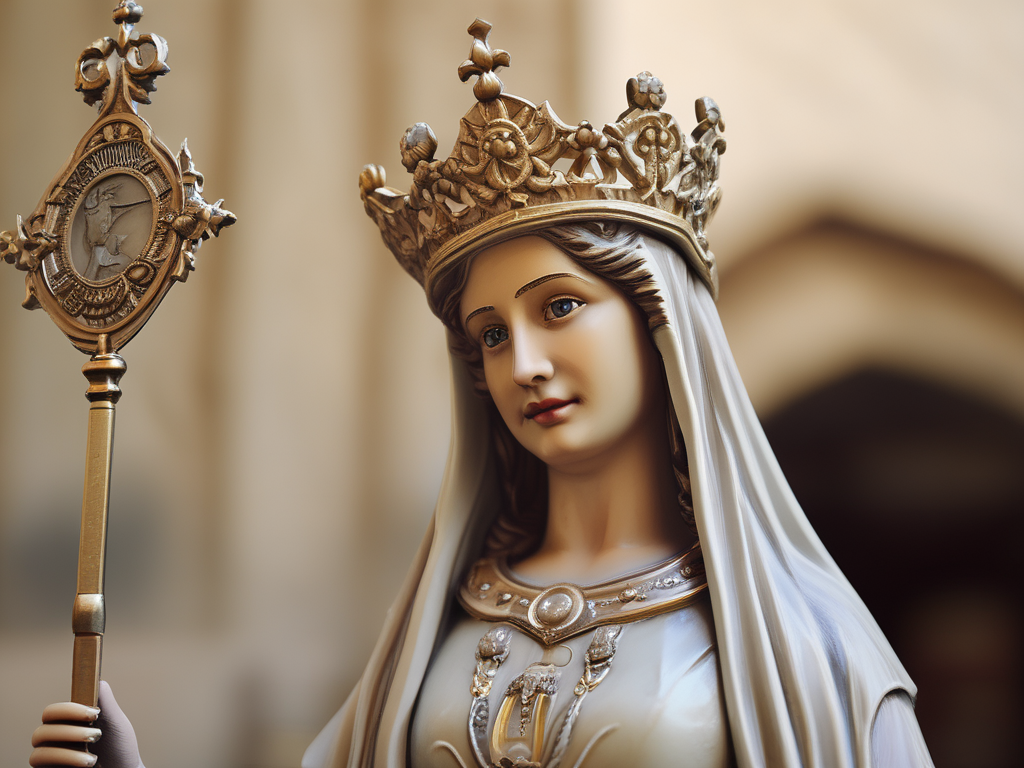
Oh beautiful Flower of Carmel, holy and singular, who brought forth the Son of God, ever still remaining a pure Virgin, assist us in our necessity! Show us that thou art Our Mother! Our Lady if Mt. Carmel, pray for us. .
Day 9 Love
”Amor saca amor.” Love draws out love.
Prayer leads us into union with God and union with God fills us with love, his love becoming ours. Teresa taught us that we should “make many acts of love.” She knew that love was active and effective, more than emotion it blossomed into friendship and service and compassion. The love of God is transformative and the more we pray the more we see that love of others deepens our prayer and prayer deepens the love with which we serve and our desire to serve.
Not only that but prayer becomes almost indistinguishable from love. Prayer becomes love and love becomes prayer.
St. Teresa pray for us and lead us into the depths of love with God. Brighten our way along the Royal Road of the spiritual life. Help us to truly know the Lord we love and live for. Remind us that love is both the means and the goal of this journey. We wish you a happy feast day and we pray for all the intentions you have for the Church, for priests, for the sanctification of the people of God, that Jesus will have the best and trustiest of friends and that we will be among them, that he will be followed and loved and praised and known by all of us. In your special honor we ask all of this of the Lord and in the sweet Name of Jesus.
St. Teresa pray for us. Our Lady of Mt. Carmel, pray for us.
This summer I finished my manuscript for a new book. The working title is Pray Like Teresa; how to pray the Prayer of Recollection of St. Teresa of Avila. The publisher will decide the official title. I agonized a lot writing it but that seems to be part of my creative process unfortunately. It was also my solace during a stressful summer as it turned out to be.
When I have a project on I continually “write” in my head until it’s finished. Then it’s hard for me to stop messing with it and to stop thinking about it all the time. I enjoyed St. Teresa’s accompaniment during the months of working on this little book for her. I hope she is happy with it.
The book is short, only 15,000 words, about half the length of my first one, Come to Mary’s House; spending time with Our Blessed Mother. It is also more instructional than Come to Mary’s House. I would describe the general vibe of the book as St. Teresa with a Shawn twist. I tried to stay absolutely true to Tersa’s teachings and to work in my own Teresian spirituality and experience as well.
An important goal I had for this book was to help everyday Catholics and others to get to know Teresa’s teachings in a friendly way. I included St. Teresa’s struggles and sense of humor along with her teachings on the Prayer of Recollection and her basic foundational teachings that underpin it. I hope for the reader to see that contemplative prayer is for everyone and that this method of prayer is one anyone can do.
I also wanted to show why contemplative prayer is desirable, not only for the growth of the person who prays but for the good of the Church and the whole world. In this way I believe deepening inner prayer and contact with God, friendship with Jesus, and the practice of a life of prayer are urgent necessities in our world today and for the renewal of the Church.
A lot of people may be intimidated by Teresa of Avila because of her profound mystical experiences, because she is the “Doctor of Prayer,” and such a great figure of Catholic spirituality. Maybe they had not thought of reading her works before because they were written about 500 years ago and they assume she is inaccessible and too Medieval to be understandable or applicable to their lives.
I hope the reader will find that St. Teresa was also very human, witty, funny, practical and grounded. Her wisdom is relevant to anyone wanting to live the spiritual life, to grow in prayer, to this day. I hope I have provided a simple way to take up this prayer that Teresa said the Lord himself taught her, to anyone who picks this book up.
I think it would be a perfect book to take to Adoration with you, enriching your prayer in that hour with Jesus, or to keep by the place you like to sit when you pray daily. One could easily read a section each day and try the part of the prayer that section suggests.
I intend to encourage everyone who reads this book to try the prayer, to stick with it, along with giving practical ideas to help them be consistent.
I arranged it as an introduction to Teresa herself, and then I played out reflectively her basic discoveries about prayer such as friendship with Jesus, his Sacred Humanity, and God being experienced as within us.
Then I wrote a section about each step of the prayer and how to do it, each one headed by a quote from Teresa or from Scripture.
I allowed myself the pleasure of writing about the effects of the prayer as well and let myself get poetic about those but not overly so I hope. I wanted to communicate the beauty and joy of intimate love of God.
I am hoping this book will appeal to the everyday Catholic who may be being called by God to cast their nets into the deep or at least the deeper or even a little bit deeper. Whether the reader takes up everything in the book as part of their daily prayer life or not I hope reading it will improve their prayer life and their relationship with the Lord at least a little. I think it will.
My parish is primarily young people in college. They are remarkably devout, however. I can imagine some of them being interested in this book. I thought of them while I was writing, but also of people my own age or so (I’m 56) who at this time of life may be more interested in contemplation and want to give it daily time. I want it to speak to anyone who looks through it.
I turned in my manuscript to Our Sunday Visitor on Assumption Day, a few days early. But I thought it was a good way to honor Our Lady and St. Teresa, whose habit (the Carmelite habit) she wore.
Evenings are my favorite time of day. Especially after the bustle of family end of day reunions, when the cooking and dinner and cleaning up is done I feel both alert and recollected.
The evenings I love most are summer evenings. There is relief from the heat of the day (sort of,) the cicadas and crickets are chanting their vespers, the neighborhood birds gather along the power line to pray and to gab about the day. I love the colors of the light at this time; rose and gold and the blue tint as dusk approaches.
Time to bring the chickens in.
They’re ready for me at the gate, waddling in a line of fluffy butts to their coop for the night.
And I love this traditional time to recite the Magnificat. I like best saying it by a window looking out so I can bless the world with Mary and her vision of the Kingdom of her Son.
Get you some iced tea now. Go to a window and pray it with us. Bless the world out there.
And Mary said,
“My soul proclaims the greatness of the Lord, my spirit rejoices in God my Savior, for he has looked with favor on his lowly handmaiden. From this day all generations will call me blessed: the Almighty has done great things for me, and holy is his Name. He has mercy on those who fear him in every generation. He has shown the strength of his arm, he has scattered the proud in their conceit. He has cast down the mighty from their thrones, and has lifted up the lowly. He has filled the hungry with good things, and the rich he has sent away empty. He has come to the help of his servant Israel for he has remembered his promise of mercy, the promise he made to our fathers, to Abraham and his children forever.” (Luke 1:46-55) Glory to the Father and to the Son and to the Holy Spirit, as it was in the beginning, is now, and will be forever. Amen.
Come into Mary’s rose garden which is the rosary, and pick red roses of devotion to bring with you on this journey with her through the Sorrowful Mysteries.
The first Sorrowful Mystery: The Agony in the Garden
rose hip: Union of will with God
“My Father, may this cup be taken from me. Yet not as I will, but as you will.” Mtt. 26:39
Mary takes your hand. She brings you to Jesus, lying prostrate as he prays. Suddenly as if you fell in, you are in the depths of Christ’s Heart, experiencing his anguish, physically feeling his bloody sweat, his stinging tears smearing on your cheek as you sink into the abyss of his agonized heart.
Let yourself feel your love for him. What do you want to say to him?
Maybe, “Jesus I love you. I will not deny you anything. “
He hands you the cup he has now drunk, compassion in his eyes.
You understand.
It tastes like fire but is sweet.
Chaos breaks out. He is arrested and taken away.
In the silent Garden of Gethsemane you and Mary lay a red rose. Beside it place the empty cup.
The Second Sorrowful Mystery: The Scourging at the Pillar
Rose hip: endurance with love
“My soul is in deep anguish. How long, Lord, how long?” Psalm 6:3
You’ve never seen or imagined cruelty like this. As hooked whips tear into Jesus’ back you want to throw up and Jesus does as his body goes into shock. You look at Mary as the violence goes on and on. How can she stand it? Her eyes are filled with tears, yet her face is resolute. His blood pools between the tiles of the courtyard. You want to stop this, comfort him, comfort her. Her arm slips around your shoulders without her taking her gaze from her Son.
Finally Jesus is carried away and the laughter of the guards fades. Holding hands, you and Mary silently venture forward. Together lay a red rose beside the pillar. Kneel here. Pray with Mary.
Third Sorrowful Mystery: The Crowning with Thorns
rose hip: reverence
“My spirit blesses the Lord, the Great King.” Tobit 13:15
They’ve been beating Jesus for what seems like Hours. Then one of the soldiers gets an idea. He weaves a crown of long thorns which is forced onto Jesus’ head. Blood runs down over his face and eyes from the wounds. This isn’t enough because they start hitting his head with reeds and shouting “Hail to the King” in mock reverence. Mary is on her knees repeating something again and again. Listening closely you can tell she is saying, Barukh ata Adonai Eloheinu, melekh ha’olam…” (“Blessed are You, LORD our God, King of the universe) in praise of God. Join her in making reparation to the Lord for the mock reverence of the soldiers who know no better.
You and Mary lay a red rose in Jesus’s cell once he is taken away for an interview with Pilate.
The Fourth Sorrowful Mystery: Carrying the Cross
Rose hip: holy perseverance
[We keep] our eyes fixed on Jesus, the leader and perfecter of our faith. For the sake of the joy that lay before him he endured the cross, heedless of its shame. Hebrews 12:2a
Your hand tightens on Mary’s as Jesus comes your way dazed and stumbling under the heavy weight of the cross, prodded on by soldiers. You don’t even want to look at Mary. It hurts too much. It hurts too much to see any of this anymore. To shut it out you close your eyes. Then you remember, “for the sake of the joy that was set before him.” Mary squeezes your hand and you understand that the joy set before the Lord that urges him on is yourself. You are his joy. Open your eyes now. Don’t be afraid to join Mary in sharing his suffering.
Once he has passed by, you and Our Lady lay a red rose on this path of sorrows.
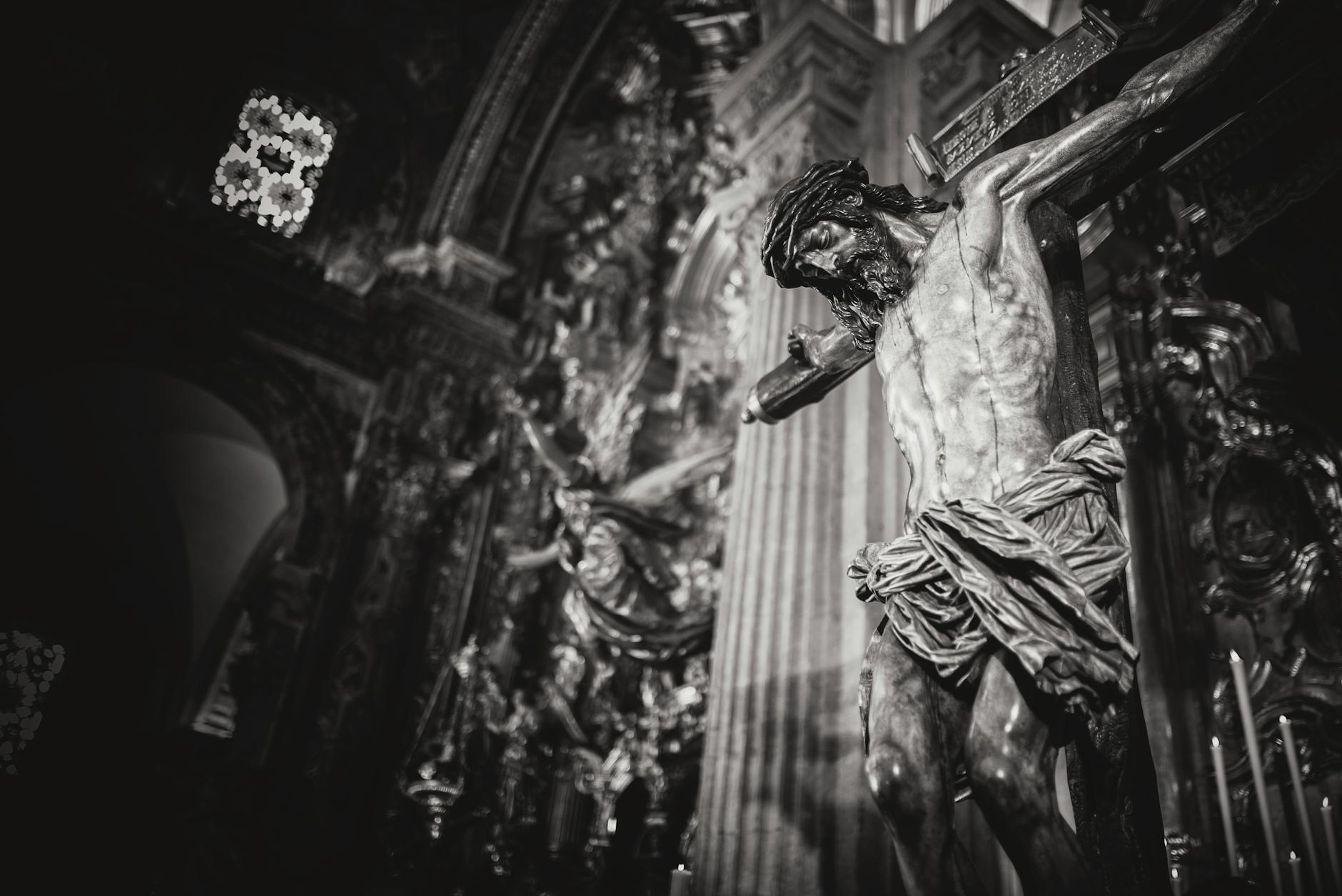
Fifth Sorrowful Mystery: The Crucifixion and Death of Jesus
Rose hip: sacrificial love
[His Mother whispered,] “do not be afraid of this executioner, but be worthy of your brothers and accept death, so that in the time of mercy I may receive you again with your brothers.” -2 Maccabees 7:29
“I’m not going to cry until he’s gone,” she says in a low voice. You understand that she has to be present to him, even participate with him, united with him in heart and purpose. She wants to look at the face of her Son as long as he has left to live. She will grieve later.
He is struggling to speak to her. “Mom. Mom, this is your son.” Then he says to you, Beloved Disciple, son, daughter, “this is your mother.”
Hold Mary close now as Jesus cries out in utter abandonment. Every strangled cry of his you can feel sending shock waves through her. And now his body is without life and the sky darkens. She collapses against you. Your prayer is only to hold her, to share her tears.
Go together now to the foot of the cross and lay a red rose in the place of sacrifice. Unpetal the others and sprinkle them over Mary. Some of the petals stick to her tear stained face, some to her hair. Most flutter down to this holy ground which has become the altar of the world. She scoops them up and throws them toward the body of her Son. You do the same.
During this little slice of Ordinary Time after Christmas and before Lent we might begin to feel spiritually unenthused. Maybe we were already. Maybe we even avoid prayer and the practice of our faith. Maybe we have an aversion to our daily duties. Maybe we’re bored and drawn mostly to distractions. What’s going on? St. Evagrius (AD 385-399) who lived in the Egyptian desert as an early monastic wrote about something called acedia.
What is acedia? The Catechism of the Catholic Church (2733) calls it a form of depression caused by giving in to spiritual laxity or presumption. The Desert Fathers thought of it as a spiritual condition people can fall into with a complex set of symptoms, a spiritual malady, or even as a demon.
[Acedia is] a hatred of industriousness, a battle against stillness, stormy weather for psalmody, laziness in prayer, a slackening of ascesis, untimely drowsiness, revolving sleep, the oppressiveness of solitude, hatred of one’s cell, an adversary of ascetic works, an opponent of perseverance, muzzling of meditation, ignorance of the scriptures, a partaker in sorrow, a clock for hunger.
St. Evagrius
Yikes.
St. Evagrious of Pontus says the real roots of acedia are self centeredness, anger and misdirected desire. When oppressed by acedia we tend to seek comfort and pleasure to counteract the restlessness we feel, and in response to our aversion to spiritual practice. We avoid the tasks we are responsible for. We withdraw from charitable activity and are more prone to gab with others for our own entertainment and distraction than to be useful to them. We fill our lives with surface busy-ness, avoiding prayer and study. We lack spiritual desire and quietly long for things and activities that will draw us away from the spiritual. We are both restless and exhausted. We want to sleep, we want to pace the floor. We feel at once angry and dissatisfied as well as listless, staring at nothing. This sounds terrible. No wonder Evagrious called it “the most oppressive of demons.’
All of this reminds me of a passage from one of my favorite books, The Phantom Tollbooth by Norton Juster.
“There once was a boy named Milo who didn’t know what to do with himself; not just sometimes but always. When he was in school he longed to be out, and when he was out he longed to be in. On the way he thought about coming home, and coming home he thought about going. Wherever he was he wished he were somewhere else, and when he got there he wondered why he’d bothered. Nothing really interested him- least of all the things that should have. “It seems to me that almost everything is a waste of time,” he remarked as he walked dejectedly home from school.”
And “… while he was never anxious to be where he was going, he liked to get there as soon as possible.”
Had Milo been a monk he would have been diagnosed by the Desert Fathers like Evagrius, as suffering from, and indulging in acedia.
If we find ourselves troubled by acedia, what is the remedy? What should we do?
Master your thoughts.
Notice when your thoughts are going into that irritable, lazy restless lane again, and change course as soon as you notice. Something that helps me is to repeat the names of Jesus and Mary; “Jesus Maria Jesus Maria Jesus Maria” each time I find myself on that negative track again. Be patient with yourself. It doesn’t help to be mad or disappointed in yourself. Simply move on and persevere.
“Whether or not all these thoughts trouble the soul is not within our power; but it is for us to decide if they are to linger within us or not and whether or not they stir up the passions.”
St. Evagrius
Resist. If you want to sleep or run away or indulge in compulsive activity, persevere in what you are actually supposed to be doing in spite of how you feel. If you are avoiding prayer, pray. If you are avoiding your duties, get back on track. If you’ve lost sight of your routines, get back to them. I suggest working on one thing at a time so you aren’t overwhelmed. When you are stuck in acedia even one of these things can be hard enough to change.
Gratitude. Write down five things you are grateful for when everything is getting on your nerves. It works surprisingly well.
Manual labor. Nothing helps me as much as some vigorous sweeping, mopping or dragging things around outside. According to the Fathers, acedia is both mental and physical. This is why it’s so hard to kick.
Meditate on the Passion and Death of Jesus. Maybe praying the Sorrowful Mysteries of the Rosary or The Way of the Cross can assist you in this. This is uniquely grounding for us as Christians.
Ask God for the gift of tears. According to Evagrius, the gift of tears in prayer, and tears of repentance are indispensable for liberation from acedia. So have a good holy cry, it cleanses the soul.
Preach the Psalms to your own soul. As Dorothy Day wrote, “My strength returns to me with my cup of coffee and the reading of the psalms. ”
Engage your intellect. I learned this from Fr. Gregory McLaughlin who taught me that when I was being ruled too much by my emotions, I should study, especially religious study such as Scripture or good spiritual reading. It works.
Go to confession. This may seem obvious but remember the Sacrament of Reconciliation is healing and restorative. God gave us Confession so we can receive his mercy, overcome our sins and begin anew which is exactly what we need to be free of acedia and free for God.
Good deeds. Go through the day quietly tucking in small kindnesses wherever you can. This is a remedy for almost any malady of any kind. When you are ready, throw yourself into working for others in some way.
Gently fold these things into your life and you will soon sense a clear fine spiritual love reclaiming its place in your heart.
Every morning as sunlight makes its way across the earth, the praises of God awaken from the heart of the praying Church. Behind the sunrise the praises and petitions continue through the hours of the day. As each time zone turns into the darkness, Night Prayer is raised to God beneath the moon and stars.
This is the official prayer of the Church called The Liturgy of the Hours, The Divine Office, “The Work of God,” prayed by Catholics of every vocation, by Pope Francis, by our Bishops, priests, religious, and by many lay people as well; the same words of prayer in every language of humanity.
It is an anchor in the day, a way to sanctify time, express unity with the whole Church, and to call our hearts back to God again and again.
Morning and Evening Prayer are laid out for us daily as a hymn, two Psalms, and a Scriptural Canticle, (a poem or song in the Bible that is not a Psalm) each with antiphons, (a reflective one line prayer) and followed by “Glory to the Father and to the Son and to the Holy Spirit. As it was in the beginning, is now, and will be forever. Amen.”
After the Psalms and Canticle there is a Scripture reading; usually from a New Testament letter.
After that there is what is called a “Responsory.” For example:
Just is the Lord, in justice he delights. — Just is the Lord, in justice he delights.
He looks with favor on the upright man; — in justice he delights.
Glory to the Father, and to the Son, and to the Holy Spirit, — Just is the Lord, in justice he delights.
This will be followed, for Morning or Evening Prayer, by a New Testament Canticle. For Morning Prayer, this will always be the Song of Zechariah (Luke 1:68-79). In the Evening it will be Mary’s Song we call The Magnificat ( Luke 1:46-55), each with their respective antiphons..
After this are the Petitions, similar to the ones we pray at mass. These are different each day. Then we pray the Our Father and a closing prayer that changes daily.
The other daytime “Hours” : midmorning, midday and mid afternoon are more abbreviated. Night Prayer is brief and includes an Examination of Conscience and Act of Contrition or Confiteor, along with its Psalms prayers and canticles. It ends with a Marian antiphon such as the “Hail Holy Queen” to kiss our mother goodnight.
The “Office of Readings” will have a longer reading, usually from the Old Testament, and a Patrisric reading (from a Church father or from the writings of a Saint) and can be prayed any time.
These prayers in their daily format can be found in the four volume version of The Liturgy of the Hours which unfortunately is a bit expensive for some. You can also buy the one volume version called Christian Prayer if the expense is prohibitive. Christian Prayer does not include the Office of Readings.
It’s hard to learn to navigate the volumes at first while you are getting used to this. You might want to buy what’s called The St. Joseph Guide, a little paper book that gives you all the page numbers for each day. There is a lot of page turning and going back to a page and so on. I once heard a priest describe it as “death by ribbons.” Yes it feels like that!
It was worth it to me to learn. The Liturgy of the Hours has become an indispensable part of my everyday life, connecting me consciously to God and to the whole Church at the times of day I pray it. As Secular Carmelite I am committed to pray Morning, Evening and Night Prayer daily.
Through hard times I have prayed every available “hour” to help me get through the day, which was healing and helpful for me. At all times the rhythm of it grounds and connects me with the family of God.
Morning and Evening Prayer should take about ten minutes for you to pray at a normal pace. The other “hours” are shorter.
When we pray the Psalms of Liturgy of the Hours we are praying with Jesus who prayed these too as did the generations before him. We are praying with the whole Church, with the voice of the Church.
I love praying with everyone.
Another thing I love about praying The Liturgy of the Hours all these years is that the Scriptures they contain are written in my heart. A line from a Psalm that is just right will come to me at exactly the right time when I need it. The prayers , Canticles and Psalms are woven into my life now like flowers in my hair.
I look forward to praying the Divine Office as I wait for my coffee to brew, or when I start thinking about what to make for dinner, or when I am getting ready for bed.
I enjoy praying it alongside others as well, especially my family and my Carmelites when we are together. When we are apart the liturgy connects me with them.
Know that praying The Liturgy of the Hours does something. It is never just a recitation.
“For the word of God is alive and active. (Hebrews 4:12a)
“So shall my word be that goes out from my mouth;it shall not return to me empty,but it shall accomplish that which I pupose
and shall succeed in the thing for which I sent it.” (Isaiah 55:11)
We are praying God’s words, and the words of the Church spoken by the Holy Spirit. We are participating in the healing of the world. We are allowing ourselves to become conduits of God’s grace when we join our brothers and sisters spiritually for “The Work of God”.
Now I will tell you a secret. The secret is that nowadays you don’t have to go through “death by ribbons” unless you just want to. I feel like a cheater because I use the app now though I still cherish the books. I have the app called Divine Office on my phone. You can also pray from the Divine Office website or the other one, Universalis.
So you see? It’s not hard. Come on and join us. You’ll be glad you did.
From the rising of the sun to its setting, let the Name of the Lord be praised. (Psalm 113:3)





















 Bethany Hang Out