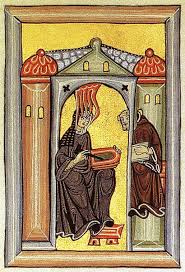
Born in 1098, the tenth child of her family and dedicated as a tithe to a monastery of Benedictine nuns at the age of eight, St Hildegard grew up to be an extraordinary and holy woman. She was a mystic, a poet, a composer of unique, soaring liturgical music so different from the plain chant of the time. St. Hildegard was the author of books, music, and plays. As a Benedictine Abbess she communicated with Bishops and Popes. She was a popular public speaker at a time women were normally not allowed to teach or speak. Abbess Hildegard was a prophet, an adviser, an influencer of her time.
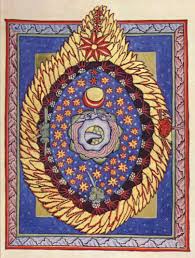
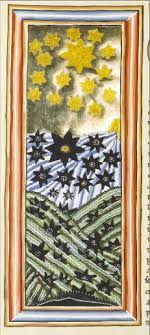
Her colorful mandala like art, not created by herself but overseen by her, represented her visions of the Trinity, and other Heavenly realities. The paintings often have a multi-layered appearance leading the eye to a central space containing a symbol. Looking at them makes me feel like I’m seeing into another world or a into a great depth.
Her illustrated book Scivias describes her mystical visions and the interpretations of them she heard from God. It was written in 1151. She begins it with her experience of God commanding her to write it. It is still available now as are other works of hers which ranged from the botanical to the medicinal, to the theological. Her exquisite music has been performed for centuries.. Her musical play, Ordo virtutum, or Play of the Virtues, may well be the oldest known morality play. It is beautiful but you may jump when in the middle of the serene vocals, the wild discordant voice of Satan interrupts the song unexpectedly for a moment. I have listened to it so many times but it still startles me. Otherwise her songs are pure ethereal loveliness. You might start with The Origin of Fire (no devil voice,) or A feather on the Breath of God which sounds as poetic and pretty as the title.
St. Hildegard’s world view, like her poetry, was lush, verdant, filled with rich, vivid imagery. She was deeply in tune with nature and the divine as expressed in creation. She was profoundly Incarnational, at once earthy and luminous in her spirituality and writing.
Here is Viridissima Virga, a hymn she wrote in honor of Mary
“ O branch of freshest green,
O hail! Within the windy gusts of saints
upon a quest you swayed and sprouted forth.
When it was time, you blossomed in your boughs—
“Hail, hail!” you heard, for in you seeped the sunlight’s warmth
like balsam’s sweet perfume.
For in you bloomed
so beautiful a flow’r, whose fragrance wakened
all the spices from their dried-out stupor.
And they all appeared in full viridity.
Then rained the heavens dew upon the grass
and all the earth was cheered,
for from her womb she brought forth fruit
and the birds of the sky
have nests in her.
Then was prepared that food for humankind,
the greatest joy of feasts!
O Virgin sweet, in you can ne’er fail any joy.
All this Eve chose to scorn.
But now, let praise ring forth unto the Highest!”
Hildegard possessed unusual wisdom and compassion. People of every class came to her for medical advise, healing remedies, wise counsel, spiritual help or prayers. At times she even delivered babies.
She was a Renaissance woman before the Renaissance, a polymath, someone brilliant in many subjects and incredibly creative.
Her faith was absolute. When she was sure she was doing Gods will she was literally unmoveable. She ran into some trouble with religious authorities for burying a sinner who had been excommunicated on the holy grounds of her monastery. She insisted the man had confessed and received absolution and communion. She was not believed by the Bishop. She was ordered to have the man’s body removed. She refused. Her sisters stood by her. She and they were placed under an interdict which meant they could not sing the Liturgy of the Hours or receive the Sacraments. It was basically a mass excommunication. Hildegard became very ill in her spiritual anguish and could not leave her bed. When the Bishop sent six men to remove her, she became so heavy they could not, no matter how many worked together to lift her, be moved at all. It was considered a sign from God.
The young man’s body remained where it had been buried.
St. Hildegard Abbey, also known as St. Hildegardis Abbey, is located in Eibingen, along the Rhein river in Germany. It was founded by Saint Hildegard in 1165. It is still functioning and is visited by pilgrims from all over the world devoted to her and interested in her life and work. .
Strangely she was not canonized for more than 800 years after her death. Finally on May 10th, 2012 Pope Benedict XVI did so though she had been already widely regarded and locally venerated as a Saint after her death in 1179. This lapse was because the necessary paperwork was lost en route to the Vatican when her cause was first undertaken. Pope Alexander III ordered the witnesses of her life and miracles to be gathered and interviewed again but somehow no one ever did so.
Maybe the delay was because we need this brilliant Saint to arrive in our consciousness now in these times we live in. Who doesn’t need a beautiful vision, remarkable and holy art, gorgeous music and vivid poetry, showing us a spirit that is unique in beauty with the ability to open our eyes in new ways to the glory and splendor of God? I think we all need that right now.
Pope Benedict XVI elevated St. Hildegard to the well deserved status of Doctor of the Church on October 7 of 2012 because of “her holiness of life and the originality of her teaching.” She is one of only four women Doctors of the Church along with St. Teresa of Avila, St. Catherine of Sienna and St.Therese of Lisieux.
After Abbess Hildegard’s death the nuns of her monastery reported seeing her luminous figure several times carrying a bright light through their monastery. She was radiant and she was chanting.
We celebrate St. Hildegard of Bingen on September 17.














 Bethany Hang Out