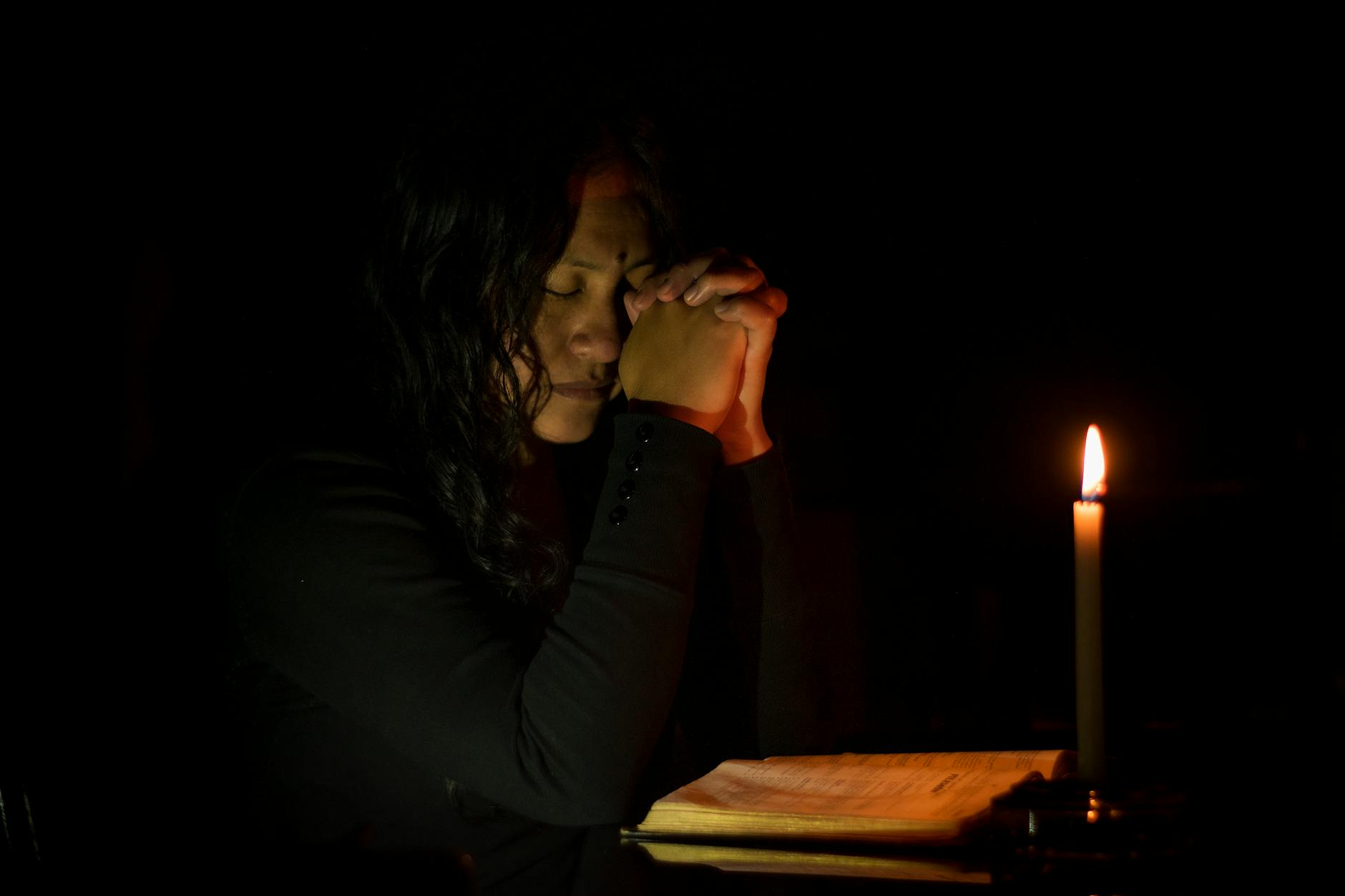
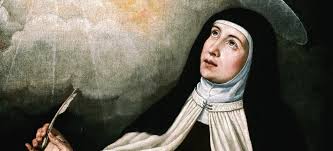
St. Teresa of Avila, Doctor of the Church, Carmelite reformer, and great teacher of Prayer, said that what she called the “Prayer of Recollection” was a method of mental prayer the Lord Himself taught her. Here is a video I have made of my brief, guided version of the Prayer of Recollection that you can use to learn it, or for a prayer break during the day. For more on the Prayer of Recollection, try reading my book, Meeting the One who Loves you, the way of prayer of St. Teresa of Avila from Our Sunday Visitor.
If I don’t watch out I can become a bit of a news junky; especially these days when scary, cruel and chaotic things happen daily. I feel like I have to keep up with all the news and analysis. This is so I can be a better activist and verbal defender of all that is good, and better able to speak up when there is injustice. I also say I keep up with world and national events because I want to hear about things I should pray about. I do pray about these things. However it occurs to me sometimes when I have read the same story or heard the basically the same discussion about the same story over and over in a week’s time, or even in one day, that my time could certainly be better spent praying.
I am thinking about this a lot today especially because it is the feast day of the beautiful Carmelite Saint, Teresa Benedicta of the Cross (Eidth Stein). My Secular Discalced Carmelite Community is named for her.
I have a strong belief that prayer takes us in Spirit along with Jesus and Mary to comfort those who suffer. St. Teresa Benedicta wrote about this beautifully.
The world is in flames: do you wish to put them out? Contemplate the Cross: from the open Heart the blood of the Redeemer pours, blood which can put out even the flames of hell. Through the faithful observance of the vows, you make your heart free and open; and then the floods of that divine love will be able to flow into it, making it overflow and bear fruit to the furthest reaches of the earth.
Through the power of the Cross you can be present wherever there is pain, carried there by your compassionate love, by that very love which you draw from the Divine Heart. That love enables you to spread everywhere the Most Precious Blood in order to ease pain, save, and redeem.
She would have known, from her formation in the Teresian Carmel, that prayer is a true work of the Church. Her spiritual Mother, St. Teresa of Avila taught this and Teresa Benedicta saw how relevant it was for the times she lived in, there in Nazi Germany when she was a woman of a Jewish family and at the end of her life, a Discalced Carmelite nun. She was taken, along with her sister, Rosa, to be put to death in a concentration camp. She was writing in urgent times. She offered her life for her Jewish people.
Some Carmelite nuns used to have a blog called, “Praying the News.’ Each week a different Sister took a news story that stood out to her and write a reflection and prayer, seemingly following the basic pattern of St. Teresa of Avila’s Prayer of Recollection. These particular nuns retired years ago and their blog is now defunct.
However, maybe I should take up their idea. I think I will do something like this. Some Chrsitian publications are doing a prayerful “nonpartisan” reflection and a little prayer about the news. It may not surprise you that I think the time for not taking a side is long over. As St. Teresa Benedicta of the Cross put it, “The world is in flames.”
The world is in flames. The struggle between Christ and Antichrist rages openly, and so if you decide for Christ you can even be asked to sacrifice your life.
To me this is self-evident if you aren’t entangled in Trump-ism. The man is an anti-Christ personality and has even led many good people astray though I will never understand how that could have happened.
There are some things I can do about it such as stand up for vulnerable people in the ways I can, and offer them my love, presence and support.
Otherwise I can pray. This kind of prayer is not of the “Oh thoughts and prayers” variety. It’s the kind that trusts God to act, not even knowing what God will do but knowing he hears and that he will.
So I’m going to start thinking about how I can pray the news, more than use up so much time reading and listening to it. (Once is enough, right?)
I’ll see what I can work on. I will try posting a “Praying the news” here each week. How about Sundays?
O beautiful flower of Carmel, most fruitful vine, holy and singular, who did bring forth the Son of God, ever still remaining a pure Virgin, assist us in our necessity.
Oh Star of the Sea, help and protect us.
Show us that thou art our Mother.
Our Lady of Mt. Carmel,
pray for us.
Amen
Day 1
*Pray the Flos Carmeli
I will allure her; I will lead her into the desert and speak to her heart.
Hosea 2:14
Mary, Queen of Carmel, take us to the places where God spoke to your heart. Teach our hearts to soften, to open as yours did, that we might hear what the Lord has to say in that tender voice of his. Clear our minds of their scurrying, and help us to be still. Lead us, gentle star, into the deepest depths of quiet and peace by your side. Draw us into the Heart of Jesus.
Spend a quiet moment with Mary now. Walk with her in silence the craggy path to the peaks of Mt. Carmel overlooking the sea. A gentle breeze flutters her veil. Watching, you realize the breeze is a voice speaking to you, that it is the Holy Spirit. What does the Spirit say to you as it ruffles your hair and kisses your face?
Our Lady of Mt. Carmel, pray for us.
Day 2
*Pray the Flos Carmeli
The desert and the parched land will be glad; the wilderness will rejoice and blossom. Like the crocus, it will burst into bloom; it will rejoice greatly and shout for joy. The glory of Lebanon will be given to it, the splendor of Carmel and Sharon; they will see the glory of the Lord, the splendor of our God.
Isaiah 35:1
In you, Mary, the Word was treasured as you meditated in your heart, and in you the Gospel blossomed abundantly. Your soul and your body were miraculously fruitful. In your humble simplicity the Spirit crowned you with splendor and glory beyond our understanding. But when I see you, Mary, you are quiet and smiling- your ornaments all within. Teach us to adorn ourselves with humility and simplicity. Draw us after you by the scent of your flowers of the heart, warmed by the sun that is the Lord’s joy shining on us.
Spend a quiet moment with Mary now. She is walking in a field of wildflowers. Catch up to her. She is picking flowers and filling the hem of her mantle with them. She motions to you and you offer her the bottom of your shirt for the overflow. She smiles and begins to fill the pocket you made for all these flowers. You have to sit down so she can fill your lap too. Lift some to your face and breathe in their scent.
Mary, beauty and glory of Carmel, pray for us
Day 3
*Pray the Flos Carmeli
Who are my mother and my brothers?” he asked.
Then he looked at those seated in a circle around him and said, “Here are my mother and my brothers! Whoever does God’s will is my brother and sister and mother.
Mark 3:33-35
Mary, you leapt to do the will of God at every sign of it with the love and trust of a little child, with the courage of a warrior bold. You were not only the physical Mother of the Lord, you were his spiritual mother and sister as well. You not only pondered the word of God given to you, but acted on it. Always you “arose and went with haste” wherever the Spirit called you. Teach us to listen, ponder, pray and to act on God’s word to us as you did unfailingly.
*Spend a quiet moment with Mary now. She puts a plate of food in front of you; bread, lentils and dates perhaps. She sits down to eat with you. As you bless the food together, you think, “Let us eat the bread of the will of God.” She smiles at you. You know you will have everything you need to do just that. And this is really good food, too.
Mary, Mother of the Word, pray for us.
Day 4
*The Flos Carmeli
God lives. I am standing in his presence. – The Prophet Elijah . (See 1Kings 17:1)
Mother of Carmel, you tended the fire of continual awareness of God’s presence in your heart daily as you swept the floor, made dinner, worked in the fields, held your Child, shopped in the market, loved and served the people around you. Open our hearts to perceive God within us, and in our daily lives; among the pots and pans, in the work we do daily, in the stolen moment of quiet, in the breaths before sleep. Help us come into the glow of constant contact with God you lived in within you and around you. Teach us the Practice of the Presence of God (Brother Lawrence)
*Spend a quiet moment with Mary now, tending the hearth, keeping the fire burning brightly, talking with her about this and that. Feel the fire’s warm glow on your face. She leans her head on your shoulder.
Mother in whose heart we live, where we find our Beloved, pray for us.
(St. Maryam of Jesus Crucified said, “I live in the Heart of my Mother. There I find my Beloved.”)
Day 5
*The Flos Carmeli
The Lord is in his holy temple; let all the earth be silent before him.
Habakkuk 2:20
Mary you were the temple of the Lord in a unique way. How beautifully you show us the truth that we who love Jesus are his temples too. Help us to make time to be alone and silent before God in the temple of our hearts with the One who we know loves us. (Teresa of Avila) As you did, let us cherish the Lord within us, love him, know him, listen to him, silently speak to him, look at him and let him look at us.
Take Mary’s hand now and allow her to lead you gently to your inner Temple where Jesus waits. Be there for a moment.
Mother of Divine Love, pray for us.
Day 6
*Pray the Flos Carmeli
I have set myself in silence and peace,
as a little child has rest in in it’s mother’s arms,
even so my soul.
Psalm 131: 2
Oh Mary, the lowly handmaid, the simple girl who loved God in your littleness, teach us to be little too. Help us to be humble in your easy, joyful way. Help us to be free to run lightly in God’s paths, to laugh easily, to dance without thinking, to be happy in his world that is so beautiful, and vast. The world around us is sign of his creative love, a glimpse of the Kingdom to come we are helping to make present by being little and humble in the arms of Jesus.
Spend a quiet moment playing with the little Mary a game you loved as a child. Let her throw her arms around you then. Hug her back.
Child Mary, little, humble and free, pray for us.
Day 7
*The Flos Carmeli
As Elisha watched, [Elijah being taken up to Heaven] he cried out, “My father, my father, the chariots and horsemen of Israel!” And he saw Elijah no more. So taking hold of his own clothes, he tore them in two. Elisha also took up the mantle that had fallen from Elijah. Then he took the mantle of Elijah that had fallen from him and struck the waters. “Where now is the LORD, the God of Elijah?” he asked. And when he had struck the waters, they parted to the right and to the left, and Elisha crossed over.…
2 Kings 2: 12-14
Holy Mother and Queen of Carmel, your Scapular is your prophetic mantle over our shoulders, a sign of our consecration to you, our silent devotion to you all though the day and during the night when we sleep figuratively wrapped in it’s protection.. The Brown Scapular is your hand on on our shoulder as we travel the Royal Road of prayer, and in the good works you lead us to. Help us to go forward with courage, to stand confidently as your children; seeing as you see, loving as you love, and serving from the heart. Help us to live as worthy sons and daughters of so wonderful a Mother.
*Spend a moment with Our Lady now. Lay your scapular in her lap and let her kiss it and put in on you again over your head and shoulders.
Mary, spiritual daughter of Elijah the Prophet, pray for us who wear your Scapular.
Day 7
*The Flos Carmeli
Carry each other’s burdens, and in this way you will fulfill the law of Christ.
Galations 6:2
Mary, in Carmel you are not only Mother and Queen, you are our sister and friend. Friends bear one another’s burdens. We know that you have always helped us bear our burdens and that you hear our sorrows. We want you to know we are here for you too. Share with us the sorrows of your loving heart, your concerns for your children. We know you always lead people to your Son, that you love us all, that human cruelty breaks your heart terribly. Help us to care about all that you care about, to listen to you, and to do something to help you in your mission to humanity, to be your kindly hands in this world where there is so much hate and indifference. Help us to find joy in all that you take joy in, the good things people do, the beauty to be seen, the love that is there in everything.
*Spend a quiet moment with Mary. Sit with her at her kitchen table maybe with tea or coffee. Ask her what she wants to tell you about. What does she say? Maybe today you can act on one of her concerns.
Mary, our friend and Sister, pray for us.
Day 8
Pray the Flos Carmeli
Leave here, turn eastward and hide in the Kerith Ravine, east of the Jordan. You will drink from the brook, and I have directed the ravens to supply you with food there.”
So he did what the Lord had told him. He went to the Kerith Ravine, east of the Jordan, and stayed there. The ravens brought him bread and meat in the morning and bread and meat in the evening, and he drank from the brook.
1 Kings 17:3-6
Mary, as Elijah did, you allowed the Lord to protect and take care of you, to take care of everything. You hid in the heart of God, drinking deeply from the stream of Divine Love. With you let us learn to hear the still, small voice of God, to let him care for us when we are afraid of the consequences of doing as he asks us. Remind us that when we hear him and respond, he will give us all that we need every time, just as he did for Elijah and for you.
*Spend a quiet moment with Mary now. Watch her as she fills a clay jar with water from the stream. It’s a sunny balmy morning. Birds are singing. You can hear the brook flowing. She brings you the water to drink. Drink deeply.
Mary, help of Christians, and Mother of Mystics, pray for us.
Day 9
Like a cedar in Lebanon I grew tall,
like a cypress on Mount Hermon;
I grew tall like a palm tree in Engedi,
like rosebushes in Jericho;
Like a fair olive tree in the field,
like a plane tree beside water I grew tall.
Like cinnamon and fragrant cane,
like precious myrrh I gave forth perfume;
Like galbanum and onycha and mastic,
like the odor of incense in the holy place.
I spread out my branches like a terebinth,
my branches so glorious and so graceful.
I bud forth delights like a vine;
my blossoms are glorious and rich fruit.
Come to me, all who desire me,
and be filled with my fruits.
You will remember me as sweeter than honey,
better to have than the honeycomb.
Those who eat of me will hunger still,
those who drink of me will thirst for more.
Whoever obeys me will not be put to shame,
and those who serve me will never go astray.
Sirach 24:13-22
Mary, Mother and Queen of Carmel, you are all of this and more to us, our beauty, our joy, our wisdom, our love for you an incense offered to the Lord who loves you even more than we can. Today we consecrate ourselves to you, Our Lady of Mt. Carmel. We dedicate our lives to God’s beauty and glory, and to yours. We belong to you, to your Son, to light and life and love. We want to spend our lives in the sweet companionship of your Spirit.
*Spend a quiet moment with Mary now. She is luminous in loveliness, as if she were made of light. You kneel before her. Closing your eyes, to pray, then opening them to see her again, you realize you are next to her in the kitchen. She is chopping vegetables. Join her. Stay with her all day.
Mary, Mother and Queen of Carmel, our Sister the Throne of Wisdom, pray for us.
I’ve found myself having trouble writing about Pope Francis since his death but I feel I should. It has been hard because I grieve him as so many do, in a deep, personal way, as well as with the Church and the world.
However, I thought with May coming up in a few days, the month the Church has dedicated to Mary, I could honor Pope Francis’ profound love of Our Lady.
Pope Francis turned to Mary the way a child turns to his mother. One of his first acts as Pope was to visit the ancient icon of Salus Populi Romani in Rome, in the Church of St. Mary Major, the oldest church dedicated to Mary. And he returned to that image again and again—before every apostolic journey, and after, to thank her. He entrusted the whole Church to her care and often encouraged us to do the same. In the Byzantine icon, Mary holds the Child Jesus, who holds the book of the Gospel. To me, since his view of Our Lady was centered in the Gospel, much as everything else about him was, that icon seems especially appropriate for him.
He has requested to be buried in St. Mary Major, near that icon where he prayed so often. He said to the coadjutor of that church, Rolandas Mackrikas, Mary appeared to him there asking him to arrange to be laid to rest in that place where Francis had so often come to visit her. He said “I’m so glad she has not forgotten me!”
Francis’ daily prayers included the Rosary, and his heart was especially close to the Marian devotions of Latin America—like Our Lady of Luján, the patroness of Argentina. Mary was not a “plaster saint” to him. (He cautioned against seeing her that way). She was a presence in his life. She was a real person to him.
The Holy Father spoke often of Mary as the “Mother of the People,” especially the poor and suffering. This view of Mary is prominent in Latin American spirituality. Mary walks with the people, accompanies them in their suffering and joy. This is what Franics himself was like. He wanted to be near people, to accompany them, love them, stand up for them, listen to them. Maybe he took after his Blessed Mother.
Pope Francis reminded us that in her Magnificat, Mary praises the God who casts down the powerful and lifts up the lowly, who feeds the hungry and sends the rich away empty. (Luke 1:46-55). Mary stood for, rejoiced in, justice for the poor and the oppressed, and we should too.
In Our Lady, he said, the Church sees what it means to be humble and brave at once.
Mary was little, and saw herself as lowly, but she was bold in faith and love.
My favorite Francis quote on Mary is about her brave humility at the Annunciation; in her response to the message of the Angel Gabriel.
“She recognizes that she is small before God, and she is happy to be so.” (Angelus December 24, 2017) He saw her humility as joyful, open to God, and brave.
And she was brave. Look at her life, so often turned upside down. But she always put Jesus and his mission, and put the Church, first, every time, even when she didn’t understand what was happening. She trusted, doing the will of God as soon as she knew it, no matter what it was, because she was great of heart.
Pope Francis is the Pope who gave us the feast of Mary, Mother of the Church, celebrated on the Monday after Pentecost. She is the Mother of Jesus, involved in our salvation and in the life of the Church, united with us in prayer as she was on the day of Pentecost. (Acts 1:14)
He also called Mary the first disciple —the one who listened deeply, believed without having all the answers, and followed her Son to the cross.
Francis loved that she was a woman of deep prayer as well as action.
Immediately after the Annunciation, “Mary arose and went with haste” to visit Elizabeth and assist her in her need. After the most intense and important mystical experience anybody on earth had ever had or ever would have, Mary immediately dives into service and love, helping her relative Elizabeth who is pregnant at an advanced age. (Luke 1:39-56) In the same way, Francis, and we, draw strength from prayer and contemplation. Then we immediately become servants of love. That is what Mary did, and it is what Francis did too. He thought of her as an evangelist, carrying Jesus to others wherever she went. To me this describes Pope Francis well.
In times of crisis, Francis always turned to Our Lady. During the pandemic, he asked the world to pray with him under her protection. In war, hunger, and fear, he encouraged us to say simply: “Mother, help us.”
In a time of grief, it feels right to turn to Mary—because that’s what Pope Francis would have done. He trusted her with his life and his Church. In this month of May, maybe we can do the same. We can pray the Rosary, light a candle, sing the Salve Regina, or simply say, “Stay with us, Mother.”
If we want to carry his spirit forward, we might start by walking with her.
In one of his homilies, Pope Francis said, “A Christian without Mary is an orphan.” But none of us are orphans, even though a wonderful father and beautiful light in the world has gone from us. Mary holds us even now, and she holds her son’s faithful shepherd, Francis close. May she carry him to the arms of Jesus, and may she walk with us until we meet again.
“Mother, help our faith!
Open our ears to hear God’s word and to recognize his voice and call.
Awaken in us a desire to follow in his footsteps, to go forth from our own land and to receive his promise.
Help us to be touched by his love, that we may touch him in faith.
Help us to entrust ourselves fully to him and to believe in his love, especially at times of trial, beneath the shadow of the cross, when our faith is called to mature.
Sow in our faith the joy of the Risen One.
Remind us that those who believe are never alone.
Teach us to see all things with the eyes of Jesus, that he may be light for our path. And may this light of faith always increase in us, until the dawn of that undying day which is Christ himself, your Son, our Lord!” – Pope Franics
I dreamed about the Prophet Elijah a couple weeks ago. We were sitting on a mountainside talking.The conversation we had is lost to me for the most part. It seemed significant that I dreamed of him. In the time following, I re-read the stories of Elijah’s life in Scripture.
*You can find these in 1 Kings chapters 17-19, and 21,
2 Kings Chapters 1-2, and in Sirach 48:1-11.
The pattern of his life that stood out to me as I read and reflected, is the path of the holy activist.
Elijah embodies the prophetic response to times of upheaval and injustice. He is an icon of a prophet arising in a time of darkness, burning like a torch. He spoke truth to power, confronted corruption, and defended the vulnerable. He drew his strength and inspiration from God as he served the hungry, healed the sick, and returned to a hostile land he had run in fear from. Sometimes he was afraid for his life, frustrated, burned out. Then he charged back into the fray, blazing, lit by God’s transforming love. Elijah’s life is a map lighting the path of the holy activist.
Elijah confronted corrupt leaders
King Ahab and Queen Jezebel were horrible, shameless, lawless people. They were greedy, murderous, corrupt idolaters and false accusers leading the people into apostasy. Elijah confronted them several times over killing the prophets and destroying God’s altars, taking from and murdering the poor, warning of consequences to come.
During one of his confrontations with Ahab, the king called Elijah his enemy, blaming him for causing trouble. This happens a lot to anyone who speaks up against wrongdoing. Elijah doesn’t care what the King says. He contradicts him briefly, undeterred. He doesn’t let himself be drawn into argument. He delivers God’s message with its warning and walks away, leaving the results in God’s hands.
If you have to call out corruption or injustice, remember to detach from what happens after you have spoken. You can do your part and the rest is up to the hearers to choose how to respond.
Elijah spoke truth to power
Baal, a pagan god whose worship included child sacrifice, was popular at the time just as destructive ideologies have so much sway now. Elijah was the only prophet of the God of Israel left and the Queen was trying to kill him as well. Sometimes we have to speak the truth at great risk.
Elijah called the priests of Baal to meet him for a duel between their false god and the true God of Israel. The prophet of God stands alone against 450 priests of Baal and before his own people who had gone over to them. He trusted God to act. Dramatically and miraculously, God came through, sending fire from Heaven to consume Elijah’s sacrifice.
God will give us everything we need to do as he asks; to stand up and speak out even if we are all alone in doing so, he is with us.
Elijah made use of humor
I want to add that Elijah made fun of the prophets of Baal as they called to their false god. He taunted them sarcastically about whether their god was sleeping, or deaf or busy. “Maybe you should yell a little louder.”
Making fun of the powerful can be a good thing at times like these so we aren’t overcome by fear or hopelessness. Those late night comedians keep me going sometimes. I’m all for it. After all, Elijah ends up slaying the false prophets and there are more ways than one to slay.
So if you can, find ways to laugh. Bring the powerful down to size with humor.
Elijah served the needy with faith and compassion
After a time of frustration and even despair, God sends Elijah on a journey to help a poor widow and her son who are on the brink of starvation.
By the prophet’s prayers and the woman’s trust, her oil jug never runs dry and her flour jar never runs out of flour until the famine is over.
Elijah prayed over her son when he fell ill and died while he was there, which brought the child back to life. Elijah shows himself to be a man of profound compassion and faith. His service to the widow renews him and helps him grow.
If you’re freaking out, an act of kindness or service will help your perspective and give you peace.
Defending the poor and oppressed
King Ahab and Queen Jezebel conspired to take the ancestral land of a man named Naboth after he refused to sell. It was already against Jewish law to press someone to sell their family land. Then Jezebel arranged false accusations against Naboth because of which he was executed. Then the King took over the man’s land. Naboth stands for all of the poor who suffer injustice and oppression, from the greed of the rich and powerful, from unjust systems.
Always defend the poor and oppressed and be sure that even if you don’t think you succeed in doing so, God will, either now or in the future.
Being guided by God, motivated by love
One of the times Elijah was in hiding, God asked him, “Elijah, what are you doing?” Elijah pours out his heart to the Lord. He tells him how scared he is with the Queen trying to have him killed. Then he tells God of his burning, intense love for him, which is the spark of his zeal. This is what it means to be a holy activist. Our inspiration, our strength, our courage to confront people in power, our compassion, our hunger and thirst for righteousness, are all from God.
Now and then it’s important for an activist of faith to do some soul searching with God. What are you doing? Why are you doing it? Is God with you on this?
Elijah experienced burnout and renewal
Twice in Elijah’s life story, we see him in hiding, scared and frustrated, overwhelmed to the point he wants to die and asks God to let him. He suffers from exhaustion, fear, frustration and self doubt. Twice God comes to him like a gentle parent, giving him bread, telling him to drink some water and have something to eat. Elijah rests, gets some sleep, and is fed by God until he is ready for a new mission, and sets out restored and reassured.
If you’re overwhelmed or burned out, let God care for you for a while. Rest, get extra sleep, until you’re ready and receive new guidance.
Elijah encounters God profoundly
God calls Elijah to the mouth of the cave he has been staying in, and invites him to experience him passing by. There is a mighty wind, but the wind is not God. There is an earthquake but neither is this God. When Elijah hears a “still, small voice” within himself, in a gesture of reverence as he covers his face with his cloak, recognizing the presence of the Lord.
Draw from the Source of all life, and practice attentiveness to God’s presence at all times. You will grow exponentially in love, strength and compassion, reflecting the Lord you love and listen to.
Elijah mentored the next generation to take on the work
An important part of activism is handing on the spirit of the work to the next generation. Elijah, after training Elisha at his side, grants him a double portion of his spirit before he is taken up to heaven. Elisha takes the mantle of his mentor over his shoulders, going on to do the great work of a prophet.
Whatever form of activism or mission you are involved in, always take time to talk to interested young people and pass on your wisdom and experience.
I’ve been so worried about so many things going on in our country, in our world. Maybe you have been too. Let us look to the Prophet Elijah to light our way, asking him for a double portion of his spirit, praying for the knowledge of his will for us and the power to carry it out. * from the 11th Step of AA
“The lord lives! I am standing in his presence.”
*Antiphon from the Carmelite proper, feast of Elijah the Prophet, July 20
if you’re dealing with a profound loss, the after effects of tragedy or post traumatic stress you may be feeling spiritually dead. Maybe you think you’ve lost your faith or that God has left you. It may be helpful for you to know there are neurological reasons for this apparent loss of your spiritual senses.
When there is a traumatic event or a terrible loss in our lives, our brains are actually affected. Trauma can disrupt the brain’s ability to process spiritual experiences by affecting its prefrontal cortex, amygdala, hippocampus, and temporal lobes. These areas are also involved in emotional regulation, memory, and our sense of self, even our feeling of connection with something greater than ourselves. Dysfunction in these regions can lead to a disconcerting loss of or distortion in a person’s spiritual life. It’s difficult for us to feel God with us, or to reach the peace we used to find in prayer and the practice of our faith.
The prefrontal cortex is responsible for self-reflection and focus. It helps us in practices like contemplative prayer and meditation by supporting awareness and attention. When this part of the brain is dealing with trauma we can’t seem to relax. We may feel void of any spirituality at all. Even the sacraments we believe in feel oddly empty as if we are merely spectators. Everything may seem meaningless to us now because the brain is preoccupied with stress and survival due to its injuries from trauma.
The amygdala and hippocampus process emotions, especially fear and joy. It gives us a sense of our life stories, of our own history. Spiritual experiences often evoke intense emotions and build on a relationship with God that we have developed over time. Trauma can even shrink the hippocampus . It may be hard to remember the love we once knew with God. Without this memory of the lived experience of God’s love and mercy, it’s hard to trust the Lord or that he is still there at all.
With post traumatic stress the amygdala becomes hyperactive, keeping our brains in a state of fear and hypervigilance. We might also feel emotionally overwhelmed and dysregulated making daily life difficult let alone communion with God.
The temporal lobes of the brain are associated with mystical experiences, and our perception of religious imagery. They also help us integrate our sensory experiences in life into spiritual meaning. Sustaining trauma can cause either overactivation or underactivation of the temporal lobes. This can lead to either intense visions or else fear-based religious thoughts. On the other hand, we may feel emotionally and spiritually blank. Where is God?
“God my God, why have you forsaken me?” Mark 15:33-34
Our anterior cingulate cortex helps us feel empathy and compassion. It’s also involved in the regulation of emotions and our sense of the Divine.The damage of trauma can impair the ACC. We may feel lost, cut off emotionally from our friends. We feel empty and alienated from people and God.
“Friend and neighbor you have taken away.
My one companion is darkness.” Ps. 88:18
The insula processes sensations and emotions, contributing to a sense of the nearness of God or a feeling of transcendence during prayer or meditation.Trauma can impair the functioning of the insula leading to either low body awareness or too much of it. We can feel a strange detachment from our bodies, unaware of even our physical needs. Conversely we may be overwhelmed by physical sensations, making it hard to relax or focus when we want to pray.
The good news is that contemplative prayer and meditation have been shown to be healing and even restorative to these areas of the brain impaired by trauma. Interior prayer practices and meditation can calm the amygdala, improve prefrontal cortex regulation, and enhance the connectivity of the ACC and insula, restoring emotional balance and renewing our sense of connection.
It means a lot to me that Jesus experienced trauma and that he allowed himself to descend into the depths of the abyss of abandonment when he cried out from the cross his desolation.
St. John of the Cross taught about the “Dark Night of the Soul,” a phase of the spiritual life of many Christian contemplatives and mystics, which seems to have similar effects as trauma does on our prayer life. St. John of the Cross wrote that “in the dark night of the soul, bright flows the river of God.” He teaches us that God is nearer than ever before at times we feel he is farthest away. He says to go on “naked faith” and not to give up.
I have found it true that “God is close to the broken hearted, those whose spirit is crushed he will save.” (Psalm 34:18)
So if you are grieving a tragedy, experiencing trauma or post traumatic stress, and your’re having trouble with spirituality as a result don’t blame yourself. You haven’t done anything wrong. Nor have you lost God.
We know Mary and Joseph were holy and faithful people but they still lost Jesus for three days. Maybe you feel bereft but he is still there in the temple of your heart and you will find him again just as they did.
It’s ok to pray in ways you can handle. Don’t hold yourself to what you used to do. For me emotional overwhelm kept me from deeper methods of prayer after a tragedy in my life. I talked to Jesus about it. I told him, “I still love you. I just need you not to come so close for now. Can you sit farther away but still nearby?” So he sat with me but not too close. I chose what felt to me a less personal or emotional method of prayer. I memorized psalms, set prayers or passages from the mystics I love like St. Teresa of Avila and Julian of Norwich. When I could handle it I sat quietly and slowly went over them in my mind as a form of prayer/meditation. Other times all I could do was hold my rosary. These things slowly began to bring me peace again.
My friend Jim had said “the devil will try to kick you when you’re down and darkness tries to overwhelm you at times like this so keep doing the things that are of light: the rosary, going to mass, whatever you can do.” He said that would keep my lamp alight no matter what I was going through. He was right.
And after all:
“The light shines in the darkness, and the darkness has not overcome it.” John 1:5
This summer I finished my manuscript for a new book. The working title is Pray Like Teresa; how to pray the Prayer of Recollection of St. Teresa of Avila. The publisher will decide the official title. I agonized a lot writing it but that seems to be part of my creative process unfortunately. It was also my solace during a stressful summer as it turned out to be.
When I have a project on I continually “write” in my head until it’s finished. Then it’s hard for me to stop messing with it and to stop thinking about it all the time. I enjoyed St. Teresa’s accompaniment during the months of working on this little book for her. I hope she is happy with it.
The book is short, only 15,000 words, about half the length of my first one, Come to Mary’s House; spending time with Our Blessed Mother. It is also more instructional than Come to Mary’s House. I would describe the general vibe of the book as St. Teresa with a Shawn twist. I tried to stay absolutely true to Tersa’s teachings and to work in my own Teresian spirituality and experience as well.
An important goal I had for this book was to help everyday Catholics and others to get to know Teresa’s teachings in a friendly way. I included St. Teresa’s struggles and sense of humor along with her teachings on the Prayer of Recollection and her basic foundational teachings that underpin it. I hope for the reader to see that contemplative prayer is for everyone and that this method of prayer is one anyone can do.
I also wanted to show why contemplative prayer is desirable, not only for the growth of the person who prays but for the good of the Church and the whole world. In this way I believe deepening inner prayer and contact with God, friendship with Jesus, and the practice of a life of prayer are urgent necessities in our world today and for the renewal of the Church.
A lot of people may be intimidated by Teresa of Avila because of her profound mystical experiences, because she is the “Doctor of Prayer,” and such a great figure of Catholic spirituality. Maybe they had not thought of reading her works before because they were written about 500 years ago and they assume she is inaccessible and too Medieval to be understandable or applicable to their lives.
I hope the reader will find that St. Teresa was also very human, witty, funny, practical and grounded. Her wisdom is relevant to anyone wanting to live the spiritual life, to grow in prayer, to this day. I hope I have provided a simple way to take up this prayer that Teresa said the Lord himself taught her, to anyone who picks this book up.
I think it would be a perfect book to take to Adoration with you, enriching your prayer in that hour with Jesus, or to keep by the place you like to sit when you pray daily. One could easily read a section each day and try the part of the prayer that section suggests.
I intend to encourage everyone who reads this book to try the prayer, to stick with it, along with giving practical ideas to help them be consistent.
I arranged it as an introduction to Teresa herself, and then I played out reflectively her basic discoveries about prayer such as friendship with Jesus, his Sacred Humanity, and God being experienced as within us.
Then I wrote a section about each step of the prayer and how to do it, each one headed by a quote from Teresa or from Scripture.
I allowed myself the pleasure of writing about the effects of the prayer as well and let myself get poetic about those but not overly so I hope. I wanted to communicate the beauty and joy of intimate love of God.
I am hoping this book will appeal to the everyday Catholic who may be being called by God to cast their nets into the deep or at least the deeper or even a little bit deeper. Whether the reader takes up everything in the book as part of their daily prayer life or not I hope reading it will improve their prayer life and their relationship with the Lord at least a little. I think it will.
My parish is primarily young people in college. They are remarkably devout, however. I can imagine some of them being interested in this book. I thought of them while I was writing, but also of people my own age or so (I’m 56) who at this time of life may be more interested in contemplation and want to give it daily time. I want it to speak to anyone who looks through it.
I turned in my manuscript to Our Sunday Visitor on Assumption Day, a few days early. But I thought it was a good way to honor Our Lady and St. Teresa, whose habit (the Carmelite habit) she wore.
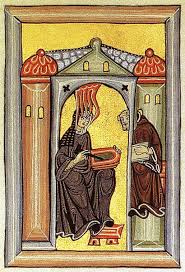
Born in 1098, the tenth child of her family and dedicated as a tithe to a monastery of Benedictine nuns at the age of eight, St Hildegard grew up to be an extraordinary and holy woman. She was a mystic, a poet, a composer of unique, soaring liturgical music so different from the plain chant of the time. St. Hildegard was the author of books, music, and plays. As a Benedictine Abbess she communicated with Bishops and Popes. She was a popular public speaker at a time women were normally not allowed to teach or speak. Abbess Hildegard was a prophet, an adviser, an influencer of her time.
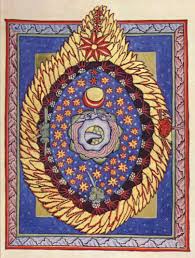
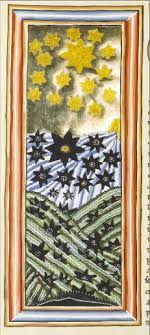
Her colorful mandala like art, not created by herself but overseen by her, represented her visions of the Trinity, and other Heavenly realities. The paintings often have a multi-layered appearance leading the eye to a central space containing a symbol. Looking at them makes me feel like I’m seeing into another world or a into a great depth.
Her illustrated book Scivias describes her mystical visions and the interpretations of them she heard from God. It was written in 1151. She begins it with her experience of God commanding her to write it. It is still available now as are other works of hers which ranged from the botanical to the medicinal, to the theological. Her exquisite music has been performed for centuries.. Her musical play, Ordo virtutum, or Play of the Virtues, may well be the oldest known morality play. It is beautiful but you may jump when in the middle of the serene vocals, the wild discordant voice of Satan interrupts the song unexpectedly for a moment. I have listened to it so many times but it still startles me. Otherwise her songs are pure ethereal loveliness. You might start with The Origin of Fire (no devil voice,) or A feather on the Breath of God which sounds as poetic and pretty as the title.
St. Hildegard’s world view, like her poetry, was lush, verdant, filled with rich, vivid imagery. She was deeply in tune with nature and the divine as expressed in creation. She was profoundly Incarnational, at once earthy and luminous in her spirituality and writing.
Here is Viridissima Virga, a hymn she wrote in honor of Mary
“ O branch of freshest green,
O hail! Within the windy gusts of saints
upon a quest you swayed and sprouted forth.
When it was time, you blossomed in your boughs—
“Hail, hail!” you heard, for in you seeped the sunlight’s warmth
like balsam’s sweet perfume.
For in you bloomed
so beautiful a flow’r, whose fragrance wakened
all the spices from their dried-out stupor.
And they all appeared in full viridity.
Then rained the heavens dew upon the grass
and all the earth was cheered,
for from her womb she brought forth fruit
and the birds of the sky
have nests in her.
Then was prepared that food for humankind,
the greatest joy of feasts!
O Virgin sweet, in you can ne’er fail any joy.
All this Eve chose to scorn.
But now, let praise ring forth unto the Highest!”
Hildegard possessed unusual wisdom and compassion. People of every class came to her for medical advise, healing remedies, wise counsel, spiritual help or prayers. At times she even delivered babies.
She was a Renaissance woman before the Renaissance, a polymath, someone brilliant in many subjects and incredibly creative.
Her faith was absolute. When she was sure she was doing Gods will she was literally unmoveable. She ran into some trouble with religious authorities for burying a sinner who had been excommunicated on the holy grounds of her monastery. She insisted the man had confessed and received absolution and communion. She was not believed by the Bishop. She was ordered to have the man’s body removed. She refused. Her sisters stood by her. She and they were placed under an interdict which meant they could not sing the Liturgy of the Hours or receive the Sacraments. It was basically a mass excommunication. Hildegard became very ill in her spiritual anguish and could not leave her bed. When the Bishop sent six men to remove her, she became so heavy they could not, no matter how many worked together to lift her, be moved at all. It was considered a sign from God.
The young man’s body remained where it had been buried.
St. Hildegard Abbey, also known as St. Hildegardis Abbey, is located in Eibingen, along the Rhein river in Germany. It was founded by Saint Hildegard in 1165. It is still functioning and is visited by pilgrims from all over the world devoted to her and interested in her life and work. .
Strangely she was not canonized for more than 800 years after her death. Finally on May 10th, 2012 Pope Benedict XVI did so though she had been already widely regarded and locally venerated as a Saint after her death in 1179. This lapse was because the necessary paperwork was lost en route to the Vatican when her cause was first undertaken. Pope Alexander III ordered the witnesses of her life and miracles to be gathered and interviewed again but somehow no one ever did so.
Maybe the delay was because we need this brilliant Saint to arrive in our consciousness now in these times we live in. Who doesn’t need a beautiful vision, remarkable and holy art, gorgeous music and vivid poetry, showing us a spirit that is unique in beauty with the ability to open our eyes in new ways to the glory and splendor of God? I think we all need that right now.
Pope Benedict XVI elevated St. Hildegard to the well deserved status of Doctor of the Church on October 7 of 2012 because of “her holiness of life and the originality of her teaching.” She is one of only four women Doctors of the Church along with St. Teresa of Avila, St. Catherine of Sienna and St.Therese of Lisieux.
After Abbess Hildegard’s death the nuns of her monastery reported seeing her luminous figure several times carrying a bright light through their monastery. She was radiant and she was chanting.
We celebrate St. Hildegard of Bingen on September 17.
During these horrifying days of unutterable violence and war, of every kind of atrocity, what can we do? We are far away. We are not leaders of nations. We have to go to work, we have to let the dogs out, listen to a little kid, put dinner together, and also be horrified, feel helpless, ache for the children caught in this, and feed the cat. We have to figure out what to wear tomorrow, wonder if we forgot something we were supposed to do, and as the scenes of mutilation blood and terror cross our minds we wonder what to even say to God.
Maybe nothing.
Maybe we should just let our hearts be pierced as Mary did. We could take on her pure and open heart completely in tune with her suffering Son’s and willing to be present and active in those hours he was slowly dying. She accepted the piercing of her heart, and “the secret thoughts of many [were laid] bare.” I used to wonder what that last part meant. I couldn’t get an answer from anyone about it that seemed right.
But what happens when our secret thoughts are laid bare? We see the truth about ourselves. Our conscience is awakened and we tend to desire to change. Maybe the piercing of Mary’s heart caused conversion of heart for others and still does.
At the same time she was made the mother of all Christians from the cross by Jesus, she received from God a special gift for nudging us toward conversion, of laying bare the truth within us. This would be in line with her role as Spouse of the Holy Spirit who is the Spirit of Truth and Love.
We know Mary has been given unique gifts and that she intercedes for us in heaven. She is advocate of the people of God and she hears the cries of the world.
Such is her unity with God that in her hearing of suffering her knowledge of it is already prayer. Mary is there in Israel and Gaza now touching every face, assisting the dying, suffering with those in distress and in the piercing of her heart at the foot of this cross the possibilities open for changes of heart.
She is to be found wherever her Son is found, exactly where he said he would be; among those who are hungry naked imprisoned or persecuted. He is with the suffering and so is Our Lady. She is there praying with all who pray. Her feet are muddy and her face is streaked with tears. She wants us to join her and in the wind of the Spirit we can.
This is not a helpless dwelling on the horror taking place. This is knowing that God makes our little prayers BIG. We are to reign with Christ and this is how he shares his reign with us. He loves to share his mission with his disciples.
We don’t know what God will do in response. But we know he will do something. We know he gave the world a mother we need so much.
We can take on the mind and heart of Mary. We can go with her and bring comfort in mysterious ways, change hearts even when we don’t know it. We can become windows of grace God’s will can flow through into this world.
We are only little windows but God doesn’t care. He shares his power and love to widen our hearts for his love to flow through.
And in our hearing and seeing and knowing if we remain close to God, our silence becomes full and active. What we know instantly becomes intercession, becomes prayer.
When you hear of bloodshed and terror you will already be praying, and prayer does things.
Like Mary let our hearts be pierced at the foot of this cross. May God receive our offering.
“Come, Holy Spirit, come by means of the powerful intercession of the Immaculate Heart of Mary, thy well beloved spouse.”

























 Bethany Hang Out