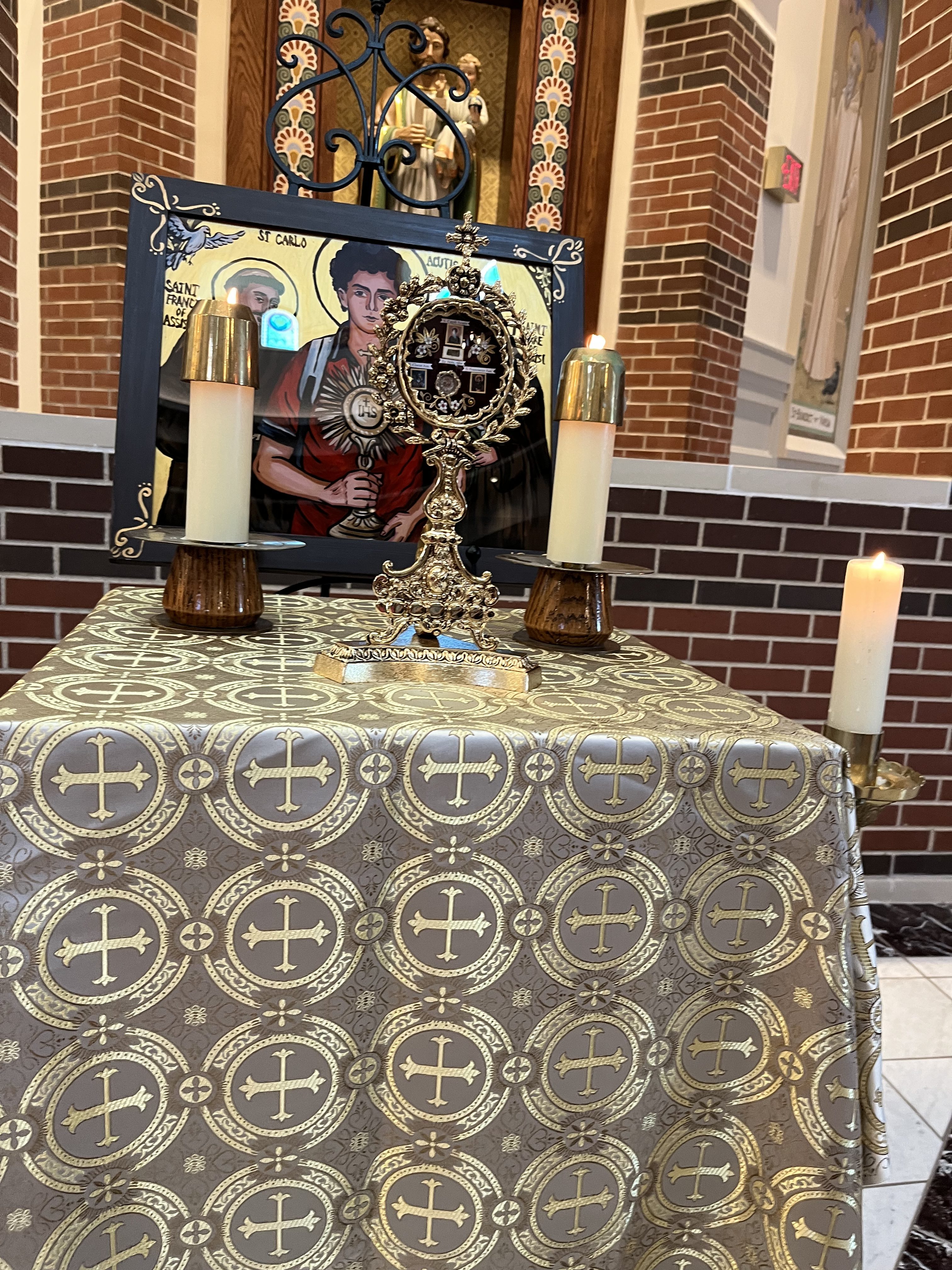
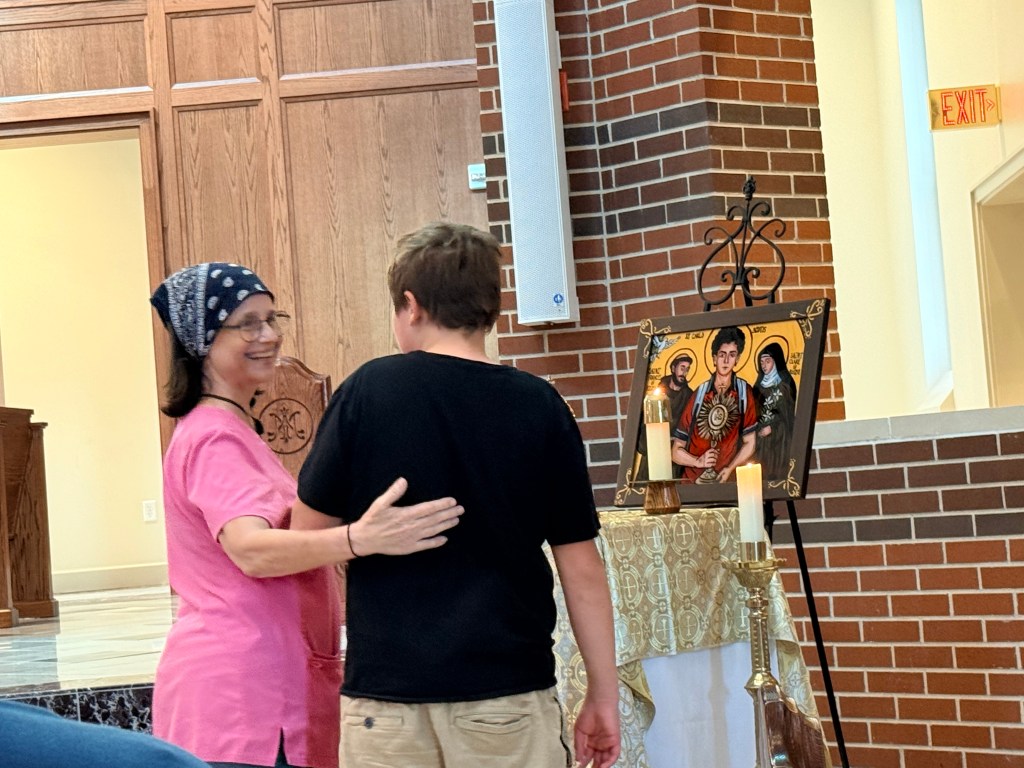
Yesterday relics of St. Francis of Assisi, St. Clare and St. Carlo Acutis visited my parish.
St. Francis is very important to me so I had to go! However I was working yesterday evening. So I asked the parents of my fourteen year old special needs guy Sean who I take care of in the evening if it was OK if I took him. They were fine with it. When I walked in with him I saw the line already snaked all over the church. After a couple minutes he was twisting out of my hand and yelling “bathroom!” So I took him there and lost our place in line, phooey. I was just wondering how we were ever going to make it through when someone in charge took us to the front of the line and explained to the people behind us. When we reached the front he made prayer hands. After a second or two he said, “OUCH!”
He sometimes does that just because he likes saying it. Then he clapped really loudly and I thought, “OK yeah time to go.” It wasn’t much but I felt uplifted as we left. Tears came to my eyes in the parking lot. I don’t really cry anymore – not for years. So that was a big deal. A small gift of tears.
St. Francis was the first Saint I ever loved even before I was ever religious. Mostly I told him that- that I loved him and thank you. 🙏 I am sure the Saints blessed my young charge also. In any case we both left happy.
I plan to write St. Francis a letter later to say more to him. 💕
The leaves are falling from the trees – from heat stress here in Central Texas. The grass os brown and crunchy under my feet. However, in my college town, the students are back flowing in to my parish past the fill line each Sunday, driving like maniacs in the increased traffic, studying in every coffee shop, and crowding the bars on the weekends. So this counts as fall around here in spite of the weather. Living with a child marks the transition as well, long before the heat lets up. My granddaughter has started fifth grade, my grandsons have started second and fourth grades, and the baby has started walking.
Thinking back on the summer of 2026, I think it was the summer of broken down cars. My daughters and I have all had excessive car trouble this summer.
It was also a summer of much reading. I tend to go through a book every 4-5 days. This is when Kindle Unlimited comes in handy with a number of free digital books. I love actual books too. In fact I finally have my Little Free Library up and running. I’ve been so excited about that. It’s something I have always wanted to do! The books haven’t been moving too fast but I hope that will change as more people notice it. If you have any ideas about books to put in it, or any advice, let me know in the comments.
I started a Christian Base Community at my house. We have had two meetings so far. And it’s just four or five people. It’s been good. We pray Lectio Divina with the Gospel from the closest Sunday, share about it, eat snacks. We talk about how we will follow up on our insights we received in prayer. So far we have been doing triage dealing with everyone’s exhaustion about the cruelty we have been seeing in our country right now. However we will move into identifying problems in our community and making plans to do something about them.
I watered my garden every day to try to help everything survive the heat. The basil did well and got so big and fluffy! I left the flowers on the plants so the bees could enjoy them, which they really seemed to. My roses bloomed a bit but by evening they looked like crinkled paper. I left water out for my chickens, cats, the birds. and squirrels and anything else that needed it.
One of my chickens, Cleo, almost had a heat stroke so we brought her in and put her feet in the sink with some water and ice until she felt better. Now we bring her in and put her in a dog crate during the hottest part of the day. The others do OK.
A crazy good thing happened to me this summer. Out of the blue I found out my book Meeting the One Who Loves You; the way of prayer of St. Teresa of Avila, won first place in the category of adult prayer and devotionals from the Catholic Media Association. I even beat out a Dominican priest! Don’t worry he still got second place for his in-depth Stations of the Cross. I had no idea I was in the running. I thought my latest book wasn’t selling that well. What do you know? Some people liked it! That was exciting and my former editor and another friend at Our Sunday Visitor told me it was a big deal. So yay!
I started cooking vegetarian for my dog this summer. I looked stuff up and figured out what to feed him. I’m vegan but I figured I would start with vegetarian for him and see how he did. His coat got shinier and softer, his energy has been up. He has not scratched as much. So success so far!
Here is my current recipe for him. He is a big dog (76 pounds) so this is one day’s food for my big boy.
Joey Francis Tribiani Chapman’s Vegetarian Dog Food
Ingredients
one cup brown rice
one cup lentils
1 cup plain yogurt or cottage cheese
a handful of ground flax seed
one cup full of chopped vegetables
a scrambled egg or two
To do
cook the lentils, rice and ground flax seed together in about 5 1/2 cups of water
(I use my instant pot for this on the bean setting)
steam the vegetables (if they are frozen you can just throw them in while the beans and rice are still hot)
stir in the yogurt or cottage cheese
scramble the egg or hard boil it
stir in the vegetables and the egg
When everything is cooked and mixed together, let the food cool off before you give it to your dog.
*Please note that dogs cannot have onions, garlic or apple cores.
One daughter is almost finished with her master’s in criminal justice. She plays around town as a singer songwriter and also in a band called The Fragments. My other girl got into flight school and already started flying. Her instructor says she will make an excellent pilot.
One of the guys I take care of as a caregiver, Mac, became very ill at the beginning of the summer. He stayed sick for such a long time, ended up in the E.R., and had a nine day hospital stay. He was still extremely ill when he got home. His parents and I had lots of extra care to do and we were all still really scared. We almost lost him. Recently he got sick again but he didn’t worsen into pneumonia it just took a long time and hard work to see him well again. Mac is so resilient.
My other guy, Sean, who is just 14, had a decent summer I think. He was out of school but he still went to his autism clinic every day. That’s where I pick him up in the late afternoon. It was too hot to go to the park or anything so sometimes we explored buildings we had never been in, and we got a snowcone every Monday because Mondays are hard. (sugar free cherry for him, lime with chili salt for me).
I started making little videos of prayer breaks this summer. I was surprised how many plays they get. I only put them on my Come to Mary’s House Facebook Page which most people don’t know about. But they get about 300 plays apiece. Funny. So I will keep doing it as long as I can. I just take little prayer breaks usually between my jobs, so I thought of sharing those.
I had the funnest day ever with my friend Mark. We went to Houston and went to our favorite coffee shops and bookstores. We ran all over the downtown, I forget how many thousands of steps he said we took. We went to the Museum of Fine art to see their Frida Kahlo exhibit. Then we went to my favorite, The Menil, and to Mark’s favorite, the Rothko Chapel. We ate at a little dive Mexican vegan restaurant, and at The Hobbit too. The big deal was a concert in honor of John Coltrane by virtuoso jazz artists from around the world. Oh it was amazing. I really felt like Coltranes’ spirit was in that place. What an experience!
I continued to volunteer with Sweet Oak Collaborative’s emergency food pantry. We have a guy who in his retirement makes vats of homemade food, boxes up meals and freezes them. He donates them to Meals on Wheels, the Boys and Girls Club, and us. A friend is donating a deep freeze which we could really use. There is a lot of need out there especially as the food banks lose federal funding and food stamps are cut for people. It’s good to be able to do something about it.
Other than tearing through one book after another, listening to audio books in the car, and Catholic Stream lecture series, listening to music, going to work and coming home, plus regular family life, and broken cars, that was my summer. My car is still down. It’s about 20 years old and my dad thinks it’s kaput. My eldest daughter has hers in the shop. Again. My youngest daughters’ car has a battery that needs to be replaced but that is difficult because of the way her engine is built (why did they make it like that). At least it runs and I am driving it too so I can get to work. Car shopping is in my near future. Wish me luck.
My eldest daughter comes over for coffee with me with the baby after she drops the boys off at school. My other daughter and my granddaughter live with me. I’m so lucky. I love them all. They’re all such unique, hilarious and wonderful people. I enjoyed my time with them this summer very much.
My Hippie Sisters pulled off some great dinner parties this summer as well. Nobody does it better.
I got to know my newly married godson better. We talked for four hours and ended up on the coffee shop steps after it closed. That was fun. He grew up to be so cool. 🙂
I also saw the son of a dear family friend who grew up playing with my youngest daughter ordained a priest in Austin this summer. That was beautiful.
Summer is still my favorite season but I don’t handle the heat as well as I used to.
Now I’ll try to get in the mood for the fall that hasn’t actually started yet.
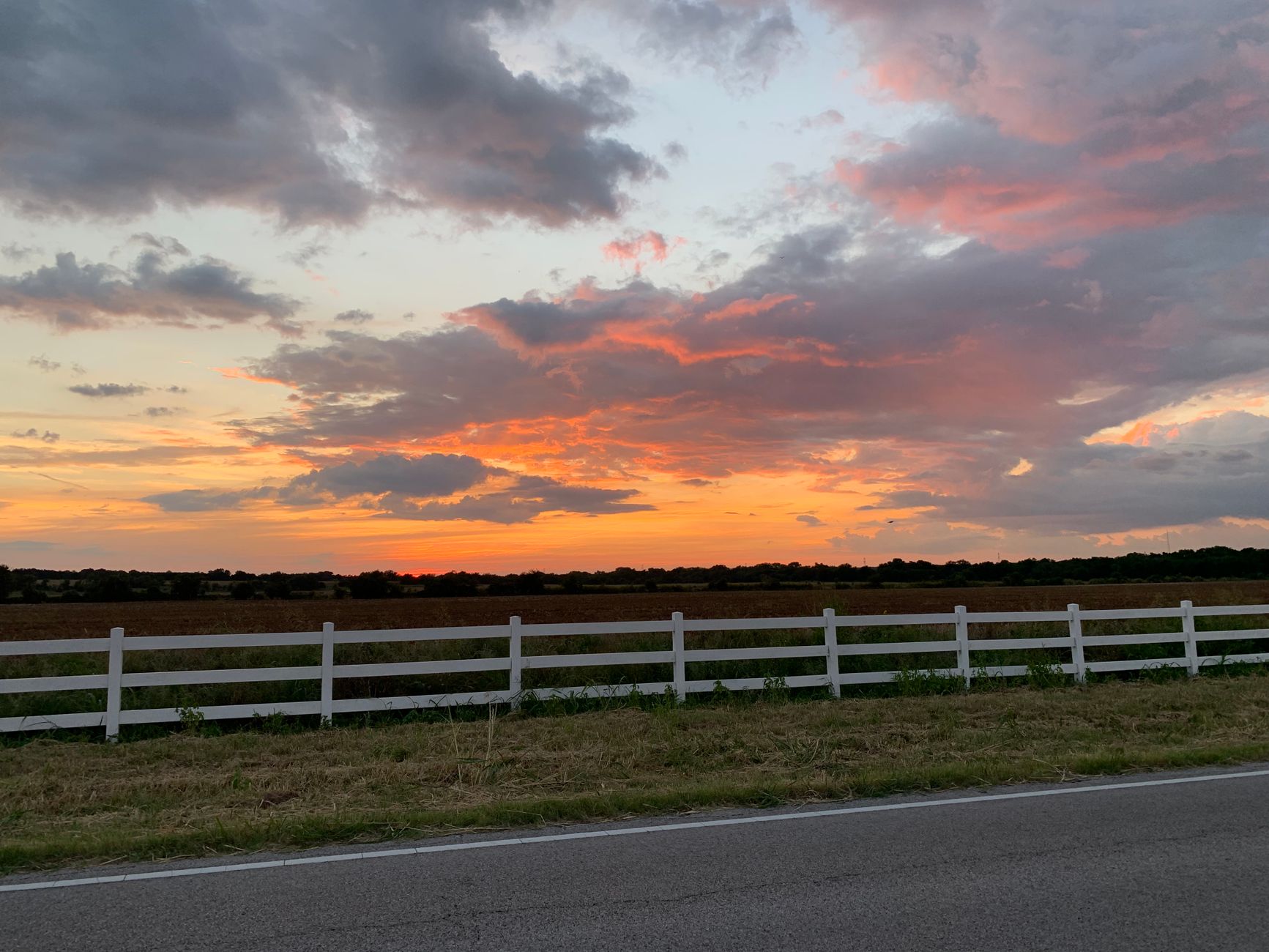
Texas sunsets in late September are especially glorious. I’m looking forward to that. And maybe to getting some new roses from the Antique Rose Emporium. Fall is the best time to plant them. I want them to be as profuse as possible around my house! I like them wild and tangled and hanging from the trees like a fairy land. That’s what I’m going for.
* Here are some things I read this summer. If you have any book recommendations for me let me know in the comments.
The Adventures of Amina Al-Sarafi by Shannon Chakraborthy. I was happy it was a trilogy.
Bat Eater and other Names for Cora Zheng by Kylie Lee Baker
Finding Francis, Following Christ by Michael H. Crosby
Remarkably Bright Creatures by Shelby Van Pelt.
The Star of Calcutta by Sujatta Massey
The Tears of Things by Richard Rorh
The Poet Empress by Shen Tao
The Poppy Wars by R.F. Kuang (a trilogy))
Katabasis by R.F. Kuang
Babel by R.F. Kuang
All six books of the Hawthorn and Horrowitz series. By Anthony Horowitz
House of Silk by Anthony Horowitz
Bunny and its sequel We Love You Bunny by Mona Awad.
The Pillow Book by Sei Shonagon
The River Has Roots by Amal El Mother (so beautiful it’s practically poetry).
The Once and Future Queen by Paula Lafferty
Green Teeth by Molly O’Neil
The Poetry of St. John of the Cross translated by Willis Barnstone
How to Clean Everything by Ann Russell (I didn’t clean much though).
Homebody by Rupi Kaur (poetry)
Children of Blood and Bone by Tomi Adeyemi ( an intense trilogy)
I also re-read a bunch of Agatha Christies and other favorite books when I ran out of stuff or one of these other books wrung me out and I needed comfort reading.
I’m currently listening to The Intrigue by Sylvia Moreno Garcia on audiobook
reading Diavola by Jennifer Thorn
and Bad Mexicans; Race, Empire and Revolution in the Borderlands by Kelly Lytle Hernandez
Listening to a course on Catholic Stream about Midieval Christianity and just finished one about the great spiritual families in the history of the Church (about the spiritualities of the different major religious orders from the Desert Fathers to the Vincentians). Recommendations welcome if you listen to Catholic Stream too- I have it on Apple podcasts)
A lot of times I am distracted at mass because, being a ball of tangled neurological divergencies, sometimes it’s hard for me to be in a crowd of people. It’s also hard for me to focus almost all the time. How did I end up a contemplative? I guess because God can do whatever he wants and he is able to undiverge my brain when he wants? I feel guilty a lot though. OK, all the time, about my problem focusing especially at mass.
A few Sundays back mass was really crowded and I was standing in a little private area near the bathrooms and the entrance to the choir loft stairs, in an attempt to quiet my mind. This helped. But my mind was still going everywhere and sometimes I didn’t even notice it. When I did notice it I felt bad. I would say, “Oh. Sorry, Lord.” Especially during the consecration, I feel bad if I am not mentally tuned in. I said it again as the host was raised, “Oh. Sorry Lord. Dang.”
He broke into my thoughts. He seemed to say, “Why can’t you just be here?” I understood that to mean he wanted me to just be there at mass even if I was having trouble wrangling my mental states and thoughts. “Just be here.” It was like he showed how he saw me over there in my corner, without struggle, just me bringing myself to mass even with all the misdirected electrical impulses in my brain, just there to be with him. And I was. I was there to be with him. I don’t have to manufacture the right feelings and thoughts or try to get a perfect clear mind. I came to see Jesus. Apparently that was enough for him.
I remembered when I used to be a Eucharistic minister, I looked out at everyone coming up the line, and I thought how amazing it was that each of them had stopped what they were doing, changed into less comfortable clothes, rallied their families if they had them, got in the car, and drove to mass just to be there. “I bet that means a lot to Jesus,” I remember thinking. And then I thought that no matter what kind of people I gave the Host to, no matter what mood they had been in before they came up for Communion, every one of them took the Eucharist with the face of a child. And that’s how Jesus sees us. He sees his children doing their best to be there with him and the Church family, gathered around his table. That’s it. I can do that.
That’s what we are all doing. “Just be here.”
He just wants us.
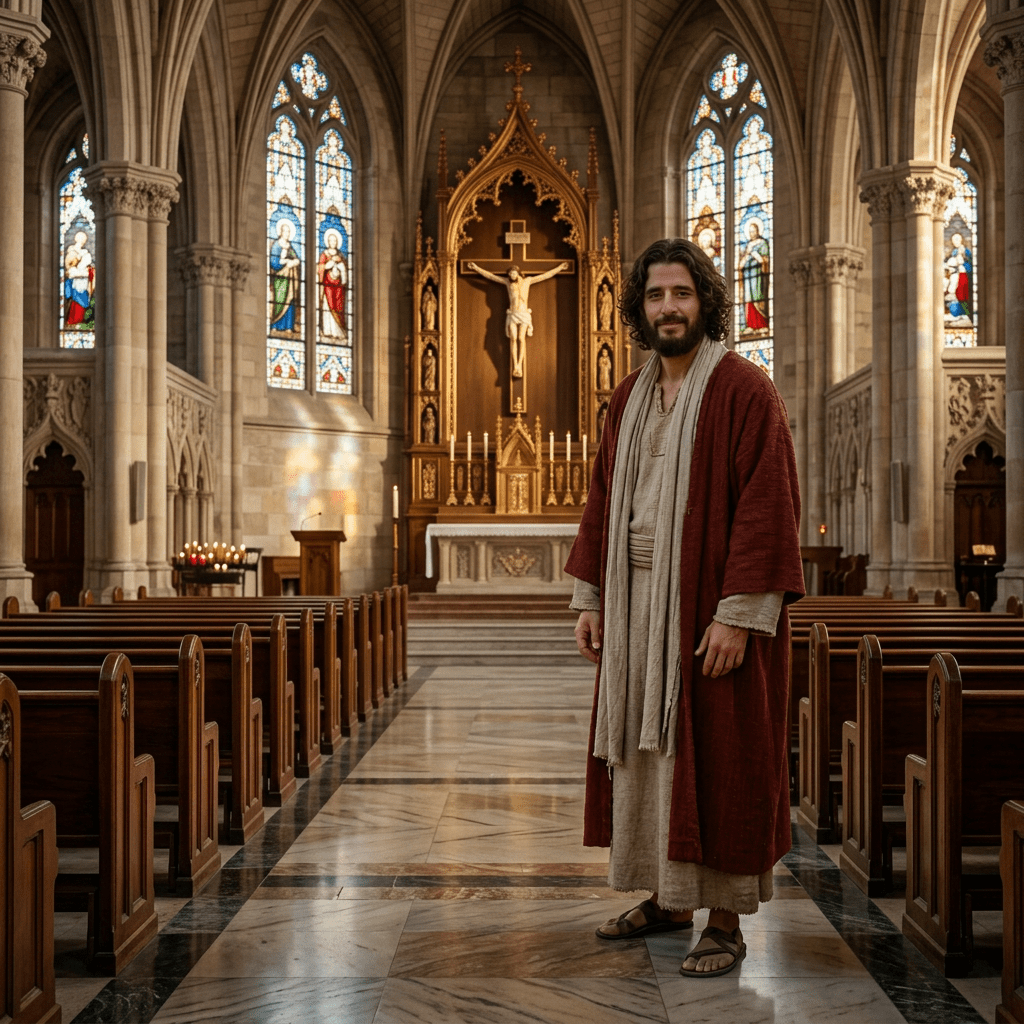
A robed traveler stands on a rocky path above an ancient hillside village at sunset.
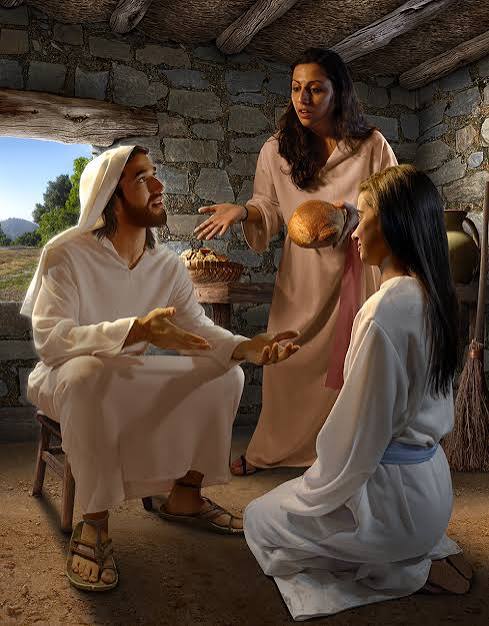
When my eldest daughter, Maire, was about four years old, my husband and I thought to make the Sunday Gospel more understandable for her, we would start doing little skits with her at home after mass. The most memorable of these was a Sunday when the Gospel story was about Martha and Mary, (Luke 10:38-42).
My husband, Marc, played Jesus, I played Martha, and Maire played Mary. I went to the kitchen and started banging pots and pans around in an angry way. Marc sat down and started talking to Maire, sitting at his feet, about being nice to everyone, and sharing your toys. I came stomping into the room demanding that Jesus tell my sister to help me with the serving. Marc stood up and said soothingly, “Martha, Martha, you are anxious and concerned about many things, but Mary has chosen the better part and it won’t be taken from her.”
I’ve never wanted the story to end there and apparently neither did Maire. She said we weren’t finished yet, so we went back to our places. My husband said, “So Mary, we need to love everyone.” My child got up, came into the kitchen, and took my hand. “It’s OK, Martha! We can trade.” She led me back to Marc, and had me sit down. And she went to the kitchen and started rattling dishes and puts and pans.
My husband and I looked at each other with wonder.
I praise you, Father, Lord of heaven and earth, because you have hidden these things from the wise and learned, and revealed them to little children
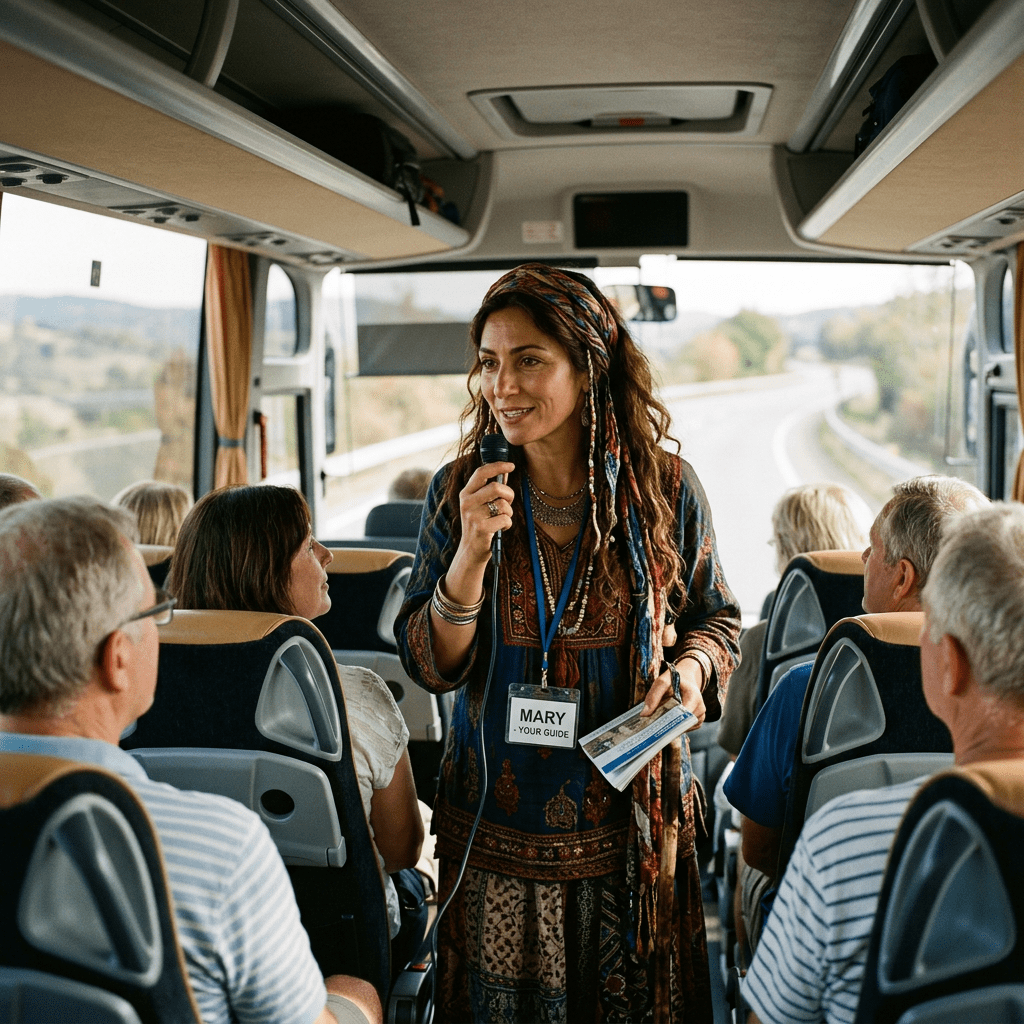
A tour guide chats with passengers on a bus journey.
I had a dream about her. At the time I was just beginning my recovery process from a lot of hellish and very deep trauma. I was a young adult flooded with regrets about the troubled teen I had been and the dark ways I had tried to deal with the pain.
So God granted me a visit from my Confirmation Saint * to bring me healing and perspective.
In my dream I was on a tour bus with a lot of other people. We were about to drive through a Gypsy camp. The tour guide, who looked to me like a Romani herself, had the bus driver stop before we drove in. She gave us a talk about not gawking and telling us to be respectful. She probably said some other things too but I don’t remember.
As we slowly drove through the camp, we looked on silently while our guide talked to us. I noticed a girl sitting under a tree with a broken leg. It was a compound fracture; her shin bone was sticking out. It was hard to watch. It was even harder to watch her try to set her leg by using a crow bar. I gasped and so did others who noticed. The tour guide urged me in particular not to judge the girl. She said I should realize the girl was doing the only thing she knew to do with the only tool she had. This is when I realized the tour guide was St. Mary Magdalen. Suddenly I understood she was trying to tell me not to judge my young self so harshly. I too had been doing the best I could, the only things I knew how to do, with the only tools available to me.
When I woke up I felt I had been touched by Heaven, that my struggle was seen, heard and understood. And I knew I had a friend who got me, who had maybe even been there herself.
To this rich dream I have often returned for strength and inspiration. And I honor our great Saint, Mary Magdalen, today on her feast day. She was a woman of courage who spoke up even when she was dismissed and not believed. She knew what she saw. She knew what to do. She had received deep inner healing from Jesus, and she was the most faithful of disciples, with him until the end, after the end, and the new beginning too. She is our faithful friend, as well. I didn’t even ask her to come to me and help me. But she came to me anyway. She loves us. She is our big sister in Christ.
If you’re wounded, grieving, broken, beset by demons of some kind, she gets you. If you’re ready for healing she will help you get there. If you’re not quite ready she will wait until you are.
May she pray for us all and take us to the heights as we follow the Lord to the end.
From his fullness we have all received; grace flowing upon grace. (John 1:16)
*I had two Confirmation Saints. Both St. Joan of Arc and St. Mary Magdalen 🙂
Why, oh WHY do so many people on social media put “laughing” reactions on posts that show terrible human suffering? Even crying children in war zones, a picture of that baby that was shot in the Walmart parking lot, a child being separated from her family. Why do some cheer on the Ebola that’s spreading in the Congo? Why do so many react defensively about injustice or the suffering of others? For example: “Well they broke the law.” Or, “he should have complied” or saying they want to buy a beer for the ICE agent who killed Renee Goode?
Here are some possibilities:
Group identity becomes stronger than compassion. People often show less empathy for those they perceive as outsiders.
Moral justification. “They broke the law” or “He should have complied” can reassure oneself that the world is fair. This is called, “just-world hypothesis.”
Distance. Seeing suffering through a phone screen is different from standing next to a crying child. Some who would comfort an injured person in real life may react callously online.
Performing for an audience. A “😂” reaction is not always actual amusement. Sometimes it’s a tribal signal: The reaction is less about the victim than showing loyalty to one’s “team.”
Dehumanization. History shows that when people are repeatedly described by leaders in media and politics as criminals, invaders, parasites, terrorists, or enemies, others begin to see them as less than fully human. That makes cruelty easier. This has been documented in many contexts, from wars to genocides.
Psychological defense. Some people cope with disturbing news by denying it, minimizing it, or mocking it.
Online disinhibition. People are often meaner behind a screen than they would be face to face. The relative anonymity and lack of immediate consequences reduce normal social restraints.
Echo chambers. If someone’s online community rewards cruel comments with likes and approval, those comments become normalized. What once would have seemed shocking gradually comes to feel ordinary.
Social media can distort our perception. I should remember that in the real world, disasters are still met with strangers donating blood, neighbors bringing meals, volunteers searching through floodwaters, and people quietly caring for one another. In spite of everything, compassion remains beautifully common.
And what is the best way to react to apparently heartless people? How do I have compassion for them?
I should remember that people who have stopped feeling compassion are not necessarily happy people. They may be afraid, angry, overwhelmed, lonely, immersed in media that constantly tells them to fear certain groups, or rewarded by their social circle for cruelty. None of that excuses their horrible comments. But it does mean that the person behind the comment is likely carrying wounds, distortions, or habits that have narrowed their ability to see another person’s humanity.
A prayer from Alcoholics Anonymous about encountering mean people is,
“This person is sick. How can I be of help? God save me from being angry.”
I do think anger is an important emotion. However, anger at random mean people is not good for me and doesn’t help them either.
I am Catholic. I don’t believe in bad people. God intended us to be good, and he made us good in spite of original sin and concupiscence, (the tendency to sin) God loves us all.
God sees everything: the suffering and injustice, as well as those committing it, and those of us who witness with empathy or mockery.
I don’t have the commission to straighten people out. They’re not my kids; they’re God’s kids.
Maybe next time I can imagine two wounded people instead of one: the victim in the story, and the commenter whose heart has become so constricted that they can laugh at suffering. The first deserves justice and mercy, and prayer. The second also needs healing, and prayer though they don’t seem to know it.
I think St. Teresa of Avila would tell me that my task is not to carry every burden in the world by sheer emotional force. As a Carmelite, my part is to stay close to Jesus, and from his sacred heart, receive the love I need to give away. If I try to absorb every tragedy and every cruel comment, it does nothing but damage my heart, which is such a mood sponge, and ruin my day. Prayer is one way of gently wringing it out.
I could, if I bump into mean posts or comments, pray a quick prayer.
“Lord, have mercy on these people who are so deeply harmed,
have mercy on the hard of heart,
and have mercy on me too.”
The best response can also be to close the app, water my persimmon trees, tend my chickens, stock my Little Free Library, pray for immigrants in detention, write a reflection, or encourage my daughter before a gig. Those are not escapes, just a better contribution to the world than freaking out.
Catholic author Leticia Ochoa Admas writes that (in paraphrase,) every act of mercy, every refusal to mock another person, every prayer for someone whose heart has hardened, is a rose laid at the feet of the Virgin Mary. Well I love her so I will let that motivate me.
The world scatters thorns wildly and seemingly without plan or reason. Maybe my job, our job is to keep growing roses anyway.
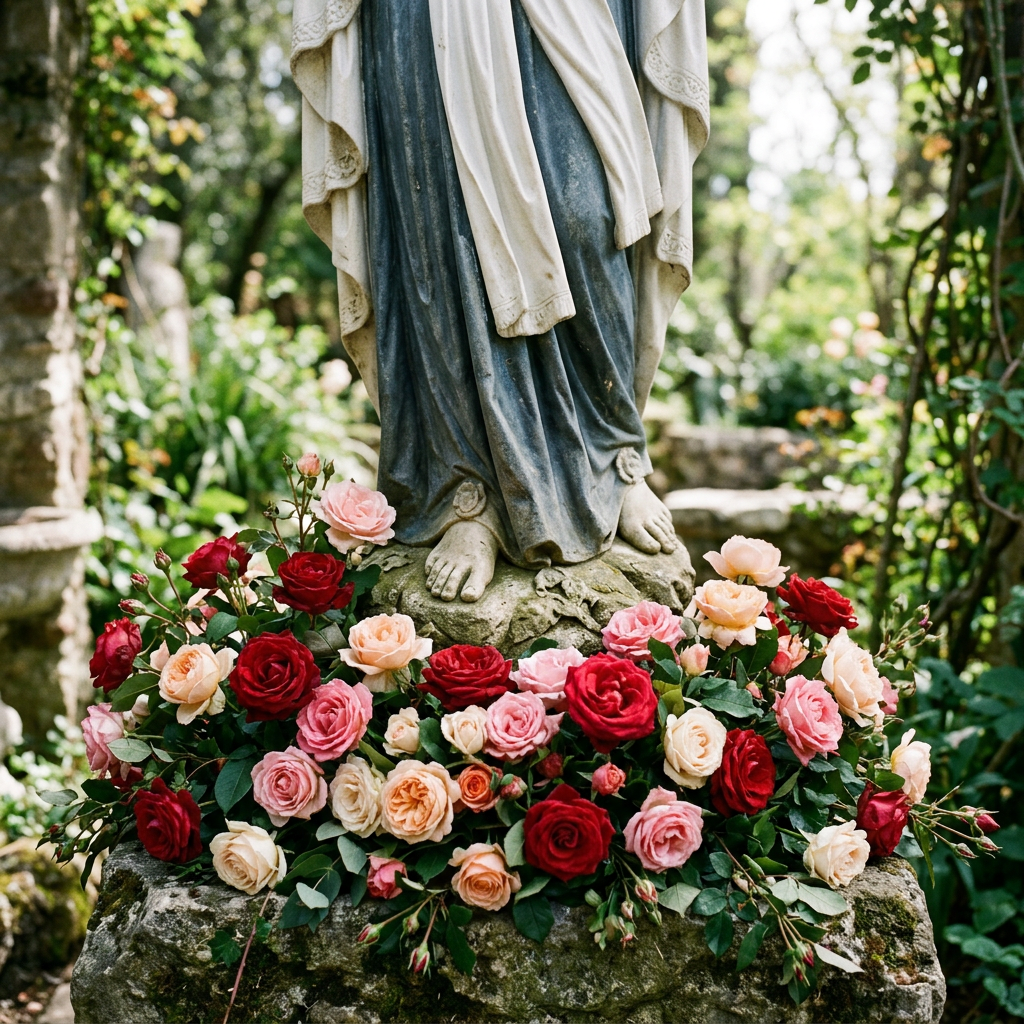
A colorful rose arrangement decorates the base of a garden statue’s feet
Rejoice always, pray continually, give thanks in all circumstances; for this is God’s will for you in Christ Jesus.”
I Thessalonians %:16-18
I was going through a difficult time when I was nineteen. My best friend had just died a couple of months before and I had no spiritual foundation for dealing with that. Not only that but my family was going through a difficult time as well. All of this was made more difficult by the fact that I was not any good at processing emotions or dealing with things in helpful ways. I was trying to change that but I was still learning. I called a mentor of mine crying, not sure what to do about feeling so bad. She said to go for a walk and think of five things I was grateful for. I didn’t understand but I was a mess so I did as she asked. I don’t remember what I was grateful for in the end. I mostly remember that being grateful for the smallest things and keeping them in mind as I walked lifted the dark heavy cloak I felt like I was wearing by at least a few pounds.
In the many years since that time I have learned that gratitude helps not only in dark times, but even in the midst of the very darkest of times. Not only that but it seems to fix a lot of problems. It may be that gratitude helps us to accept what is. Or perhaps the slight change in perspective helps us see with more clarity and makes problems appear smaller than they did when we were freaking out, and solutions seem possible. It is a great help in relationships. Appreciating people is an important glue holding us close to one another. It’s the same with God. When Jesus healed a group of ten lepers, he was shocked that only one came back to thank him(Luke 17:11-19). He appreciates our thanks. Gratitude draws us closer to the Giver.
I haven’t forgotten the bad things that have happened to me in life, at least not the big ones. But I have made a habit of gratitude to the point that, as I recently noticed, when I wake up I usually smile at God as soon as I am conscious. (How long has this been going on?) Generally I’m not elated much. However I am content overall and I have a lot of joy in my life. Sometimes I am really worried about something and sometimes I have anxiety or I get angry or depressed. However the smile is real and at the same time habitual. I am not sure anymore which came first.
I know that when I am feeling out of sorts, uneasy or upset, that one of the best tools in my tool box is to say, “OK what am I grateful for?” Sometimes the things I am grateful for are only things like “Well I’m grateful it’s not worse,” or “I’m grateful for the trees,” or “At least we’re not dead.” Sometimes I laugh at myself that those things are all I can think of. But they are still good things as well as real things. It’s a start.
Fr. Brian Eilers, when I had just confessed having lost my temper with my family, said he wanted me to go out into the main church and take up my rosary. “On each bead thank God for something. Keep going until you have been all the way around the rosary.” I had been upset when I had driven to the church. But by the time I finished my penance I was smiling. I had even thanked God for my family. I’m so pleased to have them, mad or not!
So if you’re upset or in a bad mood today, if you got bad news, or if you watched the news and lost your peace, go for a walk. While you are walking, think of five things you are grateful for. Tell God about these. When you get back, write them down. I’ve advised this to friends having a hard time before. I usually get a good report about how it went. This also helps if you’re angry with someone you love. Think of five things you are grateful for about them. I promise it helps. It can also help when you’re mad at God which at one time or another all of us has been. And when we are happy we should be sure to thank the good God for our joy.
“If the only prayer you ever say in your entire life is thank you, it will be enough.”
Meister Ekhart
You might like to try Fr. Brian’s gratitude beads with your rosary.
Maybe you can imagine you are putting flowers at the altar of God in Heaven. After all, he deserves them. And he usually ends up pouring them into your lap. He loves doing that.
It is a pronounced characteristic of our Catholic faith that both personally and as Church we meditate deeply on the suffering of Jesus. Our crucifixes, art and literature are often graphic in their portrayals of his Passion and Death. The Saints emphasize this practice, the rosary we pray, the Church calendar, all return us to our suffering Lord. In the Stations of the Cross we walk with Jesus through his suffering step by step. Why do we do this? To an outsider it might seem ghoulish to dwell on the lurid details of his torn flesh, his bloody sweat, the tears he shed.
The mystics say that Our Lord’s Passion is like a fire of love. The more we draw near to this fire the more we are warmed and transformed by it.
I am a deeply sensitive, and, I hope, compassionate person. I am always uncomfortable with the Sorrowful Mysteries of the Rosary (traditionally prayed on Tuesdays and Fridays. During Lent it is also on Sundays). Meditating on the Sorrowful Mysteries, we follow Jesus through his Agony in the Garden of Gethsemane, his Scourging at the Pillar, his Crown of Thorns, his Carrying the Cross, his Crucifixion and Death. It’s tough. But I don’t want to leave him alone in his sorrow. I want to share in it as his mother did. I want to comfort and help him. Also we can’t expect to only share the sweetness of the Lord without the bitterness of the cross. Part of love is acceptance. I don’t want to only love part of Jesus I want to love all of him, accept everything. That means following him not only in his joyous times but right into the valley of death as well, and the cruelty he experienced from others.
For me the fact of the betrayal of Judas, Our Lord’s broken heart, his grief, the abuse heaped on him, have helped me accept the sorrows in my own life. Sharing in his pain has made me more able to not look away from the suffering of others but to ‘weep with those who weep.” (Romans 12:15)
A Methodist minister friend told me he noticed that Catholics don’t see ourselves as witnesses of the events in the life of Jesus. We think of ourselves as taking part in a very present way in our prayer and especially at mass. We are there at the Last Supper at mass. We don’t think we are witnessing something. It’s not a story. We are in it. I like that. Maybe this points to why we submerge ourselves in the torture and cruelty of his death in such detail. We’re helping ourselves be there.
Our Lord’s Passion teaches about love as intense faithfulness and determination, sacrifice, acceptance. It helped me stand by my husband all through his fight with brain cancer. In his darkest and fearful moments I listened to him talk about his feelings of raw desolation, anger, and even shame, of terror, of feeling there was no comfort anywhere. In spite of my love for him, part of me wanted to run and hide from the enormity of what he was expressing.
I had no mitigating words to say. The profound suffering of another person is frightening to be present to. When he eventually asked how I felt about this on a spiritual level, all I had was the fact of Christ’s suffering. At least as we went through this with cancer we had a God with us who didn’t die gracefully in a shower of rose petals but was coldly executed, naked and bleeding like an animal, nailed to a cross, with a cry of spiritual abandonment only just having died on his lips.
My husband nodded gravely. He got it.
1565 Oil on canvas Scuola Grande di San Rocco, Venice
The Christian life is illuminated by the choice of Jesus to take our suffering on himself. It was our sins, our iniquities, yes, but our suffering too, according to Isaiah.
“Surely he took up our pain and bore our suffering… by his wounds we are healed” Isaiah 53:4-5
The incomparable light he generated by choosing to undergo his Passion as an offering shines forever. It reminds me in my own darkest times, of his compassion. My tears are his too. St. Teresa of Avila says so great is his compassion that when you visit him in his agony he will forget his own sorrow in looking at you and wanting to comfort you.
As we approach Holy Week let’s avail ourselves of the opportunity to love Jesus through his suffering and death, and to let him love us too.
I would like to invite you to a very practical and frequently unappreciated form of abstinence: that of refraining from words that offend and hurt our neighbor. Let us begin by disarming our language, avoiding harsh words and rash judgement, refraining from slander and speaking ill of those who are not present and cannot defend themselves. Instead, let us strive to measure our words and cultivate kindness and respect in our families, among our friends, at work, on social media, in political debates, in the media and in Christian communities. In this way, words of hatred will give way to words of hope and peace.
Pope Leo XIV, Message for Lent 2026
The Holy Father has, in his serene and gentle way, thrown down a gauntlet with this challenge. This is a very tough form of fasting, especially now in these times of political extremes, immovable opinions, varying understandings of reality and a shocking lack of empathy or compassion. Language is too often used in flagrant attempts to dehumanize those who differ from us In this age of rage, are we contributing to the lack of peace by our words? We long for justice but do we really care about the effect our words have on others or are we just mad? How do we do better? What steps can we take to purify the violence of our speech and still speak truth when necessary?
We need some steps to get there, some tools, a frame work.
Jesus said, “out of the fullness of the heart, the mouth speaks.” (Luke 6:45, Matthew 12:34) He said our sinful and hateful words begin in our sinful and hateful hearts. Practically speaking, this means we need to master our thoughts. When we master our thoughts, we master our words. Here is my tool box for disarmament, if you will.
On mastering our thoughts, one of the best things one can do is replace them with something else. A dear priest told me once during Confession that every time I had a hateful or judgmental thought about a certain person I was struggling with, I should mentally say, “I renounce that thought in the Name of Jesus Christ.” Guess what? It worked! That person is among my inner circle of friends and has been for many years now. She loves telling people the story.
Some years back I found myself obsessively wrapped in raging thoughts about a betrayal in my life. My rotating anger was no longer helpful. I didn’t need to talk about my feelings. This pre-occupation of mine became a problem with family and friends. Nobody wanted to hear it anymore. I didn’t want to hear it anymore. I wasn’t healing, just stuck. I had to stop.
I remembered that I had tools I knew worked. So I began to mentally repeat the names of Jesus and Mary whenever I had the urge to talk about it or think abut it all again. It worked! I went from thinking about the whole thing at least once every 15 minutes to hardly ever. If we don’t think about something like that, we stop talking about it all the time, as well.
Another thing I was doing at the same time as forming the habit of repeating the holy names, was spending time daily in silent interior prayer. My main way of doing this at that time was memorizing passages of the Bible, prayerfully and silently going over and over them in my mind. This is called Ruminatio, a loving meditative recitation of God’s Word in the heart, from the monastic tradition. It’s a “chewing” on the Word until it becomes sweetness in the heart. Sweetness in the heart is what we need most.
Another thing silent prayer does is slow our minds down and makes our emotions less volatile. We have time to think before we speak rather than just spark into fire whenever we are challenged. The Lord is in us and he calms the destructive storms. (Matthew 8:23–27, Mark 4:35–41, Luke 8:22–25). The waves of our emotions calmed, we are more likely to speak wisely and less hurtfully.
Here are some helpful considerations from a modern proverb of uncertain origin.
There are three gates your words should pass through before you speak. Ask these questions of yourself:
Is what I want to say true?
Is it necessary?
Is it kind?
If what you want to say doesn’t pass through all three of these three gates, don’t say it!
What to do instead? Go for a fast walk and repeat the Holy Name of Jesus or the Jesus prayer the whole time. Don’t come back until you are calm. (The Jesus Prayer: “Lord Jesus Christ, Son of God, have mercy on me, a sinner”).
Remember this is not something you are doing alone. God is with you and his grace will aid you. So ask him.
May the words of my mouth, and the thoughts of my heart, be acceptable to you, my God.”