“When Black Friday comes, I’m gonna dig myself a hole, I’m gonna lay down in it ‘till I satisfy my soul.”
-Steely Dan
The Advent Season is at the same time as the Shopping Season. I wish it wasn’t so. I wish, when December comes, that I could spend my Advent and Christmas as a hermit instead.
I would probably miss my brother though.
I told Jesus how much this time of year stresses me out.
There is so much to do and the whole soundtrack of Advent is Christmas music when it isn’t Christmas. They play and play those Christmas songs everywhere you go, and by the time Christmas comes I don’t even want to hear Joy to the World ever again.
I hate shopping, even on line.
I am prone to mall nausea.
Jesus listened in silence. He is good at that.
He has been helping me pack, since I am in the middle of moving.
“Can’t we just trick all the stores by moving Christmas to some other time?”
He sat back on his heels, smiling at me. “Let’s go shopping.”
“What, right now?”
But he was already putting on his shoes. Which means I had to put on mine, too.
He wanted to go to Wal-mart. I hate that place. But I drove him there.
There was a lot of traffic, and some people were not driving in their right minds. I growled at them, but I said, “God bless you, have a nice day,” because what else can you say with that guy around?
When we arrived, he wanted to sit in the parking lot and hold my hand for a while.
So we held hands sitting in the car. I looked at him sometimes, and sometimes I watched the people going by. So many of them were smiling, though many seemed pre-occupied. People handed each other carts, stepped aside for the elderly, grinned conspiratorially at the children, many of whom were skipping or jumping up and down. Parents looked at each other over their children’s heads and laughed.
I thought about how even in the midst of the over commercialization of the season, it is true that people seem to treat each other with a little more kindness. Maybe there is something to the magic of the season after all. It’s Jesus coming out in people at his special time of year.
Jesus said his mom always took him shopping when she went, that he loved going with her.
I thought about that.
We always think of Mary’s pregnancy during Advent. She was filled with Jesus. She took him everywhere. From what Elizabeth said at the Visitation, his presence could be felt in her. I imagined Mary, very big and pregnant, doing the shopping, smiling, knowing.
Jesus squeezed my hand. “Let’s go.”
At the front doors, he made sure I donated to the Salvation Army, and reminded me to thank the bell ringer for being out there.
He drew me into conversation with some little boys who were raising money for their team, prompting me to ask questions that seemed to please them.
We walked through the tinseled Wal-Mart, noticing people and blessing them. He pointed out to me the ones who were tired or worried or sad, and had me pray for them. He showed me examples of people being kind to one another across the usual social boundaries we rarely think about and seldom disregard. I began to kind of almost like Wal-mart.
I bought some dog food and we silently blessed all the people in the check out line; especially the young mother with the crying baby and fussy toddler, the cashier who looked as if she had worked a double, and the old man who counted his change out so slowly and then did it again.
Yep, there was that Christmas music. He smiled, I noticed. He said he likes Christmas music all the time.
It was crowded in the mall and I was almost instantly over stimulated. He patted me on the back.
He thought I should try smiling from the heart at everyone I saw.
This simple exercise had an amazing curative effect on my nerves.
I started seeing possible gifts my daughters might like a lot. I even started to feel a little excited. I walked a little faster. I thought how easy to please both my daughters are, and how much I love them.
As we made our way through the mall, Jesus reminded me to say a kind word to everyone I interacted with, even to go out of my way to compliment people. I was surprised how much this little effort brightened people’s faces, and mine, too.
He wanted to go into a store that looked really glitzy to me. I dislike places like that. They make me feel ridiculous.
Sure enough when we stepped across the threshold, I noticed the hole in the toe of my shoe, became conscious of the eccentric bent and general sloppiness of my clothes, the fact that I have not worn make up in years.
Looking at all those expensive beauty products on mirrored surfaces, all those swanky clothes, the fashion show music, the fast pace, being surrounded by the fashionable and well dressed, made me unusually self conscious. Then I was annoyed at myself for caring.
Jesus pinched me. Because in my self absorption, I had not noticed a teenaged girl whose bag had come open on the bottom. Her items fell and rolled across the slick, polished aisle and under clothes racks, scattering hopelessly. People stepped over her things, or avoided her or stared at her, but nobody was helping her and she was embarrassed, as teens tend to be.
I helped her find everything, even getting on my hands and knees and crawling under hanging coats, smiling because it reminded me of hiding from my mom in stores as a kid.
All her things restored to her, and a new bag procured, the embarrassed teen was on her way, hopefully feeling a little better, and thinking of what was for dinner.
On our way out, Jesus and I passed one of those triple mirrors that help you see your new outfit from every angle. As I walked by, I saw an unexpected flash of color and retraced my last two steps. I saw myself in a golden dress with bracelets on my arms, rings on my fingers, and gold sandals on my feet, a small crown on my head. I laughed as the vision faded, and the voice in my ear said, “This is how you look, to ME.” I closed my eyes in sheer joy.
When I opened my eyes, he had slipped away. He must have gone to help someone else so I got into the car alone, knowing he had his own ride home.
At a very busy intersection I saw him standing on a corner holding one of those signs saying that he was hungry, and would someone please help.
I hate when he stands on a corner where I can’t get to him unless I go to the next exit and turn around and almost get in a wreck trying to help him. But I did it anyway. I even gave him a hug along with the money. He patted me and said, “God bless you.”
Back in my car, I turned on the radio. Matt Maher was singing “Alive Again” and it made me cry a little bit.
“You called and You shouted Broke through my deafness Now I’m breathing in and breathing out I’m alive again
You shattered my darkness Washed away my blindness Now I’m breathing in and breathing out I’m alive again”
I understand. The spirit of Advent, Lord, is in listening to you, noticing you, and spending time with you in the ways you lead me to, loving in all the ways the world around me offers… even in shopping and going to Wal-Mart and the mall.
A priest and I have met in a cool, bustling lobby on a hot summer day. We smile at one another. We don’t know one another really except by sight and a few short conversations. But we have a warm, positive regard for one another and I feel safe and encouraged as soon as he comes in. I am so grateful that he is here.
We are about to head up to bless the place where my brother committed suicide. I know this is not a light task to ask someone to come along and join in.
I came here twice before to make sure I could handle it. The first time I sat in stunned silence for an hour and a half without even realizing the time that had gone by. The second time I was pretty sad but I thought I was ready. I am ready.
I am impressed that this priest who barely knows me responded to my request so readily and agreed to come here for this. He seems to understand the need for healing, both emotional and spiritual for all concerned.
Our plan is also to commend my brother’s soul to God, and to pray in that place for my family’s healing.
Father walks with me toward the elevators, which we take to a high floor. We walk down a hallway, then through a stair exit, and out onto a tiny bare balcony overlooking a pool area.
“Just be however you need to be,” he says reassuringly.
This is the spot where my brother, Mark, sitting on the railing here, shot himself and fell down to the concrete below even as friends and family repeatedly called his cell phone and frantically texted him begging him not to do it while the police looked for him not knowing where to begin. I have thought of those moments over and over, tried to understand, tried to feel the way he must have felt, wondered why it had to be this way, watched my family and our friends do the same.
What is there to say in a place like this?
After a time of respectful silence, Father talks to me earnestly about how the Cross conquers everything. “I believe that,” I say.
He has such a kind face, I think to myself. It’s an easy, open, playful face, too. He is the kind of person who puts others at ease.
photo Renee Bork
I get out my phone and show Father one of my favorite pictures of my brother. I briefly tell him about Mark, about my symbiotic relationship with him, and what happened to him as best I am able to understand it now.
Mark Timothy Manning
This gentle priest takes all this in thoughtfully.
He tells me what he would like to do, how he would like to proceed now.
I show him what I have brought: a grocery bag full of rose petals, some bubbles; a small bottle for each of us.
He smiles. He says the bubbles are a great symbol for what we are doing with the commendation. He blesses them.
He puts a thin priestly stole over his shoulders and smiles at me.
Photo by Skitterphoto on Pexels.com
We begin with the Sign of the Cross together. He prays the prayers for the blessing of a place, telling me we are also reclaiming this place for God. In our prayers we invite the angels to come and drive every trace of evil from here. We bless and bring healing to this place where there was so much pain, where there was such a tragic, senseless death.
Seriously and with purpose, he begins to fling holy water all around us; over the rail, down the stairs, all over the balcony, the walls of the building, and splashes it down to the concrete below. He blesses this place in the Name of the Father, and of the Son, and of the Holy Spirit.
I tell this dear priest how hard it is not understanding what happened, and how I agonize still about how my brother could do this. Didn’t he know we loved him? Didn’t he know that any of us who loved him would have forgiven anything, given anything, done anything for him? How could he do this to us?
Tears are running down my cheeks.
Father listens closely, nodding.
I tell him how I have come to understand that somehow, that for some reason I will never know, my brother wasn’t able to let our love and support change what he did. Maybe to him we seemed so far away, he just didn’t know his way back.
I have to cry a little bit.
“You’re being really strong right now.”
“Thank you.”
He reminds me that as Catholics we believe every soul is given a moment of choice at the time of death, an encounter with God’s merciful love and truth, so each of us has a chance to choose the embrace of mercy.
“Jesus” By Bob Chapman
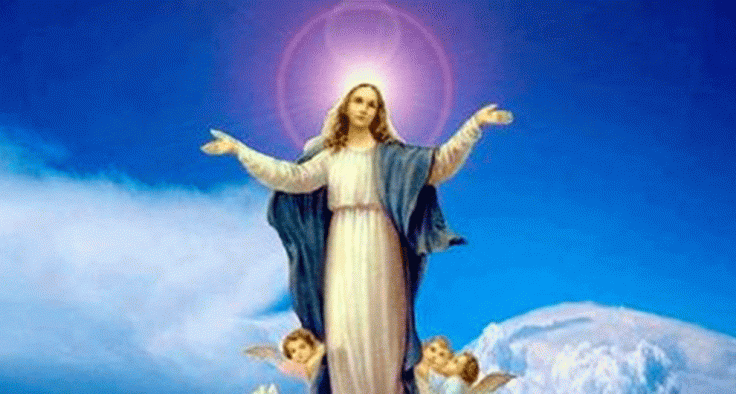
He mentions that our Lord is here on this balcony with us, and that our Holy Mother Mary is here with us, too, to pray with us.
I am moved to talk to her. I tell her I had never thought I would be OK again but now I see I can have a new life and that Jesus wants me to have life. I spontaneously renew my consecration to her offering my life to her and committing to follow her Son better than I ever have before.
I can hear Father quietly praising Jesus as I speak these words of my new hope to Mary.
I close my eyes and smile. I say, “I love you, God.”
In his gentle voice, the priest reads a reading from one of the Gospels, and we pray for my family’s healing. We pray the Our Father together. I pray for the deep inner healing of the Holy Spirit for each person in my family. We say Amen.
We talk. We pray more. I tell him about the evolution of my understanding of my brother’s death through the tenderness of God in my prayer life right through all the horror of this death, this overwhelming loss, and fear I had of finding out something that would make this even worse. I explained that I still needed to understand all the same, and how I feel God helped me in His ingenious ways.
I feel so much less alone as the priest listens quietly and with compassion to all I am saying. I don’t think even I knew how much this day would mean to me. I am grateful for his courage and kindness in coming here.
He said he would like to pray the Prayer of Commendation now, that we use for funerals. He says it is our prayer to send the soul to God, commending the person to God’s mercy and love. It serves as some release to us too, allowing us to send the person forth with love, to God.
So he prays the beautiful Prayer of Commendation.
Together we pray a Litany of the Saints.
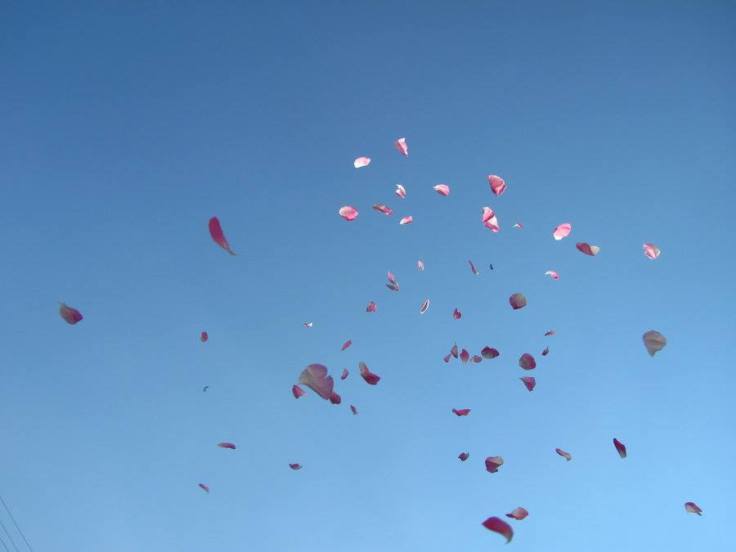
We blow bubbles and watch them glide out shimmering, into the sun, cascading down the side of the building, drifting out over the pool. We send streams of them up into the blue and watch them float gently. We can’t help but smile.
I open the bag of rose petals and toss some out over the rail. I sprinkle some over Father. ‘Yay! Thank you so much!”
We grab more and more handfuls of petals and throw them out, everywhere, like confetti at a party. Some of the petals drop quietly onto the water below, some waft out on the breeze, some scatter themselves on the patio.
“Did you SEE that?!” he exclaims, as, amazingly, some of the petals suddenly spiral upward into the sky and away. Laughing we throw more and more of them everywhere, as if we are showering the world with roses.
He takes some holy water and blesses me with the sign of the cross on my forehead.
With trembling hands, I drape a rosary over the end post of the rail and fasten two white silk roses to it.
Something I need to say to my brother:
“You’re not that.” You are not the way you died.
You’re just… my beautiful brother.”
Smiling, Father and I take pictures of each other, of the balcony, of the draped rosary, and the scattered petals, so my daughters can see what this looked like today.
We hug, and peacefully we leave the rose petal strewn balcony.
Eternal rest grant unto him, O God. ~ And let perpetual light shine upon him.
Once upon a time in Rome, during the reign of the Emperor Diocletian (in the third century), a young girl gave her life in witness to Christ under harrowing circumstances hard to imagine. She did this in spite of frightened parents, repeated and successively more cruel tortures, threats and even persuasive words and temptations from those around her. She also spent some time chained, bleeding, and broken in the Emperor’s dungeon. There Mary is said to have appeared to her and healed her, strengthening her resolve with the promise of victory and the hope of Heaven. Some of her tormenters were converted to Christ by this child’s astonishing courage, faith and perseverance through punishment after punishment.
Quite a long time later, in the year 2002, in a little chapel in San Antonio, a profoundly wounded young widow (that would be me) knelt to pray for healing for herself and her family as she faced another traumatic trial in life. I wasn’t sure I was going to make it sometimes. I had come on a day trip pilgrimage to the Lourdes grotto of the Oblates of Mary Immaculate to ask the intercession of Mary and for her motherly protection and wisdom for myself and my family.
On a small table at the end of my pew in the Eucharistic chapel there was a statue of an intense looking young saint that interested me. Her little pedestal said, “St. Philomena, Patroness of the Children of Mary.” Well then, she was the patroness of me.
Later at home I found a holy card of St. Philomena under our family Bible. I had no idea where it had come from. Did this girl saint have something to say to me in my painful struggle? I felt compelled to try to find out more about her.
I started to research her life and the devotion to her. Frankly some of the material about her was a little weird, even for me. She sounded like a fairy tale. But I eventually found the official web site of her shrine in Mugnano, Italy where her body is venerated. This site had a lot of solid information and beautiful art. It was Church sanctioned. The resting place of St. Philomena had even been visited by an impressive list of Popes.
St. Philomena’s body was found in 1802 in the catacomb of St. Pricilla in Rome. Her epitaph said, “Peace be with you, Philomena,” and showed the martyr’s palm, a drawing of arrows and an anchor; the instruments of the torture she had undergone for her faithfulness to Christ. Inside were the bones of a 13-15 year old girl. Present also was the phial of blood often collected by the early Christians when one of them was martyred. Miracles and signs surrounded the opening of her tomb, and even of the opening of the phial of blood that day in May, 1802, wonders which were witnessed by many.
It seemed God was saying to the world, “Get to know this young woman. She is very close to Me, and I have given her great works to do in My Name.”
It was hard to know anything more about her. The only accounts we have are private revelation that is approved but not as certain as written testimony from her contemporaries would be of course. According to this private revelation and the hints from the drawings on her tomb, she had been through and survived one martyrdom after another. She sounded like my kind of girl.
St. Philomena is the only saint ever to be canonized solely on the basis of her numerous miracles, some of them spectacular and public. She came to be called “The Wonder Worker,” and it was commonly said, “to St. Philomena, nothing is refused.” Among the countless people healed by her intercession is Ven. Pauline Jaricot who arrived at the shrine on the verge of death. She was dramatically healed amid shouts and rapping on the saint’s tomb from the crowd that was there. Philomena was St. John Vianney’s favorite saint. He talked to her every day, and had a small chapel built for the relic of her he was given. He encouraged devotion to her. Endearingly, he attributed all his miracles to her intercession.
I decided she definitely had something to teach me, and I began to cultivate a relationship with this mysterious little saint; thinking of her and speaking to her often, doing small things to honor her. I felt like she was with me and understood my darkness, fear, grief and trauma, very well. It seemed she was compassionate to me and laid a prayerful hand on me when I really felt I couldn’t take the suffering anymore. I think she helped me remember that in Christ I can do anything.
My daughter, Maire, took to St. Philomena so much after we read the book I Ask St. Philomena by Rick Medina, that she made her her patroness when she was 13. Maire’s eventual Confirmation name was Philomena. She always wore Philomena’s cord wound around her ankle or wrist as a kid. She still does. (It’s supposed to go around the waist but Maire never does anything the normal way.) Last year she had an anchor tattooed to her shoulder in her saints’ honor. “Look, Mom! It’s for St. Philomena!”
St. Philomena has been a good friend to us and accompanied our family through many crises and hardships. Her intercession even brought back two people who left the family. One of them, a young run-away, was found staying only a few miles from a church that had a bone chip of St. Philomena’s. It was like a wink from her. During family prayer of a novena to her we even heard a sudden knocking sound we couldn’t find the origin of. We wondered about it. Then we read that this happened all over the world to other friends of St. Philomena, too, and that it was a sign of her intercession. Another wink.
Other times she seems to have worked the even greater miracle of obtaining for us the grace and strength to accept whatever Christ asked of us, no matter how hard it was, no matter how many times He asked it, and to do it with love, faithfulness and trust in Him, as she did.
A tiny 2nd class relic of hers went with us to every radiation and chemotherapy treatment, scary doctor’s appointment and MRI my husband, Bob, had during his fight with the aggressive brain cancer, GBM. I anointed him with her holy oil before every procedure and prayed her chaplet during each one.
Bob made it two and a half years, which is an unusually long time for GBM, from his diagnosis to his death in 2012. As he often said, those years were the happiest of his life. He had an excellent quality of life almost to the end of it. He kept working. He kept helping people. He bloomed beautifully as a human being, started painting (very well, too), learned more about love than ever before, and inspired many people with his outrageous courage, sense of humor, undying hope and growth in charity during his struggles. He also fulfilled his heart’s desire of becoming a Catholic during that time. He died a beautiful, holy, love filled death.
St. Philomena has taught our family through her life and spiritual friendship over the years, that no matter what, it will be OK, and even if it’s not OK, it will be OK. Our lives are God’s. And we are going to Him. What else is there? As Bob said, “We love we, walk on”. And no matter what, “God is it.”
One way we honor St. Philomena in our family (besides having named Bob’s cat after her) is for all of us, and whoever wants to come along, to dress in red and/or white and go out for Italian food every year on her feast day, August11. Red and white are her colors. Red is for her martyrdom, the white for her purity. People sometimes ask what team we are from when they see us. ☺Here is St. Philomena Day in 2010.
In thanksgiving, we also try to let people know about her. No matter what your troubles are, and if you are suffering very much, St. Philomena will intercede for you in a special way and companion you on your journey. She never gave up. She will help you never give up either and follow Christ to the end. She may bring a miracle that is more than you asked for, or she might help you accept the martyrs’ crown, even with love and joy. She knows better than most that our tears become jewels on our garments in God’s Kingdom and that every one of our trials suffered with Christ helps us grow in the knowledge and love of Him.
We recommend to you her friendship in Christ, and we pray you find comfort in your sufferings and trials, that you receive more grace than you ever thought you could by the intercession and example of our good friend St. Philomena.
Today is the feast day of St. Teresa Benedicta of the Cross, or Edith Stein. She was born into a Jewish family, but became a decided atheist in her youth. She grew into a brilliant intellectual, writer, and philosopher. Her search for truth lead her into the Catholic Church, and into religious life as a Carmelite nun, taking the name of Teresa Benedicta of the of the Cross. Eventually, under growing persecution, she was executed at Auschwitz on August 9, 1942. She offered her life for her persecuted and suffering Jewish people.
These days we are anxious, worried and rightly horrified by many things. We wonder what we should do. Or maybe at times we fill our mouths (and our screens) with argument. Maybe we try to do our part, but we wonder what good we really do or of we are doing the right things? We are people of prayer, but perhaps we worry that it doesn’t seem to comfort us or anyone else. Maybe we wonder if our prayer actually changes anything.
What does the life and the death of Edith Stein have to say to us?
What tremendous inner power enabled her to continue to live deeply a life of prayer, love, and single minded searching for God and truth as the world darkened around her?
What motivated and empowered her, even on the train to the death camp, to brush the children’s hair and show them love when their own mothers had gone blank with terror?
What lead her to prayerfully and meaningfully offer her life, when she was executed, to God, for her people?
She would say that her love, spiritual intuition, and courage came from the practice of inner prayer, in contemplating the face of Christ, and the mystery of His Cross, from the magnifying grace Jesus fills His disciples with when they open their hearts to it.
She wrote beautifully about the mysterious power of drawing near to Christ. She knew the ability this gives us to be close to and to touch those who suffer anywhere and everywhere. She knew that in God, she could change hearts, and pour the love of Jesus into a world sickened by violence, indifference, madness, and fear.
When she was confronted by inhumanity and brutality, even as she suffered the same experiences the others were suffering, she was able to love and serve those around her.
By immersing herself in God’s love every day, she was prepared to be love in the most heartless of places, and to give her life in union with the sacrifice of Jesus, releasing a tide of grace and mercy for all by her sacrificial prayer and offering. She turned evil on its head, echoing her beloved Lord.
We know from the Gospel that Jesus lifts us up when we pray, that He loves to give His healing power of mercy into our hands, as He did when He sent out the disciples to proclaim the Kingdom of God and to heal and bring peace.
Edith Stein faced her death with sacrificial love and prayer, offering herself to God for others.
What if, in our own way, right now, we offered our lives, too?
What would that do?
When we unite ourselves to Christ completely, we free and open our hearts for Him to direct and guide, to fill with whatever graces He wants to see there.
In prayerful union with Him, we will be led where He wants us to be each day, and respond to each person and situation from a mysterious reserve of inner freedom, courage, and love.
In our prayer, God will take us all over the world like the wind of the Spirit; walking through doors, bringing the sweet breath of peace, calling others forth.
Then the floods of that divine love will flow into [your heart,] making it overflow and bear fruit to the furthest reaches of the earth. ~ Edith Stein
Maybe we can pray something like this:
God, I offer myself and my life to You, for those who suffer violence, for the persecuted, the unloved, the misunderstood. I offer my life and death for the relief of suffering, for peace, for the conversion of hearts to mercy and love; and that the knowledge of You will fill the earth; fill every relationship, every heart.
Wherever there is suffering, or a lack of love, where there is terror, fear, injustice, or a need for You, take me there, put me there- either in time and space, or in the super-imposition of prayer.
She remembers walking barefoot on pilgrimage up the road to San Salvador Mission as a child, praying the rosary together with her family and friends, each August, lead by her grandmother, Ouida, to commemorate a healing, a vision, and a community coming together in response to a message from Heaven to build a church.
She remembers her grandmother’s reluctance to talk much about the three apparitions she received at twelve years old from “a lady in black.” She only ever heard the story from her Italian American grandmother in broken English.
It’s a Scarmardo family story, a story of a community; and though it happened over 100 years ago, it is cherished and guarded by the family as a very special and somewhat private gift. To the local Catholic community it is the quiet, lovely legend behind a beloved little mission church out past the river, whose parent parish is St. Anthony’s in Bryan.
In 1894 getting to mass was very difficult for a small rural Texas community of Italian immigrants, as there was not a reliable bridge to cross the Brazos river and go to Bryan, where the nearest Catholic Church was. They mostly depended on a priest to come to them when he could, celebrating mass on someone’s porch.
One of these times, in the middle of mass, there was a sudden strong gust of wind and the crucifix fell onto the altar. The crash on the altar was so sudden and forceful, the people were uncomfortable and wondered what it meant.
The next day, in her family’s cotton field, in the wake of a gentle breeze, a young girl named Ouida (pronounced“Weeda”) suddenly saw a lady in black who asked why there was no church in this place. “There needs to be a church here.””
The girl told her parents about it, but they didn’t take it seriously at the time.
Then there was another appearance of the lady, possibly in a dream this time, during which she gave the girl more details about the church she wanted to be built there, even including a list of the men who were to build it.
The girl’s parents wondered but were still not taking this too seriously until there was a yet another apparition, and this time the lady asked why the church had not been built yet.
Ouida’s concerned parents decided to take her to talk to the priest in Bryan, Fr. Antonio Simone. It seems the priest soothed their worries about their child because what happened next was that the community discerned that they should and they could do as the Lady from Heaven, understood to have been Mother Mary, had asked.
Each family gave their first crops, another family donated land, and the church was built in six weeks.
It was named for the patronal feast of Cefalu, Sicily, the native village of these Italian immigrants, a feast they call San Salvador, “Holy Savior,” which is August 6, the feast of the Transfiguration of the Lord.
First mass was said at its altar in October 1908.
Ouida had breast cancer at the age of 40 and vowed that she would make a barefoot pilgrimage to the church every year on the feast of San Salvador, the Transfiguration, if she was cured. She was cured. And the pilgrimage was made for many years, even revived by a third generation and walked for several more.
San Salvador Mission celebrated its centenary in 2008 with Bishop Gregory Aymond.
Today there are good bridges into Bryan, and not so many people still live near San Salvador Mission, which still stands in the midst of an expanse of farm land near a country road. But it is cherished nonetheless and mass is attended there still by those who love it.
The first time I went out to take pictures of it, I was surprised to find it locked. A red truck pulled up, and a kindly woman, who told me she grew up right next to the church and still lived nearby, let me in. In the course of our conversation, she let me know that she had come to check on the sanctuary light. When she is at home she gets a feeling when it is out and she goes and changes it to honor the presence of Jesus in the Blessed Sacrament. When I remarked on how touching I thought that was, she said,
“When you get the grace to pay attention, it’s just an amazing life we live. “
San Salvador stands as a testament to a community that paid attention, and still does.
*Many thanks to Ouida’s granddaughter, Mary Jo (Scarmardo) Lindsay, and to her cousin, Judy (Scarmardo) Comeaux, two lovely women, for sharing their memories with me.
**Mass at San Salvador is celebrated the First Saturday of the month, at 7PM. You’ll find it at County Road 222 – 1/4 Mile off Farm Road 50 (County Road 286), Bryan, TX 77836
*** No approval for this Marian apparition was ever sought. It is a private revelation given to Ouida that was responded to by her community of faith.
We are sitting in a bar on a hot summer day. I stare at my dejected feet on the bar stool, then out the door at the hot day, the burning sidewalk, the occasional overheated human being passing by.
I don’t want to look at him, though I am relieved by his presence. I glance sideways at his calloused elbow resting on the dark, scratched wood of the bar; noticing, too, a scrape on his for arm. He always has at least one.
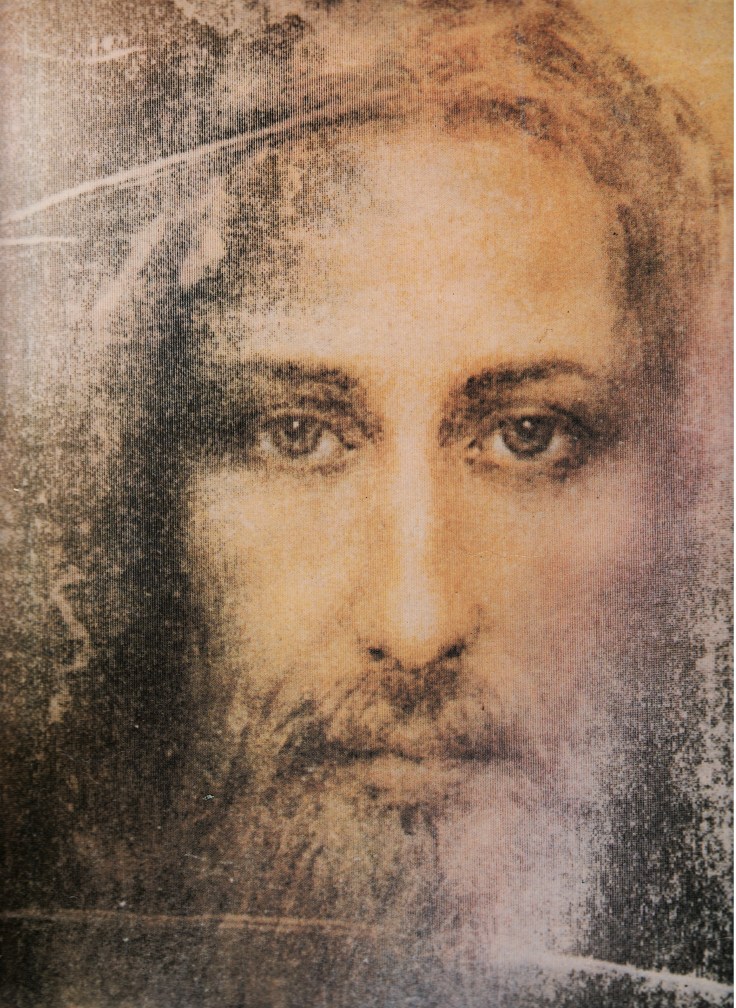
I am captivated because when one looks at Jesus, even without seeing, one knows by faith, apprehends by love, the radiant beauty of his features, the dark loveliness of his eyes, the gentle tenderness of his smile, the silent fire of his gaze, that comes from who he is.
Maybe the strangest thing about this looking at Jesus is seeing one’s own reflection. Stranger still is how different one looks reflected in the pupils of such eyes as these.
Jesus asked the Twelve: “Who do people say that I am?”
He listened to the various answers; all of them incomplete at best, though understandable.
Then he asked his disciples, “Who do you say that I am?”
I am going to stop right there. I am stopping because it is easy, seemingly, for me to answer, with all my heart, at one with Peter, “You are the Messiah, Son of the living God.” I know this to the depths of my soul. It is the guiding truth of my life: Jesus is Lord.
But today I have a question. I have this question because my heart is broken, forsaken, wounded, my life in ruins, and I have lost something in my suffering and dismay; something almost as important to my existence as who this Lord is who has captivated me and will for all eternity.
“Jesus,” I ask, “Who do you say that I am?”
What happens when you ask this question of the Lord?
What has happened for me is that he has been answering me in different ways ever since I asked; in verses from Scripture that show up at mass or in the Liturgy of the Hours, or that quietly come to mind as I pray or go about my day:
“You are sacred to me.”
You are “…beloved of God and called to holiness.”
“…a new name pronounced by the mouth of the Lord… a glorious crown in the hand of the Lord, a royal diadem held by your God.”
“… light of the world…. salt of the earth.”
He has seemed to send the right song into my day at the right moment, drawing my attention to it, speaking straight to my heart.
He has sent unlooked-for love into my life and increased the strength of my soul.
He has brought me to understand that each of us are, on a certain level, and in a very real way, all the things he is, because he shares them with us and lives in us. We even share in his very being and his place in the Father’s Heart.
We reflect him. He reflects us back to ourselves.
And when we look at this Light of the World,
this Way, Gate, Shepherd, Truth, Bread from Heaven,
Life and Love itself – he who is gentle and humble of heart,
we are looking, Christian soul,
at ourselves.
When we see ourselves in his eyes, his yoke becomes easy and his burden, even the cross, becomes light. He shows us who we are to him, and we are filled with his grace. Perhaps we can go forward after all, once we know who we are in the Lord, doing all things in him who strengthens us.
Maybe, even, we shine with glory from the inside as we make our way through the elements of this world, with our eyes fixed on him whom we radiate.
” I will give to each one… a new name that no one understands except the one who receives it.” ~ see Rev. 1:17b
Biblically, the heart is the center of the human being, the seat of decision, the place of prayer to which one withdraws. It is where God comes to make His home in us. The heart is the place of longing, and spiritual thirst, the place of encounter, the place of union.*
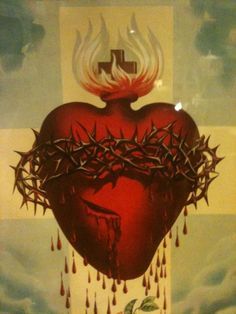
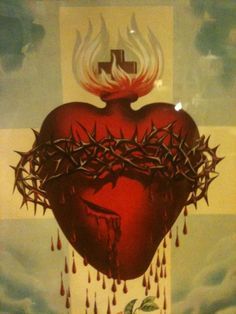
Incarnate in Jesus, God now has a human heart, at one with His divine nature, a Heart which we call “The Most Sacred Heart of Jesus.” Some version of this representation of Him adorns nearly every Catholic Church and home. Usually the image is of St. Margaret Mary’s apparition of Our Lord with a visible Heart which is on fire with divine love, radiant like the sun, surrounded by the thorns that symbolize His suffering and death, and topped by the cross, the symbol of His victory.
This is a very dearly loved image of Jesus, and one of great power for us. Jesus’ heart is the center of His being, the seat of His human consciousness, the abyss of His Divine love, mercy, and compassion.
We find in the Scriptures, and we experience, in the practice and grace of prayer, that Christ has thirsted for us, has loved us first. He can easily be found by our withdrawing in prayer into our own hearts, where we are, where He is.
The Sacred Heart of Jesus is one in love with the sacred heart of you, the sacred heart of me, our hearts reflecting His, and His ours, living within one another. We need only be conscious of this to make this truth part of our lives of love, prayer and service, and to look for and find Him in every human heart.
Christ living within us has experienced our loves, humiliations, rejections, our own sufferings, deaths and resurrections. We, living in Him, as His Body and Bride, the Church, have experienced His life, too. The Sacred Heart in religious art can also be seen as a symbol of this solidarity and union, this communion and humanity we share with Christ, as well as the mystical union we have with His divinity. More obviously it is a symbol of His love for us, which is the heart of prayer, which is the Heart of our lives.
Sometimes it is hard to remember that Jesus suffers with us and takes our pain upon Himself. In the midst of the extremes of life’s suffering love, we need to know that His tears are mixed with ours, that we have a God who knows sorrow, a God who is Love, a God who wants to give Himself to us in the Eucharist, and share with us His divine life in the Trinity forever.
In my times of deepest pain, it does not help much to ask why. It helps a lot more to “look” silently at the Sacred Heart of Jesus, into the tender darkness to which I withdraw, into the ruins of my heart, made sacred by His dwelling there, so it can be re-built to His purpose. In that gaze, “why” doesn’t matter, as much as Who this is Who loves me, and is my God. That’s where trust comes from; accepting the Heart of this Lord, Who is Love. What else is there? What more could we need, than to know and live in this Heart, allowing Christ’s Heart to live in us.? What more could we give anyone else, than the knowledge, by our love and presence, that this is so, and that the Heart of Jesus lives in us for them and in them for us? What more could we give our beloved Lord than to “Return love for Love” as He asked us through St. Margaret Mary, by being attentive to His holy presence in our hearts?
Jesus took up the cross, the Scripture says, “for the sake of the joy that lay before Him.” It’s easy to think about His joy as His future Resurrection and glory with His Father in Heaven. But we forget sometimes, that part of the joy that lay before Him, was ourselves. Being with us was worth it to Him. After all, this is also why He came to begin with, from the glory He had from the beginning, to take on our humanity, to be with us, to capture our hearts, to transform,redeem and raise us, to be one with us, that our hearts might burn with divine fire. May we be willing to wear the crown of thorns that love often requires of us, until we share in the victory of the cross, and in His divine life itself, bringing many with us.
Let’s withdraw into the silence of our hearts and find His own beating there as often as possible. We can do this in the moments of recollection we can find through the day, and in the time we set aside to give Him, in silent love, especially before the Blessed Sacrament. May we grow always and everywhere in awareness of His indwelling, nurture His presence in us, love Him better, be His joy.
Happy June, month of the Sacred Heart.
May the Sacred Heart of Jesus be praised, adored, and loved, in the tabernacle of every human heart, to the end of time, and forever in the the life to come! Amen.
My daughter, Maire, got in trouble at her Catholic middle school for wearing green nail polish, which was against the rules. (Only clear or light pink nail polish allowed, if I remember right.) When asked about her indiscretion, she said, “It’s for Ordinary Time!”
I laughed hearing about that. At least she remembered what season we were in as Church, and it meant something to her.
We have just begun Ordinary Time, that big section of green, the liturgical color of the current Church season, that fills most of the wheel illustrating the Liturgical Year.
We have special things we do at other seasons in the Church year. What about Ordinary Time?
Ordinary Time has it’s own feel. I associate its’ post Pentecost beginning with that first breath of cool air from the church door as I step into the intimate hush of daily Mass on a hot Summer day. This season is a contrast of calm and peace after the penance of Lent and the holy fire of Easter and Pentecost. It’s a return to the simple holiness of daily life.
One of our family albums is titled, “Ordinary Time.” It is a scrapbook of our family life during a few months of Summer and Fall. Into it I recorded our daily “rule of life;” (or sometimes not-so-rule,) song lyrics to music we were listening to at the time, the every day prayers we prayed, the silly things we did on the spur of the moment like a spontaneous family dance in the middle of dinner, as well as our little celebrations of the feasts of Ordinary Time, such as the Nativity of Mary (September 8.)
We always made Mother Mary a birthday cake. “Chocolate. What other kind of cake would she eat, right?” the caption says in green ink.
We remembered this part of the Church year by keeping green candles on our family alter. We prayed a “kid version” (when the kids were younger,) of the Liturgy of the Hours I put together for family prayer, which always reflected the current season.
Ordinary Time at Sts. Cyril and Methodius in Dubina
At Mass, the vestments and alter cloths will be green or have green trim. My mom, always the gardener, used to say this was because “green is the color of life.” In Ordinary Time, the focus shifts from the culminating moments in the life of Christ and His Church; the birth of Jesus, His death and resurrection, and then Pentecost, to the space in between where most of life is lived.
“Ordinary” comes from the word, “Order.” So we enter into the daily order of the Church at this time of year, and the emphasis of the Gospel readings is on the ministry of Jesus; His preaching and healing, His daily encounters with people, His conversations, his journeys.
Ordinary time can be a time we pay special attention to our own encounters, conversations, and the events of our own lives, and how God speaks to us in these. How does the life of Jesus unfold in your own?
What do you do every day? I know I spend a lot of time coping, and sometimes I need to cultivate more conscious awareness of life so it doesn’t just happen to me and I miss it.
I am not by nature a very rule or schedule oriented person. But I do know paying attention to my loosely interpreted cadenza of a life, makes it more of a little holy rule instead of a stream of consciousness in which I might forget to practice the presence of God. * When I can lightly observe the rhythm of the day with holy intention, I feel peaceful and connected.
Ordinary Time is a great time to learn to pray the Liturgy of the Hours, to read the daily mass readings, (or maybe just the Gospel each day, as my youngest adult daughter and I do.) It’s a good time to get in the habit of sanctifying time by stopping, or at least pausing, in our day, to pray, even for a moment. It’s a good time to remember to look around and notice how beautiful God is, and how He is everywhere represented and speaking to us.
Now is a great time to carry Jesus into the work we do, and to consciously do all we do as it truly is; through Him, with Him and in Him. We can try doing every task with gentleness and love. Whether we sit, or lie down, or are talking to our children, whether we are in our house, driving our car, doing the shopping or at work, when we are sitting with friends, or going for a walk, we can try always to be remembering the nearness of God, even in our breathing.
“God is alive. I am standing in His presence.” ~Antiphon from The Carmelite Proper for the feast of Elijah the Prophet (July 20)
We can each day seek to understand how it is that His yoke is easy, His burden light, His Heart meek and humble. We can slowly begin to incorporate that lightness, that easiness, that meekness and humility of heart into our lives as we become more aware of the sweet companionship of His spirit every day.
This is how we enjoy life as people who consciously live in God; by bringing the remembrance of Him into the sacred Ordinariness of our time.
“See that I am God. See that I am in everything. See that I do everything. See that I have never stopped ordering my works, nor ever shall, eternally.
~ Revelations of Divine Love by St. Julian of Nowich
* The Practice of the Presence of God is a term coined by the Carmelite mystic, Brother Lawrence, and is the title of a collection of his writings.