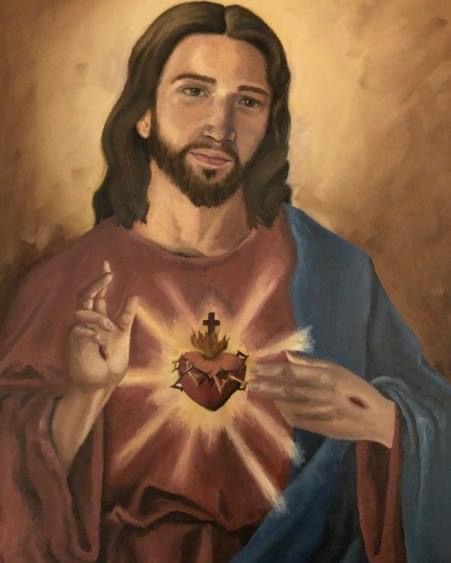
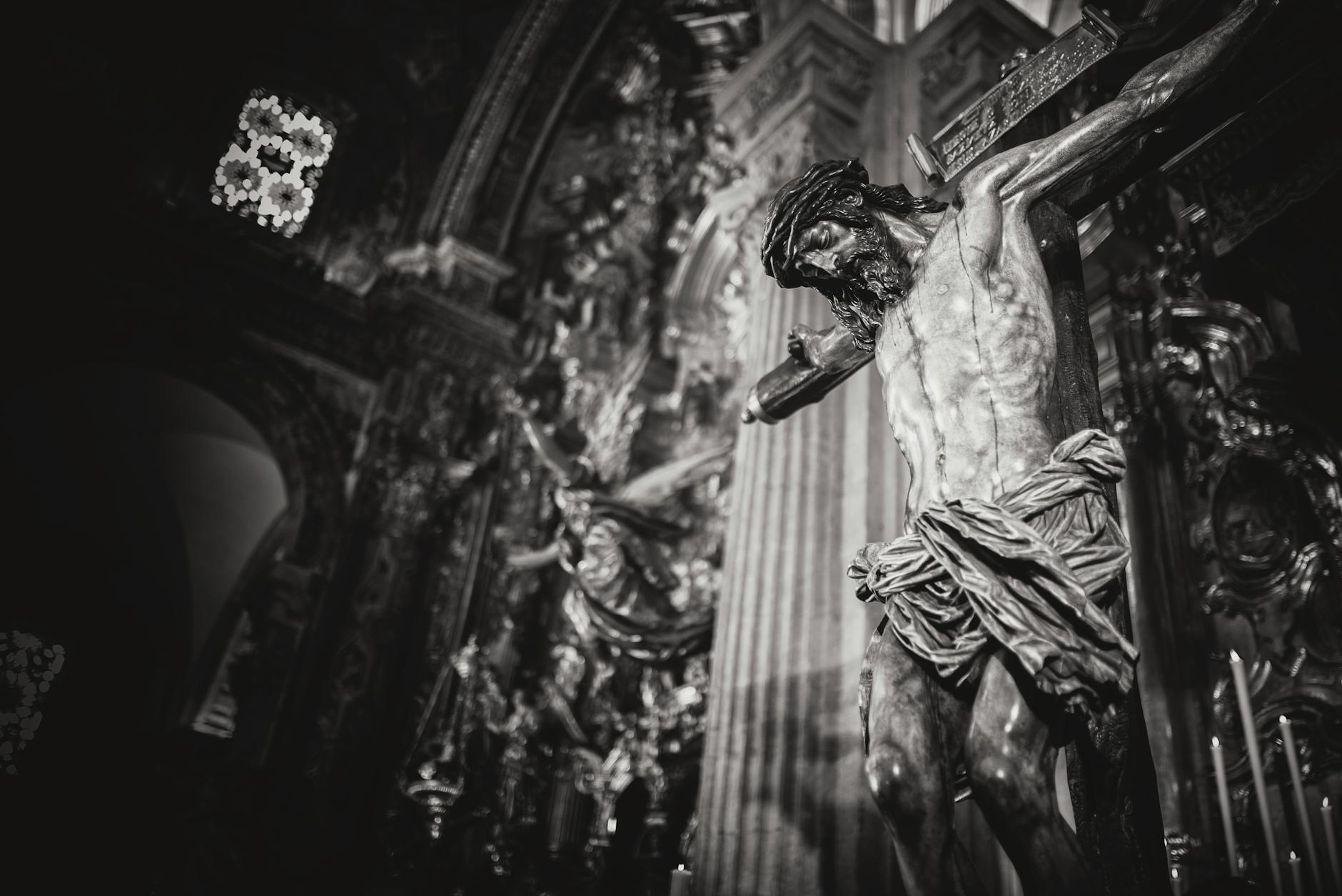
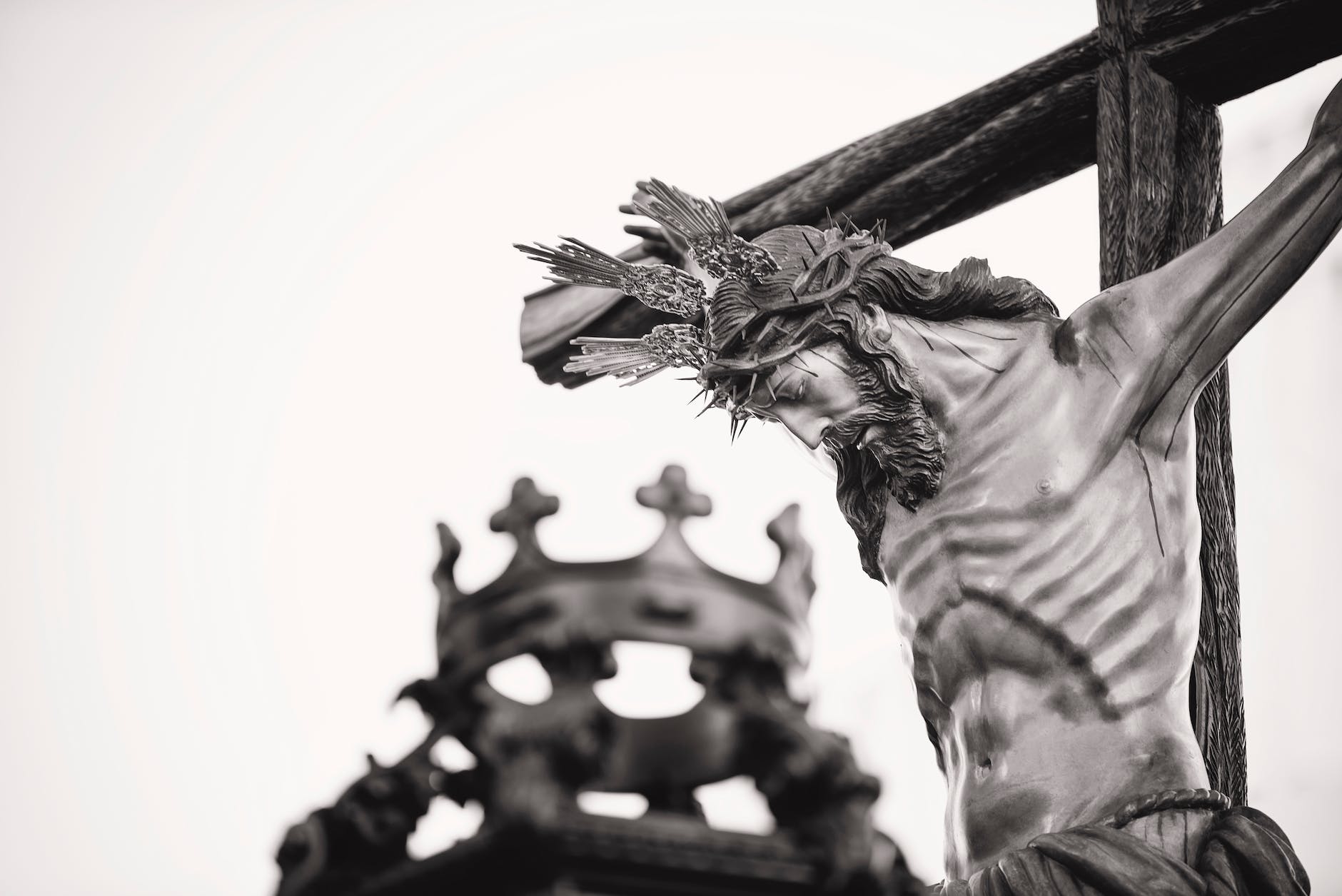
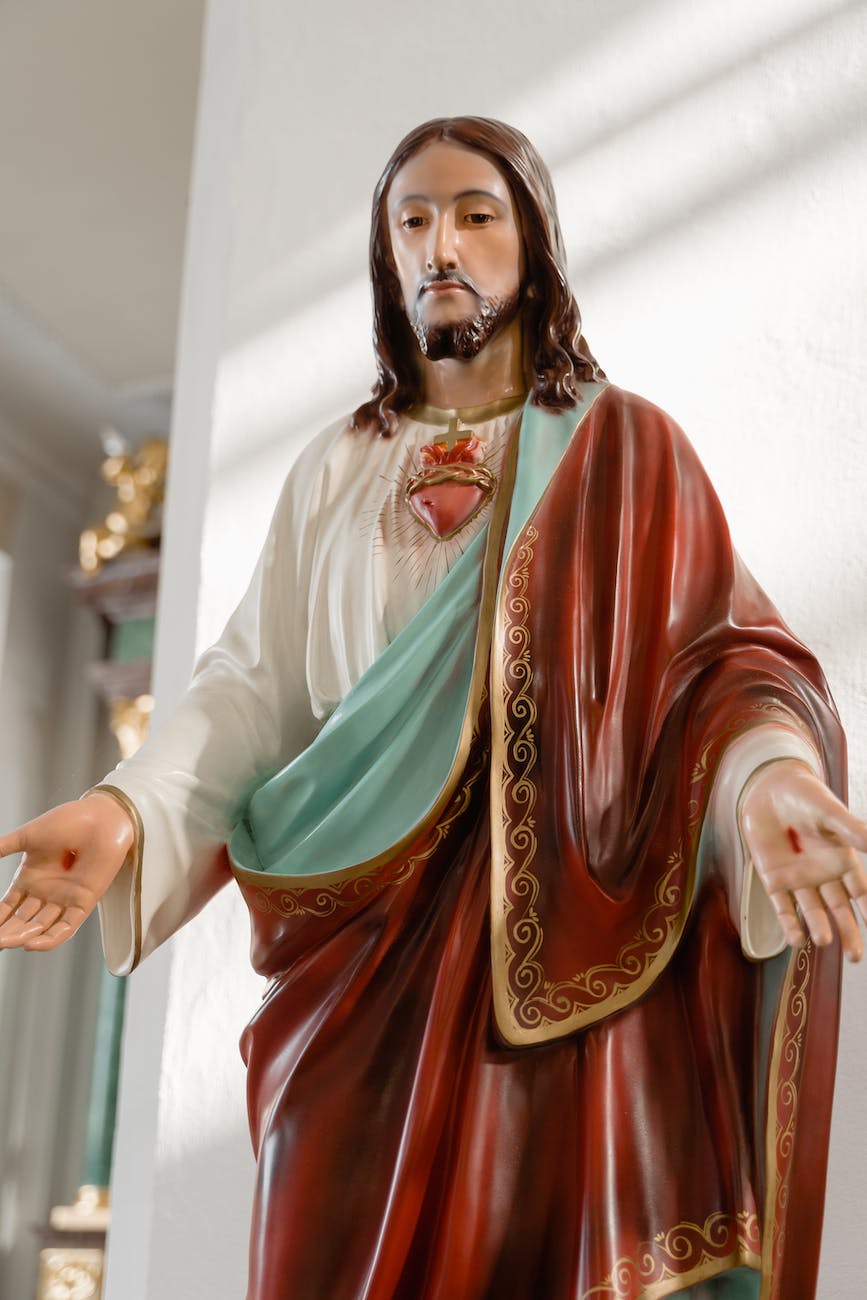
Today is Body and Blood of Jesus Sunday, otherwise known as the feast of Corpus Christi ♥️ So happy feast.
This is a good time to reflect on the humility of God who became incarnate and remains with us as simple Bread and Wine for us to eat and drink, sharing in our humanity that we might share in his Divinity. There is one Lord who suffered and died for us and we take part in his redemption of all when we suffer with that intention; of uniting our suffering to his in union with his mission of salvation, mercy and love. Under those conditions we can say someone is suffering with Christ or in a way that Jesus did. We can also say he suffers in the poor, the oppressed and those in the margins of society as he said he did in the Gospel of Matthew. That’s it. Anything else is blasphemous. We should keep our eyes on the sinless Son of God who deserves all of our love. One God one faith one baptism. He is God and there is no other.
I’m writing about this because it’s disturbing to see pictures of Trump “crucified” with Jesus or Jesus “embracing” Trump and whispering that he too was wrongly convicted. To me this is an insult to the martyrs who deserve that consolation. We Christians understand that their unjust deaths were for their faith, for their love of God and were their sacrifice for the Gospel.
Trumps’s conviction is not a situation like that whether one believes he is guilty or not. That’s almost beside the point.
Yes God loves the powerful the rich and political figures too and cares about them just as he does the rest of us. However I think there is an innate danger both spiritual and secular in comparing a political figure to Jesus. Let us rather pray for our leaders that they will be what God wants them to be and created them to be. What more could we ask for anyone? Let’s stick with that. We can never go wrong in praying for God’s will. He will give what is right – and only he truly knows what that is.
Then Peter came to Jesus and asked, “Lord, how many times shall I forgive my brother or sister who sins against me? Up to seven times?” Jesus answered, “I tell you, not seven times, but seventy times seventy times.
Mtt. 18 21-22
It’s been almost nine years but I’m still not sure whether I have forgiven it or not. I still struggle with how I am supposed to forgive someone who turned out not to be who I thought they were. Forgive who? What was that who was that?
In the aftermath I realized I was thinking of the whole mess about once every 15 seconds. I began training myself to repeat the names of Jesus and Mary any time I caught myself dwelling on the whole thing. I had dwelt on it long enough truly. I increased my prayer time. I decided to try to stop talking about it. It helped a lot. Slowly I didn’t think about it, not even every week.
I went to Confession. In exasperation I asked the priest, “How do I get to Father forgive them for they know not what they do?” He said my penance would be to go out and meditate on the crucifix in the church and ask the Lord, “Father forgive me for I knew not what I did.” Instant peace came to me then.
As time passed I realized that I “forgave” this person over and over again while they were still in my daily life but not in any real way because what I did was be upset about what they had done, avoid them for a while and then simply go on as before so that they did the same things again and again. My kids suffered emotional scars because of this lack of boundaries on my part. I let this person be with us for so long. At the time I didn’t realize how much the girls were harmed especially when they were still young. How did I fall into this trap? How could I not know how mean this person was being to them? Even the things I did know about them should have been bad enough. I should have not allowed this person around my daughters. I certainly did do things I didn’t know I was doing. Those mistakes seem crazy now.
Then at a time of another tragedy in my life, this person set out to ruin my reputation, blame me, interfere with my friendships and even my family relationships, to tell distorted versions of my private sufferings, commandeer one of my daughters with lies and emotional scenes when she needed me most and was too young ti break out of that situation. This person deeply hurt my other daughter as well during a time of grief and shock for my family with hateful accusations and not allowing her to retrieve what was hers and precious to her from the house. This person also participated in grave financial harm to me and one of my kids that we will never recover from. I was emotionally and socially betrayed on a level that was traumatic enough to keep me curled up on the couch for days. I never thought they would go that far especially at a time like that. Why was I shocked? I can’t answer that fully.
One thing I have learned from all this is that being a forgiving Christian does not mean having destructive people in my life. Even Jesus had boundaries.
But Jesus did not entrust himself to them because he knew their hearts.
Jn. 2:24
However I sometimes still feel angry at this person, even after I have peeled away several layers of resentment and reached certain levels of forgiveness. I didn’t feel that it was complete. Because of those feelings of rage coming up now and then, especially recently, I tend to think of this person every time I pray the Our Father. How can I forgive this person as God forgives me? God forgives me more than completely. God is mercy, God is love. I always ask that I will be able to do this. I have learned forgiveness is a grace. We just have to be willing to receive it. Was I willing? I didn’t know. My mom used to say that sometimes we have to ask to be willing. Other times we have to be ask to be willing to be willing. Sometimes the situation is so difficult we have to pray to be willing to be willing to be willing. I think this is like that.
Recently, sitting quietly in prayer, I felt that the Lord untangled my thinking a bit about what forgiveness looks like in a situation like this. In a flash I understood that all Jesus wanted from me now was to pray for this person’s salvation. I felt my heart open as it seemed the Holy Spirit prayed in me for just that: for this destructive person’s salvation. It was an understated but all the same beautiful moment. I understood that God did not need my tortuous worry about my lingering feelings about this, or the useless dead end paths of my self judgement or scrupulosity on this point. Just prayer for their salvation that is all. The rest was between that person and God. Oh.
Three times I pleaded with the Lord to take it away from me. But he said to me, “My grace is sufficient for you, for my power is made perfect in weakness.”
2 Cor. :8-9a
Then I prayed the our Father in freedom and when I said, “forgive us our trespasses as we forgive those who trespass against us,” I almost felt a kiss from Jesus, and I had to smile. I love that guy.
Come into Mary’s rose garden which is the rosary, and pick red roses of devotion to bring with you on this journey with her through the Sorrowful Mysteries.
The first Sorrowful Mystery: The Agony in the Garden
rose hip: Union of will with God
“My Father, may this cup be taken from me. Yet not as I will, but as you will.” Mtt. 26:39
Mary takes your hand. She brings you to Jesus, lying prostrate as he prays. Suddenly as if you fell in, you are in the depths of Christ’s Heart, experiencing his anguish, physically feeling his bloody sweat, his stinging tears smearing on your cheek as you sink into the abyss of his agonized heart.
Let yourself feel your love for him. What do you want to say to him?
Maybe, “Jesus I love you. I will not deny you anything. “
He hands you the cup he has now drunk, compassion in his eyes.
You understand.
It tastes like fire but is sweet.
Chaos breaks out. He is arrested and taken away.
In the silent Garden of Gethsemane you and Mary lay a red rose. Beside it place the empty cup.
The Second Sorrowful Mystery: The Scourging at the Pillar
Rose hip: endurance with love
“My soul is in deep anguish. How long, Lord, how long?” Psalm 6:3
You’ve never seen or imagined cruelty like this. As hooked whips tear into Jesus’ back you want to throw up and Jesus does as his body goes into shock. You look at Mary as the violence goes on and on. How can she stand it? Her eyes are filled with tears, yet her face is resolute. His blood pools between the tiles of the courtyard. You want to stop this, comfort him, comfort her. Her arm slips around your shoulders without her taking her gaze from her Son.
Finally Jesus is carried away and the laughter of the guards fades. Holding hands, you and Mary silently venture forward. Together lay a red rose beside the pillar. Kneel here. Pray with Mary.
Third Sorrowful Mystery: The Crowning with Thorns
rose hip: reverence
“My spirit blesses the Lord, the Great King.” Tobit 13:15
They’ve been beating Jesus for what seems like Hours. Then one of the soldiers gets an idea. He weaves a crown of long thorns which is forced onto Jesus’ head. Blood runs down over his face and eyes from the wounds. This isn’t enough because they start hitting his head with reeds and shouting “Hail to the King” in mock reverence. Mary is on her knees repeating something again and again. Listening closely you can tell she is saying, Barukh ata Adonai Eloheinu, melekh ha’olam…” (“Blessed are You, LORD our God, King of the universe) in praise of God. Join her in making reparation to the Lord for the mock reverence of the soldiers who know no better.
You and Mary lay a red rose in Jesus’s cell once he is taken away for an interview with Pilate.
The Fourth Sorrowful Mystery: Carrying the Cross
Rose hip: holy perseverance
[We keep] our eyes fixed on Jesus, the leader and perfecter of our faith. For the sake of the joy that lay before him he endured the cross, heedless of its shame. Hebrews 12:2a
Your hand tightens on Mary’s as Jesus comes your way dazed and stumbling under the heavy weight of the cross, prodded on by soldiers. You don’t even want to look at Mary. It hurts too much. It hurts too much to see any of this anymore. To shut it out you close your eyes. Then you remember, “for the sake of the joy that was set before him.” Mary squeezes your hand and you understand that the joy set before the Lord that urges him on is yourself. You are his joy. Open your eyes now. Don’t be afraid to join Mary in sharing his suffering.
Once he has passed by, you and Our Lady lay a red rose on this path of sorrows.
Fifth Sorrowful Mystery: The Crucifixion and Death of Jesus
Rose hip: sacrificial love
[His Mother whispered,] “do not be afraid of this executioner, but be worthy of your brothers and accept death, so that in the time of mercy I may receive you again with your brothers.” -2 Maccabees 7:29
“I’m not going to cry until he’s gone,” she says in a low voice. You understand that she has to be present to him, even participate with him, united with him in heart and purpose. She wants to look at the face of her Son as long as he has left to live. She will grieve later.
He is struggling to speak to her. “Mom. Mom, this is your son.” Then he says to you, Beloved Disciple, son, daughter, “this is your mother.”
Hold Mary close now as Jesus cries out in utter abandonment. Every strangled cry of his you can feel sending shock waves through her. And now his body is without life and the sky darkens. She collapses against you. Your prayer is only to hold her, to share her tears.
Go together now to the foot of the cross and lay a red rose in the place of sacrifice. Unpetal the others and sprinkle them over Mary. Some of the petals stick to her tear stained face, some to her hair. Most flutter down to this holy ground which has become the altar of the world. She scoops them up and throws them toward the body of her Son. You do the same.
“The Sovereign Lord has opened my ears; I have not been rebellious, I have not turned away. I offered my back to those who beat me, my cheeks to those who pulled out my beard; I did not hide my face from mocking and spitting. Because the Sovereign Lord helps me, I will not be disgraced. Therefore have I set my face like flint, and I know I will not be put to shame.”
(Isaiah 50:5-7)
Anyone can give intellectual assent to Christ’s existence, his nature and purpose. Anyone can quote Scripture. Satan did both of those things. When the devil tempted Jesus in the desert he quoted Scripture just fine. The demons exorcised by Jesus proclaimed his truth screaming, “You are the Christ the Som of God!” as they left the scene at his command.. So it isn’t enough to know the Bible or to acknowledge Jesus in order to belong to him. Following him, identifying with him, seeking unity with him, living as he did, loving him in all of his mystery, that is what being Christian is.
His triumph was all of the things that most confound the forces of hell: sacrifice, obedience, love, surrender, acceptance, humility, non-violence, abandonment to God, suffering and losing a fight in front of the whole world, and on purpose.
Even we don’t understand it unless we console ourselves that he was resurrected on the third day, which he was. But in that moment he died with trust and abandonment. He gave himself over and faced his enemies in silence.
This throws Satan, and sadly it throws us too.
Even we Christians hold a deep attachment to violence and revenge. We cannot let go of the exhilarating high of vainglorious triumph.
And yet the Beautiful One admonished us to take up our crosses and follow him.
I don’t think that is simply putting up with the hardships of life hoping for reward though I know that is part of it. I think we need to respond to the violent world as he did.
Turning the other cheek to me means, “I will not be turned back from love.” That kind of power can only come from God and we have to want it.
We have to renounce ourselves and follow Jesus. That’s how we find life and even find ourselves.
I haven’t gotten there yet. I have been there sometimes but it is not yet my home, my way of being. Not yet. I suppose that is how it is for most of us.
I still want to win. I want to win, I tell myself, for others; for the poor, for those on the margins, for immigrants. However, like anyone, my motivations are mixed. There is still a selfishness and pride in it. We all want to force things, to feel powerful. It is the effect of the fall of humanity in us.
The real battle we have is against ourselves, as St. Teresa of Avila says. And this is hard, she points out, “because we love ourselves very much.”
God gave us an innate sense of justice and right. There is nothing wrong with this. We go wrong when we stray from the Gospel. A line in the Oscar Romero movie, Romero got to me. St. Oscar said to a fellow priest and advocate for justice, who tried to talk him into joining the rebels with him on behalf of the suffering people of El Salvador, “If you do this you will lose God just as they [those he would take up arms against] have.” Whether these were St. Romero’s exact words or not it is an incredibly powerful statement. It rings utterly true. If we persist in our attachment to violence we will lose God. Nothing, absolutely nothing is worth that. And we will “lie down in torment.” (Isaiah 50:11)
I have read that some people are starting to complain to their pastors when they preach on the Beatitudes, that the preaching was too left leaning. When confronted with the fact that these are the words of Jesus Christ, they retort that this is outdated, doesn’t work, is “weak.” Look at us. We haven’t changed. The Cross, the Gospel, is still a scandal, still makes no sense.
However, When he was insulted, he returned no insult; when he suffered, he did not threaten; instead, he handed himself over to the one who judges justly. (1 Peter 2:23)
“For to this you have been called, because Christ also suffered for you, leaving you an example, so that you might follow in his steps” (1 Peter 2:21).
There is really no way around that.
Even those of us who know and accept the teachings of Jesus have parts of ourselves still attached to violence and our own ideas of justice. We still hope Jesus will clear the world of bad people on his return.. Not us though because we are nice people, right?
St. John of the Cross said that even if the only thing keeping a little bird tied to a tree branch is the thinnest of threads, the bird is still tethered, still not free.
We have to cut the thread.
On this Triumph of the Cross in 2023, in this era of mass shootings, unkindness and cruelty, and the promotion of a lack of compassion as a good thing by a significant portion of society, even by a good number of our fellow Christians, lets renounce violence in the Name of Christ, embracing instead the way of Jesus.
We can’t belong to the Christ of Revelation unless we belong to the Jesus of the Gospels with all that he showed us.
Thank God he is with us to help us with his endless grace.
He who has begun the work in us will complete it. (Philippians 1:6)
We have only to decide, every day, and trust that he will triumph in us.
“I have promised it and I will do it, says the Lord.” (Ezekiel 37:14b)
July 29 is the feast of Sts. Martha, Mary and Lazarus, the siblings of Bethany. Bethany was a little village not far from Jerusalem. It seems to have been Jesus’ favorite stop on his journeys, his home away from home. Apparently these three friends were great company, and supportive of his mission. They had a house big enough for his travel companions, the food was great and Martha, Mary and Lazarus were always eager to be caught up on the latest adventures of Jesus and his itinerant followers.
Martha and Lazarus’ sister Mary has been conflated with St. Mary Magdalene since the Middle Ages and this impression continued for centuries in Christian hagiography and art. Modern Biblical scholarship and a pronouncement of Pope Paul VI put an end to that mix up. St. Mary Magdalen continues to be celebrated on July 22, and Mary of Bethany joined her brother and sister as her own person.
This leaves us with three Gospel stories of St. Mary of Bethany.
At the feet of Jesus (Luke 10:38-42)
Poor Martha is hosting all by herself, running ragged, resentful and starting to bang the pots and pans in the kitchen. Finally she decides to get her feelings out. She unburdens her heart right to Jesus. Isn’t that what we should do? Maybe not in front of the company, granted, but we should lay out burdens before him and be honest with him. He knows what’s inside us anyway.
I like to think the Lord’s answer gave Martha peace. All the times Jesus has straightened me out when I was wrong or off course I have felt instant peace. Whether what he asked of me was easy or unpleasant I felt peace and that’s how I knew he was speaking. It seems Martha had taken on more than she was required to. I have taken on tasks and responsibilities God was not asking me to and the first symptom I have is usually exhaustion followed by resentment and self righteousness. Eventually there will be an outburst. I hope Martha felt unbound and freed by what Jesus said to her.
It’s easy to see Mary feeling affirmed and freed, protected and understood by Jesus’ defense of her. I recently read that the way she is sitting at Jesus’ feet listening to his teaching would have been controversial in her time and culture. It was something a disciple did. Rabbis weren’t supposed to have female disciples. The study of Torah and the pursuit of knowledge was for men only. By sitting at Jesus’ feet as his student she was being quite bold and acting as an equal to the men. Jesus affirms her in this, allowing her to keep the place she has chosen.
Of course we also see Mary of Bethany here as a beautiful model for Christian contemplatives. She is deeply attentive to Jesus, looking at his face, internalizing all that he says, pondering in her heart.
During a skit of this scene we acted out as a family my then four year-old daughter Maire had Mary get up, offer to take over the host duties, and invite Martha to take a turn at Jesus’ feet. I like that a lot. Maybe it was that way.
Mourning Lazarus John (11:1–45)
Lazarus fell ill. His sisters cared for him and prayed over him, waiting for Jesus to come and heal him. They knew he could save their brother. They sent an urgent message. Mary would have sat by her brother’s bed keeping vigil, offering him her gift of profound presence and connection. Martha would have changed his blankets, kept a wet rag on his head, brewed medicinal teas, asked advice from the wise, sent for doctors, made favorite dishes she hoped he would eat. Sometimes they would have had to switch places and learn the other one’s ways of loving and serving.
Jesus never comes, though they keep a lamp burning for him through every night in hopes he will. Every footfall outside, every stirring they hear they think perhaps it is Jesus or at least a message from him. They don’t understand. Why doesn’t he come? Why doesn’t he respond?
Lazarus’ illness becomes imminently life threatening, their anxiety for him so intense, neither of them sleeps at all. They hold him in his struggle for breath and as life ebbs away.
They try to comfort one another. They ask each other, “Why did Jesus never come?”
They wash and anoint his body with the women of their family winding him in scented burial cloths to bury him in their family tomb.
Finally Jesus shows. Martha as we have seen her do before, makes her thoughts and feelings known to him. She confronts Jesus while at the same time expressing her faith in him. She knows he could have saved her brother as he has saved so many others. She also has come to know and believe he is the Messiah and Son of God, just as Peter had also done and she says so. “Even now,” Martha says hopefully, “I believe.”
She runs to get her sister who is in the house with all the mourners and tells her Jesus is here and asking for her.
It’s when Jesus sees Mary’s tears that he cries too. This is important to me, to all of us. Yes for some reason Jesus does allow bad things to happen to us. At the same time, as Madeleine Le’Engle says, everything that happens to us happens to God too.
Mary also confronts Jesus, falling at his feet, her movement a desperate plea of prostate grief.
He doesn’t ask Mary for a declaration of faith. Maybe he knew she had it in abundance already. He only responds with his tears and his actions. He gives her her brother back alive.
This is the beautiful story that captures the imagination so powerfully; Mary of Bethany interrupts dinner, unbinding her hair, carrying in an alabastron of outrageously expensive perfume worth a year’s wages.
Since she seems to have been unmarried (as she is living at home) perhaps it had been meant for her dowry. To me this brings out an extra meaning. Perhaps she intended never to marry and to fully dedicate her life to Jesus, pouring out her love and devotion to him alone.
Her contemplative nature, her attentiveness and connection to Jesus lead her to anticipate his death; the only one of his followers who understood that it was imminent, and maybe even what his death would mean.
With compassion she comes to acknowledge both what he is about to endure and what he means to her.
Have you ever smelled spikenard, aka nard? It is not a floral scent but a sharp, pungent smell. It would have filled the whole house and the scent would have lingered for days and days in every room and on both Jesus and on her hair.
The others at the table were offended at her extravagance, saying the nard could have been sold and used to feed the poor. Jesus defends her. We will always be able to help the poor but we would not always have him. “She has done a beautiful thing for me.” She dries his feet with her hair.
Women’s hair was supposed to be covered in public and especially in the presence of men who were not their husbands. Here our Mary of Bethany unveils and not only that dries the feet of Jesus with her hair. I wonder what those present would have made of that?
I’m thinking of the spiritual marriage written about and experienced by the great mystics of our faith such as Sts. Teresa of Avila, John of the Cross, Rose of Lima, Catherine of Sienna among others, in which the soul becomes one with God. Maybe Mary of Bethany was experiencing this or had. Maybe this bold and lavish gesture was her response, her understanding of his destiny born of that union and love.
Wouldn’t you love to be able to comfort Jesus with your compassion and love? To do something that is deeply meaningful for him? To pour out your love diffusing its fragrance through all his house, to smell it on your hair for days to remind you, knowing he also carried it? To remember his words, that you had done a beautiful thing for him?
We can. When we love, when we serve, when we pray like an oil poured out to the One we love.