Search

Bethany Hang Out

Catholic contemplative life and devotion

Category

coping

Healing Spirituality After Trauma: Finding God Again

Photo by Mikhail Nilov on Pexels.com


if you’re dealing with a profound loss, the after effects of tragedy or post traumatic stress you may be feeling spiritually dead. Maybe you think you’ve lost your faith or that God has left you. It may be helpful for you  to know there are neurological reasons for this apparent loss of your spiritual senses. 

When there is a traumatic event or a terrible loss in our lives, our brains are actually affected. Trauma can disrupt the brain’s ability to process spiritual experiences by affecting its  prefrontal cortex, amygdala, hippocampus, and  temporal lobes. These areas are also involved in emotional regulation, memory, and our sense of self, even our feeling of connection with something greater than ourselves. Dysfunction in these regions can lead to a disconcerting loss of  or distortion in a person’s spiritual life.  It’s difficult for us to feel God with us, or to reach the peace we used to find in prayer and the practice of our faith. 

The prefrontal cortex is responsible for self-reflection and focus.  It helps us in practices like contemplative prayer and meditation by supporting awareness and attention. When this part of the brain is dealing with trauma we can’t seem to relax. We may feel void of any spirituality at all. Even the sacraments we believe in feel oddly empty as if we are merely spectators.  Everything may seem meaningless to us now because the brain is preoccupied with stress and survival due to its injuries from trauma. 

The amygdala and hippocampus process emotions, especially fear and joy. It gives us a sense of our life stories, of our own history. Spiritual experiences often evoke intense emotions and build on a relationship with God that we have developed over time. Trauma can even shrink the hippocampus . It may be hard to remember the love we once knew with God. Without this memory of the lived experience of God’s love and mercy, it’s hard to trust the Lord or that he is still there at all. 

With post traumatic stress the amygdala  becomes hyperactive, keeping our brains in a state of fear and hypervigilance. We might also feel emotionally overwhelmed and dysregulated making daily life difficult let alone communion with God. 

The temporal lobes of the brain are associated with mystical experiences, and our perception of religious imagery. They also help us integrate our sensory experiences in life  into spiritual meaning. Sustaining trauma can cause either overactivation or underactivation of the temporal lobes. This can lead to either intense visions or else fear-based religious thoughts. On the other hand, we may feel emotionally and spiritually blank. Where is God? 

“God my God, why have you forsaken  me?” Mark 15:33-34

Our anterior  cingulate cortex helps us feel empathy and compassion. It’s also involved in the regulation of emotions and our sense of the Divine.The damage of  trauma can impair   the ACC. We may feel lost, cut off emotionally from our friends. We feel empty and alienated from people and God. 

“Friend and neighbor you have taken away. 

 My one companion is darkness.” Ps. 88:18

The insula processes sensations and emotions, contributing to a sense of the nearness of God or a feeling of transcendence during prayer or meditation.Trauma can impair the functioning of the insula leading to either low body awareness or too much of it. We can feel a strange detachment from our bodies, unaware of even our physical needs.  Conversely  we may be overwhelmed by physical sensations, making it hard to relax or focus when we want to pray. 

The good news is that contemplative prayer and meditation have been shown to be healing and even restorative to these  areas of the brain impaired by trauma. Interior prayer practices and meditation can calm the amygdala, improve prefrontal cortex regulation, and enhance the connectivity of the ACC and insula, restoring emotional balance and renewing our sense of connection.

It means a lot to me that Jesus experienced trauma and that he allowed  himself to descend  into the depths of the abyss of abandonment when he cried out from the cross his desolation.

 St. John of the Cross taught about the “Dark Night of the Soul,” a phase of the spiritual life of many Christian contemplatives and mystics, which seems to have similar effects as trauma does on our prayer life.  St. John of the Cross wrote  that “in the dark night of the soul, bright flows the river of God.” He teaches us that God is nearer than ever before at times we feel he is farthest away. He says to go on “naked faith” and not to give up. 

I have found it true that “God is close to the broken hearted, those whose spirit is crushed he will save.” (Psalm 34:18) 

So if you are grieving a tragedy, experiencing trauma or post traumatic stress, and your’re having trouble with spirituality as a result don’t  blame yourself. You haven’t done anything wrong. Nor have you lost God. 

We know Mary and Joseph were holy and faithful people but they still lost Jesus for three days. Maybe you feel bereft but he is still there in the temple of your heart and you will find him again just as they did. 

It’s ok to pray in ways you can handle. Don’t hold yourself to what you used to do. For me emotional overwhelm kept me from deeper methods of prayer after a tragedy in my life. I talked to Jesus about it. I told him, “I still love you. I just need you not to come so close for now. Can you sit farther away but still nearby?” So he sat with me but not too close. I chose what felt to me a less personal or emotional method of prayer.  I memorized psalms, set prayers or passages from the mystics I love like St. Teresa of Avila and  Julian of Norwich. When I could handle it I sat quietly and slowly went over them in my mind as a form of prayer/meditation. Other times all I could do was hold my rosary.  These things slowly began to bring me peace again. 

My friend Jim had said “the devil  will try to kick you when you’re down and darkness tries to overwhelm you at times like this so keep doing the things that are of light: the rosary, going to mass, whatever you can do.” He said that would keep my lamp alight no matter what I was going through. He was right. 

And after all: 

“The light shines in the darkness, and the darkness has not overcome it.” John 1:5 

Cookies in spirit

Photo by Lisa Fotios on Pexels.com


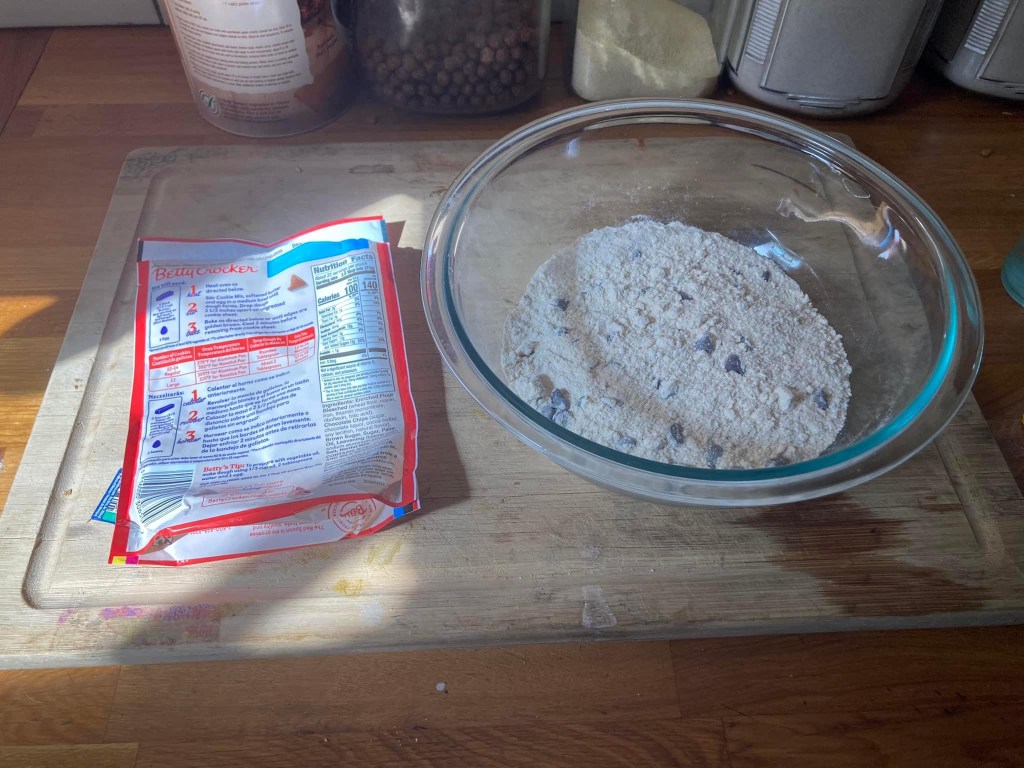
Something Zane loved to do was make cookies. This is something we did nearly every day. I used to hold his hand to help him crack an egg and make sound effects for him. He liked that. He used to try to eat the butter and show his enthusiasm for our baking activity by mouthing the bowl. His very favorite part was pouring the mix into the bowl. I used to say, “Here comes your favorite part!” I bought the same cookie mix today and I’m in my kitchen making cookies in spirit with Zane, smiling and chuckling at the parts of our process that I remember.

Well. my granddaughter will be happy and surprised to see cookies when she gets home from school.

  • Zane was a young nonverbal autistic guy with cerebral palsy that I took care of for the last four years of his life. He died at 20 years old on August 22.

Exaltation of the Cross

Photo by Dietmar Janssen on Pexels.com


Triumph of the Cross is today. It sounds like “ha ha what a win” but I never think of it that way. I think of intense love, non-violence, humility, sacrifice in the face of indifference, cruel efficiency, fear and profound misunderstanding. The death of the Lord confused Satan a lot because it was something he would never do. He waited for Jesus to come down from the cross and be a lion, challenge him to a fight or a match of wills, anything. I think he even wondered what was wrong with these people around Jesus who either ran away or merely stood by. He had no understanding of love. He is a powerful super intelligent being but humility, love and sacrifice, forgiveness he can’t understand at all. In that moment I don’t think he understood anything. Neither did most people. It’s still a bit of a problem for us, especially the take up YOUR cross part. It’s a big big ask. Only the One who really did that can help us to do such a thing and find the flowers in it. So we have to ask him all the time for that.

Photo by Merve Gu00fcl on Pexels.com

Decisions. I hate those things.

Photo by O H on Pexels.com

I have been rather dysfunctional lately. I go to work (I still have one of my jobs) and I come home, do the minimum such as take care of my chickens cats and dogs. Then I lay in my bed and stare at the ceiling. My heart hurts. I feel like I am dying. It’s grief of course, for Zane, who died suddenly and unexpectedly August 22 of this year.

At the same time I have lost my job. I took care of Zane for about four years. I also take care of Mac, another special needs young man.

So I have lost my main job, my job with Zane, which is a crisis in itself. It’s hard to make decisions when you’re grieving and it’s not the best time to do it. However, I don’t have time to do this any other way.

I really love working with special needs young people. I seem to have a knack especially with those who are nonverbal. It is a calling I believe, to do this work. It’s a work that is love. It means a lot to me.

I interviewed with a new family. It went very well and they would love me to come work for them. I liked them too. I said I would let them know in a day or two. Then I cried in the car and had to go over and hug Zane’s mom. We sat on the couch and talked for a while about Zane, about things. Her loss is so great I had to stop typing for a few seconds just now thinking of it. I feel guilty talking about my own grief but I can’t help it.

When my mom got restless or had a problem she needed to think about, she re-arranged the furniture and cleaned madly. Sometimes she pulled up carpet or made new curtains and painted the living room to match. I’m not good at sewing. I don’t have money for paint. So I stuck with re-arranging the furniture and cleaning madly.

I talked to my friend Shawna who somehow manages to give me clarity when I need it. I continued to clean madly. My dogs were a little concerned.

I thought about how I am worried about the pay for a prospective new job which is far less than I made at my last. I wondered how I would pay the mortgage now. I finally got a house and I am not giving it up. I was thinking about what to do about that.

However the main issue is grief. It’s hard for me to think of replacing Zane and trying to love someone new already. I reflect that I have never failed to love anyone I have taken care of. In the nursing home where I did my clinicals there is no way to really get to know the people you care for. You take care of their immediate physical needs and even if they’re crying or something you have ten other patients you have to get to who need to be changed or whatever. Even then I always cared for each one in a loving way as best I could. That’s just how I do it. I can do this.

I have a daughter in college. I will do whatever I can to make sure she gets as far with her education as she wants to. She is busy applying for master’s programs lately. No matter what she is going. My other daughter has been going through hell this summer. It’s pretty unimaginable the way she is holding it together. However she needs me. Sometimes she needs my help. I’m going to be here ready.

If there is anything in my life I have learned to do it’s grieve and fight for my family at the same time.

I can work out the pay part somehow but I prayed about my next person to take care of. I think this could be the one I asked for or was led to. . I think I will try it and do my best.

The dogs needn’t worry. I think I am through cleaning for now.

OK, Beloved Lord. Lead on.

O Brother where art thou

I did not cry for nine years after you self destructed like a kamikaze in our midst. There are not even any pieces left to sort through. Where did you go and why couldn’t I stop you. We were closer than close and I should have known when you locked me out what was coming. We always said when we didn’t spend time together neither of us was right in ourselves so we should always make sure to connect no matter what was going on. You kept trying to apologize, trying to come back into our front porch days. You said “When I hurt you I hurt me and I can’t stand that I hurt your feelings. I hate that.” And I always said it was ok. I said we can work through anything just like we always have. I had faith in that. Absolute faith. How crazy did you have to be for me to not be surprised. Denial is more powerful than I ever thought. When you said “I’m scared I might be mentally ill,” I should not have reassured you that you weren’t. The last time I saw you I hugged you brother and I rubbed your little head. You looked like a small boy that day who had been sick, safe at his parents’ dinner table. Your letter to Dad said I would be OK. Well I’m not. None of us are. You must have hurt so badly to do something like that. You just needed it to stop. I thought oh he will be back like always. He just needs to think. I was so close. But I think you thought we were far away and you had no idea how to get back. You couldn’t find us. And you thought we couldn’t help. I finally cried the other night and it was about something else. It felt weird. It didn’t last long. I wish I could miss you the way I miss everyone else. But there is just a void where you used to be. Like the Mariana Trench. No one knows what’s down there, only how unfathomably deep it must be. I’ve been there. But I couldn’t understand anything.


How to love in troubled times; St. Teresa Benedicta of the Cross (Edith Stein)

St. Dymphna

Photo by Radwan Menzer on Pexels.com


700 years ago in Ireland a young girl left her home in the middle of the night as swiftly and silently as she could. She left with a priest,  two household servants and a court jester who were her friends.  She was not fleeing a forced marriage to a foreign prince or running away to a convent. She was running from her own father who seemed to have lost his mind after her mothers’ death and was trying to make his daughter marry him in her place. 

Dymphna and her friends were able to make it to a Belgian town called Gheel.  

She must have been a hard worker and had a compassionate heart. She and her friends established themselves in the town and Dymphna began caring for the sick and the poor. She had a special sympathy for people suffering from mental illness. She still shows that sympathy now through her intercession. 

Eventually her father, who was a minor Irish king, found out where she was. He had her priest executed as soon as he arrived and demanded Dymphna return home. When she refused he beheaded her on the spot. She was 15. 

The people of Gheel eventually built a church over where Dymphna was buried. Over the years it began to be noticed that healings happened at her tomb, especially healing from mental illness. 

Inspired by St. Dymphna’s special concern for the mentally ill the people of Gheel began to take into their homes the pilgrims who came to visit Dymphna’s tomb. In a time when the mentally ill were chained,  beaten and  locked away the families of Gheel made these sufferers part of their households with acceptance, freedom, dignity and whatever level of responsibility they could handle. Some stayed for a short time, some for the rest of their lives becoming members  of the family. 

Gheel became famous for this model of family care that seemed to work so well. This tradition is still ongoing though now combined with a hospital that is only used when absolutely necessary, and with modern medicine as part of overall treatment. 

Gheel’s example makes us want to rethink the way we treat the mentally ill, especially those whose conditions  are severe. Gheel shows us how it could be. 

Among us here the mentally unwell often end up without homes or anyone to assist them. Federal and state agencies set up to help these people are understaffed and overwhelmed. It is a testament to  serious failures on our society’s part. To see some poor emaciated sufferer shouting and waving his arms at traffic with toilet paper wrapped around his legs as I did last week breaks the heart. It’s wrong and we know it. Unfortunately our state is last in mental health access in the country. 

Gheel and St. Dymphna challenge us. How can we as people of faith contribute in a respectful and merciful way to necessary change, to the well being of people who suffer mental, emotional or neurological difficulties? Our society is not set up for them. How can we help? How can we change that? 

Perhaps we can begin by asking for St. Dymphna’s intercession and inspiration. 

St. Dymphna,  healer of mental and emotional suffering, pray for us. Pray for everyone in mental or emotional pain, especially those left on the outskirts without resources. You inspired a whole town to take people with mental  suffering into their homes so that they might live near you and the place you are buried.  They still come and stay with you and the people of your town today. Help us build a culture of compassion and acceptance so these children of God can live with dignity among us  as the people they are and so that the rest of us don’t miss out on what they can give, on their potential part in building community.  Show us the way. Amen.

St. Dymphna’s feast day is May 15th. She is the patron saint of the mentally ill, victims of incest and domestic abuse, and runaways.

Yes I did say 70×7 but stop freaking out about it

Photo by Ron Lach on Pexels.com

Then Peter came to Jesus and asked, “Lord, how many times shall I forgive my brother or sister who sins against me? Up to seven times?”
 Jesus answered, “I tell you, not seven times, but seventy times seventy times.

Mtt. 18 21-22

It’s been almost nine years but I’m still not sure whether I have forgiven it or not. I still struggle with how I am supposed to forgive someone who turned out not to be who I thought they were. Forgive who? What was that who was that?

In the aftermath I realized I was thinking of the whole mess about once every 15 seconds. I began training myself to repeat the names of Jesus and Mary any time I caught myself dwelling on the whole thing. I had dwelt on it long enough truly. I increased my prayer time. I decided to try to stop talking about it. It helped a lot. Slowly I didn’t think about it, not even every week.

I went to Confession. In exasperation I asked the priest, “How do I get to Father forgive them for they know not what they do?” He said my penance would be to go out and meditate on the crucifix in the church and ask the Lord, “Father forgive me for I knew not what I did.” Instant peace came to me then.

Photo by Skylar Kang on Pexels.com

As time passed I realized that I “forgave” this person over and over again while they were still in my daily life but not in any real way because what I did was be upset about what they had done, avoid them for a while and then simply go on as before so that they did the same things again and again. My kids suffered emotional scars because of this lack of boundaries on my part. I let this person be with us for so long. At the time I didn’t realize how much the girls were harmed especially when they were still young. How did I fall into this trap? How could I not know how mean this person was being to them? Even the things I did know about them should have been bad enough. I should have not allowed this person around my daughters. I certainly did do things I didn’t know I was doing. Those mistakes seem crazy now.

Then at a time of another tragedy in my life, this person set out to ruin my reputation, blame me, interfere with my friendships and even my family relationships, to tell distorted versions of my private sufferings, commandeer one of my daughters with lies and emotional scenes when she needed me most and was too young ti break out of that situation. This person deeply hurt my other daughter as well during a time of grief and shock for my family with hateful accusations and not allowing her to retrieve what was hers and precious to her from the house. This person also participated in grave financial harm to me and one of my kids that we will never recover from. I was emotionally and socially betrayed on a level that was traumatic enough to keep me curled up on the couch for days. I never thought they would go that far especially at a time like that. Why was I shocked? I can’t answer that fully.

One thing I have learned from all this is that being a forgiving Christian does not mean having destructive people in my life. Even Jesus had boundaries.

But Jesus did not entrust himself to them because he knew their hearts.

Jn. 2:24

However I sometimes still feel angry at this person, even after I have peeled away several layers of resentment and reached certain levels of forgiveness. I didn’t feel that it was complete. Because of those feelings of rage coming up now and then, especially recently, I tend to think of this person every time I pray the Our Father. How can I forgive this person as God forgives me? God forgives me more than completely. God is mercy, God is love. I always ask that I will be able to do this. I have learned forgiveness is a grace. We just have to be willing to receive it. Was I willing? I didn’t know. My mom used to say that sometimes we have to ask to be willing. Other times we have to be ask to be willing to be willing. Sometimes the situation is so difficult we have to pray to be willing to be willing to be willing. I think this is like that.

Recently, sitting quietly in prayer, I felt that the Lord untangled my thinking a bit about what forgiveness looks like in a situation like this. In a flash I understood that all Jesus wanted from me now was to pray for this person’s salvation. I felt my heart open as it seemed the Holy Spirit prayed in me for just that: for this destructive person’s salvation. It was an understated but all the same beautiful moment. I understood that God did not need my tortuous worry about my lingering feelings about this, or the useless dead end paths of my self judgement or scrupulosity on this point. Just prayer for their salvation that is all. The rest was between that person and God. Oh.

Three times I pleaded with the Lord to take it away from me.  But he said to me, “My grace is sufficient for you, for my power is made perfect in weakness.”

2 Cor. :8-9a

Then I prayed the our Father in freedom and when I said, “forgive us our trespasses as we forgive those who trespass against us,” I almost felt a kiss from Jesus, and I had to smile. I love that guy.

Photo by MART PRODUCTION on Pexels.com

Acedia; a spiritual malady

Photo by Maria Geller on Pexels.com

During this little slice of Ordinary Time after Christmas and before Lent we might begin to feel spiritually unenthused. Maybe we were already. Maybe we even avoid prayer and the practice of our faith. Maybe we have an aversion to our daily duties. Maybe we’re bored and drawn mostly to distractions. What’s going on? St. Evagrius (AD 385-399) who lived  in the Egyptian desert as an early monastic wrote about something called acedia. 

What is acedia? The Catechism of the Catholic Church (2733) calls it a form of depression caused by giving in to spiritual laxity or presumption. The Desert Fathers thought of it as a spiritual condition people can fall into with a complex set of symptoms, a spiritual malady, or even as a demon. 

[Acedia is] a hatred of industriousness, a battle against stillness, stormy weather for psalmody, laziness in prayer, a slackening of ascesis, untimely drowsiness, revolving sleep, the oppressiveness of solitude, hatred of one’s cell, an adversary of ascetic works, an opponent of perseverance, muzzling of meditation, ignorance of the scriptures, a partaker in sorrow, a clock for hunger.

St. Evagrius

Yikes. 

St. Evagrious of Pontus says the real roots of acedia are self centeredness, anger and misdirected desire. When oppressed by acedia we tend to seek comfort and pleasure to counteract the restlessness we feel, and in response to our aversion to spiritual practice. We avoid the tasks we are responsible for. We withdraw from charitable activity and are more prone to gab with others for our own entertainment and distraction than to be useful to them.  We fill our lives with surface busy-ness, avoiding prayer and study. We lack spiritual desire and quietly long for things and activities that will draw us away from the spiritual. We are both restless and exhausted. We want to sleep, we want to pace the floor. We feel at once angry and dissatisfied as well as listless, staring at nothing. This sounds terrible. No wonder Evagrious called it “the most oppressive of demons.’ 

All of this reminds me of  a passage from one of my favorite books, The Phantom Tollbooth by Norton Juster. 

“There once was a boy named Milo who didn’t know what to do with himself; not just sometimes but always. When he was in school he longed to be out, and when he was out he longed to be in. On the way he thought about coming home, and coming home he thought about going. Wherever he was he wished he were somewhere else, and when he got there he wondered why he’d bothered. Nothing really interested him- least of all the things that should have. “It seems to me that almost everything is a waste of time,” he remarked as he walked dejectedly home from school.”

And “… while he was never anxious to be where he was going, he liked to get there as soon as possible.” 

Had Milo been a monk he would have been diagnosed by the Desert Fathers like Evagrius, as suffering from, and indulging in acedia. 

Photo by Jose Aragones on Pexels.com

If we find ourselves troubled by acedia, what is the remedy? What should we do?

  1. Master your thoughts. 

Notice when your thoughts are going into that irritable, lazy restless lane again, and change course as soon as you notice. Something that helps me is to repeat the names of Jesus and Mary; “Jesus Maria Jesus Maria Jesus Maria” each time I find myself on that negative track again. Be patient with yourself. It doesn’t help to be mad or disappointed in yourself. Simply move on and persevere.

“Whether or not all these thoughts trouble the soul is not within our power; but it is for us to decide if they are to linger within us or not and whether or not they stir up the passions.”

St. Evagrius
  1. Resist. If you want to sleep or run away or indulge in compulsive activity, persevere in what you are actually supposed to be doing in spite of how you feel. If you are avoiding prayer, pray. If you are avoiding your duties, get back on track. If you’ve lost sight of your routines, get back to them. I suggest working on one thing at a time so you aren’t overwhelmed. When you are stuck in acedia even one of these things can be hard enough to change.
  1. Gratitude. Write down five things you are grateful for when everything is getting on your nerves. It works surprisingly well. 
  1. Manual labor. Nothing helps me as much as some vigorous sweeping, mopping or dragging things around outside.  According to the Fathers, acedia is both mental and physical. This is why it’s so hard to kick.  
  1. Meditate on the Passion and Death of Jesus. Maybe praying the Sorrowful Mysteries of the Rosary or The Way of the Cross can assist you in this. This is uniquely grounding for us as Christians.
  1. Ask God for the gift of tears. According to Evagrius, the gift of tears in prayer, and tears of repentance are indispensable for liberation from acedia.  So have a good holy cry, it cleanses the soul. 
  2. Preach the Psalms to your own soul. As Dorothy Day wrote, “My strength returns to me with my cup of coffee and the reading of the psalms. ” 
  1.  Engage your intellect. I learned this from Fr. Gregory McLaughlin who taught me that when I was being ruled too much by my emotions, I should study, especially religious study such as Scripture or good spiritual reading. It works.
  1.  Go to confession. This may seem obvious but remember the Sacrament of Reconciliation is healing and restorative. God gave us Confession so we can receive his mercy, overcome our sins and begin anew which is exactly what we need to be free of acedia and free for God. 
  2. Good deeds. Go through the day quietly tucking in small kindnesses wherever you can. This is a remedy for almost any malady of any kind. When you are ready, throw yourself into working for others in some way.

Gently fold these things into your life and you will soon sense a clear fine spiritual love reclaiming its place in your heart. 

Photo by Tim Eiden on Pexels.com

Blog at WordPress.com.

Up ↑