During these horrifying days of unutterable violence and war, of every kind of atrocity, what can we do? We are far away. We are not leaders of nations. We have to go to work, we have to let the dogs out, listen to a little kid, put dinner together, and also be horrified, feel helpless, ache for the children caught in this, and feed the cat. We have to figure out what to wear tomorrow, wonder if we forgot something we were supposed to do, and as the scenes of mutilation blood and terror cross our minds we wonder what to even say to God.
Maybe nothing.
Maybe we should just let our hearts be pierced as Mary did. We could take on her pure and open heart completely in tune with her suffering Son’s and willing to be present and active in those hours he was slowly dying. She accepted the piercing of her heart, and “the secret thoughts of many [were laid] bare.” I used to wonder what that last part meant. I couldn’t get an answer from anyone about it that seemed right.
But what happens when our secret thoughts are laid bare? We see the truth about ourselves. Our conscience is awakened and we tend to desire to change. Maybe the piercing of Mary’s heart caused conversion of heart for others and still does.
At the same time she was made the mother of all Christians from the cross by Jesus, she received from God a special gift for nudging us toward conversion, of laying bare the truth within us. This would be in line with her role as Spouse of the Holy Spirit who is the Spirit of Truth and Love.
We know Mary has been given unique gifts and that she intercedes for us in heaven. She is advocate of the people of God and she hears the cries of the world.
Such is her unity with God that in her hearing of suffering her knowledge of it is already prayer. Mary is there in Israel and Gaza now touching every face, assisting the dying, suffering with those in distress and in the piercing of her heart at the foot of this cross the possibilities open for changes of heart.
She is to be found wherever her Son is found, exactly where he said he would be; among those who are hungry naked imprisoned or persecuted. He is with the suffering and so is Our Lady. She is there praying with all who pray. Her feet are muddy and her face is streaked with tears. She wants us to join her and in the wind of the Spirit we can.
This is not a helpless dwelling on the horror taking place. This is knowing that God makes our little prayers BIG. We are to reign with Christ and this is how he shares his reign with us. He loves to share his mission with his disciples.
We don’t know what God will do in response. But we know he will do something. We know he gave the world a mother we need so much.
We can take on the mind and heart of Mary. We can go with her and bring comfort in mysterious ways, change hearts even when we don’t know it. We can become windows of grace God’s will can flow through into this world.
We are only little windows but God doesn’t care. He shares his power and love to widen our hearts for his love to flow through.
And in our hearing and seeing and knowing if we remain close to God, our silence becomes full and active. What we know instantly becomes intercession, becomes prayer.
When you hear of bloodshed and terror you will already be praying, and prayer does things.
Like Mary let our hearts be pierced at the foot of this cross. May God receive our offering.
“Come, Holy Spirit, come by means of the powerful intercession of the Immaculate Heart of Mary, thy well beloved spouse.”
July 29 is the feast of Sts. Martha, Mary and Lazarus, the siblings of Bethany. Bethany was a little village not far from Jerusalem. It seems to have been Jesus’ favorite stop on his journeys, his home away from home. Apparently these three friends were great company, and supportive of his mission. They had a house big enough for his travel companions, the food was great and Martha, Mary and Lazarus were always eager to be caught up on the latest adventures of Jesus and his itinerant followers.
Martha and Lazarus’ sister Mary has been conflated with St. Mary Magdalene since the Middle Ages and this impression continued for centuries in Christian hagiography and art. Modern Biblical scholarship and a pronouncement of Pope Paul VI put an end to that mix up. St. Mary Magdalen continues to be celebrated on July 22, and Mary of Bethany joined her brother and sister as her own person.
This leaves us with three Gospel stories of St. Mary of Bethany.
At the feet of Jesus (Luke 10:38-42)
Poor Martha is hosting all by herself, running ragged, resentful and starting to bang the pots and pans in the kitchen. Finally she decides to get her feelings out. She unburdens her heart right to Jesus. Isn’t that what we should do? Maybe not in front of the company, granted, but we should lay out burdens before him and be honest with him. He knows what’s inside us anyway.
I like to think the Lord’s answer gave Martha peace. All the times Jesus has straightened me out when I was wrong or off course I have felt instant peace. Whether what he asked of me was easy or unpleasant I felt peace and that’s how I knew he was speaking. It seems Martha had taken on more than she was required to. I have taken on tasks and responsibilities God was not asking me to and the first symptom I have is usually exhaustion followed by resentment and self righteousness. Eventually there will be an outburst. I hope Martha felt unbound and freed by what Jesus said to her.
It’s easy to see Mary feeling affirmed and freed, protected and understood by Jesus’ defense of her. I recently read that the way she is sitting at Jesus’ feet listening to his teaching would have been controversial in her time and culture. It was something a disciple did. Rabbis weren’t supposed to have female disciples. The study of Torah and the pursuit of knowledge was for men only. By sitting at Jesus’ feet as his student she was being quite bold and acting as an equal to the men. Jesus affirms her in this, allowing her to keep the place she has chosen.
Of course we also see Mary of Bethany here as a beautiful model for Christian contemplatives. She is deeply attentive to Jesus, looking at his face, internalizing all that he says, pondering in her heart.
During a skit of this scene we acted out as a family my then four year-old daughter Maire had Mary get up, offer to take over the host duties, and invite Martha to take a turn at Jesus’ feet. I like that a lot. Maybe it was that way.
Mourning Lazarus John (11:1–45)
Lazarus fell ill. His sisters cared for him and prayed over him, waiting for Jesus to come and heal him. They knew he could save their brother. They sent an urgent message. Mary would have sat by her brother’s bed keeping vigil, offering him her gift of profound presence and connection. Martha would have changed his blankets, kept a wet rag on his head, brewed medicinal teas, asked advice from the wise, sent for doctors, made favorite dishes she hoped he would eat. Sometimes they would have had to switch places and learn the other one’s ways of loving and serving.
Jesus never comes, though they keep a lamp burning for him through every night in hopes he will. Every footfall outside, every stirring they hear they think perhaps it is Jesus or at least a message from him. They don’t understand. Why doesn’t he come? Why doesn’t he respond?
Lazarus’ illness becomes imminently life threatening, their anxiety for him so intense, neither of them sleeps at all. They hold him in his struggle for breath and as life ebbs away.
They try to comfort one another. They ask each other, “Why did Jesus never come?”
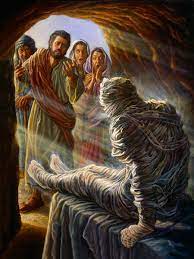
They wash and anoint his body with the women of their family winding him in scented burial cloths to bury him in their family tomb.
Finally Jesus shows. Martha as we have seen her do before, makes her thoughts and feelings known to him. She confronts Jesus while at the same time expressing her faith in him. She knows he could have saved her brother as he has saved so many others. She also has come to know and believe he is the Messiah and Son of God, just as Peter had also done and she says so. “Even now,” Martha says hopefully, “I believe.”
She runs to get her sister who is in the house with all the mourners and tells her Jesus is here and asking for her.
It’s when Jesus sees Mary’s tears that he cries too. This is important to me, to all of us. Yes for some reason Jesus does allow bad things to happen to us. At the same time, as Madeleine Le’Engle says, everything that happens to us happens to God too.
Mary also confronts Jesus, falling at his feet, her movement a desperate plea of prostate grief.
He doesn’t ask Mary for a declaration of faith. Maybe he knew she had it in abundance already. He only responds with his tears and his actions. He gives her her brother back alive.
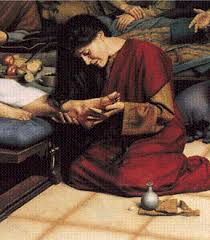
This is the beautiful story that captures the imagination so powerfully; Mary of Bethany interrupts dinner, unbinding her hair, carrying in an alabastron of outrageously expensive perfume worth a year’s wages.
Since she seems to have been unmarried (as she is living at home) perhaps it had been meant for her dowry. To me this brings out an extra meaning. Perhaps she intended never to marry and to fully dedicate her life to Jesus, pouring out her love and devotion to him alone.
Her contemplative nature, her attentiveness and connection to Jesus lead her to anticipate his death; the only one of his followers who understood that it was imminent, and maybe even what his death would mean.
With compassion she comes to acknowledge both what he is about to endure and what he means to her.
Have you ever smelled spikenard, aka nard? It is not a floral scent but a sharp, pungent smell. It would have filled the whole house and the scent would have lingered for days and days in every room and on both Jesus and on her hair.
The others at the table were offended at her extravagance, saying the nard could have been sold and used to feed the poor. Jesus defends her. We will always be able to help the poor but we would not always have him. “She has done a beautiful thing for me.” She dries his feet with her hair.
Women’s hair was supposed to be covered in public and especially in the presence of men who were not their husbands. Here our Mary of Bethany unveils and not only that dries the feet of Jesus with her hair. I wonder what those present would have made of that?
I’m thinking of the spiritual marriage written about and experienced by the great mystics of our faith such as Sts. Teresa of Avila, John of the Cross, Rose of Lima, Catherine of Sienna among others, in which the soul becomes one with God. Maybe Mary of Bethany was experiencing this or had. Maybe this bold and lavish gesture was her response, her understanding of his destiny born of that union and love.
Wouldn’t you love to be able to comfort Jesus with your compassion and love? To do something that is deeply meaningful for him? To pour out your love diffusing its fragrance through all his house, to smell it on your hair for days to remind you, knowing he also carried it? To remember his words, that you had done a beautiful thing for him?
We can. When we love, when we serve, when we pray like an oil poured out to the One we love.
To me Ordinary Time is getting back to the everyday and delightful work of prayer and service that makes up our beautiful Christian lives. It means hot Texas afternoons, coming into the cool, quiet church, feeling relieved as the sweat evaporates from my face and back and peace surrounds me.
“Hi Jesus. hi. Help me pay attention at mass this time.” I can’t help but smile to myself, or really, at him, in his sweet presence there.
His presence is also right here with us, in us.
Ordinary Time beckons
with the promise of quiet inner space
to be with Jesus in the center of my heart,
I in the center of his,
drawing from the source of all life.
St. Teresa wrote about how the companionship of the Lord is magnified when we are prayerfully solitary, our awareness of him not in the least disturbing our perfect solitude.
“Contemplation is nothing more than making time to be alone with the one who we know loves us.”
Instructing us in how to go about practicing inner prayer, she writes, “And now that you are alone, daughter, make the Sign of the Cross.”
In this way you acknowledge that you are in the presence of God, with the intention of spending time alone with him.
You will notice this kind of quiet and solitude are more full than empty, and that the fullness is nourishing, often joyful. Again, it makes me smile. “Hi Jesus, hi.”
If you have trouble with your focus when you are alone, if stillness causes you anxiety, or of you have many worries that disturb your peace, here are a few things to try.
It helps me to listen to the sounds around me. If you are blessed with a silent house or a quiet chapel, these sounds will be small. Mentally note them, starting with the farthest away. Maybe a dog barks from a neighbor’s yard down the street. Someone is mowing in the distance, a car drives by. Now bring your awareness closer. Maybe you hear birds singing, children playing next door, wind in the trees outside your window, a sprinkler perhaps. How about sounds in your house or wherever you are right now? A clock ticking, a washing machine swishing, the refrigerator humming, the dog drinking its water in the kitchen;
listen.
What sounds are in your room? The ceiling fan, the air coming on… your own breathing.
Speaking of breathing, take a few deep breaths; in through your nose, out through your mouth.
Put all your worries in a little pile; Milagros to leave here in his lap while you pray. He will take care of you.
And now that you are alone, daughter, son, love of God’s life, make the Sign of the Cross.
To us who celebrate it every year the Ascension of Jesus seems to naturally follow the initial celebration of his Resurrection.
However I imagine it was an earth shattering surprise to his followers that he would be leaving them yet again.
When I reflect on this event as part of the rosary the virtue I link to the Ascension is detachment as I see him beautifully disappear before the eyes of his followers as “a cloud removed him from their sight.”
The family of believers had to let go of their expectations that Jesus as they knew him would permanently remain to walk and talk with them. Again they had to face that Jesus was not about to get rid of the Roman occupiers either. There would be no restoration of the Davidic Kingdom in the literal way they had thought of it. And the One they loved was going to withdraw from them yet again. They must have felt as if they were back from the defining experience of their lives with nothing to show for it, as if they were just a rag tag group of people standing on a mountainside for no particular reason. They were shocked and bereft. They didn’t understand what Jesus meant about him having to leave that the Holy Spirit could come to them. How could they?
When the angel said that Jesus would be back they must have shaken their heads. Jesus had said for them to go and baptize, to take his message to the world. This must have seemed like too much for them, an overwhelming task, especially on their own.
They had to greatly expand their understanding of God even past the miraculous three years they had left everything for and deeply identified with now.
They had to let go so they could be filled and receive Jesus in a whole new way, by his presence in their hearts, and to come to know the Holy Spirit who was new to them.
How can we receive the Spirit without detachment, self emptying, without freedom of heart?
“Love- the way God wants to be loved, and leave off your own way of acting,” said St. John of the Cross.
Or, as Jesus said to St. Angela of Foligno, “Make of yourself a capacity and I will make myself a torrent.”
Jesus said that if his friends loved him they would be happy he was going to the Father. (Jon.14:28) Is there something more to that than being happy for him? Yes, because he says, “for the Father is greater than I.” Maybe it also means that we have to let our current perhaps more comfortable understanding go to make room for the immensity he has for us. We can be happy he is going to the Father because then, in letting him go as we thought we had him, he then is truly closer than our breath, more accessible than ever. Detachment is hard. We feel that we are losing our Treasure.
St. Faustina said of Mary’s experience of the Ascension that she deeply grieved as any mother would that her Son was leaving but that, “her heart could not want what God did not want.”
In seeking a pure heart for God and a Marian detachment; a detachment with great love, a detachment even from the way we thought Jesus would be present to us, we open ourselves to what is even greater, beyond what we could ever have thought of ourselves. But first we let go.
“Bend my heart according to your will, O God.” (Ps. 119:36)
Then,
“I shall run in your paths for You will enlarge my heart.” (Psalm 119:32)
In this is peace that comes from open-ness to God and freedom of heart.
These verses are a perfect prayer to cultivate holy detachment as the disciples struggled to do this, standing there on the Mount of Olives, not knowing what to do with themselves.
Fortunately we don’t have to rely on our own strength in this and neither did they.
Jesus had said to wait in Jerusalem and to pray. They did. They trusted in simplicity. And prayer continually purified theirattachments and intentions as disciples, transforming their dismay into receptivity.
They still longed for Jesus; his voice, his hug, the sound of his footsteps, “like a deer that longs for running streams in a dry weary land without water,” (Ps. 42:2) However they soon found that once emptied, their muddled and broken hearts were then open to the new gift of God’s presence; the descent of the Holy Spirit at Pentecost, filling them past overflowing, their thirst for God more than quenched. “Your torrents and all your waves swept over me.” (Ps. 42: 8)
I went to see Fr. Cassian Sibley to discuss Prayer of the Heart in the Eastern Orthodox tradition. The sign on the house read, Theotokos of the Life-Giving Spring Russian Orthodox Church. That has to be the coolest church name I have ever heard in my life. I told Fr. Cassian so when he opened the door. He is a cheerful man with a kind face and a big bushy beard. He offered me coffee and showed me an assortment of beautiful prayer ropes, or “chotki” used for the meditative repetition of the “Jesus Prayer,” (“Lord Jesus Christ, Son of God, have mercy on me, a sinner”) which is at the core of Prayer of theHeart. Some of the chotkis were made with beads, some with knots in the shape of crosses. Some were quite long, and some were tiny, designed to fit on a baby’s wrist.
He explains that the simple repetition of the Jesus Prayer is the most common use for lay people, in order to pray without ceasing as they go about their busy lives. I am familiar with this because of one of my favorite spiritual books, The Way of the Pilgrim/The Pilgrim Continues His Way. The pilgrim wanders across Russia praying the Jesus Prayer until his heart prays it continually without effort. The book charts his travel, conversations and spiritual growth in the prayer.
Fr. Cassian points out that by replacing the “me” in the prayer with the name of someone else, one can use the prayer as an intercessory prayer – while warning that one does not use the phrase “a sinner” while doing so, since a Christian has no authority or right to judge another.
I had brought a rose for Mother Mary which he put in the chapel. Then I followed him into a pleasant sitting room filled with morning light, and comfortable furniture, lined with books. A parrotlet sang from a nearby cage. I got out my notebook but the conversation was so interesting and lively that I hardly took any notes. I couldn’t have been more content. I was sitting in a cozy chair conversing with an extremely intelligent and deeply spiritual person in a relaxed and friendly way, neither of us hurried. Priests are busy people so I was aware of what a gift his time was.
Fr. Cassian grew up Southern Baptist but was, as an early teen drawn to the Anglican Church and was preparing to be ordained as an Episcopal priest. As he studied theology though, he became more and more sympathetic to the Orthodox Church, and as a teen, he had read the J.D. Salinger novella, Franny and Zooey, and been introduced to the Jesus Prayer and The Way of the Pilgrim. Eventually he converted to Eastern Orthodoxy and ultimately was ordained as an Orthodox priest.
I told him my story of being tricked by Mother Mary into falling for Jesus and the Catholic Church after having grown up without religion. He chuckled knowingly and we talked about Mary in both our traditions. I really like the Orthodox title for her, “The Theotokos,” meaning “God-bearer.”
Our discussion turned to the life of prayer as experienced and expressed in each of our faiths’ contemplative traditions. We have so much in common. There are some interesting differences in our mystical theology, and in our ideas about the experience of Heaven. The Orthodox regard heaven as a continuous free growth of divinization -as an “ever moving rest” – which the Orthodox feel is in contradiction to the experience of what the Western Church calls the Beatific Vision. I said that St. Therese is busy “spending [her] Heaven doing good on earth,” so maybe we’re not so different there after all.
We discussed Confession, local events and world news, Church history, the degrees of union with God, the differences between praying with the chotki and the rosary, (for instance we use imaginative prayer and the Orthodox strongly caution against it).
We talked about the importance of being willing to know Jesus as he is, being ready to shed our own ideas and misconceptions and our lamentable tendency to only accept the aspects of the Lord that we are comfortable with.
I learned some Greek words and heard a few Russian ones I would be unable to reproduce.
Eventually we came to the point of my visit, the practice of Hesychasm (the path of deep prayer and living the life of prayer in the Orthodox tradition) and the practice of Prayer of the Heart.
Before Fr. Cassian gives me practical instructions, he cautions that if one desires to enter into this practice, a spiritual guide, teacher or spiritual director is extremely helpful – which is why the more mystical and non-verbal use of the Jesus prayer is more common, in Orthodoxy, amongst monastics and those with a monastic spiritual father or mother.
He goes on to say that today in Western Society we think of ourselves as centered in the brain, the mind, and that we tend to pray from there. Biblically, however, the heart is seen as the center of the person where both thoughts and spiritual movements occur. In Orthodox prayer, the pray-er seeks to redirect his or her awareness from the head down into the heart. Fr. Cassian touches his heart often as he speaks, seemingly unconsciously, closing his eyes when he does so. It seems to me that when he does this, a switch is flipped somewhere, a “peace switch” that visibly changes his entire demeanor. Maybe it is a breaker switch because I feel it too!
Practical Instructions for Prayer of the Heart
Stand or sit comfortably with your back relatively straight, in silence, solitude and stillness.
Breathe in, and allow one’s conscious awareness to follow that breath as one prays, silently, “Lord Jesus Christ”
Exhale slowly, maintaining, if possible, one’s conscious awareness in the heart, as one prays silently, “Son of God,”
Inhale, as before, while silently praying “have mercy on me”
Breathe out slowly and prayerfully acknowledge that one is “a sinner.”
Slowly repeat this cycle again and again.
Continually bring your awareness into your heart, bringing Jesus’ Name, his presence into it. Eventually it will be the heart that keeps time, so to speak, and the heart that speaks. After that, everything is up to God, and God alone.
The true Prayer of the Heart as he describes it sounds like what a Carmelite would call the grace of infused contemplation, where it is God who acts within us, and we are drawn into union with him.
We talk about the traditional understanding of the progress of the soul through the Purgative Way (purification), the Illuminative Way (the growing knowledge of God and his ways) and finally the Unitive Way (one-ness with God).
Before I leave, Fr. gives me a copy of his wife’s new book of poetry, Zoom and the Neanderthal Girl by Olympia Sibley, (I highly recommend it!) and I give him a copy of my book, Come to Mary’s House; Spending Time with Our Blessed Mother. (Release date September 26)
He invites me to come again, perhaps for dinner with his wife and him. I say that would be great.
I had set out today to write about the Prayer of the Heart but I can’t help but feel that perhaps Fr. Cassian and I have begun to do our part in healing the Great Schism one conversation, one prayer, one friendship at a time.
*My thanks to Fr. Cassian Sibley for his assistance with this piece.
Lectio Divina is an ancient prayer form developed by the Benedictines in the 6th century, a way to deeply pray with Scripture. One read attentively, pondered, as Mary did, the word of God, responded back to God, and rested in simple contact with him. In the 12th century a monk called Guigo decided to divide it into more definite steps. For me over time this prayer became less formal and more of a flow that happens naturally in the Spirit. In fact with long practice it is just the way I hear and respond to Scripture when I am really paying attention. Maybe that is how this prayer arose before it had a set of concrete steps to follow. The pray-er experienced a natural, Holy Spirit guided progression between attentive reading, deep prayerful pondering and simple rest in loving awareness and receptivity to God’s presence.
It was cool of Guigo to organize this into steps however. The steps helped me a lot when I was new to it and still do sometimes especially when I am upset and can’t focus. Also everyone is different. Some people pray more freely with a sense of order and clarity. Others do best with spontaneity and receptivity. God loves both of these and can work with equal grace with every soul, no matter the preference.
Here are the steps.
Step One Lectio: First, slowly and reflectively read a passage of the Bible three times, paying special attention to any word or phrase that catches your attention.
Step Two Meditatio: Quietly ponder the word or phrase that stands out to you slowly repeating it in silence. Ask the Lord what he is saying to you in this Word, brought to your attention by the Holy Spirit.
Step Three Oratio: When you receive light on what God is saying in your soul through that word or phrase, respond back to God in prayer, perhaps asking for all that you need to carry out his will, or maybe in praise and thanksgiving; whatever is appropriate. Have a conversation with him.
Step Four Contemplatio: Rest now in simple love, in communion with him for a time.
Some people will add:
Step Five Actio: Like Mary after the Annunciation, arise with haste and act on what you have received in prayer! (Luke 1:39)
Encounters with God don’t always lead us into immediate service but if they do go with it!
Photo by jacts_WAITAMINUTEu2014REALLY? carig on Pexels.com
General advice:
If I don’t have a particular Biblical passage in mind I choose from the mass reading of the day. I consider the readings of the day to be chosen by the Holy Spirit. If none of these particularly catch my attention I pick the Gospel reading. 🙂
The number of minutes you pray Lectio Divina is up to you. God will definitely be there throughout regardless. He is unlimited by time. 5, 10, 15 or 30 minutes will all work. I tend to set a a quiet alarm so I am not tempted to worry about time. I know the sound will call me back at the right moment and I can relax into prayer.
If you are new to silent interior prayer, I suggest you start with 5 or 10 minutes at first. You are more likely to make a habit of prayer when you feel you can succeed and are less likely to feel overwhelmed and avoid it. Baby steps!
Some people say to pray at the same hour in the same place every day. You may find this helpful in creating the habit and sticking with it. At times I have found that helpful too.
To me any quiet and solitude I can find will work. And anyway I like to change things up now and then.
Always remember that God responds to any good faith approach. He doesn’t get all weird, scrupulous or worried about things the way we do. He just wants to be with us.
“All I need is Jesus, His will, and silence.” – St. Miriam of Jesus Crucified
I know I’ve been quiet this Summer. It’s been a busy, hot and stressful summer so far. I feel like I’ve either been busy or tired. I’m certainly not one of those writers that sits down at a desk and writes all day the way I have read that some do. I tend to write obsessively for a while and then not write for a while. I am always writing in my head though. So maybe I should be one of those writers who writes all the time. I will have to work on that. Whenever I have an “all the time” to do that in. 🙂
We took in a cat who is a great cat (Annie) but she turned out to be pregnant. She had six lovely kittens April 30. We live in a little apartment so when they began running around and then reached that really obnoxious age where they seem totally crazy and become destructive little gymnasts, it was a bit much even for us. However we had no trouble finding wonderful homes for all but one, the most hapless one who we decided may as well stay on. We love her. My granddaughter named her Princess Buttercup.
I’ve been helping to found a new non profit in my community. That’s been exciting. I will write more about it when we are closer to getting all the way off the ground. It will have to do with helping those in need, helping connect the dots for them and staying with them through the process of finding help until they have actually gotten the help they need. It will be a community center, a food pantry, and a hub for local available services (with comprehensive case management for people in crisis.) We already have an office too! We will have a community garden and oh my goodness we are doing so much stuff! So that’s the gist of it. We have lots of ideas and I am so delighted that more than we even expected is happening, really happening.
I’ve been watching grandchildren on the days I am not working. Those are some stellar little kids. They kill me! My granddaughter I live with is getting ready to begin school again. (First grade!) This is a relief to her and to us as she has been so bored and driving us nuts!
My youngest daughter (who lives with me) started performing in public again. She is a singer/song writer/guitarist. It’s been years since she has done so and we are so proud of her for getting back out there. She heads back to college in a couple days.
My eldest has been into archery and modeling and painting cow skulls she sells at a store called “Cowboy Up.” Also she works as a secretary at an appliance installation place. Both girls are raising their children admirably though, there sure have been a lot of struggles in their lives this summer. Good thing they are both so tough.
I spend most of my work day outside and it’s been a crazy hot summer here in Texas! I can hardly keep my plants alive either!
My friend Molly flew me up to Duluth to see her for a few days. What a beautiful town and a wonderful escape from our weather! We had a blast. She is one of those friends that you end up having four hour conversations with. We talked and laughed our heads off!
So that’s my “What I did this summer” run down.
Most of all, however, I checked on my book today and was utterly astonished to see that it’s already available on Amazon Kindle. I can’t believe it! I wanted to let you know about this crazy surprise, reader!
The print version can be pre-ordered and will be released September 26th. But if you want to you can already read it! WHAT?!














 Bethany Hang Out