Search

Bethany Hang Out

Catholic contemplative life and devotion

Author

Shawn Rain Chapman

Shawn Chapman is the mother of two young adult daughters, enthusiastic grandmother of three small children, a Discalced Secular Carmelite and writer. She is the Catholic Columnist for Bryan-College Station Eagle Newspaper and a Care Giver and author of the book Come to Mary's House, spending time with Our Blessed Mother from Our Sunday Visitor, available anywhere books are sold. She likes hanging out with friends, reading, and cooking awesome vegan food.

Advent tea with St. Therese

“The Lord will dawn on you in radiant beauty. You shall see his glory within you.” — Liturgy of the Hours

We are sitting in my living room, reflecting silently together in the glow of the blinking lights of the Christmas tree. It looks particularly lovely in the dark. Its light turns the smooth, gentle face of my companion from pink to yellow to blue and back again. She seems content with her tea in a flowery cup from our kitchen.

“St. Therese, what is Christmas?” I ask.

She likes this question. I have been trying and trying to write about her, but she wanted me to interview her about Christmas. So we’re talking about Christmas.

“It is the time that the children of God remember and celebrate the birth of the infant Jesus.”

She smiles with a faraway look, “It is also a time that once again the doors of heaven swing open, great graces and torrents of spiritual light are poured into the world. The child Jesus will come to each person in a special way, to be reborn in each soul, all the world receives a blessing from heaven.”

“So many people have a hard time with Christmas, St. Therese. Some people have trouble with their families, don’t have money for gifts, or are agitated and stressed at Christmas, or they get their feelings hurt at their family celebration, or things don’t go the way they want them to, or they feel lonely or they are grieving. Can you address situations like that?”

She looks at me tenderly, knowing my mixed feelings at this time of the year, and that, as I said, they are shared by far too many others. She herself suffered grief, sorrow, loneliness, depression, severe illness and disappointment.

“I want God’s children to know that Jesus truly comes to them in all humility and with love. Just as he left his beautiful heaven to be with us on earth, so he comes to be in your soul, a heaven infinitely more dear to him because of his love, his personal love for you. When you are tired, look inside and find the little beggar of love. Cradle him, cherish him; look at him. Find a moment of peace there in the Christmas stable of your heart and he will give you his grace.”

“What should we do if we are disappointed or get our feelings hurt with our families at Christmas?”

“One Christmas when I was 13, my family got back from midnight Mass, and my father was very tired and grumpy. I overheard him say he hoped this was the last year for presents for me because I was getting a little old for this. I was crushed! I had been a very sensitive child ever since the death of my mother when I was little. My family doted on me, but they knew a torrent of tears was coming and they dreaded it. I ran upstairs to cry. Somehow something happened before I reached the top stair. Everything changed for me. A new strength, a new tenderness touched my soul. I encountered in the depths of my heart the light and tenderness of the Holy Child and in an instant I just … changed my mind. My tears dried, I turned around, came back down the stairs and surprised my family very much with my joyful opening of presents and sharing with them all the happiness of the occasion. It was a Christmas miracle!”

“How do we get in touch with the grace you describe in that transforming moment of your life?”

“If I reflect on it, I see that I had been preparing myself for that moment by making small sacrifices wherever I could. I saw this as adorning my heart with freshly gathered flowers for Jesus. Some of these were violets and roses, others were cornflowers or daisies or forget-me-nots. I wanted all the flowers I could gather to cradle the baby Jesus in my heart. “

She is leaning forward now, and I see how her face lights up talking about this.

“It seems to me you are talking about how you trained yourself not to let an opportunity to do a kindness, or make a small sacrifice slip by. Is that what you mean?

“I found that life would bring me plenty of opportunities. So if one of you should find yourself naturally irritated with someone this Christmas, decide for peace and serve that person nicely. It will set you free.

“If your Christmas isn’t going the way you planned, give up your expectations as a sacrifice to Jesus, and you will feel your burden lightened.

“If someone wants to argue, let her win; just this one time.

“You will be surprised how you can walk away happy, or even find that you regard that irritating person with genuine affection. Find opportunities this Christmas, to be kind, to serve, to take the lowest place. I will be there winking at you!”

I laugh, imagining this. “That’s perfect!” I say. “I will be looking for you.”

I lift my tea cup for a toast and we clink our cups together, smiling.

She tells me a story about life in the convent when now and then one of the novices would lose her temper with St. Therese and tell her angrily exactly what she thought of her. “I decided to savor these incidents like good vinegar on a fresh salad.” She chuckles. “You could use that at Christmas, to counteract all those holiday sweets! I will be there to give you a high five to celebrate your glorious victory over yourself, and Jesus will grant you immense strength, you will see.”

“This is hard stuff, though,” I say.

She knows it is hard.

“I had such a longing to be one of God’s great heroes. I had such overwhelming desires to do great things. I came to understand that doing these small things with great love offers plenty of challenge. Yes, these are almost the hardest things of all, these little things to do! But before you know it, you will find such joy. You will realize the presence of the Little Beggar of Love in your soul. And you will be glad you gave him what he wanted for Christmas most of all. The milk of your love at every opportunity you had.

“Ask the good God to show you an opening to do a small bit of good around you, to lighten someone’s burden quietly.”

I am smiling now because I know she is right. This is a way to be good soil for the seeds of the Gospel Jesus came to bring. If we give ourselves over to little Jesus in this way, he will find our souls full of flowers for him to be cradled in, and he will make his sweet presence there known.

We will find ourselves not only doing small things with great love, but with great joy.

And if you burn the cookies, or you say something you shouldn’t have, be patient with yourself, she says.

“Little children fall often but don’t have far to fall, so they don’t hurt themselves very much.” So strive to be little, even to yourself.

Practice this “Little Way,” for his Christmas presents, fill your heart with these flowers, and the little Jesus will come to you with his grace to be cherished within you.

That is the Christmas spirit, I believe, according St. Therese of the child Jesus.

“Love him,” she says, draining her teacup.

“Love him in everything. It’s that simple.”

“In this brilliant night which illuminates the joy of the Holy Trinity, Jesus, the gentle little child of the hour, will change the darkness of my soul into torrents of light.” — St. Therese of Lisieux

Photo by Konevi on Pexels.com

How a St. Francis statue changed my life

Photo by Shakhawat Shaon on Pexels.com

I was 19, and living back home with my family for a while, when, coming in one evening, I found everyone very bemused with me.

“We got a call from the Christian book store that the book you ordered is in…….?” My mom queried.

“OK.”

“We thought it might be a wrong number……?”

“No, that’s the book I ordered about St. Francis.”

They all looked at each other.

As I headed down the hall to my room, I heard my brother ask, “What? Did you hear that?”

My step dad said, “Well… you never know what Shawn is going to do.”

At that time I was getting ready to go to Corpus Christi to spend some time with my Granny.

I planned to re-paint the St. Francis statue she had in her back yard while I was there.

Someone had given it to her in the distant past, to set at the grave of a beloved family dog who had died long ago. The worn, concrete statue was of a serene faced man in a tattered habit, a hood drawn over his head. He is holding a small, trusting bird against his chest, his eyes closed in prayer, or perhaps gazing down tenderly.

This statue had stood under the cottonwood tree year after year. It was a marvel of Granny’s household, having survived three major hurricanes without tipping over, even though it was a knee high concrete statue anyone could lift.

One night, however, the St. Francis’ face had been vandalized; spray painted an ugly red and black. I planned to fix that.

None of us knew much about St. Francis the person.

How a st. francis statue changed my life

We had heard he had been known to communicate with animals.

Granny was in the habit of adopting injured, stray and abandoned animals to the point her house was filled with them. (It’s a good thing she cleaned all the time!) Most of her grocery bill was for pet food, and the veterinarian down the road heard from her often.

Generally Granny had a rough, colorful personality. However, she would break down sobbing over the suffering or death of an animal.

She had a special love for birds, and daily fed the ones who frequented her back yard. Crowds of them weighed down the branches of the giant oleanders, and sang in the orange and mulberry trees around her garage each evening. A few sea gulls usually circled above. She would hear their “racket,” and go out to her waiting admirers.

She would raise an old metal trash can lid, turned up and filled with birdseed high above her head, and a whirl wind of wings would surround her. Some of the birds settled on her shoulders, or even in the palm of her hand. It looked like magic.

She had the quaint habit of talking to animals seriously, as if they were people, and they seemed to listen to her.

A saint who could commune with animals would naturally interest her. I had only recently begun to believe in God, and to learn to pray and meditate a little. I was not open to religion.

I thought it would be nice, however, to learn about St. Francis while I worked on his statue.

So we would put on a pot of coffee now and then each day, and as she worked her trade of re-weaving,*  I sat on the floor by her work table. As I had done since I was a little girl, I read aloud to her.

francesco-7p

I don’t know what I expected, but The Way of St. Francis by Fr. Murray Bodo, was a very reflective book. Reflective Christianity was a new experience for me.

I was impressed with the author’s depth, warmth, humility, and spirituality.

St. Francis surprised me, too. His Christian faith made him more authentic rather than less so. His unabashed love for Jesus led him to embrace people and ideas he had always been afraid of, and to renounce social acceptability when it got in the way of going where God, where love, was leading him.

Because he wanted to be a faithful Christian, he practiced radical inclusiveness, and unconditional love.

Because He loved God, He loved the created world for His sake.

He did delightfully crazy things.

He was charming and challenging.

He was adventurous and full of joy, love, and humility, ready for anything.

I had never heard of living simply, in solidarity with the poor, out of love for “the poor Christ,” or of voluntary poverty as a spiritual discipline.

It was healing for me that he did not seem to trample on other people’s feelings or their sense of self. Instead, they were won over by his kindness and love, his respect, his happiness, and by the fact that he really did visibly live what he believed in, even down to his love and obedience toward Church authority.

He knew suffering, but he found inner joy from knowing God, and from loving with abandon.

I felt very impressed with the beautiful, joyful life of love St. Francis lived.

As I sanded the statue, and carefully painted it in calming shades of blue and gray, I found myself thinking about him and smiling.

images

I had not known it was possible to listen for the voice of God in one’s heart, and to actually be inspired be that.

Striving for a certain type of life was also a new idea for me.

I loved learning about Francis’ soul friend, St. Clare. I had never heard of contemplative Christianity before. What a deep, poetic, courageous woman. She was the first of many women mystics I would read from or about in the years ahead, opening my heart, a little more at a time, to God and prayer.

images-3

Granny and I both loved the stories about St. Francis. Of course she really liked hearing that he had preached to the birds, and tamed the wolf of Gubio. My favorite was the surprising story of Francis and the Damietta prostitute. 

I was inspired to memorize the St. Francis prayer, and to use it as a point of meditation for years to come. Later, Granny sent me a prayer card of it that I still have.

Over the next several years, I would sand down and re-paint the statue on my lone visits to Granny. It became a kind of ritual for me.

Granny started to talk to St. Francis over her morning coffee on the back porch before she got to her work, and at other times during the day, and to pray more often.

I earnestly tried to begin to live a spiritual life and to learn to love, little by little.

I don’t know if all of my attempts were directly inspired by St. Francis, but I think he and his example had a lot to do with it.

I tried several things that changed the way I lived and saw the world.

I began to try to reach out and connect with people even though that was hard for me, and to try to see the good in everyone.

I got over my embarrassment and started to talk to homeless people whenever I saw them, to give them what I could, to hug them if it was OK with them.

I attempted to smile from the heart at every human being I saw. I still try to do that.

I became more interested in prayer.

I made conscious efforts to live more simply, as a spiritual practice, and so that I could share more with others.

I recognized joy, love, and humility, as virtues to respect, to look for and see in others, to hope for, for myself.

I rediscovered my childhood connection to nature and to animals. I saw beauty more and more, and learned how to drink it in and enjoy it.

I started to notice my hardness of heart and to try to become more open and loving.

I was not about to become a Christian, (so I thought.) But getting to know St. Francis began to give me new ideas about life and about God.

Many things happened over time that drew me slowly into the Catholic Church, and inspired me to live the faith as fully as possible. Maybe my friend, St. Francis was helping me along.

Eventually, my granny was baptized and confirmed as a Catholic. She chose the name Francis at her Confirmation.

When she was asked, “Ruth, what do you ask of God’s Church?” She unconsciously went “off script” and answered from the heart, “I want to love and to be loved.” Everyone smiled.

That St. Francis statue stands faithfully at my grandmother’s grave today. It is even more worn by the weather now, into a wonderful blend of shades and textures from years of being outside, and from my different loving restorations of it. Since I set it there beside her head stone, I have chosen not to repaint it anymore. It is beautiful just as it is.

How a St. Francis statue changed my life

*Re-weaving was the trade of re-weaving cloth that had holes, flaws or tears in it, making it look new. My grandmother was the last re-weaver in Texas.

Soul and Service

Photo by Anna Tarazevich on Pexels.com

 Pope Francis has said, “Do not be afraid to go out to encounter the marginalized. You will find you are going out to meet Jesus.” Dr. Esther Miranda is always up to something in this regard and she is practically bursting with ideas, projects and collaborations, with stories of soul and service.   

Esther moved to Bryan-College Station thirty years ago, having grown up in India in the presence of Mother Teresa where the Missionaries of Charity used to meet in her grandfather’s house.  “Poverty is much more visible there. Every day there were people at our gate.” Early in life she learned how much getting to know the poor could open her eyes, and she was inspired to do more. 

When she came to College Station for the first time, she thought, “OH what a beautiful town!” It seemed so clean and prosperous. She didn’t even see any poor people around. She assumed this was because there were none. She volunteered at St. Vincent de Paul Society, a Catholic organization that works with people in need (where she is now Vice President,) and was quickly disabused of this notion. “There were people living with no windows, no bed, no electricity! There might be eight people sleeping on the floor, getting up and working all the time but there was no food in the kitchen!”  

“It’s about opening eyes, Shawn, opening eyes.” 

She goes on to say passionately, “We are the hands and feet and heart of Jesus in this messy world! Sometimes we have to reveal the mess to do any good!” 

Her favorite representation of Jesus is of him as the Good Shepherd knocking on the door for us. “He is there waiting! In quiet, just ask him to tell you about himself.”  

She doesn’t think that is all we should do though. 

“So many people want to talk talk talk talk about knowing Jesus.” She thinks the proof is in what we do. As St. Teresa of Avila said, our prayer must lead us to good works. 

Esther says, “You want to know Jesus, get in my car! I’ll show you!” 

If you’re nervous about meeting those in poverty or crisis, remember, “You don’t have to have all the answers for them. More than anything, listen. They need that! It’s good for us too. We shouldn’t assume they have nothing to teach us.” 

Pope Francis says, “The poor always evangelize us  because they show us the true Face of the Father.” 

After the martyrdom of Pope Sixtus in Rome (259AD,) St. Lawrence was ordered to turn the treasures of the Church over to the Roman government in accordance with the law that an executed Christian should have his property confiscated. 

First, Lawrence distributed every bit of it to the poor. 

 Then he presented himself to the prefect, and when ordered to deliver, he presented the indigent, the crippled, the blind, the sick and the poor. “These are the true treasures of the Church!” 

“OOOOOOH! I LOVE THAT STORY!” cries Dr. Miranda. Of course she does. It’s her story; holding dear and caring for the true treasures of the Church.  

Some have objected, “The job of the Church is evangelization.” Esther doesn’t see the conflict. She is evangelizing!

“ Have you ever seen anyone come to church from preaching? I haven’t! If people’s physical and emotional needs aren’t met, none of that stuff makes any sense to them! They can feel Jesus in a warm meal, in someone who cares. They aren’t waiting for a Bible verse, they need someone to care about them and to show it!”     

She repeats several times her favorite maxim, “REACH BEFORE YOU TEACH!” 

“When someone is hungry and has no place to sleep or take a shower, you give them these things, and you listen to their stories. This is what they need, and to know somebody cares. The next morning, maybe they are feeling a little bit better. You get them some coffee and maybe after breakfast you can say, ‘Would you like to pray with me?’ They may say, ‘yes I would love that,’ or maybe not, or maybe they will do it because you have been kind to them.” We should never judge them or require them to do anything in order to be helped. Always respect their dignity. Then maybe you can find out what to do next to help them along their way. 

She says maybe you have planted a seed just giving them a good example of a Christian who is kind and compassionate. “Today this is not the impression a lot of people have of us and it’s very sad. If we can help them see the heart of Jesus in us we will have done something important.”

Dr. Miranda has some tips for being a better listener with people who are in trouble.  “If you are talking, ask yourself, ‘Why am I talking?’  Remember to slow down, to pause, to listen. Own what you are about and remember that listening doesn’t threaten that. Welcome what they have to say.” 

Esther started a furniture ministry five years ago that has grown from two volunteers to thirty- two and has helped two hundred and fifty local families in need so far.  

St. Vincent de Paul and the furniture ministry are not all she wants to do. Esther decided to spend “the year of Covid,” calling every organization that does anything for the poor, getting to know the work they do. She asked each one, “Tell me what doesn’t happen, what frustrates you, what you wish somebody would do.” She found out there was so much she didn’t know about what others were doing. 

She realized, “Our beautiful town needs a community center that does not seek to duplicate the work anyone else is already doing. We need a place where anyone, regardless of who they are, can come, where they can easily get answers! When people are in the depths of despair, they don’t need yet another brochure or list of numbers to call, that may end up being a wild goose chase or a series of dead ends. They don’t need to be told to fill out a form online when they don’t have a computer!” 

Photo by kira schwarz on Pexels.com

Dr. Miranda envisions a place where a single mom can come in and use the computers for her children’s homework, even ask someone to hold the baby for her. 

“If people have one problem, there are a whole slew of problems, complex problems,” she says. We can have the information right there and call for them, help them fill out the forms they need to fill out right there!” 

She wants people to be able to come in and be given a cup of coffee or something to eat, have someone listen to them as long as is needed, and walk them through their next steps.  

She wants there to be not only a focus on service and collaboration but on education and leadership. There can be skills classes people need to better their lives, classes for people who want to serve, programs to train young people to be community leaders. “Government and churches cannot fix these problems alone. It takes small groups of committed, like- minded people.” 

Dr. Miranda is “so grateful, so grateful” for all of the people who have joined her on this journey. “So many wonderful people!” She welcomes everyone to join her in this new echumenical collaboration. 

She has dreamed of this but she felt that Jesus said to her not long ago, “Esther! What are you waiting for?” 

“So I have to go forward in faith! And Jesus has never once let me down! Everything comes to me when I have that attitude! If one organization or one person won’t help, I try not to let it anger me too much or discourage me! I move on! I move on to the next one, and the next one, and the next! And it’s working! It’s coming together! God is making it happen!” 

As for us who are among the more materially fortunate, she says, “We all need places where we can go to get closer to Jesus.” This center will be one. 

  • This piece originally appeared in The Bryan-College Station Eagle newspaper in my monthly column. This is the extended uncut interview with Dr. Miranda

I hear you.

Our Lady of Sorrows 2021

May 23 2021, a young black man was shot to death by police in front of my apartment. During the commotion that preceded the shooting I had rushed onto my balcony. I saw the whole thing. I called out to him while he lay in the parking lot as the police shouted at him to put his hands up. He couldn’t seem to do it so I was saying, “You can do it please do as they say! I’m praying for you!” I didn’t want them to shoot him again. Finally he was able to raise one shaking hand. He couldn’t seem to bring up the other arm.

He had come out of his apartment (next to mine) waving a gun earlier. When I saw that I knew they were going to shoot him. I decided that I was not going to turn away from what was about to happen. I felt I had no right to. I should remain.

As soon as he had finally put one hand up, a couple of officers turned him over on his face. It was raining. The parking lot has a lot of cracks and dips in it, repairs in the shape of square patches. He was in a bit of a puddle, still alive. His pants had fallen down when he was turned, exposing his naked butt and nobody pulled his pants up for him. The blood from his chest began seeping into the water around him.

That’s the scene that runs through my mind at least once a day.

He had looked so shocked when they shot him. He swayed and looked around at all the faces in front of him; each human face in the arc of police who had fanned out and then closed in. He looked at everyone before he collapsed.

Another neighbor had been caught between two cars and was hunched down crying. I went downstairs to hug her even though she was talking to her son on her cell phone. I heard the young man’s girlfriend screaming and the police shouting at her to stay back. I ran over there, worried she would get herself shot too, or arrested. I put my arms around her and reminded her that he needed her now, and she wanted to be able to be there for him so she should comply. She called to him that she loved him and she was there and she wasn’t going anywhere. She stayed back.

However when she saw her mother across the parking lot she ran to her with police shouting at her the whole way so I went with her and said over and over that she was just going to her mother. As we went past the stretcher, my arm brushed the young man accidentally and his head lolled to the side.

Everything happened so fast that day. I don’t know how objective I could ever be about something like this. I’m not trying to be.

I’m also not writing down everything that happened. These are the parts that have stayed with me the most, that tend to replay for me.

Soon after, maybe the next day, I saw a woman downstairs obviously overcome with traumatic grief. I went out on my balcony not knowing what to do but wanting to do something for her. She looked up at me so I called down to her and asked if she would like a hug. She said she would and I went down and held her close. She needed to sit down so we halfway got in her car and I held onto her.

“I can’t believe they shot my baby! How could they do that?”

There was nothing to say except “I don’t know.” Because that is the truth about these things. We can never understand them no matter what anyone says. At the bottom there is just no real answer.

This is what I am thinking about on this memorial of Our Lady of Sorrows. We can say all of these exalted things about Mary’s sorrow and I know they are all true. But maybe we love her best when we remember that no answer satisfies a mother’s shattered heart.

Happy Birthday Mother Mary

Photo by Markus Spiske on Pexels.com

Today, September 8, is Mother Mary’s birthday! (Well we don’t know when it actually was but we celebrate it today!) Time to burn rose incense and get out all of her baby pictures and make a cake! (Chocolate! What other kind would she eat?) Happy birthday to our mother, our sister, our Queen, the one who was continually amazed. In her companionship may we come to live in a state of wonder as we follow her Son at her side.

Here is a little family prayer service I used to do with my kids before we had Mary’s birthday cake and that I will be doing with my daughter and granddaughter this evening.

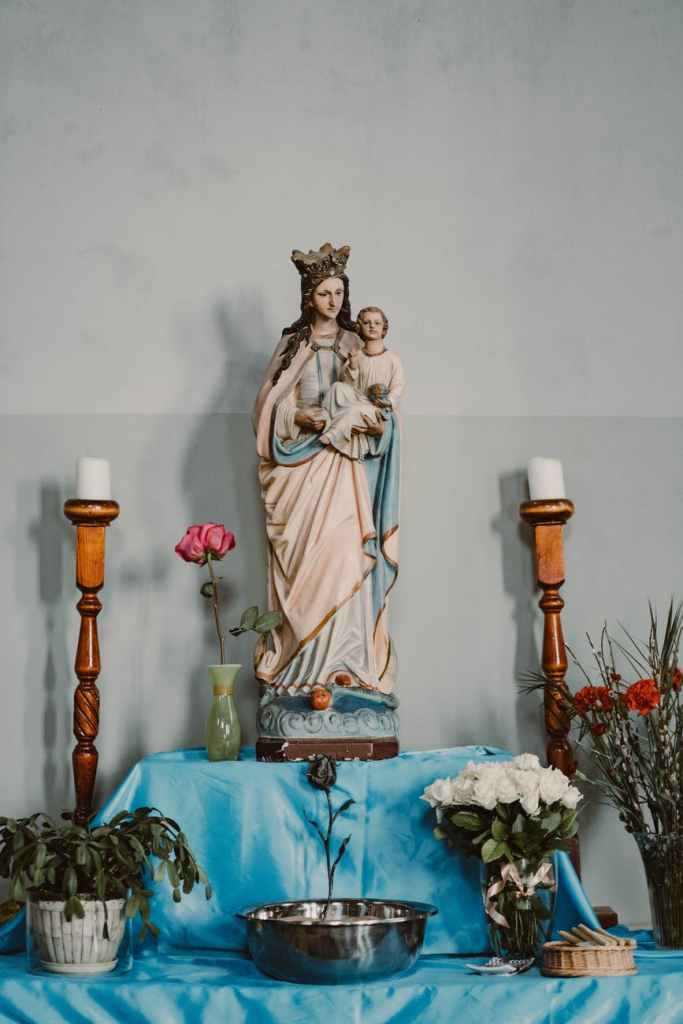
(You might set a statue of Mary on the table, and any flowers or candles you may have.)

Opening Prayer:

Leader: We give thanks for the gift that Mary is in our lives in the Name of the Father, and of the Son, and of the Holy Spirit.

All: Amen

Reader:

A reading from the book of Judith (13:18)

“Blessed are you, daughter, by the Most High God, above all the women on earth; and blessed be the Lord God, the creator of heaven and earth.”

Petitions:

Leader: St. Therese the Little Flower said she felt bad for you, Mary, because unlike herself, you don’t have a Blessed Virgin Mary to love! Thank you Mary, for your gift of self.

Respond All: Be blessed, sweet Mother of God.

You are the glory of Jerusalem, the joy of Israel; you are the fairest honor of our race. We praise God because of you.

Be blessed, sweet Mother of God.

Pray for us, Holy Mother, that we may be made worthy of the promises of Christ.

Be blessed, sweet Mother of God.

May we live in your kindly companionship, meditating in our hearts on the Gospel of your Son with love.

Be blessed, sweet Mother of God

Leader:

Happy Birthday to you, dawn of our salvation, lover of God, friend as we follow him.

(Pray together a Marian Prayer such as the Hail Mary)

Sing happy birthday.

Close by blessing the cake and allowing the youngest person present to blow out the candles.

Mary, we love you! Happy birthday!

Photo by cottonbro on Pexels.com

It’s been a couple minutes

I’ve been gone forever. There are a lot of reasons for this. One of them is that I was writing a book. I tried to keep up with my other writing but I could only keep up with my column at the paper and even so I often used old material. It seemed like even when I wasn’t engaged in writing my book, I was constantly writing it in my mind, or reflecting on an idea for one of the devotional entries.

Photo by rikka ameboshi on Pexels.com

The book is about friendship with Mary, based on the fact that Mary is real and accessible. I really had fun writing…. when I wasn’t agonizing. It is a devotional with reflections on Mary and her contemplative spirituality, her role in our lives; the sneaky ways she leads us to Jesus, and to deeper and deeper prayer. Each devotional is followed by an imaginative sequence about coming to Mary’s House to hang out with her. In the appendix I have written about how to get started with contemplative prayer: four different methods and some tips and words of encouragement.

I turned it in on August 31, which was so scary. Here goes. I hope they like it!

What happens next is that it will be in editing for a while.

I chose an artist who has done a wondrous job creating art that fits beautifully with the book. Hopefully they will like it too at Our Sunday Visitor!

My friends and family have put up with hearing the parts I was working on over and over and over! And also listening to me freak out.

Mary, I have really enjoyed this year and a half writing about you. It seems like this little book of 30,000 words should be so much longer for all the time it took to write. But truly, that is just how long it took. It was an adventure with you and you took me in different directions at times than I expected. I feel closer to you because of it. I pray others will feel closer to you, too when they read and pray along with it. I hope this book has made you happy.

And so, reader, just so you know, that’s what I have been up to. Hopefully I can think of other things to write about now sometimes.

My book’s working title is Come to Mary’s House. I will let you know what happens next with it.

Photo by Isabella Mendes on Pexels.com

The dignity of the human person, the common good, subsidiarity and solidarity in local politics

To me the evening felt like a small council meeting of spiritual mothers (and one grandmother; the grandmother being myself.) 

We were on my friend Julia’s Motekaitis’  patio with our snacks.  I had never met Jane Sherman before but we connected well.  Our idea for the evening  was to discuss faith and civil engagement. All three of us are very devout Christians; Julia and I are Catholic, Jane is Protestant (though married to a Catholic.) 

After the early chatter died down, she asked us what the Catholic Church teaches about how to go about voting and about political involvement in general. “What are the guidelines?” 

I felt like saying “Yes” to that question because, as the USCCB says in its letter, Forming Consciences for Faithful Citizenship, for Catholics, “responsible citizenship is a virtue” and “participation in political life, an essential duty.” We can’t just hide under the bed when it comes to voting and being involved in the public square. 

Julia and I ticked off  the four basic pillars of how we are to form our political consciences and Jane, as she is currently running for County Commissioner of Brazos County explained her own concerns and values regarding our community which turned out to relate to the principles of the dignity of the human person, the common good, subsidiarity, and solidarity quite well to us.        

The dignity of the human person:  

One of the things we talked about was the need for mental health services locally and the growing problem of homelessness in our community. Jane explained what a county commissioner does, and that 8% of the budget is for indigent care. We talked about mass incarceration as a national issue and she talked about how locally we spent six million on enlarging our youth detention center. “Twenty million to lock kids up and nothing on how we might prevent it.” I never thought I could have an impact locally about this issue  I care deeply about. Julia and I were surprised about some of what Jane said was possible. I guess I thought all this just happened willy nilly? It happens because that’s what the local government, accountable to voters, decides. I should be a better Catholic and pay attention to local politics more. 

The common good: 

According to the principle of promoting the common good, every person we vote for, each decision we make as a community  must be considered with the goal  of the common good of everyone, not just that of a few. Some of these are the rights of workers, (we say something will bring jobs for instance but are these the kind of jobs people can support their families with or will they need three of those jobs to even come close?) The Church believes everyone has the right to a good education, health care, adequate nutrition. We must concern ourselves with making sure that everyone is able to build a good life here in the Brazos Valley. We want everyone not just to survive here but to thrive. 

 At the council of mothers (and one grandmother) this was a very high priority. We discussed education and the decisions of the school board and how they affect the poorer students. Julia talked about one school wanting to limit how many “free lunch” kids they were willing to come in, wanting to limit that in some way.  This upset me, having been a free lunch kid myself while my parents were students here.

It should also be noted that according to the USCCB (in the same letter referred to above) has said, 

“While the common good embraces all, those who are weak, vulnerable, and most in need deserve preferential concern. A basic moral test for our society is how we treat the most vulnerable in our midst” (no. 50).

So when we consider our local politics and the direction our towns are taking, we should always keep the common good and the preferential option for the poor in mind as well. 

People who can only afford mobile homes but own their own property in town were discussed. Their homes may have been “grandfathered in,” with the new zoning but they won’t be allowed to replace them, and this city wide unless one lives in a designated park in the right zoning. What happens to these home and landowners? Where do they go? This question has to be a priority.

This also includes care of the environment, considering the impact of any given direction will have on the environment. An example would be how we have experienced flooding in the last few years and the damage it has done to people’s homes. Some of this has been due to decisions made in the past that had unwanted consequences for local homeowners. How we decide future flooding is best to be prevented should morally be according to the common good. 

Subsidiarity: Here Jane talked about how the decisions that have the most effect on our lives are local ones. She listed the issues of the day like Covid-19, the availability of mental health services, how money is allocated in funding the local justice system, affordable housing and the care of indigents. These are addressed by the local government. The principle of subsidiarity holds that smaller local communities should be able to solve their own problems without interference from larger organizations or institutions as long as the smaller organization is able to provide for its needs and protect the vulnerable. I thought this principle harmonized well with her call to get involved locally. 

As a woman who ran a community center in a lower income neighborhood of El Paso said to me, “We don’t need liberals coming in here and telling us what we need or ‘helping’ us to ‘get out of here.’ And we don’t need conservative big business guys coming in and trying to ‘develop’ us. We want to solve our own problems. No one who came to help ever asked what we wanted for our neighborhood.” 

What they wanted was to make a community center where they could learn about world affairs and also local wisdom. They also founded a community owned restaurant with neighborhood people contributing their grandmothers’ and great grandmother’s traditional  recipes. It’s doing well. They said they based all that they have done on Pope Francis’ Care of Our Common Home encyclical. They have a community garden as well and they have gardening classes from green thumb neighbors in the community center.  What an excellent use of the principle of subsidiarity. 

Solidarity. The Holy Father has been talking a lot about solidarity lately, saying it is the way to come out of this pandemic better than before. We will have to work together to protect everyone and rebuild our common life. 

I had been struck by another of his  remarks that, “We build towers and skyscrapers, but we destroy community. We unify buildings and languages, but we mortify cultural wealth.” Having grown up here, and witnessing good and bad changes, this is close to my heart. 

Both Julia and Jane are very active in the community. They talked about the heightened need in our two cities for affordable housing and how this need is, they don’t think, being considered enough and hasn’t been historically. Jane had been the marketing director of Habitat for Humanity locally and Julia and her family had helped with a youth build, which is how the two met. I agreed about affordable housing. It seems to me it is beginning to be under threat in Bryan too as well as College Station running off most, it seems of its poor. My community involvement is more informal but I agreed with what each of them said about this. I have noticed that there are more homeless among us than ever locally. 

Julia talked about “a charitable literacy.” She thinks we as a community need to restore the rubrics of real dialog about these issues. We have all gotten so used to the intensity of the “us and them” way we talk about others, and the way we often approach differences with vicious verbal attacks and general disrespect. Jane thought that humility is key in these exchanges. We can respect others if we see ourselves clearly. Then maybe we could balance everyone’s needs better. 

To me solidarity means to be “poor in spirit.” This Beatitude has other meanings in the life of prayer but to apply it to politics it means to me that whatever I do, and whatever my socio-economic status, my heart should be with the poor and vulnerable at all times. 

Julia thinks that perhaps we should develop a model of the virtues as a method of deciding about a candidate. The Catechism defines  virtue “a habitual and firm disposition to do the good.”

The traditional Christian virtues according to the Church Fathers are: prudence (right/wise judgement,) justice, temperance, and fortitude (or courage,) And also of course, the theological virtues of faith, hope, and love. How do our candidates stand when it comes to these? 

Jane said often people don’t know what’s available to them in the community or that they can speak up about things that affect them or that they care about right here where we live.  “You are asking for crumbs,” she says she wants to tell people, “but Jesus invites you to the table to have a voice!” 

I have often felt that Jesus calls me to help, or to stand up for those worse off than I am or who are suffering a grave injustice. I felt impelled. It has not always been a great experience or has required sacrifices that weren’t so fun. However, Jesus and the people he asks us to love and especially care for have to come first. 

We took turns praying aloud, particularly about the issues we discussed and for one another. We also prayed Come, Holy Spirit and part of the Mary’s Magnificat, that the mighty would be brought down from their thrones and the lowly lifted, that the hungry would be filled and the rich sent away empty and that in this, all would feel God’s blessing.

The council of mothers (and one grandmother) parted in good spirits that night with the intention to meet again. 

 Julia said that she guessed we had solved the world’s problems. 

I said I thought that we had. That is how the world, or a small-medium town changes. People talking to each other over delicious snacks.  

Photo by Daniel Reche on Pexels.com

Our Lady of Sorrows

The profound suffering of another person is frightening to be present to. When my husband’s cancerous brain tumor came back after two years of remission, he asked to be alone for a while. When he wanted me there I came and got into his chair with him and held him. I listened to him talk about his feelings of raw desolation, anger, and even shame, of terror, of feeling there was no comfort anywhere.

I had no mitigating words to say. Even if I had they would have been inappropriate and insensitive. Even with the intense devotion and deep bond I had with him, there were moments I wanted to run out in the back yard away from the enormity of what he was expressing. So I prayed as I listened; just the names of Jesus and Mary every time that urge came up. That simple effort made me able to share that space with him.

When he eventually asked how I felt about this on a spiritual level, all I had was the fact of Christ’s suffering. At least as we went through this we had a God who didn’t die in a shower of rose petals but naked and bleeding like an animal, nailed to a cross, with a cry of spiritual abandonment only just having died on his lips.

My husband nodded gravely.

I thought of Mary, surrounded by mockers, violent men, her weeping friends, silently sharing the space with her Son.

I believe she was near to me as I tried to open my heart to its fullest in the weeks that followed; through Bobs creeping paralysis, his growing confusion, his final inability to speak. She was close, I know, when I tried to surrender with love at the right time to set my husband free when he was ready.

Mary was the face of love to Jesus as he suffered. I tried to be that too, to lay my own grief aside. I have no doubt that is what she did at the Cross. I am sure she thought to herself, “I will grieve later. Right now I have to be here for him, I want to look at his beautiful living face as long as I can in these last moments.” I am sure about this because when you love, that is what you do.

May Our Lady pray for us when we are called to walk with someone who suffers terribly, which all of us are in some way at some time. May she companion us when we must find a way to love more than we feel able, to seek the true meaning of profound compassion that she embodied at the scene of her Son’s execution.

Triumph of the Cross

Today we celebrate the Feast of the Triumph of the Cross, which is essentially God’s kind of win, so different from our own. The cross isn’t about leaving anyone humiliated or diminished. There is no gloating involved, and no revenge. No one who does not want to be left out is left out.

Jesus took all the negative consequences of both “winning” and” losing” all on himself for his kind of triumph. Love always redeems, lifts up, and seeks out the other. Love sacrifices. Love believes in the loved one’s ability to be made new by the experience. All those Psalms asking God to break our enemies cheekbones and all that perhaps startle when we read them. However, in light of the Triumph of the Cross, they seem so different now that we know what Jesus considers defeating the enemy; turning someone’s belligerence, their attachment to all the wrong things, into their own deliverance.

God’s kind of win is a real win, and that win is for everybody, regardless of our human games, our social understandings of competition and power.

So never be turned back from love, oh soul. That’s what winning is.

We adore you O Christ and we praise you

because by your Holy Cross, You have redeemed the World

Blog at WordPress.com.

Up ↑